Replacing a drill turned the entire production process upside down at Tries GmbH & Co. KG in Ehingen (Germany) on the Danube, internationally known for their hydraulic control blocks, valves, and cylinders: Switching to the "Exburrdrill" from deburring specialist Kempf not only improved the quality of the holes but also increased the tool life tenfold and saved a lot of effort in deburring.
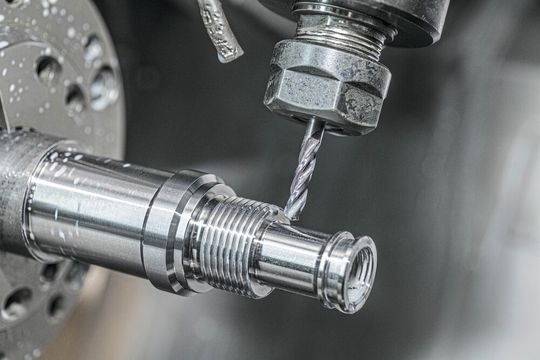
The hydraulic housing made of steel, clamped in the CNC machine. The "Exburrdrills" used with TiAlN coating (diameter 5 mm, approx. 0.2 inches, z=3) drills the four holes into the component within seconds, without the need for subsequent deburring. Thus, the workpiece comes directly from the machine, finished and already burr-free.
(Image: Kempf)
In the production of a turned part with cross holes for hydraulic blocks, which measures about 120 mm in length and with a quantity of approximately 25,000 parts per year has become a standard product at Tries, the supposedly "simple" drilling application turned out to be a real sticking point in the entire machining process.
Problem: High Burr Formations
The drills used created such high burr formations at the hole exit on the inside of the component that it was necessary to first manually deburr the parts and then have them thermally deburred by an external service provider as a second step.
Gallery
In addition, there was the relatively short tool life of the drills used and the resulting lack of or non-plannable process reliability, as the burr formation had to be continuously checked and the drills had to be replaced after varying durations of use (usually at about 2000 drillings).
Many Drilling Tests with Different Manufacturers
Overall, the production process was not satisfactory for Robert König, the head of series production, which is why a new and better solution was sought.
After several attempts with various drills from well-known manufacturers, which all failed to achieve a satisfactory result regarding the burr height at the hole exit, Tries finally became aware of the "Exburrdrill" from Kempf. The burr-minimizing drill, a development by the deburring specialist from Reichenbach-Fils (D), promises through its special geometry that no drilling caps remain attached to the component.
Application and Material-Specific Tool Solution
In addition, the "Exburrdrill," according to the manufacturer, impresses with various other advantages that can optimize machining in many areas compared to the use of standard drills. To fully exploit its performance range, the special drill from Kempf is not offered as an off-the-shelf tool but is individually manufactured for the respective customer application in a diameter range of 0.8 mm to 20 mm.
Taking into account the engagement conditions at the bore exit and the material of the component, the tool geometry of the "Exburrdrill" is parametrically designed. The individual tool manufacturing also allows for the combination of several process steps in one drilling operation.
Residual Burr Significantly Smaller
By using a step drill, for example, both the downstream deburring process and a countersinking or reaming process can be eliminated. This reduces tool change and main times on the machine. The "Exburrdrill" was principally designed to drill with minimal burr at ideally higher feed rates than standard drills, while also not leaving behind any drilling caps that always present a risk to subsequent tools. Due to the special cutting edge of the "Exburrdrill," this risk does not exist. If edge breaking on the workpiece is required, the subsequent deburring tool is significantly relieved by the minimal remaining burr. If the hole is ECM deburred, this also runs with significantly fewer disturbances, as the remaining burr is considerably smaller.
Performance of the Special Drill Surprised
At Tries, expectations for the "Exburrdrill" were kept in check due to the many unsatisfactory preliminary tests. A satisfactory performance would have been achieved if external thermal deburring could be dispensed with. Therefore, the performance of the special drill was all the more surprising.
Run on several machines, the burr formation at the bore exit was not visible or hardly measurable even after many thousands of drilled holes. In the continuous operation running since then, the performance is so good that there is essentially no inspection effort, but the drill is preemptively changed at around 20,000 parts to prevent any potential burr formation.
Bore Exits no Longer Need to be Reworked
Since the implementation of the Kempf "Exburrdrill," the hole exits no longer require reworking. The constant inspection effort and the machine downtime associated with tool changes are also things of the past. "After the first successful use of the 'Exburrdrill,' the drill is now also used in other components with a total of three different diameters," summarizes Robert König. "The drill has to perform up to eight holes per component, and even with these applications, we no longer have problems with burr formation."
Quality was the top priority when the engineering firm Manfred Tries was founded in 1964. Therefore, it did not take long before an in-house production was established and integrated alongside the development and design of hydraulic components. In 1978, the present Tries GmbH & Co. KG was founded, which now employs nearly 180 people and is internationally known for its hydraulic control blocks, valves, and cylinders, among other products.
Date: 08.12.2025
Naturally, we always handle your personal data responsibly. Any personal data we receive from you is processed in accordance with applicable data protection legislation. For detailed information please see our privacy policy.
Consent to the use of data for promotional purposes
I hereby consent to Vogel Communications Group GmbH & Co. KG, Max-Planck-Str. 7-9, 97082 Würzburg including any affiliated companies according to §§ 15 et seq. AktG (hereafter: Vogel Communications Group) using my e-mail address to send editorial newsletters. A list of all affiliated companies can be found here
Newsletter content may include all products and services of any companies mentioned above, including for example specialist journals and books, events and fairs as well as event-related products and services, print and digital media offers and services such as additional (editorial) newsletters, raffles, lead campaigns, market research both online and offline, specialist webportals and e-learning offers. In case my personal telephone number has also been collected, it may be used for offers of aforementioned products, for services of the companies mentioned above, and market research purposes.
Additionally, my consent also includes the processing of my email address and telephone number for data matching for marketing purposes with select advertising partners such as LinkedIn, Google, and Meta. For this, Vogel Communications Group may transmit said data in hashed form to the advertising partners who then use said data to determine whether I am also a member of the mentioned advertising partner portals. Vogel Communications Group uses this feature for the purposes of re-targeting (up-selling, cross-selling, and customer loyalty), generating so-called look-alike audiences for acquisition of new customers, and as basis for exclusion for on-going advertising campaigns. Further information can be found in section “data matching for marketing purposes”.
In case I access protected data on Internet portals of Vogel Communications Group including any affiliated companies according to §§ 15 et seq. AktG, I need to provide further data in order to register for the access to such content. In return for this free access to editorial content, my data may be used in accordance with this consent for the purposes stated here. This does not apply to data matching for marketing purposes.
Right of revocation
I understand that I can revoke my consent at will. My revocation does not change the lawfulness of data processing that was conducted based on my consent leading up to my revocation. One option to declare my revocation is to use the contact form found at https://contact.vogel.de. In case I no longer wish to receive certain newsletters, I have subscribed to, I can also click on the unsubscribe link included at the end of a newsletter. Further information regarding my right of revocation and the implementation of it as well as the consequences of my revocation can be found in the data protection declaration, section editorial newsletter.
The focus today, as it was back then, is on the development and design of custom special solutions, which are carried out in close collaboration with customers. As a result, Tries produces quantities ranging from a few individual pieces to several tens of thousands per year, depending on the component and requirements, primarily used in special vehicles, wheeled excavators, and cranes by various large and well-known manufacturers.



:quality(80)/p7i.vogel.de/wcms/ad/17/ad170d33176b28534ae903fda8bb2ce4/0130651888v1.jpeg "According to Fronius, manual MIG/MAG welding simply cannot be dispensed with, even if the process continues to be automated. How about using welding systems that combine solid craftsmanship with modern support technology? (Image:Fronius)")
:quality(80)/p7i.vogel.de/wcms/9b/cf/9bcf43857ff151866d28f8888e0eda17/0131146046v1.jpeg "What you can see here are various components that are found in beverage bottling plants, but which wear out again and again due to the constant stresses and strains. In order to save costs, Morsan now relies on its own 3D printing with Lehvoss materials to procure spare parts. (Image:Morsan)")
:quality(80)/p7i.vogel.de/wcms/f5/78/f5786d33e991cdcfc88b5682e634363d/schleser-web-800x450v1v1.jpeg "Prof. Dr.-Ing. Markus Schleser from Aachen University of Applied Sciences is researching laser beam welding as part of the Holla project. (Image:private)")
:quality(80)/p7i.vogel.de/wcms/a1/21/a1219c8f7dfd1c9bc13cb67c80237ae3/0128030242v1.jpeg "The new Quick-Bend EVO press brake sets new standards in terms of ergonomics, dynamics and energy efficiency. (Image:Boschert)")
:quality(80)/p7i.vogel.de/wcms/c1/70/c170fd5c52c08ceb4bc2b58eb94ea95f/newsimage421365-2048x1151v1v1.jpeg "Diving robot from TU Bergakademie Freiberg before its first dive at the Malter dam (Image:Andreas Hiekel/TUBAF)")
:quality(80)/p7i.vogel.de/wcms/5d/0d/5d0d8676fd82a1a94afe763f7f0600a0/0130214448v1.jpeg "In pharmaceutical and biotechnological production, manual labor is undesirable for reasons of hygiene and safety. (Image:Adobe Stock/angellodeco)")
:quality(80)/p7i.vogel.de/wcms/12/f3/12f38d566c2473fc0df9211b0f140c60/0130026531v1.jpeg "Acting out everyday situations is intended to prepare for similar situations. (Image:HCC - TU Graz)")
:quality(80)/p7i.vogel.de/wcms/bf/9e/bf9eeb84e6bb75e89c8a06a2c9bc8954/0131116806v1.jpeg "Holger Lösch, Deputy Managing Director of the BDI. (Image:BDI)")
:quality(80)/p7i.vogel.de/wcms/55/93/55936485100842cd9e83fa3ec053e9c1/2-995x560v1v1.png "The research team at the Technical University of Munich measures and controls the tendon forces on the robot. The aim of the research project is to develop new control concepts. (Image:TU Munich)")
:quality(80)/p7i.vogel.de/wcms/c2/df/c2df275b52afda5130ec90662fc767af/adobestock-1858604981--c2-a9-20vladyslav-20andrukhiv-20-e2-80-93-20stock-adobe-com-ki-generiertv1.jpeg "Artificial sun on earth: Start-ups in China are working to accelerate the development of the virtually inexhaustible energy source of nuclear fusion with AI. (Source: © Vladyslav Andrukhiv - stock.adobe.com/AI-generated)")
:quality(80)/p7i.vogel.de/wcms/80/5c/805c31ab52ed4e39222b5bf82b135e03/0131052307v1.jpeg "The brain remains untouched: The electrode mat (Laplace electrode) placed under the skin stimulates the cortex with electrical pulses through the skull. (Image:Precisis)")
:quality(80)/p7i.vogel.de/wcms/7c/7a/7c7add6694f68fc130544868d8fa3289/0131131855v1.jpeg "A mass element also makes it possible! What is symbolized here is an iron(I) compound that is currently being examined more closely at KIT in Karlsruhe. It can replace the typical—but expensive—precious metals used in catalysts. Read more here ... (Image:KIT / O. Townrow)")
:quality(80)/p7i.vogel.de/wcms/cd/c4/cdc4f646f0c1e71e5788f4054dff870b/0131136593v1.jpeg "Highly integrated inverter with a power density of 500 kW/l, optimized for maximum power density (Image:Fraunhofer IZM / Volker Mai)")
:quality(80)/p7i.vogel.de/wcms/77/4f/774f215a5fdd4d688f9f14fcc246470c/0131065816v1.jpeg "Pirelli and Univrses want to use cyber-tyre technology to analyze road conditions. (Image:PIRELLI GERMANY)")
:quality(80)/p7i.vogel.de/wcms/4e/a3/4ea3c3704bca640b86cf668745688812/0130570612v1.jpeg "VW is developing a new E/E architecture for its future Chinese models. Experts say that the technology in this area is developing faster than the organizations. (Image:Volkswagen AG)")
:quality(80)/p7i.vogel.de/wcms/55/d6/55d679c4ba0be53dc1d902770d72aacf/0130571863v1.jpeg "For the automotive industry, green steel is one way of reducing its calculated fleet emissions. (Image:Thyssenkrupp Steel Europe)")
:quality(80)/p7i.vogel.de/wcms/0b/a0/0ba05fb723da711a306a511fac9705b4/0131080817v1.jpeg "trategy for the industry of tomorrow: Delta EMEA President Dalip Sharma and Head of Automation Michael Mayer-Rosa explain how AI and decentralized energy networks will make companies more resilient. (Image:Manuel Christa)")
:quality(80)/p7i.vogel.de/wcms/3f/94/3f9454f1b06cd27e64855fce6bd1afa2/0131089404v1.jpeg "Visible difference at peak brightness: The comparison at the SID 2026 shows Samsung's new Flex Chroma Pixel OLED in direct comparison. Thanks to the new PSF emitter materials, the color saturation (96% BT.2020) is maintained even at extreme luminance levels without the colors washing out. (Image:Samsung Display)")
:quality(80)/p7i.vogel.de/wcms/0b/50/0b50d1a8f9918b41167997eb8fe5665b/0131078602v1.jpeg "The AI Hub from Nordson Intelligence (N-Intelligence): Users can take control of their inspection process thanks to an intuitive user interface and advanced AI features. (Image:Nordson)")
:quality(80)/p7i.vogel.de/wcms/40/99/4099add7d32a896edb1b9cfa1ffac885/0131120525v1.jpeg "QWEN in smart card format: The battery-free sensor platform combines a supercapacitor and printed indoor solar cell to make smart building sensor technology more economical without changing batteries. (Image:Ligna Energy)")
:fill(fff,0)/images.vogel.de/vogelonline/companyimg/76800/76895/65.jpg "FAULHABER_120mm.jpg ()")
:fill(fff,0)/p7i.vogel.de/companies/69/de/69de1b7403b0d/simtos-logo.jpeg "simtos-logo (SIMTOS)")
:quality(80)/p7i.vogel.de/wcms/0d/85/0d85a784dc20fabdea891b976fb2d122/0124723494v1.jpeg "The component on the right and the cut-open variant for investigation on the left. The complete hole is clearly visible as well as the two sawed holes on the left and right (in the left component). The hole diameter is 5 mm (approx. 0.2 inches), and the inner diameter of the main hole at this point is 14 mm (approx. 0.5 inches).(Image: Kempf)")
:quality(80)/p7i.vogel.de/wcms/63/d3/63d36cf0e1182a291ebfe47d4ecec076/0124723503v1.jpeg "For these components, the \"Exburrdrill\" is used with a total of three different diameter variants. The fourth diameter variant with 3 mm is currently still in the testing phase.(Image: Kempf)")
:quality(80)/p7i.vogel.de/wcms/0b/3c/0b3c9ca50bf3356cb38169f2ae66c523/0124723497v1.jpeg "The hydraulic housing made of steel, clamped in the CNC machine. The \"Exburrdrills\" used with TiAlN coating (diameter 5 mm, approx. 0.2 inches, z=3) drills the four holes into the component within seconds, without the need for subsequent deburring. Thus, the workpiece comes directly from the machine, finished and already burr-free.(Image: Kempf)")
:quality(80)/p7i.vogel.de/wcms/57/1d/571d0ddfaa30fbc381d011c9bd8a3ffe/0124723500v1.jpeg "The bore exit seen in the close-up on the inside of the workpiece was created after about 4000 drillings with the \"Exburrdrill.\" No visible burr is detectable.(Image: Kempf)")
:quality(80):fill(efefef,0)/p7i.vogel.de/wcms/67/ad/67adf4a647532/elatec-wp-machine-authentication.png "Elatec WP Machine Authentication")
:quality(80)/p7i.vogel.de/wcms/c0/c7/c0c72d813b322431d67710cc1011d2a3/0124421887v1.jpeg "The hydraulic housing made of steel, clamped in the CNC machine. The ExBurrDrill with TiAlN coating (diameter 5 mm, Z=3) drills the four holes in the component within a few seconds, without having to deburr them afterwards. The workpiece comes directly from the machine finished and burr-free. (Image:Kempf GmbH)")
:quality(80)/p7i.vogel.de/wcms/fc/08/fc08d01b203a388ea2350819f9e0887c/0130735114v1.jpeg "Robot-assisted high-pressure water jet deburring for targeted deburring and cleaning of complex components with holes, channels and functional areas. (Image:BvL Oberflächentechnik GmbH)")