As Chinese manufacturers unveil one “AI-defined car” after another, the main question that arises is: What exactly is that? This is currently the subject of lively debate in the Chinese auto industry. Prototypes and the first production models reflect different concepts of how artificial intelligence is expected to transform vehicle design, the driving experience, and even the automakers themselves.
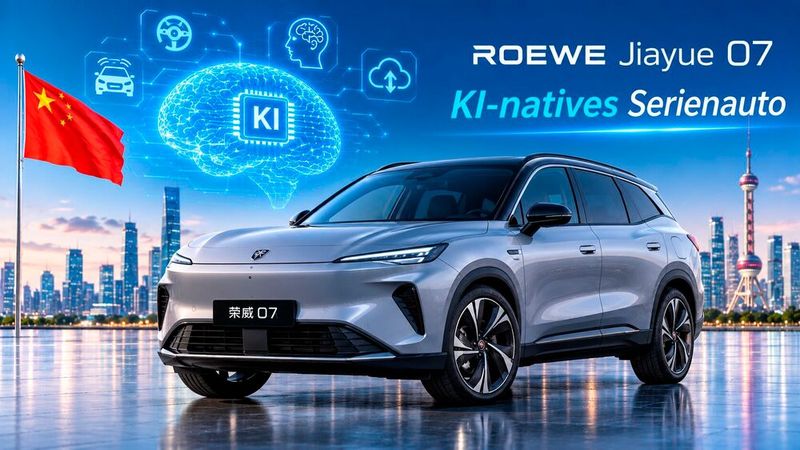
Is the Roewe Jiayue 07 the world's first AI-native production car? At least that's how its manufacturer, SAIC, described the vehicle. ((Featured image))
(Image: AI-generated)
On October 23, the “Roewe Jiayue 07” was launched, and its manufacturer, SAIC, is promoting it as the “world’s first AI-native production car,” according to the Chinese automotive website Gasgoo. In this context, “AI-native” can be understood to mean “defined by AI through and through.”
Over the past two years, large language models (LLMs) and chatbots were the first to make their way into the cockpits of dozens of manufacturers. More or less intelligent chat functions and the ability to control the air conditioning or adjust the seats via voice commands were initially hailed as impressive achievements of AI. Everyone agrees that this is no longer enough.
Incorporate AI into the Definition of Vehicle Architecture
AI is moving from the virtual, voice-based world toward direct collaboration with the hardware—and from the cockpit into the chassis. It no longer controls just individual vehicle functions, but entire chains of actions—from the driver’s voice command to its execution on the road. The new EREV “Roewe Jiayue 07” from Chinese automaker SAIC demonstrates what this means in practice. The car’s intelligence comes from Volcano Engine, the technology division of the TikTok parent company Bytedance.
“Keep a little more distance from the car next to us,” a driver can now simply say, for example. The car then carries out the command on its own. This becomes possible not just by adding individual AI functions to existing vehicle architectures, but when “AI becomes the central point of interaction in an AI-native vehicle,” as Qian Yang, CEO of SAIC Roewe, told the business magazine Caijing.
To achieve this, AI must be integrated into the definition of the vehicle architecture from the very beginning. It will then no longer be used to follow rigid, deterministic rules, as is the case with software-defined driving. Rather, it will interpret the driver’s intent using AI inference and within clearly defined limits. Meng Chao, who heads the “Center for Intelligent Software” in SAIC Motor’s passenger car division, illustrated this point in September at an industry forum on AI-defined driving with a vivid example.
It’s nighttime, it’s raining, and a child is sleeping in the back seat. The driver says, “Let’s be quiet, find a pharmacy that’s open, and let me know when we’re almost there.” Right now, you’d have to look for a pharmacy yourself, enter the address into the GPS, turn off the music, and keep an eye out for when it’s time to look for a parking spot.
In the new system, just a few remarks would suffice. An AI assistant could then take over the coordination of the vehicle’s hardware and other online services from the cockpit, according to the report. “An AI-native system understands the goal of ‘buying medicine’ and takes into account the guidelines ‘don’t wake the child, minimize detours, and remind me before arrival.’ It then coordinates navigation, interior functions, vehicle controls, and connected services, and continuously adjusts the plan as external conditions change,” says Gasgoo, describing the brave new world of driving that will soon be available for purchase.
New Requirements Call for New Hardware
While driving, sensors detect bumps in the road and adjust the suspension of the Roewe Jiayue 07’s “AI-controlled mCDC comfort chassis” accordingly in advance. Why it’s called “07” and not “007” remains a mystery to the manufacturer. One more zero in the name, and the car would probably be good enough for James Bond. “By an AI car, we don’t simply mean a vehicle equipped with AI, but a new form of physical AI,” Yang Liwei, vice president of Volcano Engine, is quoted as saying by Caijing. The focus is shifting from the AI models used to the question of which features are truly useful for drivers.
Date: 08.12.2025
Naturally, we always handle your personal data responsibly. Any personal data we receive from you is processed in accordance with applicable data protection legislation. For detailed information please see our privacy policy.
Consent to the use of data for promotional purposes
I hereby consent to Vogel Communications Group GmbH & Co. KG, Max-Planck-Str. 7-9, 97082 Würzburg including any affiliated companies according to §§ 15 et seq. AktG (hereafter: Vogel Communications Group) using my e-mail address to send editorial newsletters. A list of all affiliated companies can be found here
Newsletter content may include all products and services of any companies mentioned above, including for example specialist journals and books, events and fairs as well as event-related products and services, print and digital media offers and services such as additional (editorial) newsletters, raffles, lead campaigns, market research both online and offline, specialist webportals and e-learning offers. In case my personal telephone number has also been collected, it may be used for offers of aforementioned products, for services of the companies mentioned above, and market research purposes.
Additionally, my consent also includes the processing of my email address and telephone number for data matching for marketing purposes with select advertising partners such as LinkedIn, Google, and Meta. For this, Vogel Communications Group may transmit said data in hashed form to the advertising partners who then use said data to determine whether I am also a member of the mentioned advertising partner portals. Vogel Communications Group uses this feature for the purposes of re-targeting (up-selling, cross-selling, and customer loyalty), generating so-called look-alike audiences for acquisition of new customers, and as basis for exclusion for on-going advertising campaigns. Further information can be found in section “data matching for marketing purposes”.
In case I access protected data on Internet portals of Vogel Communications Group including any affiliated companies according to §§ 15 et seq. AktG, I need to provide further data in order to register for the access to such content. In return for this free access to editorial content, my data may be used in accordance with this consent for the purposes stated here. This does not apply to data matching for marketing purposes.
Right of revocation
I understand that I can revoke my consent at will. My revocation does not change the lawfulness of data processing that was conducted based on my consent leading up to my revocation. One option to declare my revocation is to use the contact form found at https://contact.vogel.de. In case I no longer wish to receive certain newsletters, I have subscribed to, I can also click on the unsubscribe link included at the end of a newsletter. Further information regarding my right of revocation and the implementation of it as well as the consequences of my revocation can be found in the data protection declaration, section editorial newsletter.
New hardware is needed to meet the new requirements. Computing power measured in trillions of operations per second (TOPS) alone is no longer sufficient as a benchmark for the performance of automotive chips, said Meng Chao. Equally important are memory bandwidth, the efficient translation of models for the chips, their utilization, and technical reliability—which depends, among other things, on their thermal stability.
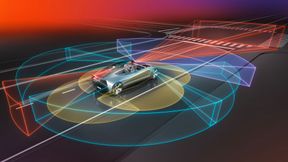
The Roewe Jiayue 07 runs Momenta’s R7 AI world model on chips from Xinxin Hangtu’s XHEART X7 series, which not only offers driver-assistance features for city driving and highway travel but, according to the manufacturer, can also distinguish between 300 different types of parking spaces during automatic parking. Equipped with lidar, 4D millimeter-wave radar, 12 ultrasonic sensors, and 11 high-resolution cameras, the car is reasonably priced as an SUV in the under-150,000-yuan price range, which is equivalent to about 20,000 euros ($22,800). SAIC and Volcano Engine justified their claim to have built the first “AI-native production car” at the vehicle’s launch by stating that they were the first to make the leap from “AI on the screen” to “AI behind the wheel.”
AI-First Developers instead of Automakers
A number of other automakers in China would likely disagree. Almost all of them are working to integrate AI. BYD is relying on its Xuanji architecture and high production volumes to make smart technology more widely available. Geely is developing “Super Eva,” an AI agent built on its StepFun platform, which can also execute voice commands. Great Wall Motor has established its own AI lab. Caijing describes the prevailing trend as established manufacturers seeking to more closely integrate driver assistance systems, the cockpit, and the powertrain.
Other companies in China have been positioning themselves for some time now as “AI-first” developers, rather than as automakers. Xpeng, for example—VW’s partner in China—describes itself as a global company for embodied intelligence and is seeking synergies between autonomous driving and robotics, because AI can do both. “Today’s automakers must become AI companies,” Nio founder Li Bin also stated in June of this year, as reported by Caijing.
Startups looking to hold their own in this environment of technological competition on steroids are trying to do so with even bolder concepts in the field of AI-driven driving. “Aiva,” a new electric vehicle brand from manufacturer Saidou Technology, has adopted the motto “AI first, car second.”
Saidou Technology was formerly known as Landian Technology and is now 32.96 percent owned by the successful automaker Seres (which also owns “Aito,” among others), the world’s largest battery manufacturer CATL (approximately 9.89 percent), and a state-owned enterprise, which is the largest shareholder. The car is built at Seres’ “Phoenix Plant” in the Shapingba district of Chongqing.
This powerhouse consortium unveiled a prototype of its “AIVA ME7” at Paris Fashion Week in September. Its AI concept is called “2 + 22.” The two hours a day that a car owner spends on average in their vehicle are linked to the remaining 22 hours outside the car via an AI agent and a wearable wristband. “In this concept, a car is no longer an isolated device waiting for instructions, but a space where AI can continuously understand the user, serve them, and perform tasks,” explains the Chinese online portal Wandian.
A concrete example is a weekend trip. During the week, while away from the car, the driver can suggest taking a trip to the countryside on Saturday. The car—which is connected to the “Loop” via a wristband or cell phone—is informed of the plans. It knows who’s coming along and whether the plan is to go hiking or to a restaurant. It suggests destinations within a suitable distance and works out the routes. When the family gets in on Saturday, all it takes is a quick confirmation, and off they go.
To implement such concepts technically, AI must be factored into the design of a new vehicle from the very beginning. If everything works as intended, these concepts will transform the relationship between humans and (motorized) machines. The car will become a “companion” that can proactively recognize situations, carry out actions, and continuously learn in the process.
AI-Driven Driving is the Future
It remains to be seen how much autonomy and how much data buyers will be willing to cede to AI agents and “AI-native cars.” This is also a topic of much debate in China. “Behind this sense of optimism, however, lies a deeper contradiction. The industry is aligning its strategy for intelligent driving with an increasingly comprehensive vision. Yet when it comes to the fundamental issue of user trust, comparable progress has so far been lacking,” comments Caijing. The auto industry enthusiastically proclaims that the car is a “gateway to physical AI,” but in doing so, it sometimes gets a little ahead of users’ sense of security.
Given the fierce competition in the Chinese auto market, it is inevitable that automakers there will take a much faster and bolder approach to integrating AI than in Europe, where the pace is comparatively cautious. The key unique selling point (USP) that determines success or failure in the industry has now shifted from electrification (batteries, electric drives) to navigation and driver assistance, and further to the system-wide integration of artificial intelligence.
Exactly which AI concepts will prevail may be a matter of debate. However, it is already clear that “AI-native driving” will define the future of mobility in one form or another.