ElectromobilityChina's Electric Car Manufacturers Back on Growth Track
From
Henrik Bork | Translated by AI
4 min Reading Time
After a weak start to the year, the market for electric cars in China is picking up again. Established manufacturers dominate, start-ups sharpen new strategies.
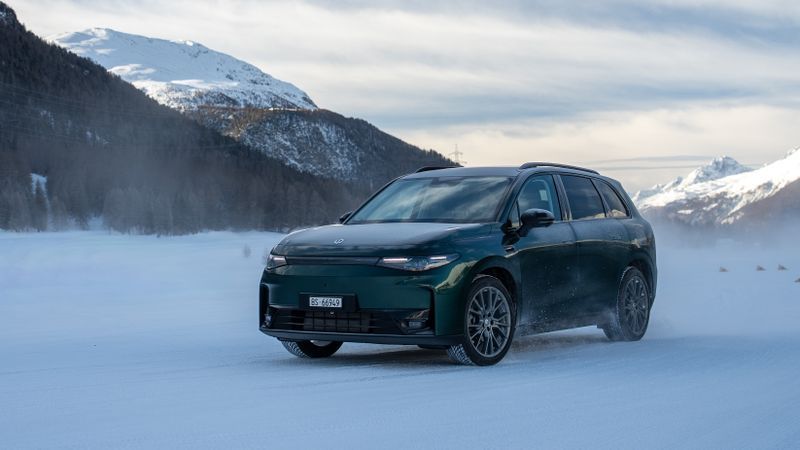
It was a difficult winter for Leapmotor on the Chinese market. The manufacturer started the spring with significantly better sales figures.
(Image: Stellantis/Leapmotor)
The Chinese market for electric cars recovered significantly in March, after experiencing a significant drop in the first two months of the year. Sales of New Energy Vehicles (NEVs), mainly electric cars and plug-in hybrids, rose to 1.13 million units. This represents an increase of 56 percent compared to the weak February (in the wholesale market).
These preliminary data from the Passenger Car Association (CCA) show that the weakness at the beginning of the year was only temporary. In March, almost every second new car sold in China was an NEV. Their market penetration climbed to over 47 percent.
Since January 1, 2026, NEV buyers in China have had to pay a purchase tax of five percent for the first time. Many customers, therefore, brought their purchases forward to December 2025 while the tax exemption was still in effect. The Chinese New Year festival, which fell in mid-February this year, further enhanced this early-year drop.
Market Recovers – BYD Too
Now the market is normalizing again: BYD remains unchallenged at the top. The electric car and battery company from Shenzhen, which only builds NEVs, sold almost 300,000 passenger cars in March, more than twice as many as the second-placed Geely Group (127,300 units).
Strategically, BYD is noticeably shifting its focus away from merely maximizing sales figures towards long-term investments in charging infrastructure. The company has established 5,000 of its own FLASH fast-charging stations and plans to quadruple this number to 20,000 by the end of the year. Together with the second generation of its in-house Blade Battery, an ecosystem of vehicles, battery technology, and charging network is to be created.
Tesla ranked third in March with over 85,000 vehicles and remains the only foreign car manufacturer playing in this league.
Leapmotor is the Best-Selling Startup
Sales of pure electric car startups in China have also recovered significantly in the third month of the year. Leapmotor, supported by the European Stellantis Group, sold 50,000 vehicles in March, an increase of 35 percent year-over-year.
This makes Leapmotor the best-selling startup among Chinese electric car manufacturers. At the same time, the company is now operating in the black, something previously only achieved by Li Auto in this cohort of "new forces."
In 2025, Leapmotor reported its first annual profit with nearly 600,000 cars sold, according to specialist publication CNEVPOST. Notably, Leapmotor is consistently implementing a strategy of vertical integration. The company announced that 65 percent of vehicle costs are attributed to self-developed components.
Technology Focus is Well Received
In addition, a strong focus on technology resonates well with Chinese customers. The new entry-level model A10 has attracted attention since its launch at the end of March, in the price range equivalent to 13,000 euros (approx. USD 15,300). During the last weekend of March, it recorded more than 9,000 firm orders within a few days.
Leapmotor has also recently opened its first development center outside China in Munich. The design center in the Schwabing-Freimann district oversees future new models and works closely with the studios in Hangzhou and Shanghai.
Li Auto delivered 41,000 units in March, securing second place among startups. After setbacks with its fully electric models, the company has refocused on its strengths—plug-in hybrids with extended range and family-friendly SUVs.
Li Auto and Nio Increase Sales
After resolving production bottlenecks following the New Year festival, sales of the "LI i6" model exceeded the 24,000 mark in March, Li Xiang, founder and CEO of Li Auto, was quoted in media reports. In the price range equivalent to 26,000 to 39,000 euros, the Li i6 is among the best-selling all-electric SUVs in China.
Date: 08.12.2025
Naturally, we always handle your personal data responsibly. Any personal data we receive from you is processed in accordance with applicable data protection legislation. For detailed information please see our privacy policy.
Consent to the use of data for promotional purposes
I hereby consent to Vogel Communications Group GmbH & Co. KG, Max-Planck-Str. 7-9, 97082 Würzburg including any affiliated companies according to §§ 15 et seq. AktG (hereafter: Vogel Communications Group) using my e-mail address to send editorial newsletters. A list of all affiliated companies can be found here
Newsletter content may include all products and services of any companies mentioned above, including for example specialist journals and books, events and fairs as well as event-related products and services, print and digital media offers and services such as additional (editorial) newsletters, raffles, lead campaigns, market research both online and offline, specialist webportals and e-learning offers. In case my personal telephone number has also been collected, it may be used for offers of aforementioned products, for services of the companies mentioned above, and market research purposes.
Additionally, my consent also includes the processing of my email address and telephone number for data matching for marketing purposes with select advertising partners such as LinkedIn, Google, and Meta. For this, Vogel Communications Group may transmit said data in hashed form to the advertising partners who then use said data to determine whether I am also a member of the mentioned advertising partner portals. Vogel Communications Group uses this feature for the purposes of re-targeting (up-selling, cross-selling, and customer loyalty), generating so-called look-alike audiences for acquisition of new customers, and as basis for exclusion for on-going advertising campaigns. Further information can be found in section “data matching for marketing purposes”.
In case I access protected data on Internet portals of Vogel Communications Group including any affiliated companies according to §§ 15 et seq. AktG, I need to provide further data in order to register for the access to such content. In return for this free access to editorial content, my data may be used in accordance with this consent for the purposes stated here. This does not apply to data matching for marketing purposes.
Right of revocation
I understand that I can revoke my consent at will. My revocation does not change the lawfulness of data processing that was conducted based on my consent leading up to my revocation. One option to declare my revocation is to use the contact form found at https://contact.vogel.de. In case I no longer wish to receive certain newsletters, I have subscribed to, I can also click on the unsubscribe link included at the end of a newsletter. Further information regarding my right of revocation and the implementation of it as well as the consequences of my revocation can be found in the data protection declaration, section editorial newsletter.
Nio reported 35,500 deliveries for March, an increase of 136 percent year-over-year. In the first quarter, Nio sold a total of over 80,000 vehicles, nearly twice as many as in the same period last year.
The manufacturer from Shanghai pursues a multi-brand strategy: In addition to the premium core brand, the volume brand Onvo serves the mid-market. The new entry-level brand Firefly is intended for the lower price segment.
Current Trends
In March, Xiaomi surpassed the 20,000 monthly deliveries mark for the first time, a milestone closely watched by analysts in China. With three models currently in production scaling, the company is trying to apply the quick product cycles and aggressive marketing from the consumer electronics world to car manufacturing.
From the current numbers and strategies, two major trends can be discerned. Firstly, there is the trend that electrification in China continues unabated. If anything, there is expected to be a temporary acceleration of this trend due to the crisis in the Strait of Hormuz.
Secondly, there is increasing pressure on manufacturers to develop clear strategic profiles. Not only are sales of electric cars and hybrids growing, but competition is also intensifying.
The companies' responses vary: BYD is building the ecosystem described above. Leapmotor is focusing on radical cost minimization in the mass market. Nio is investing steadfastly and long-term in technology and battery swapping. Xiaomi is trying to apply familiar methods from the consumer electronics segment.
While China's economy, in general, is growing somewhat more slowly than in the boom phase of the early days, the e-mobility market is becoming more mature and the competition is tougher than ever.



:quality(80)/p7i.vogel.de/wcms/9e/23/9e23111e49d73012e9e3b7c69428ad5c/0134019347v1.jpeg "The Dominant VA45 high-helix tap from Bass, made of lead-free brass. The long chips, which result from the absence of lead, are clearly visible. (Image:Bass, Inc.)")
:quality(80)/p7i.vogel.de/wcms/1d/09/1d0999956ef87709b72ab1d0402ba207/csf-minis-gruppe-final-01-outputv1.jpeg "Since mid-2026, Harmonic Drive has been offering its CSF Mini gearheads in size 7 as well, in six variants designed for different installation scenarios. (Source: Harmonic Drive)")
:quality(80)/p7i.vogel.de/wcms/ab/08/ab08675922c3a7edea45128248b45b00/0133857009v1.jpeg "In the aerospace industry—one of the most demanding sectors of all—the Shanghai-based company TOPNC has already made a name for itself. (Image:TOPNC)")
:quality(80)/p7i.vogel.de/wcms/ff/48/ff48b1154746e79128935f28bd73ba0e/0113143253v1.jpeg "In our China Market Insider, we regularly provide you with relevant information straight from China. (Image:© Eisenhans - stock.adobe.com)")
:quality(80)/p7i.vogel.de/wcms/ad/d8/add899fae30176e09e7643883e1e155e/0134059801v1.jpeg "The Siemens plant in Erlangen is set to become a global model for AI-supported, autonomous manufacturing. (Image:Siemens AG)")
:quality(80)/p7i.vogel.de/wcms/ca/24/ca24d741a2fd714fa14d2a3e9db1c904/image1v1.jpeg "With 117,500 units sold, transportation and logistics will remain the leading application area for service robotics in 2025 as well. (Image:Innok Robotics)")
:quality(80)/p7i.vogel.de/wcms/b7/95/b795d5fb82459f8a526e880f0698dffa/1-maxon-mind-covershot-landscapev1.jpeg "Claude Jaquemet demonstrates the Maxon Mind demo system. (Source: Maxon)")
:quality(80)/p7i.vogel.de/wcms/be/66/be661616d5250d4c3814a25688f3904b/0133917202v1.jpeg "Neuron AI combines 3D vision, touch, hearing, proprioception, and language—along with memory—into a Perception-Language-Action (PLA) model. Robots can grasp objects they cannot see. (Image:Neura)")
:quality(80)/p7i.vogel.de/wcms/51/b8/51b8e08d2105fdd9952aff385f154192/graphic-2-adma1v1.png "The new surface hardening process enhances the performance of corrosion-resistant alloys by improving their tribological and mechanical surface properties, while preserving the properties of the base material. (Source: Bodycote)")
:quality(80)/p7i.vogel.de/wcms/96/ef/96effc239916cb7e0f396ab75627b8c0/image-space-testingv1.jpeg "Two scientists in front of a vacuum chamber used for testing: As technical instruments for spaceflight become more sensitive, the test facilities are becoming a critical system. (Source: Busch Group)")
:quality(80)/p7i.vogel.de/wcms/5a/12/5a1294a38a634f839f542c0055024d7a/jie-yin-feather-star-header-1500v1.jpeg "Underwater Acrobatics: The new soft robot mimics brittle stars—using minimal propulsion technology. (Source: North Carolina State University)")
:quality(80)/p7i.vogel.de/wcms/96/89/9689197f666e4aa9bc4a1f395c25d3ef/0133739635v1.jpeg "The 2026 Nobel Prize in Medicine laureates: Karl Deisseroth, Peter Hegemann, and Georg Nagel. (Image:Nobel Prize Outreach)")
:quality(80)/p7i.vogel.de/wcms/e9/ea/e9ea034dfa0235d6ec69fc032add864e/0134003342v1.jpeg "Embedded Rust is also becoming increasingly attractive for automotive applications. But what impact does this have on the underlying software architecture? (Image:intellias)")
:quality(80)/p7i.vogel.de/wcms/c8/8b/c88bddfadbd858445414cf92d149ac8f/0134039618v1.jpeg "Green Science Alliance, a Japanese chemical and GreenTech company, is now working in Switzerland on innovative battery recycling processes. (Image:Green Science Alliance)")
:quality(80)/p7i.vogel.de/wcms/fe/f7/fef766ae8b8310ca6dd0852208923e4e/hendrik-malinowski-coo-01v1.png "Hendrik Malinowski Takes on New Role as CCO of BUGATTI RIMAC (Source: Bugatti)")
:quality(80)/p7i.vogel.de/wcms/d9/5f/d95fd82eb5368ce77a8bc9de3a085376/yoshihiro-nakatav1.jpeg "“We are a European manufacturer”: Yoshihiro Nakata, CEO of Toyota Motor Europe, at the corporate briefing in Brussels. (Image:Toyota)")
:quality(80)/p7i.vogel.de/wcms/8b/35/8b35660420abba32fb891a4c5cc42fbd/0134018092v1.jpeg "Long-range UVC LED with lens and reflector: Close-up of a square LED with a transparent, dome-shaped lens on a dark base plate. The hermetically sealed housing ensures greater reliability and durability under demanding environmental conditions. (Image:FBH_Schurian)")
:quality(80)/p7i.vogel.de/wcms/a4/1c/a41cd52e0a26e5173bd4e1f834d4f7f4/0134025034v1.jpeg "As chips become more complex, the demands on semiconductor testing increase. Teradyne and FormFactor plan to combine their technologies for future applications. (Image:freely licensed)")
:quality(80)/p7i.vogel.de/wcms/7b/64/7b64e9fe595b88d2b01ed79e0f2baf94/pm-weidm-ller-elatec-substation-line-switchv1.jpeg "Caption: The Substation Line managed switches can accommodate up to three HSR/PRP modules. (Image:Weidmüller)")
:quality(80)/p7i.vogel.de/wcms/b3/bf/b3bf55a31510b319bb473f73aa205477/0133987448v1.jpeg "In court, Qualcomm achieved a partial victory in its legal dispute with Arm, but was awarded only a symbolic $2 in damages—for now. (Image:Dall-E / AI-generated)")
:quality(80)/p7i.vogel.de/wcms/33/be/33be0659e7949b9459d12230d26bbc14/byd-haendlertagung-de-5-20-281-29-3240x1822v1v1.jpeg "The photo was taken at the BYD dealer conference in Germany. Globally, the manufacturer has significantly expanded its sales network and thereby been able to substantially increase its sales. (Image:BYD)")
:quality(80)/p7i.vogel.de/wcms/ea/63/ea63b38c81a6ec68e763b39cf6f9fc39/leapmotorscarexterior-6a1d5cd0c65dav1.jpeg "Leapmotor on a success course: It is now the most successful EV start-up in China. (Image:Stellantis/Leapmotor)")