The next frontier for artificial intelligence is not in the algorithms, but in the energy supply. While AI models are becoming ever more powerful, power grids, supply chains and data centers are increasingly reaching their physical limits.
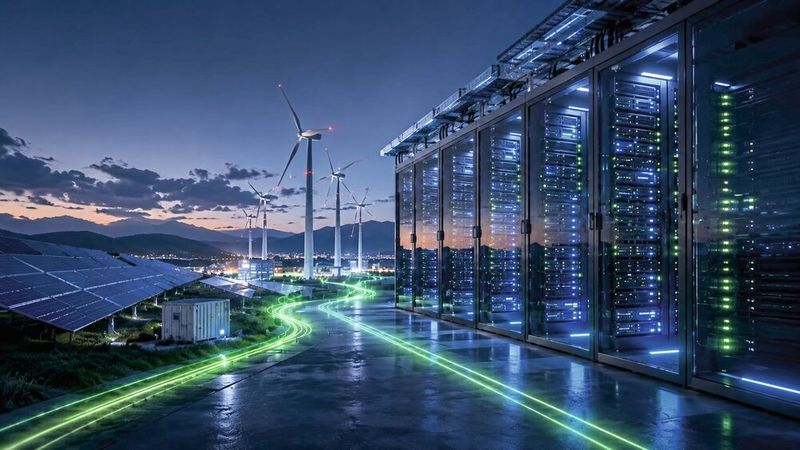
The increasing use of AI applications is increasing the energy requirements of modern data centers and posing new challenges for power grids and energy infrastructures.
(Image: Dall-E / AI-generated)
The increasing spread of artificial intelligence is not only changing the IT industry, but also the demands on the energy supply. Ever larger data centers, more powerful AI models and increasing investments are driving up electricity demand significantly. The latest IEA special report "Key Questions on Energy and AI" is the first to comprehensively analyze how the AI boom is affecting power grids, energy generation and industrial supply chains. The focus is on the development of power consumption in data centers, technical and infrastructural bottlenecks and the question of what role AI itself can play for the energy industry in the future.
This article analyzes the core findings of the report: the predicted doubling of data center power demand by 2030, the disruptive dynamics of hardware efficiency versus demand explosion, and the physical and geopolitical restrictions of energy and IT supply chains. At the same time, it sheds light on how the tech industry is becoming a catalyst for nuclear and renewable generation structures, while AI itself acts as an optimization tool for the energy transition.
Problem Definition
In recent years, the evolution of artificial intelligence (AI) has sparked a dynamic that has rendered traditional forecasting models of global infrastructure needs obsolete. As impressive as the advances in AI models are, their operation is ultimately based on physical infrastructure. Data centers require power, cooling, network connections and powerful hardware. As AI becomes more widespread, the question of whether energy supply, networks and supply chains can keep pace with this development is becoming increasingly important. With the publication of the groundbreaking special report "Key Questions on Energy and AI" (IEA, 2026) as part of the World Energy Outlook, an empirical foundation is now available that decodes the complex interdependencies between artificial intelligence and the global energy sector. The report fills a critical data gap for policy makers and industry experts alike by outlining quantitative scenarios up to the end of the decade.
The Quantitative Dimension of Electricity Demand
The primary indicator of digital transformation pressure is the steadily increasing electricity consumption of data centers. According to IEA modeling, the global electricity consumption of data centers in 2025 amounted to around 485 terawatt hours (TWh). The IEA's baseline scenario forecasts an almost exact doubling of this figure to around 950 TWh by 2030, by which time the sector will account for around 3% of global electricity demand.
Core figures:
950 TWh: Forecasted global electricity consumption of data centers by 2030 (approx. 3% of global demand).
+50 %: Growth in power consumption of dedicated AI data centers in 2025 alone.
The dynamics within the dedicated AI infrastructure are particularly toxic. While the overall market for all data centers recorded an already considerable growth of 17% in 2025, the power consumption of systems specifically designed for AI workloads exploded by 50%. AI-specific energy requirements are expected to triple by 2030. This development will be driven by investments by the leading technology groups (hyperscalers), which will exceed the USD 400 billion mark in 2025 and are expected to increase by a further 75 % in 2026. The investments of five leading technology groups alone now exceed global investments in oil and gas production.
The Efficiency Equation And the Jevons Paradox
One of the most interesting findings of the IEA report concerns the relationship between efficiency and overall consumption. Modern AI systems are becoming increasingly efficient per computing operation. At the same time, the number of applications is increasing so rapidly that the total energy requirement is nevertheless growing. This effect is reminiscent of the so-called Jevons paradox: although increases in efficiency reduce the energy requirements of individual applications, greater use can lead to higher overall consumption. The IEA notes significant technological progress: The specific energy required to perform a single, isolated AI computing operation is falling by at least an order of magnitude each year thanks to algorithmic optimization and improved chip architectures. Today, a standardized text query consumes less electrical energy than a conventional television requires in the same period of time.
However, this efficiency gain is more than offset by the qualitative and quantitative expansion of applications. At the same time, new AI applications are fundamentally changing the demands on computing power. While simple text queries require comparatively little energy, video generation, complex reasoning processes or autonomous agent systems require significantly greater computing resources. According to the IEA, the energy requirements of individual queries can be hundreds to thousands of times higher than those of a classic text query.
Physical And Regulatory Bottlenecks
Although the project pipelines for new data centers are reaching historic dimensions, the IEA identifies critical, non-monetary restrictions that dampen growth in practice and act as structural brakes:
Date: 08.12.2025
Naturally, we always handle your personal data responsibly. Any personal data we receive from you is processed in accordance with applicable data protection legislation. For detailed information please see our privacy policy.
Consent to the use of data for promotional purposes
I hereby consent to Vogel Communications Group GmbH & Co. KG, Max-Planck-Str. 7-9, 97082 Würzburg including any affiliated companies according to §§ 15 et seq. AktG (hereafter: Vogel Communications Group) using my e-mail address to send editorial newsletters. A list of all affiliated companies can be found here
Newsletter content may include all products and services of any companies mentioned above, including for example specialist journals and books, events and fairs as well as event-related products and services, print and digital media offers and services such as additional (editorial) newsletters, raffles, lead campaigns, market research both online and offline, specialist webportals and e-learning offers. In case my personal telephone number has also been collected, it may be used for offers of aforementioned products, for services of the companies mentioned above, and market research purposes.
Additionally, my consent also includes the processing of my email address and telephone number for data matching for marketing purposes with select advertising partners such as LinkedIn, Google, and Meta. For this, Vogel Communications Group may transmit said data in hashed form to the advertising partners who then use said data to determine whether I am also a member of the mentioned advertising partner portals. Vogel Communications Group uses this feature for the purposes of re-targeting (up-selling, cross-selling, and customer loyalty), generating so-called look-alike audiences for acquisition of new customers, and as basis for exclusion for on-going advertising campaigns. Further information can be found in section “data matching for marketing purposes”.
In case I access protected data on Internet portals of Vogel Communications Group including any affiliated companies according to §§ 15 et seq. AktG, I need to provide further data in order to register for the access to such content. In return for this free access to editorial content, my data may be used in accordance with this consent for the purposes stated here. This does not apply to data matching for marketing purposes.
Right of revocation
I understand that I can revoke my consent at will. My revocation does not change the lawfulness of data processing that was conducted based on my consent leading up to my revocation. One option to declare my revocation is to use the contact form found at https://contact.vogel.de. In case I no longer wish to receive certain newsletters, I have subscribed to, I can also click on the unsubscribe link included at the end of a newsletter. Further information regarding my right of revocation and the implementation of it as well as the consequences of my revocation can be found in the data protection declaration, section editorial newsletter.
Grid connection capacities: In the relevant global clusters, the administrative and technical waiting times for an adequate electricity grid connection are now between 5 and 10 years.
Infrastructure supply chains: The lead times for essential grid components such as large transformers are two to three years. Delivery times for stationary gas turbines for self-supply have been extended to up to five years.
IT hardware restrictions: An acute shortage of high-bandwidth memory (HBM) is limiting the GPU deployment sector and will continue until at least the end of 2027, according to the IEA.
Geopolitical risks: The helium shortage triggered by the Middle East conflict in 2026 (damage in Ras Laffan/Qatar, force majeure, Strait of Hormuz) temporarily caused around a third of global production to be cut—critical because helium is essential for semiconductor production.
The Transformation of the Generation Structure
The enormous and continuous base load demand of the IT infrastructure is forcing the tech industry to play an active role in the global energy transition. Hyperscalers are already responsible for around 40% of the private-sector power purchase agreements (PPAs) for renewable energies concluded worldwide.
As data centers need to be reliably supplied with electricity around the clock, renewable energies alone are often not enough. This is why there is growing interest in low-CO2 technologies with base load capability. This is particularly evident in small modular nuclear reactors (SMRs), whose project pipeline has increased from 25 to 45 GW within one year, according to the IEA." -> The direct reference to geothermal energy, which was still included in the previous draft, is missing from the second part of the sentence. When you talk about "onsite generation" in the third paragraph, you should round it off.
At the same time, the sluggish expansion of the grid is forcing a fossil-based bridging strategy: the IEA is forecasting a significant increase in decentralized natural gas power generation directly on site (onsite generation). An estimated 15 to 27 GW of onsite gas capacity could be created by 2030, leading to a predicted doubling of global natural gas usage in the data center segment.
Geographical Concentration And Local Market Disruption
A significant systemic risk arises from the extreme geographical concentration. More than half of the world's new capacity is being built in existing core regions (such as Northern Virginia in the USA or the FLAP-D hub in Europe) or in newly emerging, high-density clusters. In these micro-regional markets, data centers threaten to account for 20 % to 30 % of total local electricity demand by 2030. This will result in considerable strain on the distribution grids and potential price-driving effects for end consumers and traditional industry.
AI As An Instrument of the Energy Transition
However, the report does not just look at the increasing demand for energy due to AI. At the same time, the technology itself could help to use energy more efficiently. AI systems are already being used for grid monitoring, load forecasting, predictive maintenance and the optimization of industrial processes. According to IEA estimates, this could save more than 13 exajoules of energy worldwide by 2035. AI systems are establishing themselves as a key technology for the management of modern, decentralized energy systems. Through real-time grid monitoring, predictive maintenance algorithms and the optimization of thermal processes in heavy industries, it is estimated that over 13 exajoules (EJ) of primary energy can be saved by 2035—equivalent to around 3% of current global final energy consumption. However, according to an IEA survey of energy suppliers, the primary bottleneck for this efficiency revolution is not the technology itself, but the acute shortage of qualified specialists at the interface of IT and energy technology as well as restrictive data release guidelines.
Conclusion And Outlook
The IEA Special Report "Key Questions on Energy and AI" makes it clear that the future of artificial intelligence is inextricably linked to the evolution of energy systems. The sector acts simultaneously as a massive consumer, pushing grids to their physical limits, and as a technological pacesetter, driving investment in the latest generations of nuclear, geothermal and storage technologies. The crucial task for policymakers and industry will be to shape the regulatory framework in such a way that grid bottlenecks are minimized, while the enormous potential of AI for system optimization can be fully exploited. (mr)



:quality(80)/p7i.vogel.de/wcms/66/90/669096f10c10efa89ce3ce6be0f6f44d/0132279760v1.jpeg "State-of-the-art machine technology, the best tool holders and high-performance tools, combined with finest process expertise, optimize production at toolcraft. (Image:Zecha)")
:quality(80)/p7i.vogel.de/wcms/d9/f3/d9f3079879e7f48a38b42525acad0908/0132025590v1.jpeg "Retrofits can be specifically sold through tangible effects such as higher plant availability. (Image: ©eakgrungenerd - stock.adobe.com)")
:quality(80)/p7i.vogel.de/wcms/71/98/719829d11b80bccd920fcb456e93b74d/0131508423v1.jpeg "With Iscar's Quickturn, WST Precision Technology machines output shafts significantly faster and more reliably than before. (Image:Iscar)")
:quality(80)/p7i.vogel.de/wcms/57/0f/570f1c1fe8f74e6ac0cc2863b73f306a/0132412565v1.jpeg "EOS can be pleased, as the demand for the engine systems of its customer Beehive Industries (one can be seen in the picture) from the USA is increasing due to the global crises. Now there has been a nice order concerning 3D printers ... (Image:N. Leach-Proffer)")
:quality(80)/p7i.vogel.de/wcms/f0/36/f03666f7af96a5a2e37c5344c99ca38e/aufmacher-mvtec-success-20story-vista-3--40vistav1.jpeg "Two robots carry out the inspection process. (Image:Vista)")
:quality(80)/p7i.vogel.de/wcms/16/2b/162beed76aab51d57a32282ddd5ce96b/0132430948v1.jpeg "Security by System: Seamless monitoring of network edges and zero-trust concepts are becoming mandatory in automation. (Image:Gemini / AI-generated)")
:quality(80)/p7i.vogel.de/wcms/68/2d/682d831b9b58bc00faef2b0f5b264875/p90650697-highres-bmw-group-plant-landv1.jpeg "BMW is developing software for humanoid robots at the Landshut site. (Source: BMW)")
:quality(80)/p7i.vogel.de/wcms/89/78/897815ff95e3c63b844b898c83d8ea9e/26-06-22-st-c3-b6ber-ab-eisenmann-bild-201v1.jpeg "In a painting system at Eisenmann, an industrial robot with a gripper handles rims of different sizes and weights. Precise drive technology from Stöber is used in the process. (Image: Stöber Drive Technology GmbH + Co. KG)")
:quality(80)/p7i.vogel.de/wcms/17/40/1740ea2e261b768a3cafcf7805adccfb/adobestock-789872912--c2-a9-20littlewolf1989-20-e2-80-93-20stock-adobe-comv1.jpeg "The tractor gearbox was removed for maintenance purposes. (Stock image) (Source: littlewolf1989 – stock.adobe.com)")
:quality(80)/p7i.vogel.de/wcms/bc/25/bc25f24bffe77b798e23dcbdb4bf13db/0132052516v1.jpeg "When it comes to thermal management, hardware developers and engineers should collaborate. (Image: ROSSandHELEN photographers)")
:quality(80)/p7i.vogel.de/wcms/35/e2/35e29bb4a9f8326c2c1fb2d772547828/adobestock-2094390289--c2-a9-20moneymoney-20-e2-80-93-20stock-adobe-com-ki-generiertv1.jpeg "A central question in the concept of the underwater data center was how to cool the server cabinets in sealed chambers on the seabed. (Symbol image) (Source: © moneymoney – stock.adobe.com / AI-generated)")
:quality(80)/p7i.vogel.de/wcms/eb/a9/eba93106e9c9d4c67e10de61afd17117/0132396640v1.jpeg "Simulation is not an external tool for quality assurance but a part of the design process. This also allows better control of complex components. (Image: PTC)")
:quality(80)/p7i.vogel.de/wcms/17/e4/17e49b36addd1f4c52f83fbf17c283b5/org-blobs-user-response-file-output-528ce347-e0de-4ba7-b658-13b8d0094427-file-1784187263841-jpgv1.jpeg "Many drivers are distracted by screens and mobile phones. Today's common vehicle warnings fall short, according to the verdict of several experts. (Image:)")
:quality(80)/p7i.vogel.de/wcms/ed/02/ed023b1fdf0ce9dab50436c68c21d572/40f910458b38205d15ba8dc67a2d7b5be0b33010v1.jpeg "Volkswagen has launched the ID Cross, an electric SUV positioned above the VW Polo. (Image: Volkswagen)")
:quality(80)/p7i.vogel.de/wcms/e8/3d/e83dad6aec16f55013606a99e0dc12a7/sichtbares-zeichen-der-zusammenarbeit-opel-hisst-am-tag-der-unterzeichnung-der-absichtserklaerung-vor-dem-adam-opel-haus-am-stammsitz-in-ruesselsheim-die-flaggen-von-deutschland-und-algerienv1.jpeg "Opel plans to build a plant for vehicle final assembly and combustion engines in Algeria. (Image:Opel)")
:quality(80)/p7i.vogel.de/wcms/5e/95/5e959fa6b3550a4ee9f5ea2d829db3cd/sany-20250709160607815v1.jpeg "Chinese truck manufacturers like Sany want to sell their heavy trucks in Europe as well. (Source: Sany)")
:quality(80)/p7i.vogel.de/wcms/8b/1b/8b1bffc74848d00e529f260e139186cc/0132446234v1.jpeg "AI burglars, AI security teams - Science fiction becomes reality (Image:AI-generated)")
:quality(80)/p7i.vogel.de/wcms/2d/9c/2d9c9463fd6d5e5c656b5a6ad41582a8/0113143253v1.jpeg "In our China Market Insider, we regularly provide you with relevant information directly from China. (Image:© Eisenhans - stock.adobe.com)")
:quality(80)/p7i.vogel.de/wcms/7e/39/7e396550e88eb6397dfcc7b4cbd59cad/org-blobs-user-response-file-output-b2db88da-a3d2-433b-b1ec-519a69337afa-plugin-output-votrp58pv1.png "In nuclear facilities, radiation penetrates cable materials over many years and gradually alters them, damaging their molecular structure. (Source: AI-generated / Gemini)")
:quality(80)/p7i.vogel.de/wcms/e8/22/e822ea25c9996b65cd0d1fd1e6fd46a9/0132350103v1.jpeg "FEV collaborates with Microsoft on efficient AI models for vehicle applications based on Nvidia. (Image:FEV)")
:fill(fff,0)/p7i.vogel.de/companies/69/88/69882c428938e/tmts2026-ticec-banner-en-2000px.png "tmts2026-ticec-banner-en-2000px (https://www.tmts.tw/en)")
:quality(80):fill(efefef,0)/p7i.vogel.de/wcms/65/a6/65a678f1a2373/etmm-artificial-intelligence.png "ETMM Artificial Intelligence")
:quality(80)/p7i.vogel.de/wcms/22/d0/22d03cd48e992435338b59464c428d41/0129739814v1.jpeg "More electric vehicles on the roads mean a higher demand for electricity - which should ideally be covered by renewable energies. (Image:BMW)")
:quality(80)/p7i.vogel.de/wcms/98/4d/984d6c0c110788f3144c1a528468e04c/0131691467v2v1.jpeg "Converting for the future: In order to cope with the enormous workloads of generative AI, operators must fundamentally rethink the architecture of their data centers at all levels. (Image:AI-generated)")