Working with unsafe laser machines poses a significant risk to the health of employees. That is why several manufacturers have joined forces in the CECIMO Working Council to enforce European machine safety standards.
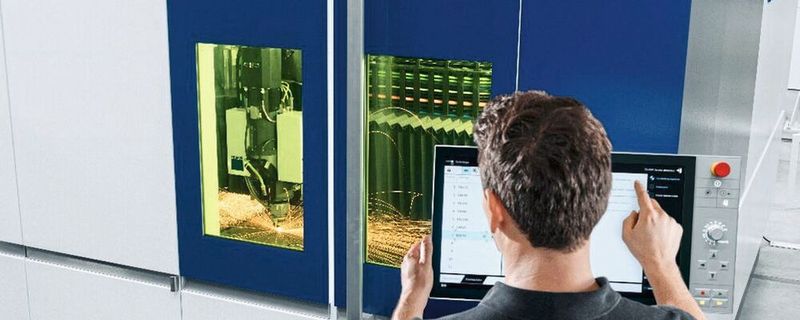
The operator can look into the machine without worry when using safe machines.
(Image: Trumpf)
The safety of workers and operators should always be a top priority. Unsafe machines pose a significant risk for accidents, injuries, and even fatalities. Working with unsafe laser machines, especially those without sufficient beam protection, entails serious health risks. These include skin burns and permanent eye damage from direct or accidental laser exposure, inhalation hazards, chemical exposure, electrical risks, and long-term health consequences. To ensure operator safety, choosing compliant and properly secured laser machines is essential. For end users and customers, machine safety means protecting their employees, securing their investments, and minimizing potential legal and financial implications. Furthermore, the use of compliant machines contributes to the reputation and credibility of the entire industry. However, ensuring CE compliance alone can easily mean a price difference of 10 to 20 percent, significantly influencing decision-making. Established providers worldwide—particularly in the EU—are increasingly witnessing cases where potential customers, drawn to attractive prices, unknowingly consider machines with counterfeit safety solutions.
End users play a crucial role in ensuring the safety and compliance of the machines they purchase. One of the most important steps is to demand proper documentation and certification from the manufacturers. This includes checking for CE markings and obtaining relevant information regarding the machine’s compliance with required safety standards, as end users often mistakenly view the CE marking as a "certificate" or may even be misled by the very similar "China Export" symbol, which looks almost identical to a CE marking. Collaborating with established and reputable manufacturers and seeking recommendations and advice from industry associations can also contribute to informed decisions. For this purpose, CECIMO has published a simplified CE checklist for machine tools, which has been ratified by the Federal Institute for Occupational Safety and Health (BAuA) and can be found here: Guidelines of CE Marking on Laser Machines—CECIMO.
Legally Responsible for Employee Safety
Non-compliant machines may initially appear cost-effective, but the risks far outweigh the benefits. Non-compliant machines can lead to frequent breakdowns, inefficient operation, and prolonged downtime due to unexpected malfunctions. Moreover, not all end users are aware that, within the EU, they are legally responsible for the safety of their employees, even if the non-compliant functions of a machine are due to the manufacturer's negligence. The manufacturer's responsibility for damages arising from inadequate safety measures in the design and production of the machine does not absolve the employer of their own responsibility. Employers are obligated to eliminate risks for employees using the machine and to adopt modern technologies to ensure employee safety in the workplace.
Even within the EU, specific regulations vary from country to country. Given this complexity, it would benefit all market participants to have an EU-wide standardized procedure and unified jurisdiction. The new EU Supply Chain Act, also known as the Directive on Corporate Sustainability Due Diligence (CSDDD), could, if implemented correctly, already ensure a level playing field for all EU and non-EU suppliers in Europe. This is also why it is challenging for market surveillance authorities to detect unsafe equipment—it is nearly impossible to take action, as exemplified in the USA, which recently blacklisted several suppliers, meaning their products can no longer be imported into the US even without inspection. India has also responded by halting the import of unsafe equipment. In turn, this could lead to even more unsafe machines entering the EU market in the future, requiring increased awareness from end users and market surveillance authorities.
Commitment to Safety, Transparency and Compliance
Established providers worldwide report cases where potential customers, attracted by appealing prices, unknowingly consider machines with counterfeit safety solutions. Competing with manufacturers that prioritize cost savings over safety is a challenge. However, these experiences motivated the European machine tool industry to emphasize their commitment to safety, transparency, and compliance and to come together on this topic in a CECIMO working council. Through the exchange of experiences and educating customers about potential risks from both legal and economic perspectives, they aim to create a market environment where safety takes precedence above all.
Date: 08.12.2025
Naturally, we always handle your personal data responsibly. Any personal data we receive from you is processed in accordance with applicable data protection legislation. For detailed information please see our privacy policy.
Consent to the use of data for promotional purposes
I hereby consent to Vogel Communications Group GmbH & Co. KG, Max-Planck-Str. 7-9, 97082 Würzburg including any affiliated companies according to §§ 15 et seq. AktG (hereafter: Vogel Communications Group) using my e-mail address to send editorial newsletters. A list of all affiliated companies can be found here
Newsletter content may include all products and services of any companies mentioned above, including for example specialist journals and books, events and fairs as well as event-related products and services, print and digital media offers and services such as additional (editorial) newsletters, raffles, lead campaigns, market research both online and offline, specialist webportals and e-learning offers. In case my personal telephone number has also been collected, it may be used for offers of aforementioned products, for services of the companies mentioned above, and market research purposes.
Additionally, my consent also includes the processing of my email address and telephone number for data matching for marketing purposes with select advertising partners such as LinkedIn, Google, and Meta. For this, Vogel Communications Group may transmit said data in hashed form to the advertising partners who then use said data to determine whether I am also a member of the mentioned advertising partner portals. Vogel Communications Group uses this feature for the purposes of re-targeting (up-selling, cross-selling, and customer loyalty), generating so-called look-alike audiences for acquisition of new customers, and as basis for exclusion for on-going advertising campaigns. Further information can be found in section “data matching for marketing purposes”.
In case I access protected data on Internet portals of Vogel Communications Group including any affiliated companies according to §§ 15 et seq. AktG, I need to provide further data in order to register for the access to such content. In return for this free access to editorial content, my data may be used in accordance with this consent for the purposes stated here. This does not apply to data matching for marketing purposes.
Right of revocation
I understand that I can revoke my consent at will. My revocation does not change the lawfulness of data processing that was conducted based on my consent leading up to my revocation. One option to declare my revocation is to use the contact form found at https://contact.vogel.de. In case I no longer wish to receive certain newsletters, I have subscribed to, I can also click on the unsubscribe link included at the end of a newsletter. Further information regarding my right of revocation and the implementation of it as well as the consequences of my revocation can be found in the data protection declaration, section editorial newsletter.
Politics has also understood that the EU must place greater focus on its competitiveness than before. The European internal market, in particular, must be quickly protected from unfair competitors and subsidized low-cost products. To this end, the EU Commission recently identified significant shortcomings with its new internal market strategy. The EU e-commerce strategy from early February also brings these issues further into focus. However, recognition alone is not enough. Concrete solutions are needed, such as holding platform operators accountable or creating a unified EU market surveillance authority. With the involvement of customs authorities, non-compliant products and machines must already be identified and rejected at the EU’s external borders. Customs reforms and the digital product passport can play a key role here. In the fall, discussions will enter a critical phase regarding the so-called New Legislative Framework (NLF). This framework provides the legal basis for product regulations such as the CE marking and the declaration of conformity. It is essential that these measures take effect quickly and strengthen the competitiveness of quality and safety-conscious companies now. Currently, political focus is heavily directed at low-cost products sold online in the B2C sector, but the issue of machine safety should urgently be included due to the economic impact of these expensive machines and the high risks of non-compliance.
The collaboration of politics, market surveillance, professional associations, suppliers, organizations, and users is fundamentally important. It increases the overall safety of machines across various industries and ensures the well-being of users. Furthermore, it promotes fair competition by eliminating the advantage of non-compliant manufacturers due to lower production costs. Ultimately, we aim for a safer and more reliable market environment that benefits both businesses and employees.
CECIMO
CECIMO is the European Association of Manufacturing Technologies. Focusing on machine tools and additive manufacturing technologies, it brings together 15 national associations representing around 1,500 industrial companies in Europe (EU + UK + EFTA + Turkey), over 80 percent of which are SMEs.
*Member of the CECIMO task force on "unsafe machines"



:quality(80)/p7i.vogel.de/wcms/6c/7b/6c7bd9f4d139a19fabb4827af99aae44/bild-01-fa-con-sept-01-entwicklung-abstimmung-ventiltrieb-kits-300dpi-gr-c3-b6-c3-9ferv1.jpeg "The valve train is a critical component in the combustion engine. Tolerance management and material selection are crucial. (Source: Con‑Sept)")
:quality(80)/p7i.vogel.de/wcms/85/82/858260a185cd5d1c4837b241a09c84fe/0131909549v1.jpeg "In the future, the European Parliament wants this situation to be only a temporary phase, not a permanent one. That’s because a new regulation stipulates that cars will soon have to be designed so that their individual parts can be removed and reused as easily as possible ... (Image:Scrap King)")
:quality(80)/p7i.vogel.de/wcms/9a/d4/9ad4b344d2a55a0ab294d6b5df706c25/0131921459v1.jpeg "The Chinese yuan is actually worth more than the valuation allowed by the Beijing government! This artificial devaluation costs Germany billions. According to experts, a fair exchange rate is therefore necessary. And China could also benefit more from it than suffer ... (Image: Cinbi-yuan)")
:quality(80)/p7i.vogel.de/wcms/d0/4c/d04c032c8e1e150bf33ba84def4ed9a6/0130721540v1.jpeg "Müller Precision Tools supports its customers with customized, application-specific tools. (Image: Müller)")
:quality(80)/p7i.vogel.de/wcms/b9/bf/b9bf31d5b4ca0bdb517f78cc2e5f4afe/japanische-20flagge-1365x768v1v1.jpeg "Japan plans larger investments in the fields of artificial intelligence, semiconductor technology, and space exploration. (Image:)")
:quality(80)/p7i.vogel.de/wcms/df/9a/df9aa8af9dbdfea96a7d952b3bdab940/260422-pm-abb-robotics-powa-3v1.jpeg "Six payload classes ranging from 7 to 30 kilograms, the longest reach, highest additional arm load, and a leading top speed of up to 5.8 m/s distinguish the new PoWa cobot family from ABB Robotics. (Image:ABB Robotics)")
:quality(80)/p7i.vogel.de/wcms/24/db/24dbdaca5cda28ec5f2742f6c582ae35/0131055501v1.jpeg "With SurfaceControl Automotive, Micro-Epsilon offers a robot-based inspection system for fully automated surface inspection of raw car bodies (body-in-white). (Image:Micro-Epsilon)")
:quality(80)/p7i.vogel.de/wcms/24/44/2444962c9c322838487c67597a5d591d/0131850457v1.jpeg "(Image: Neurawork AI / Leonardo.ai / AI-generated)")
:quality(80)/p7i.vogel.de/wcms/0b/ff/0bffa42ea605978169d5e25eedb2c1ee/0131826953v2v1.jpeg "In the picture: from right to left, Pascale Herman, Christophe Delhovren, Antoine de Ryckel, Olivier de Laet. They intend to work together in the future. (Image:Valeo)")
:quality(80)/p7i.vogel.de/wcms/3c/f8/3cf83e1d11902f2e6a4a921cc13af926/sb1-260520-7177v1.webp "Małgorzata Zboińska with samples of the 3D-printed material. (Source: Chalmers University of Technology)")
:quality(80)/p7i.vogel.de/wcms/4f/99/4f99d2a7711e404111d5acc3857691a5/comsolv1.jpeg "Trionda in its natural habitat. (Source: Comsol)")
:quality(80)/p7i.vogel.de/wcms/57/ee/57ee3d6f18d0fb35638d80a85158af35/0131921474v1v1.jpeg "The EU Commission believes that new means must be developed to help minimize the Union's dependency on critical raw materials from China. However, as the saying goes, the details are unclear ... (Image: EU)")
:quality(80)/p7i.vogel.de/wcms/a7/12/a7127af2ca9a5d452b61213dccfe8e34/0131827191v2v1.jpeg "Rivian is launching the electric car R2 in the USA. The model is also set to debut in Europe. (Image:Image: Rivian/Eric Anderson)")
:quality(80)/p7i.vogel.de/wcms/4d/2a/4d2a53e944dff81dc2b06c149e509fd6/0131904075v1.jpeg "The highly precise maneuvering and coupling of the driveboard and capsules is a key function to enable the modular approach of U-Shift. (Image:DLR)")
:quality(80)/p7i.vogel.de/wcms/bb/91/bb91c197aa157f87831e5bed406dd81e/keyou-hice40-actros-h2-sattelzugmaschine-key-visual-pressphoto-02-cmykv1.jpeg "Keyou will offer the retrofitted trucks under the designation \"Keyou Hice 4.0\" in the future. (Source: Keyou)")
:quality(80)/p7i.vogel.de/wcms/6a/6f/6a6f71b7f8067cb4274a7fc476cbfa8f/0131933181v1.jpeg "With the QSE-5, QuantumScape has already unveiled its first product intended for commercial use. Now, the company has also secured Honda R&D as a research partner. (Image:QuantumScape)")
:quality(80)/p7i.vogel.de/wcms/10/33/10337e60c95e1fec578aca8a93c17df1/0131899287v1.jpeg "(Image:Codesys)")
:quality(80)/p7i.vogel.de/wcms/a0/c0/a0c0b94a965844b86119153280a1cb81/0131920022v1.jpeg "A battery-free encapsulated sensor transmits the temperature from inside the body. (Image: MIT News)")
:quality(80)/p7i.vogel.de/wcms/45/99/459982625e5f27bee3c16c402a380707/0131930816v1.jpeg "Autonomous mobile robotics applications: quickly developed using the robotics reference platform from Arrow and STMicroelectronics. (Image:Arrow ST)")
:quality(80)/p7i.vogel.de/wcms/a4/6a/a46ad22b3de9ea56320405b63ead0250/0131913830v1.jpeg "Renesas has acquired Pictorus to simplify and accelerate software development for embedded applications within the Renesas 365 platform. The purchase price was not disclosed in the available information. (Image:Reneas)")
:quality(80)/p7i.vogel.de/wcms/fe/21/fe2195356233cf56e7763bf1a2c9ff71/0124389421v1.jpeg "The core of the AI regulation consists of the extensive provisions for high-risk AI—what falls under this? (Image:freely licensed)")
:quality(80)/p7i.vogel.de/wcms/61/1b/611b1cd86c69b91fbf3f291fdefdb3aa/0127961821v1.jpeg "India introduces new regulations for machine safety. The \"Machinery and Electrical Equipment Safety (Omnibus Technical Regulation) Order, 2024\" will require BIS certification and a local representative in the future. Pilz India can support companies in meeting the requirements and exporting to India. (Image:© iStock.com/gorodenkoff, Pilz GmbH & Co. KG)")