For decades, they were reserved for luxury cars. Now, this chassis technology is moving into the upper mid-range segment—thanks to domestic production, starting at around USD 35,000.
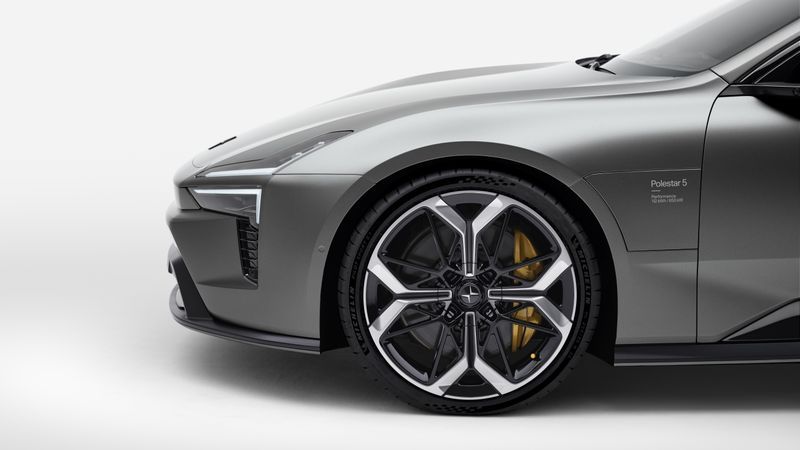
Polestar uses magnetorheological shock absorbers. Originally developed in the USA, the patents are now located in China.
(Image: Polestar)
As well-suspended as a Ferrari or a Porsche, yet the entire vehicle is available from as little as 30,000 euros. This is now a reality in the Chinese automotive market. Magnetorheological shock absorbers produced domestically make it possible.
The suspension technology, which for decades was reserved for Ferraris, Cadillacs, and other luxury cars, is now moving into the upper mid-range of the mass market.
A current example of this trend is the "Wendao V9" from Arcfox, a family car with a range-extender drivetrain. Its manufacturer, BAIC, a state-owned automaker, highlights its "magnetorheological adaptive suspension" in its marketing. During this year’s Beijing Auto Show, more than 8,000 pre-orders were reportedly received within 48 hours.
Prices for the seven-seat MPV range from 220,000 to just under 290,000 yuan, or roughly 28,000 to just under 37,000 euros. The new suspension technology is reserved for the top-spec versions of the vehicle. Nevertheless, it has attracted considerable attention. This technology had previously been "reserved for luxury vehicles costing millions," wrote the Chinese auto portal Gasgoo—referring to millions of yuan, meaning prices above 130,000 euros (approx. USD 153,000).
Adjustable Up to 1,000 Times per Second
According to the manufacturer, the damping in the new adaptive suspension can be adjusted up to 1,000 times per second—around 20 to 30 times faster than Continuous Damping Control (CDC) systems. This allows the system to respond to bumps and potholes almost without delay, significantly improving ride comfort.
In addition, in combination with sensors, cameras, and LiDAR—already on board for driving intelligence—the new technology even enables "predictive" control. The actuators adjust the suspension before the car reaches a pothole or bump.
The supplier of the advanced suspension technology in the Wendao V9 is Yangzhou Dongsheng Automotive from Jiangsu Province in eastern China. The company was officially designated a "Little Giant" in 2019—a group of mid-sized champions inspired by Germany’s "Hidden Champions" and supported by the government in Beijing.
The company has already been supplying stabilizers for some time to the luxury sedans of the Chinese brand Hongqi ("Red Flag"). In China, this is considered a mark of quality, as President Xi Jinping rides in a Hongqi across Tiananmen Square during major military parades—just as Mao Zedong once did.
Yangzhou Dongsheng has also worked with Porsche in China, likely gaining valuable experience. Since offering the technology with its own further-developed magnetorheological fluids for commercial vehicles—a segment where it is still relatively rare—the company has risen into the ranks of global market leaders in this category.
Technology Monopoly Broken
With its products, named MR25, MR28, or MR35, the company claims to have broken the long-standing technological monopolies of foreign manufacturers, as it proudly states in its press releases.
Its list of customers is indeed impressive. In the passenger car aftermarket, shock absorbers from Yangzhou Dongsheng have already been adapted for models such as the BYD Han and the Mercedes-Benz Vito. In the commercial vehicle segment, the company supplies established bus manufacturers King Long and Yutong. With its two production lines, the "Little Giant" can mass-produce 600,000 units per year.
In the market for adaptive suspensions in China, three main approaches are now competing. Air suspension offers high comfort but is expensive and mechanically complex. Electromagnetic valve dampers, known here by the abbreviation CDC, can adjust damping but suffer from mechanical inertia, with system response times of 25 to 55 milliseconds.
Date: 08.12.2025
Naturally, we always handle your personal data responsibly. Any personal data we receive from you is processed in accordance with applicable data protection legislation. For detailed information please see our privacy policy.
Consent to the use of data for promotional purposes
I hereby consent to Vogel Communications Group GmbH & Co. KG, Max-Planck-Str. 7-9, 97082 Würzburg including any affiliated companies according to §§ 15 et seq. AktG (hereafter: Vogel Communications Group) using my e-mail address to send editorial newsletters. A list of all affiliated companies can be found here
Newsletter content may include all products and services of any companies mentioned above, including for example specialist journals and books, events and fairs as well as event-related products and services, print and digital media offers and services such as additional (editorial) newsletters, raffles, lead campaigns, market research both online and offline, specialist webportals and e-learning offers. In case my personal telephone number has also been collected, it may be used for offers of aforementioned products, for services of the companies mentioned above, and market research purposes.
Additionally, my consent also includes the processing of my email address and telephone number for data matching for marketing purposes with select advertising partners such as LinkedIn, Google, and Meta. For this, Vogel Communications Group may transmit said data in hashed form to the advertising partners who then use said data to determine whether I am also a member of the mentioned advertising partner portals. Vogel Communications Group uses this feature for the purposes of re-targeting (up-selling, cross-selling, and customer loyalty), generating so-called look-alike audiences for acquisition of new customers, and as basis for exclusion for on-going advertising campaigns. Further information can be found in section “data matching for marketing purposes”.
In case I access protected data on Internet portals of Vogel Communications Group including any affiliated companies according to §§ 15 et seq. AktG, I need to provide further data in order to register for the access to such content. In return for this free access to editorial content, my data may be used in accordance with this consent for the purposes stated here. This does not apply to data matching for marketing purposes.
Right of revocation
I understand that I can revoke my consent at will. My revocation does not change the lawfulness of data processing that was conducted based on my consent leading up to my revocation. One option to declare my revocation is to use the contact form found at https://contact.vogel.de. In case I no longer wish to receive certain newsletters, I have subscribed to, I can also click on the unsubscribe link included at the end of a newsletter. Further information regarding my right of revocation and the implementation of it as well as the consequences of my revocation can be found in the data protection declaration, section editorial newsletter.
Magnetorheology is based on a different technical principle. Inside the cylinders of the shock absorbers is a fluid infused with microscopic iron particles. Under a magnetic field, this fluid transitions from liquid to semi-solid in less than a millisecond. This allows damping to be controlled almost in real time—without the need for valves.
From Delphi to BWI
The technology was originally developed by Delphi Automotive Systems in the United States, a subsidiary of General Motors that was spun off in 1995. In November 2009, China’s BWI Group acquired Delphi’s suspension and braking business, including the global rights to the magnetorheological shock absorber brand "MagneRide."
In March of last year, BWI began mass production of the fourth generation of MagneRide at a new plant near Shenzhen. The Chinese supplier invested more than 2.3 billion yuan in this, equivalent to around 295 million euros/USD 348 million. The initial capacity is 600,000 dampers per year and is set to be expanded to up to two million.
Today, BWI’s MagneRide dampers are installed in more than 30 luxury platforms and over 100 performance and premium vehicles worldwide, including models such as the Cadillac Escalade IQ, Land Rover Discovery Sport, Polestar 5, and several European supercars.
More recently, Chinese mainstream models have been added, such as the Chery iCAR V27 and the Changan Deepal L06. According to the manufacturer, the latter vehicle, equipped with magnetorheological suspension, even outperformed a Porsche 911 in a test at around 86 km/h (approx. 53 mph).
Demand Driven by Intelligent Chassis Systems
Suspensions of this type have been "used in luxury vehicles for more than 20 years," but are now attracting a growing number of Chinese automakers as customers, BWI also writes on its website.
In particular, the integration of intelligent chassis systems with driver assistance systems is driving strong demand for the new technology. Core components of their damping systems respond within milliseconds, with signal processing and control frequencies of up to 1,000 times per second, according to the BWI Group. Predictive road detection based on LiDAR and camera data improves vehicle stability—for example in sharp corners, on uneven road surfaces, and during emergency maneuvers, BWI states.
Market observers expect this young market to grow very rapidly. In China alone, the volume for magnetorheological suspensions is expected to exceed ten billion yuan by 2028, equivalent to around 1.3 billion euros, according to Gasgoo citing the Gaogong Intelligent Automotive Research Institute. By 2030, global installations could surpass three million units, with a worldwide market volume of more than 20 billion yuan (around 2.6 billion euros; USD 2.9 billion).
This suspension trend is another example of how quickly Chinese automakers are catching up technologically and then setting new benchmarks in certain segments where, just a few years ago, European and American premium manufacturers were leading the way.



:quality(80)/p7i.vogel.de/wcms/eb/2b/eb2bd1b8487afe577b37363cd02f16ff/0113143253v1.jpeg "In our China Market Insider, we regularly provide you with relevant information straight from China. (Image:© Eisenhans - stock.adobe.com)")
:quality(80)/p7i.vogel.de/wcms/dd/b8/ddb8edc98c49b384734ab2432b297eb5/adobestock-1913662309--irene-stock-adobe-com-ki-generiertv1.jpeg "Rotary joints are used in grippers and swivel mechanisms to allow assemblies to rotate or swivel smoothly relative to one another, even under very high loads (illustrative image). (Source: Irene - stock.adobe.com / KI-generiert)")
:quality(80)/p7i.vogel.de/wcms/d1/ef/d1ef6b6f7d4543f7999980bacccaf22b/0133499261v1.jpeg "As the growing imbalance in trade relations with China continues to widen, the EU Chamber of Commerce foresees a day when trade with China will have to be seriously reevaluated ... (Image: AI-generated)")
:quality(80)/p7i.vogel.de/wcms/fe/1f/fe1fa5ee713f94deaba963dc24c3abc5/0133299273v1.jpeg "The Flexistar enables highly flexible production of laser-welded tubes thanks to its tool-free clamping system. (Image:Because Technology, LLC)")
:quality(80)/p7i.vogel.de/wcms/60/ef/60ef4f07e4829b2c2929befc0f353c58/0133511729v1.jpeg "Humanoid robots can match human performance in certain tasks. (Image:Gemini / AI-generated)")
:quality(80)/p7i.vogel.de/wcms/2e/99/2e99726b522e4b35b690e25eb6a42643/0133463991v1.jpeg "Robotics: In AMR applications, connection technology must reliably transmit power, signals, and data despite vibration and shock loads—in very confined spaces and in a way that allows for regular maintenance. (Image:Hyperever)")
:quality(80)/p7i.vogel.de/wcms/d0/18/d01801e3d5dbd7bc9d0b4f60408b630c/0133468429v1.jpeg "Quality requirements for film packaging are on the rise. At the same time, many companies are turning to recyclable film materials, which, however, have their own challenges. Fraunhofer researchers have therefore developed a fast system that detects problems in real time. (Image:Fraunhofer IKTS)")
:quality(80)/p7i.vogel.de/wcms/b1/06/b106cf44923ce39565c3264982fd20eb/0133414574v1.jpeg "Robots Build Robots: At the new Ubtech factory, automated systems even handle parts of the material supply and logistics for the production of humanoid robots. (Image:Ubtech)")
:quality(80)/p7i.vogel.de/wcms/c0/52/c052f405eb55fc3d08c4837e77206fc0/adobestock-2021845957--aucartstudio-stock-adobe-com-ki-generiertv1.jpeg "An innovation from China to combat extreme summer heat: A novel coating lowers temperatures. (Source: © AucArtStudio – stock.adobe.com_AI-generated)")
:quality(80)/p7i.vogel.de/wcms/66/a7/66a7b78159caeacce57136529688799f/0133503398v1.jpeg "Sunlight Makes Stone! These stone blocks weren't made the traditional way. Instead, they were additively manufactured from sand using a laser. In the future, however, the laser is set to be replaced by concentrated sunlight—if the startup Addisol is successful... (Image:Addisol / F. Fiedler)")
:quality(80)/p7i.vogel.de/wcms/72/b9/72b995c2c8d812c5e2115cbef31e035a/0133462727v1.jpeg "Eggl manufactures center hoods that are precisely tailored to each cooking island—whether standard size or custom shape. They are made entirely of stainless steel and are individually customized in terms of size and filter arrangement. (Image:SPI)")
:quality(80)/p7i.vogel.de/wcms/13/5d/135dfae6229ceaf5c55467a43e8f7257/adobestock-1879961393--ardi-stock-adobe-com-ki-generiertv1.jpeg "Annoying chatterboxes or awkward silences in response to questions—a moderator should specifically prepare for difficult situations in order to navigate them effectively. (Image:ardi - stock.adobe.com_AI-generated)")
:quality(80)/p7i.vogel.de/wcms/aa/a2/aaa2c6dd2daa24b485cddbf9297590c0/0133467318v1.jpeg "Battery Monitoring: Battery monitoring using electrochemical impedance spectroscopy offers several advantages. (Image:TI)")
:quality(80)/p7i.vogel.de/wcms/39/b2/39b21bf03be1683831862239a369987c/0133469638v1.jpeg "Data from autonomous vehicles and robots operating autonomously is in high demand, and Ruqi wants to capitalize on this. (Image:Ruqi Mobility)")
:quality(80)/p7i.vogel.de/wcms/8a/bb/8abbb6217220595edc1549ac9b84f307/0133429906v1.jpeg "The IAA in Hanover showcased the ambitions of Chinese commercial vehicle manufacturers in Europe. (Image:Wehner - VCG)")
:quality(80)/p7i.vogel.de/wcms/0c/53/0c5313ef91c14b6df0d0996efc33c8ad/jpg03568-bearbeitetv1.jpeg "The category winners of the 2027 German Car of the Year award. (Source: GCOTY)")
:quality(80)/p7i.vogel.de/wcms/48/15/4815da27c45973ca629a99b375ac3aef/0133509585v1.jpeg "Ventuno Q RoadTest: Designed to help the Element14 community gain practical insights from real-world tests using the Ventuno Q. (Image:Farnell/Element14)")
:quality(80)/p7i.vogel.de/wcms/17/2b/172bd132f9febdfcbcedba292ad0504d/aufmacherv1.jpeg "Micro-Epsilon offers a wide range of IO-Link-compatible sensors. (Source: Micro-Epsilon Messtechnik GmbH & Co. KG)")
:quality(80)/p7i.vogel.de/wcms/ca/b4/cab46fd26d19d6a2febca032048200b6/0133471827v1.jpeg "Photonics SDK for C and Python: Computational operations are now abstracted as standard mathematical functions. (Image:Q.ANT)")
:quality(80)/p7i.vogel.de/wcms/92/b2/92b2ed5299cde450c0764f4f64468395/0133505895v1.jpeg "The \"Iris 100\" test system for high-precision volume production of microLEDs uses a spectrometer and a high-resolution camera. (Image:Teradyne)")
:fill(fff,0)/images.vogel.de/vogelonline/companyimg/76800/76895/65.jpg "FAULHABER_120mm.jpg ()")
:fill(fff,0)/p7i.vogel.de/companies/69/de/69de1b7403b0d/simtos-logo.jpeg "simtos-logo (SIMTOS)")
:quality(80)/p7i.vogel.de/wcms/0d/10/0d10c395214fb844bb977303c81c0ce5/0132387775v1.jpeg "Oh, Maybach! Luxury cars are still in demand in China, but the trend is shifting towards domestic brands. European—and thus also German—automakers are feeling this. For the past year, there has also been a tax on luxury vehicles. Read here to find out how this is affecting the market ... (Image:Mercedes)")
:quality(80)/p7i.vogel.de/wcms/93/4d/934de334b47abaa526c78cba1417d7af/0130343495v1.jpeg "The new SU7 is available in three price categories, \"Standard\", \"Pro\" and \"Max\" (Image:Xiaomi)")