Robots and artificial intelligence in the care sector are an often-touted future scenario, but often fail in practice. Which technologies are actually useful and desirable for care? Researchers from Vienna and Linz are working with care staff and care home residents to find answers and develop practical prototypes.
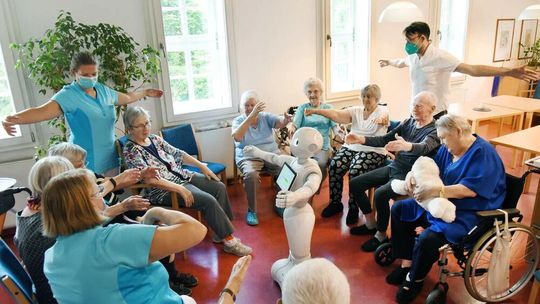
The use of robots in day-to-day care is being tested and further developed in pilot projects such as this House of Generations.
(Picture: APA-Images / dpa / Waltraud Grubitzsch)
'Robear' was one and a half meters tall, weighed 309 pounds and had a cute bear face. The care robot developed in 2015 was intended to lift care home residents, but never made it past the prototype phase. The more compact lifting robot 'Hug' also failed tests in Japanese care homes. Both products were time-consuming, awkward to move and the lifting process was uncomfortable for many residents.
Questioning the Role of Technology
Robear and Hug are representative of the disappointed expectations placed in robots and artificial intelligence (AI) in view of the ageing population and the shortage of nursing staff. "The fact that they have not yet become established in practice is largely due to the fact that the complexity of care is massively underestimated when designing the technology," says Laura Vogel, PhD student at the Department of Ergonomics and Organization at TU Wien. "The idea of simply setting up a device that then solves problems falls short of the mark."
Gallery
Vogel's colleague Reinhard Kletter, a doctoral student at the Institute of Management Sciences at Vienna University of Technology, is a robotics expert and has seen care robot prototypes come and go: "Technology often looks great on paper. But if it doesn't meet the day-to-day requirements and values of care, it's a waste of effort. With many solutions, the cost of implementation and maintenance is currently underestimated. The result is frequent software updates that shift costs and work to the IT area instead of saving them," emphasizes Vogel.
User-oriented research, on the other hand, attempts to place the needs of the care facility at the center of product development. This is often based on a specific technology with the aim of applying it to the care context.
Participation And Dialog
In the transdisciplinary project 'Caring robots // Robots in care', Laura Vogel, Reinhard Kletter and other researchers from the fields of computer science, robotics and social sciences are taking a step back: "Together with carers and people receiving care, we asked what roles are desirable and useful for robots and artificial intelligence in the care context," says Kletter.
In order to understand the needs and challenges in the care sector, Vogel and other social scientists interviewed care staff and systematically observed their day-to-day work. In addition, the project team organized a series of workshops with care staff and residents in Caritas care homes. "The aim was to learn from each other: first, we presented the technical background to AI and robotics: how do robots 'see', how can you talk to machines using language models, and what possibilities does this open up?" explains Kletter.
Finally, together with the workshop participants, the researchers collected wishes and ideas for application in the care context. Building on this, Kletter and his colleagues from the fields of computer science, electrical engineering and robotics are currently developing several prototypes.
Language Models Instead of Robots?
"For many desired applications, it turns out that a robot with a body is not necessary at all," concludes Kletter. Nursing staff are hoping for support with documentation in particular. The scientist has therefore developed AI assistance software that is currently being tested and continuously improved. The idea: care staff wear a small clip-on microphone that records conversations during care activities. "This is important because even small talk can contain care-relevant information," says the researcher. With the help of speech recognition and large language models, care-relevant information is subsequently extracted and a structured report is created that can be used for care documentation. In addition, the researchers are using another prototype ('Calls of Care', see graphic) to test how language models can be used for conversational animation and biography work in a meaningful way, especially for people with dementia.
Value-Oriented Technology
It is not enough for care technology to be functional. It must also be in harmony with ethical care values. In his doctoral thesis, Reinhard Kletter specialized in the issue of privacy, which is particularly important to residents and caregivers: "Privacy must be considered in the design right from the start. It's not just about data protection, but also about ensuring that an aid does not change the interaction between the caregiver and the resident." In the case of the AI documentation aid, only the transcript with the care-relevant information is retained, while the audio file is deleted directly. The mere possibility that the technology can also be used for monitoring is a problem and requires clear communication and transparency.
Date: 08.12.2025
Naturally, we always handle your personal data responsibly. Any personal data we receive from you is processed in accordance with applicable data protection legislation. For detailed information please see our privacy policy.
Consent to the use of data for promotional purposes
I hereby consent to Vogel Communications Group GmbH & Co. KG, Max-Planck-Str. 7-9, 97082 Würzburg including any affiliated companies according to §§ 15 et seq. AktG (hereafter: Vogel Communications Group) using my e-mail address to send editorial newsletters. A list of all affiliated companies can be found here
Newsletter content may include all products and services of any companies mentioned above, including for example specialist journals and books, events and fairs as well as event-related products and services, print and digital media offers and services such as additional (editorial) newsletters, raffles, lead campaigns, market research both online and offline, specialist webportals and e-learning offers. In case my personal telephone number has also been collected, it may be used for offers of aforementioned products, for services of the companies mentioned above, and market research purposes.
Additionally, my consent also includes the processing of my email address and telephone number for data matching for marketing purposes with select advertising partners such as LinkedIn, Google, and Meta. For this, Vogel Communications Group may transmit said data in hashed form to the advertising partners who then use said data to determine whether I am also a member of the mentioned advertising partner portals. Vogel Communications Group uses this feature for the purposes of re-targeting (up-selling, cross-selling, and customer loyalty), generating so-called look-alike audiences for acquisition of new customers, and as basis for exclusion for on-going advertising campaigns. Further information can be found in section “data matching for marketing purposes”.
In case I access protected data on Internet portals of Vogel Communications Group including any affiliated companies according to §§ 15 et seq. AktG, I need to provide further data in order to register for the access to such content. In return for this free access to editorial content, my data may be used in accordance with this consent for the purposes stated here. This does not apply to data matching for marketing purposes.
Right of revocation
I understand that I can revoke my consent at will. My revocation does not change the lawfulness of data processing that was conducted based on my consent leading up to my revocation. One option to declare my revocation is to use the contact form found at https://contact.vogel.de. In case I no longer wish to receive certain newsletters, I have subscribed to, I can also click on the unsubscribe link included at the end of a newsletter. Further information regarding my right of revocation and the implementation of it as well as the consequences of my revocation can be found in the data protection declaration, section editorial newsletter.
Care Quality First, Hype Second
The aspect of privacy shows how new technology can change the social structure in the work context, says Laura Vogel. She is currently particularly concerned with the effects on the professional self-image of care staff: "Technology should create added value, i.e. make work easier or strengthen skills, instead of degrading care staff—for example, if they have to clean up after a machine and ultimately spend less time on care." The autonomy and participation of nurses must be maintained in all care processes, adds Kletter, who therefore wants to incorporate 'human in the loop' steps into AI-supported care documentation.
Many of the wishes expressed in the discussions—such as for a robot that cooks together with residents—reflect a fundamental tension, according to Vogel: "Care should be time-efficient, but ideally holistic and person-centered at the same time. I don't think this conflict of objectives will be resolved if machines divide the work into many small automated steps." When it comes to the question of what the care of the future should look like, we as a society should critically scrutinize the advantages and disadvantages of AI and robotics—free from hype and blind faith in technology.
Robots in care
A research project at TU Wien is developing technologies for care that are geared towards users. The aim is to develop technologies that are suitable for everyday use and make life easier in the care sector—instead of large robotics projects, many of which turn out to be impractical.



:quality(80)/p7i.vogel.de/wcms/9f/5e/9f5ebdd436f99ade82edb3b60628c9f9/0132744768v1.jpeg "During welding, molten, glowing metal particles fly around. To ensure the welder is well protected, there are several things to consider. This includes protection from head to toe, covering the body, hands (image), and even feet. Arbeitsschutz-Express provides advice here ... (Image:Nitras)")
:quality(80)/p7i.vogel.de/wcms/80/92/8092cd36dac1d263ca6e705b8a7b0a69/0132724408v1.jpeg "New infrastructure projects in Kazakhstan aim to bring Europe and Asia closer together on the so-called Middle Corridor. (Image:Die Astana Times)")
:quality(80)/p7i.vogel.de/wcms/7d/1b/7d1b6a432c52f68600583b25f7d5c80d/0113143253v1.jpeg "In our China Market Insider, we regularly provide you with relevant information directly from China. (Image:© Eisenhans - stock.adobe.com)")
:quality(80)/p7i.vogel.de/wcms/09/42/09426afd0e023190089bd8c1c36c432f/0132473007v1.jpeg "Particularly in the area of solid carbide cutters, Pferd Tools has thousands of variants in its portfolio. (Image:Pferd Tools)")
:quality(80)/p7i.vogel.de/wcms/11/b0/11b041587fe5783597a78530b628ed7c/0132682714v1.jpeg "Symbolic image: New US rules could make market access more difficult for foreign providers of mobile robots and connected inverters. (Image:Dall-E / AI-generated)")
:quality(80)/p7i.vogel.de/wcms/f2/2d/f22d62adcc688c71e6bea844be9c2a9c/0132344529v1.jpeg "IO-Link is an important component for the Smart Factory. With high transmission speeds, additional data, simplified wiring, and easy integration, IO-Link offers crucial advantages for automation processes. (Image:Baumer)")
:quality(80)/p7i.vogel.de/wcms/2b/00/2b00bf86ad24c2db6c80b9edda1bb375/aufmacher-iotmaxx-gateways-cmykv1.jpeg "With the freely programmable Linux gateways from IoTmaxx, individual integration requirements can be implemented. They are now also available in customized switch cabinets from IoTmaxx. (Source: IoTmaxx GmbH)")
:quality(80)/p7i.vogel.de/wcms/6a/ab/6aab1e6c486540a1587dd92605efa931/0132684773v1.jpeg "Autonomous execution of workflows in the assembly of car doors at Audi. (Image:Mimic Robotics / Audi)")
:quality(80)/p7i.vogel.de/wcms/ca/90/ca90a13919cdade100d393bb3d2f4b3a/0132724138v1.jpeg "Improved cooling concept: Thanks to the cavity microstructure, known as vascular metamaterials, not only are volume and weight reduced, but the cooling capacity is also increased. (Image:Automoteam)")
:quality(80)/p7i.vogel.de/wcms/79/7d/797da27ccb047d5f70ba1d067db9aa81/newsimage425644v1.jpeg "Porous ceramic cubes from the 3D printer use energy-efficient evaporative cooling and noticeably reduce the temperature. (Source: Lunghammer - TU Graz)")
:quality(80)/p7i.vogel.de/wcms/ee/27/ee27620db6bb24e898d15a9452578774/titel-pumpev1.jpeg "Pressure fluctuations and flow forces directly influence the mechanical behavior of technical systems. Multiphysics analyses reveal critical interactions already in the early development stages. (Source: Merkle CAE Solutions)")
:quality(80)/p7i.vogel.de/wcms/47/a6/47a65bc9763ddfc99d52e7d9e48e8220/najwa-abdel-latif-shingle-matrix-fraunhofer-isev1.png "The project manager at Fraunhofer ISE, Najwa Abdel Latif, inspects the interconnected solar cells on the shingle matrix stringer at Fraunhofer ISE. (Source: Fraunhofer ISE / Sophia Bächle)")
:quality(80)/p7i.vogel.de/wcms/90/bb/90bb490f64a7eb60cf1805d9fdb541f0/353166-1-5v1.jpeg "A new electric car is almost always better for the climate than continuing to drive with a combustion engine. (Source: Volvo)")
:quality(80)/p7i.vogel.de/wcms/93/a5/93a52e2b9980dd2fe4823c8054d33c75/0132691285v1.jpeg "At the test bench, data from approximately 240 analog channels is measured. In total, including the channels captured via CAN, around 900 channels are recorded and monitored at the test bench. (Image: Liebherr)")
:quality(80)/p7i.vogel.de/wcms/0a/5c/0a5c469cb4bb53f28ff81c7689ebd868/0132728214v1.jpeg "Junghyun Kwon, Executive Vice President, Head of Autonomous Driving at Hyundai. (Image:Hyundai)")
:quality(80)/p7i.vogel.de/wcms/fd/f4/fdf477763e22c638539d9c204e6428f7/0132654523v1.jpeg "77 percent of EV batteries were manufactured in Asia, primarily in China, in 2025. This is an increase of 7 percent compared to 2024. (Image: AI-generated)")
:quality(80)/p7i.vogel.de/wcms/da/39/da39a38e5c07b0461d44b1a4660aa24f/0132715760v1.jpeg "Product innovation: Innodisk announces GMSL2 camera modules and adapter board series. (Image: Innodisk)")
:quality(80)/p7i.vogel.de/wcms/83/a9/83a9493ad202f37e188f3323c56aa2c6/0132672260v1.jpeg "After Moore's Law: Packaging is becoming the most important driver for semiconductor technology. (Image: ©Svitlana - stock.adobe.com)")
:quality(80)/p7i.vogel.de/wcms/1c/ba/1cba2c23c75d7e5d18f726598dc00708/0132680361v1.jpeg "Symbolic image: Data centers, chips, and circuit boards represent the real AI infrastructure—the fragile bubble represents the high expectations for its continued growth. (Image:Dall-E / AI-generated)")
:quality(80)/p7i.vogel.de/wcms/df/b6/dfb6fc4bd19a03eaff97541bd402c942/newsimage425602v1.png "In their work, researchers at Fraunhofer SIT first create deepfakes themselves to train the system. (Source: Fraunhofer SIT)")
:fill(fff,0)/p7i.vogel.de/companies/69/88/69882c428938e/tmts2026-ticec-banner-en-2000px.png "tmts2026-ticec-banner-en-2000px (https://www.tmts.tw/en)")
:fill(fff,0)/p7i.vogel.de/companies/69/de/69de1b7403b0d/simtos-logo.jpeg "simtos-logo (SIMTOS)")
:quality(80)/p7i.vogel.de/wcms/6f/f5/6ff58c55638ba84c88bbdd226fe25182/0131216591v1.jpeg "Researchers, residents and caregivers work together to shape the use of robotic technologies. In the picture, they discuss a computer vision system that recognizes objects in the environment and makes them visible on a screen, and exchange views on desirable applications and technical and ethical limits in everyday care.(Image: Helena A. Frijns / Caring Robots)")
:quality(80)/p7i.vogel.de/wcms/11/76/1176cc29e423965c93b22662f953e6cd/0131216567v1.jpeg "The 'Calls of Care' prototype is an AI-supported dialog system in the form of a classic landline telephone. People with dementia receive calls and have stimulating conversations with the AI voice about their everyday life and their past. The system validates the person's subjective reality and picks up on biographical topics with which the system has been trained.(Picture: Ralf Vetter / Caring Robots)")
:quality(80)/p7i.vogel.de/wcms/7f/ce/7fce6f12180214ffce22dfaa56d20e04/0131216512v1.jpeg "The use of robots in day-to-day care is being investigated in pilot projects around the world, but not all of them make it into practice.(Image: Mohamed Nohass i/ unsplash+)")
:quality(80):fill(efefef,0)/p7i.vogel.de/wcms/65/f0/65f0715271f4e/dassault-wpcover-mm.png "Dassault_WPCover_MM")
:quality(80)/p7i.vogel.de/wcms/5b/ad/5badd27bd7a5feb1c589b1f3b909da93/sc8-2894-e1770098794852-1200x675v1.jpeg "sc8-2894-e1770098794852-1200x675v1 (Source: Sakari Röyskö | Forum Virium Helsinki)")
:quality(80)/p7i.vogel.de/wcms/78/76/7876189b22214d51effdfbbf244359ad/0132477485v1.jpeg "GenAI helps engineers process unstructured data from device logs and service records and improve predictive maintenance workflows. (Image: MathWorks)")