AI agents were the most important trend at this year's "Auto China". It is the most visible signal to date that the third disruption of the automotive industry has begun. After electrification and intelligent driving, "AI-defined driving" is now following with force.
At Auto China in Beijing, it became clear that the race for the best AI in vehicles is in full swing. This will not be decided by the vehicle manufacturers, but by the platform and the best partner.
(Image: freely licensed at Pexels)
Chinese manufacturers in particular are currently outdoing each other with the announcement of AI agents. After the first wave of AI adoption in vehicles primarily led to better voice assistants in the cockpit, artificial intelligence is now set to take on more complex tasks. The AI agents will no longer just chat or answer questions, but will interpret intentions, break down tasks and carry out multi-stage chains of action such as ordering food, making restaurant reservations, payment, navigation and specific vehicle control via ADAS in a closed loop.
AI is More than Just A Tool
The voice in the cockpit is to become an intelligent conductor that can control the entire vehicle. "In other words, the competition has moved away from AI as a chat tool. AI must now be able to act," the Chinese internet portal NetEase quoted Zhong Xuedan, VP at Tencent Smart Mobility, as saying. A video about the Zeekr 8X electric car from the Geely Group shows what will be possible. "Drive me to pick up my child from school and find a McDonald's on the way. I need to get there before 5pm," is the command given to the car by a user in the PR video. The car then plans the best route itself, switches on assisted driving, stops at a McDonald's, drives on and finally parks automatically in front of the school. The driver no longer has to do much himself, apart from handing his child a hamburger and perhaps cleaning the seats afterwards.
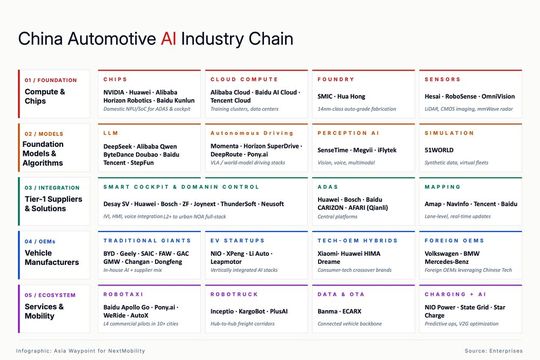
AI supply chain in China
(Image: Asia Waypoint)
"It's not a voice assistant that researches something for you. It's an AI agent that performs tasks for you," is how the Chinese tech magazine Jike Gongyuan describes the technological leap that has just begun. There is no mention of when the Zeekr 8X will be delivered with exactly these capabilities. However, it apparently won't be long now. According to the manufacturer, more than 10,000 orders were received for the Zeekr 8X within the first 29 minutes of its market launch on April 17. Trade media are writing about the first Chinese response to Tesla's "Grok + FSD model".
This agentic vehicle AI was developed by an industrial alliance founded specifically for this purpose. The car manufacturer Geely, its AI subsidiary Afari (Qianli Technology) and the AI start-up StepFun have jointly developed "Super Eva". It is a combined suite of AI agents that can perform multi-step actions in the car across domains.
These functions are made possible by a multimodal AI model developed by StepFun that covers speech and image recognition simultaneously. It works partly as an edge model in the vehicle, for more complex thinking tasks in the cloud. According to the business newspaper Shangguan Xinwen, only around 40 days passed between the first release of the AI model 3.5-Flash and its installation in the car. This cannot be verified exactly, but it gives an approximate idea of the speed at which these or similar AI functions are likely to be rolled out in the Chinese automotive industry from now on.
New Scenarios Possible
Other Chinese manufacturers are also upgrading with AI agents and presented their first results in Beijing. XPeng updated its AI model so that commands such as "Park near the entrance to the shopping center" also work without a map or coordinates. With the help of AI, the car navigates solely by perceiving the real world on site, simply using a camera.
Xiaomi, on the other hand, has just released an update for its HyperOS car operating system, which processes complex to-do lists while driving, makes restaurant reservations, orders coffee and recognizes from the driver's voice whether he is stressed when he gets home so that he can switch on soothing lights and soft music as a precaution.
What is currently being heralded here in more or less impressive functions is the next investment race in the automotive industry. Anyone who doesn't play along here will soon no longer appeal to the spoiled Chinese car customers. Huawei has already announced that it will invest more than 9 billion US dollars in computing power for intelligent driving over the next five years.
German Manufacturers in A Tight Spot
The German manufacturers, who have been struggling to catch up in terms of electrification and autonomous driving functions, are once again under pressure. BMW China has just presented its "BMW Intelligent Personal Assistant", which is based on Alibaba's Qwen model and will be available in new iX3 models and the BMW 7 Series.
Volkswagen currently seems to be the furthest along, having announced a suite of AI agents for all cars in China for the second half of the year. This is no longer just about the interaction between man and machine in the cockpit, but about precisely those chains of action that are already being used to advertise the Zeekr 8X. "The car should be like a companion," explains Thomas Ulbrich, CTO of VW in China.
Date: 08.12.2025
Naturally, we always handle your personal data responsibly. Any personal data we receive from you is processed in accordance with applicable data protection legislation. For detailed information please see our privacy policy.
Consent to the use of data for promotional purposes
I hereby consent to Vogel Communications Group GmbH & Co. KG, Max-Planck-Str. 7-9, 97082 Würzburg including any affiliated companies according to §§ 15 et seq. AktG (hereafter: Vogel Communications Group) using my e-mail address to send editorial newsletters. A list of all affiliated companies can be found here
Newsletter content may include all products and services of any companies mentioned above, including for example specialist journals and books, events and fairs as well as event-related products and services, print and digital media offers and services such as additional (editorial) newsletters, raffles, lead campaigns, market research both online and offline, specialist webportals and e-learning offers. In case my personal telephone number has also been collected, it may be used for offers of aforementioned products, for services of the companies mentioned above, and market research purposes.
Additionally, my consent also includes the processing of my email address and telephone number for data matching for marketing purposes with select advertising partners such as LinkedIn, Google, and Meta. For this, Vogel Communications Group may transmit said data in hashed form to the advertising partners who then use said data to determine whether I am also a member of the mentioned advertising partner portals. Vogel Communications Group uses this feature for the purposes of re-targeting (up-selling, cross-selling, and customer loyalty), generating so-called look-alike audiences for acquisition of new customers, and as basis for exclusion for on-going advertising campaigns. Further information can be found in section “data matching for marketing purposes”.
In case I access protected data on Internet portals of Vogel Communications Group including any affiliated companies according to §§ 15 et seq. AktG, I need to provide further data in order to register for the access to such content. In return for this free access to editorial content, my data may be used in accordance with this consent for the purposes stated here. This does not apply to data matching for marketing purposes.
Right of revocation
I understand that I can revoke my consent at will. My revocation does not change the lawfulness of data processing that was conducted based on my consent leading up to my revocation. One option to declare my revocation is to use the contact form found at https://contact.vogel.de. In case I no longer wish to receive certain newsletters, I have subscribed to, I can also click on the unsubscribe link included at the end of a newsletter. Further information regarding my right of revocation and the implementation of it as well as the consequences of my revocation can be found in the data protection declaration, section editorial newsletter.
Korean carmaker Hyundai brought its all-electric Ioniq brand to China, which uses software from Chinese developer Momenta and an AI assistant on a Qualcomm chipset. "China is the place where the future of mobility is being defined, and Hyundai intends to help," emphasizes José Muñoz, President and CEO of Hyundai Motor Company.
Race for the Best Platform And Partners
This new race for the best AI in cars will almost certainly not be decided by the individual car models, nor by the vehicle manufacturers alone. The decisive factor will be who integrates into the best platforms and finds the best partners. AI control for the chassis, in the cockpit, connection to payment platforms, credit and bank card and service apps must all come together.
This is a major new opportunity for China's major internet and AI companies, especially Tencent, known for its super app WeChat. "As an intelligent carrier that integrates hardware and software and is strongly connected to the physical world, the automobile is predestined for the use of AI agent scenarios," says Tang Daosheng, Senior EVP at Tencent. On April 23, the Group launched an "open platform for AI agents in mobility for all scenarios". Seven agents for ordering, navigation, internet searches, connectivity, infotainment, roadside assistance and valet parking can be integrated relatively easily into various vehicle models.
Such platform providers are likely to be of interest to many OEMs, at least until they have developed their own AI agents. More than 100 car manufacturers currently use the Tencent Cloud. Tencent's cockpit solutions are used in more than 80 percent of China's car brands and have been installed in around 18 million vehicles to date, reports the NetEase portal.
There's no getting around WeChat, because it's the "killer app" on almost every Chinese cell phone, which is used to communicate, research and pay for everything from luxury cars to dinner and melons on the side of the road.
Even Tesla upgraded the cockpit of its cars in China in March 2026 with WeChat integration, among other things so that users can send "live locations" directly from chat and map apps to the vehicle navigation system. Alibaba, ByteDance and Baidu are also working on integrating their large-scale AI models into as many vehicles as possible. (se)



:quality(80)/p7i.vogel.de/wcms/21/b6/21b61c2ac1df28254fb0dad1574fb2d7/0132853015v1.jpeg "The rose-gold, TiAlSiN-based coating material InoxaCon contributes significantly to the stability and service life of HPTec's new RQR-350 milling tool. It enables safe and efficient automated processes in the manufacturing of surgical instruments. (Image:Cemecon)")
:quality(80)/p7i.vogel.de/wcms/d2/73/d273374d6347651e4e6200cf6061ea4e/0132860560v1.jpeg "Even in July, the flag of the Chinese economy did not flutter particularly briskly in the air. Read here what’s happening and why production in China is apparently declining ... (Image:AI-generated)")
:quality(80)/p7i.vogel.de/wcms/18/47/1847f131e3afda201d1dbb98ad0ecb04/0132826776v1.jpeg "Image 1: Difender armored steels from Dillinger stand out with top scores in ballistic testing and cold bending. Defense companies therefore readily choose them. They can be found, for example, in the armored vehicles Fuchs and GTK Boxer of the German Armed Forces. (Image: Dillinger)")
:quality(80)/p7i.vogel.de/wcms/1e/7d/1e7d651782e0e97b3efc25abf2b52350/img-3485v1.jpeg "The Siemens Energy employees attach balancing weights at the precisely calculated and adjusted angular position to achieve the best possible result. (Source: Schenck Rotec)")
:quality(80)/p7i.vogel.de/wcms/a7/38/a73840cb81da9dc3c503f4c04bf66b96/0132892768v1.jpeg "Unitree's IPO symbolizes the high expectations for humanoid robots and embodied AI. (Image:Dall-E / AI-generated)")
:quality(80)/p7i.vogel.de/wcms/1c/a5/1ca5e3ef5d834c3a42de8909c872e3c6/0132876444v1.jpeg "The autonomous transport system Active Shuttle marketed by Bosch Rexroth has been sold to Neura Robotics. (Image:Bosch Rexroth)")
:quality(80)/p7i.vogel.de/wcms/30/1a/301a1aa59e093d848b69e9ff7006b83e/image1v1.jpeg "Wireless switching devices offer advantages in numerous industrial applications – wherever wired communication reaches its limits (Image: Steute) (Image:)")
:quality(80)/p7i.vogel.de/wcms/a2/85/a285b12508af812e28b17be3482a736c/0132488872v1.jpeg "NIS2 is no longer an abstract requirement in the distant future for many industrial companies. (Image:AI-generated)")
:quality(80)/p7i.vogel.de/wcms/41/fc/41fc456ff1ff8f30807924663e8df127/img-0942v1.jpeg "In industrial additive manufacturing, the production strategy must influence the design from the very beginning. (Source: Materialise)")
:quality(80)/p7i.vogel.de/wcms/44/fe/44fe86a16c26c09bb363b3671bf0b930/0132847771v1.jpeg "CoreTechnologie (CT) points out that the 3D printing software 4D_Additive has been equipped with additional application possibilities. Here you can learn more about what the new version 1.8 can do – such as generating complex lattice structures or optimizing faulty data ... (Image:CT)")
:quality(80)/p7i.vogel.de/wcms/b4/f2/b4f2c272247f79c5e87334a6839f20cb/0132549860v1.jpeg "Morefire analysis: Many mechanical engineering websites focus on technical specs instead of customer benefits. Translating features into clear benefits increases visibility, inquiries, and competitiveness. (Image: ©peopleimages.com - stock.adobe.com)")
:quality(80)/p7i.vogel.de/wcms/b4/9a/b49aaad0500e06e253f7d75ecb77338a/adobestock-4840668--dani-kreienb-hl-stock-adobe-comv1.jpeg "Metal processing in 2026 will be more digital, automated, and data-driven – but not automatically easier. (Image:© Dani Kreienbühl - stock.adobe.com)")
:quality(80)/p7i.vogel.de/wcms/5b/88/5b88d94e6a43f2b857462cd1921f7386/0132281427v1.jpeg "The eTurbo solves a well-known turbocharger problem: by combining an exhaust gas turbocharger and a permanently excited synchronous motor into a highly integrated core assembly, the compressor achieves sufficient speed even when the exhaust energy is actually not yet sufficient. (Image: BorgWarner)")
:quality(80)/p7i.vogel.de/wcms/75/fe/75feffb63bc6275786606d78a8d797c4/0132901853v1.jpeg "Steyr Motors reports similar business results as last year. Here you can learn more about the details of the Austrian company's situation ... (Image:E-Steyr)")
:quality(80)/p7i.vogel.de/wcms/57/d2/57d2b75d884c18866b46e776126fb46b/org-blobs-user-response-file-output-dac07b02-0e97-4452-9a3a-26528da583b3-file-1787126178766-jpgv1.jpeg "The memory manufacturer CXMT has had an extremely successful IPO. Among the investors are several car manufacturers. (Image:KI-generiert)")
:quality(80)/p7i.vogel.de/wcms/d0/68/d0681c9d26012538a22ff5c103429612/0132875205v1.jpeg "Electric vehicles: Structure of the zone architecture in a modern vehicle. (Image:TI)")
:quality(80)/p7i.vogel.de/wcms/22/82/22826566c11220ed61efac5982fb94a2/0132896083v1.jpeg "Electrodes made from paper and copper paste deliver comparable signal quality to the established gold standard. They perform significantly better in all environmental impact analyses. (Image:Screentec)")
:quality(80)/p7i.vogel.de/wcms/c4/9f/c49f5b8173f678f7ef071355b1fbbd7c/yamu-jay-ai-generated-9088888v1.jpeg "As part of a strategic partnership, Siemens and Reinhausen are advancing the future of energy supply solutions for AI data centers. (Symbol image) (Source: pixabay / AI-generated)")
:quality(80)/p7i.vogel.de/wcms/28/20/28204a4592a69a8682bfbf9a8f7e1dc2/0132846993v1.jpeg "The health status of a lithium-ion battery changes with increasing aging. AI models can utilize characteristic changes in the charge and voltage curves to estimate the state of health. (Image:freely licensed)")
:quality(80)/p7i.vogel.de/wcms/90/dc/90dc332e30a3e4bd3ff77646ed0633b7/0132833369v1.jpeg "Through a compromised repository of the widely used open-source tool LiteLLM, attackers were able to capture several terabytes of data and login credentials. Security company CloudSEK concludes, after analyzing the data, that the attack conducted in March of this year affected more than 2,000 companies, including major players like Microsoft, Nvidia, AWS, and Deutsche Bahn. (Image:freely licensed)")
:fill(fff,0)/p7i.vogel.de/companies/69/de/69de1b7403b0d/simtos-logo.jpeg "simtos-logo (SIMTOS)")
:quality(80)/p7i.vogel.de/wcms/90/db/90db3087d3af0560fcdb4dbc42443ce1/0130157448v1.jpeg "The switch to SDV is the most complex transformation the industry has ever had to master. The end consumer gets a vehicle that gains rather than loses value over its lifetime. (Image:Sonatus)")
:quality(80)/p7i.vogel.de/wcms/c4/ad/c4ada9bb9fe9a3970ff52b5513aeac3a/0127142013v1.jpeg "Cockpit of the Mercedes CLA 250+ Shooting Brake with EQ technology: In China, the all-electric CLA is set to be equipped with an AI agent from ByteDance. (Image:Mercedes-Benz AG)")
:quality(80)/p7i.vogel.de/wcms/f4/23/f4237da377044edc41a38afcf6c6d626/b2026cw00152-3840x2158v1v1.jpeg "AI agents in vehicles: this was the big topic for Volkswagen AG at the \"Auto China\" 2026 trade fair. (Image:Volkswagen AG)")