In our "Fascinating technology" section, we present impressive research and development projects to designers every week. Today: the development of NASA's new Nancy Grace Roman space telescope.
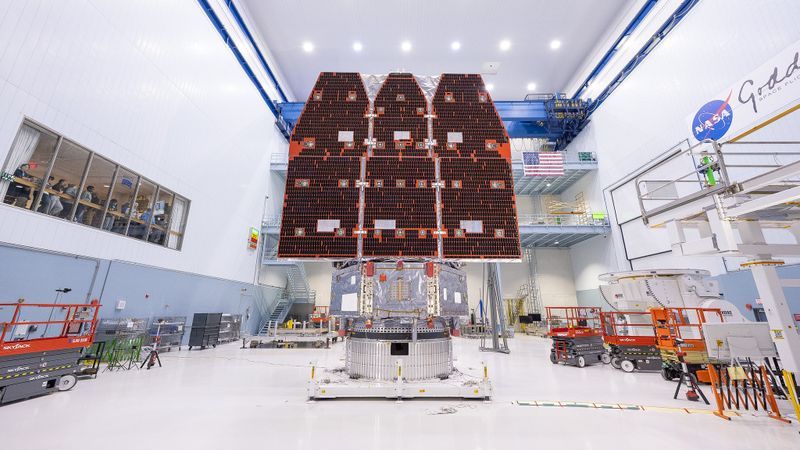
The Nancy Grace Roman space telescope was completed in the largest clean room at NASA's Goddard Space Flight Center. It is due to be launched into space in September 2026.
(Image: NASA/Jolearra Tshiteya / CC BY 4.0)
More than a thousand technicians and engineers assembled the Nancy Grace Roman space telescope from millions of individual parts. It is almost 43 feet long and cost around $3.8 billion.
Many components were manufactured and tested in parallel to save time. After completion, Roman will now undergo a series of tests before it is transported to NASA's Kennedy Space Center in Florida in the summer of 2026. The space telescope is due to start its mission into space in May 2027 at the latest, but the team is aiming for a launch as early as fall 2026.
Roman uses state-of-the-art sensors that build on the many years of experience with infrared detectors in NASA's Hubble and Webb instruments. However, Roman's image area is much larger in order to capture a significantly wider field of view.
Greg Mosby, research astrophysicist at NASA Goddard
Optical Wide-Angle Detection at A New Level
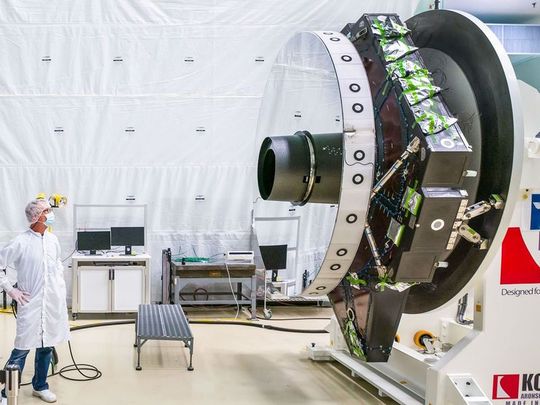
The primary mirror has a diameter of 2.4 meters and is therefore the same size as the primary mirror of the Hubble Space Telescope.
(Image: NASA/Chris Gunn)
The Roman Telescope is not just another observatory in space—it is a technological paradigm shift in wide-field optical sensing. Although it uses the same optical aperture as the legendary Hubble telescope with its 8 feet primary mirror, its system design revolutionizes the way astrophysical data is generated. The newly developed Wide-Field Instrument (WFI)—an infrared camera—increases the field of view by a factor of 100—with exactly the same level of detail resolution.
The Hardware Specifications at A Glance:
Optical sensor technology: An array of 18 high-precision H4RG-10 infrared detectors forms a focal plane with over 300 megapixels.
Data throughput: Optoelectronics generates around 11 terabits of raw data per day, which is transmitted to earth at 250 to 500 Mbps.
Mechanical precision: A hexapod mechanism (Alignment Compensation Mechanism) aligns the detectors in the nm range (nanometers) to compensate for thermal deformations.
The Detectors of the Wide Field Instrument (WFI)
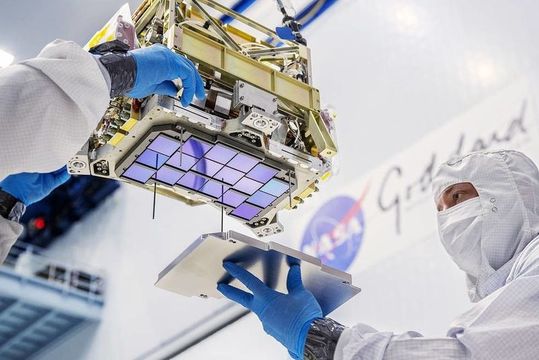
The detectors, each about the size of a salt cracker, have around 16.8 million tiny pixels and provide the mission with an excellent image resolution. Pictured: Lead technician Billy Keim mounts a cover plate over the space telescope's detectors.
(Image: NASA/Chris Gunn)
Each of the infrared detectors—roughly the size of a salt cracker in terms of form factor—has an extremely high packing density of 16.8 million pixels. For the flight configuration, 18 of these sensors were integrated into the focal plane array of the WFI camera. In keeping with proven space redundancy concepts, NASA has six additional sensors available as flight-ready spares. This highly complex instrument converts infrared light into electrical signals that are processed into 300 megapixel images. Each individual "shot" of this wide-field instrument captures a section of the sky larger than the apparent area of a full moon.
For the system architecture, this means a massive throughput: Roman collects data hundreds of times faster than Hubble and will generate a gigantic 20 petabytes (20,000 terabytes) of image data over the course of the five-year primary mission.
Systematic Scanning Instead of Selective Recording
Instead of performing complex, lengthy individual maneuvers for specific target objects, Roman operates as a highly efficient "survey mission". This means that the system continuously and automatically scans gigantic areas of the sky. This produces comparative data sets on a scale that will pose new challenges for astronomical databases. The observation data from a single month of operation alone will be sufficient to compile an unprecedented database for the majority of the stars in our home galaxy.
This unprecedented data pipeline is crucial for mapping the distribution of matter in the cosmos, detecting exoplanets and unraveling the physical mystery of dark energy.
Dual Heat And Energy Management
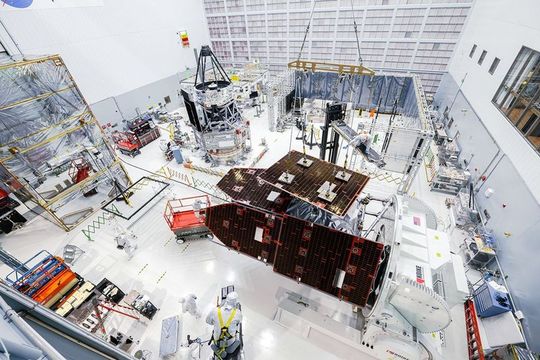
One of the most critical subsystems for the stable operation of the telescope is the solar array sun shield. Here, the designers had to combine two fundamental requirements in one component group: a constant energy supply and highly efficient passive thermal management. The structure consists of six panels that are fitted with high-performance solar cells across the entire surface. While the two central panels remain rigidly connected to the outer barrel assembly (the outer housing structure), the four outer panels are only deployed in space via a deployment mechanism and locked in place at the same level as the central panels.
Technicians install solar panels on the outer façade of the observatory. The inner part of the telescope can be seen in the background, slightly to the left of the center of the picture.
(Image: NASA/Sydney Rohde)
In its orbital orientation, this array is permanently aligned with the sun in order to supply the on-board electronics with fail-safe power. At the same time, the extended surface acts as a massive heat shield that keeps the sensitive optics and sensors in the shade. This thermal insulation is vital for the survival of an infrared telescope: as infrared radiation is in fact thermal radiation, the waste heat from solar radiation on the housing would already saturate the highly sensitive detectors and completely "blind" the telescope. The design of the Sun Shield is therefore a prime example of multifunctional system integration in space travel.
Date: 08.12.2025
Naturally, we always handle your personal data responsibly. Any personal data we receive from you is processed in accordance with applicable data protection legislation. For detailed information please see our privacy policy.
Consent to the use of data for promotional purposes
I hereby consent to Vogel Communications Group GmbH & Co. KG, Max-Planck-Str. 7-9, 97082 Würzburg including any affiliated companies according to §§ 15 et seq. AktG (hereafter: Vogel Communications Group) using my e-mail address to send editorial newsletters. A list of all affiliated companies can be found here
Newsletter content may include all products and services of any companies mentioned above, including for example specialist journals and books, events and fairs as well as event-related products and services, print and digital media offers and services such as additional (editorial) newsletters, raffles, lead campaigns, market research both online and offline, specialist webportals and e-learning offers. In case my personal telephone number has also been collected, it may be used for offers of aforementioned products, for services of the companies mentioned above, and market research purposes.
Additionally, my consent also includes the processing of my email address and telephone number for data matching for marketing purposes with select advertising partners such as LinkedIn, Google, and Meta. For this, Vogel Communications Group may transmit said data in hashed form to the advertising partners who then use said data to determine whether I am also a member of the mentioned advertising partner portals. Vogel Communications Group uses this feature for the purposes of re-targeting (up-selling, cross-selling, and customer loyalty), generating so-called look-alike audiences for acquisition of new customers, and as basis for exclusion for on-going advertising campaigns. Further information can be found in section “data matching for marketing purposes”.
In case I access protected data on Internet portals of Vogel Communications Group including any affiliated companies according to §§ 15 et seq. AktG, I need to provide further data in order to register for the access to such content. In return for this free access to editorial content, my data may be used in accordance with this consent for the purposes stated here. This does not apply to data matching for marketing purposes.
Right of revocation
I understand that I can revoke my consent at will. My revocation does not change the lawfulness of data processing that was conducted based on my consent leading up to my revocation. One option to declare my revocation is to use the contact form found at https://contact.vogel.de. In case I no longer wish to receive certain newsletters, I have subscribed to, I can also click on the unsubscribe link included at the end of a newsletter. Further information regarding my right of revocation and the implementation of it as well as the consequences of my revocation can be found in the data protection declaration, section editorial newsletter.
Who is Nancy Grace roman?
The space telescope is named after Dr. Nancy Grace Roman (1925-2018), a pioneer of astronomy and space travel. She joined NASA in 1959, just a few months after the agency was founded. She was the first woman in a leadership position and served as the first Chief of Astronomy. She made it her life's work to put telescopes into orbit and established NASA's first astronomical space program.
Nancy Grace Roman played a critical role in the design, planning and, most importantly, funding of the Hubble Space Telescope. She spent years convincing members of Congress and skeptical scientists to support the project.
Originally, the novel project was given the purely technical name WFIRST (Wide Field Infrared Survey Telescope). In May 2020, NASA finally officially announced that the telescope would be renamed the Nancy Grace Roman Space Telescope in her honor.
In the fall of 2025, the observatory consisted of two main segments:
The inner section included the telescope, the instrument carrier, two instruments and the satellite bus,
while the outer section consisted of the outer tube assembly, the retractable aperture cover and the solar panels.
The outer part passed a vibration test and an intensive sound test, while the inner part was subjected to a 65-day thermal vacuum test. At the end of November, work began to bring the two segments together and now NASA has announced the completion of the Nancy Grace Roman Space Telescope.
With the completion of Roman, we stand on the brink of unimaginable scientific discoveries. In the first five years of the mission, over 100,000 distant worlds, hundreds of millions of stars, and billions of galaxies are expected to be explored.
Julie McEnery, Senior Project Scientist at NASA Goddard
Despite precisely defined mission parameters, the developers and scientists are looking forward to one thing in particular: unpredictable system deviations in the form of scientific discoveries.



:quality(80)/p7i.vogel.de/wcms/eb/2b/eb2bd1b8487afe577b37363cd02f16ff/0113143253v1.jpeg "In our China Market Insider, we regularly provide you with relevant information straight from China. (Image:© Eisenhans - stock.adobe.com)")
:quality(80)/p7i.vogel.de/wcms/dd/b8/ddb8edc98c49b384734ab2432b297eb5/adobestock-1913662309--irene-stock-adobe-com-ki-generiertv1.jpeg "Rotary joints are used in grippers and swivel mechanisms to allow assemblies to rotate or swivel smoothly relative to one another, even under very high loads (illustrative image). (Source: Irene - stock.adobe.com / KI-generiert)")
:quality(80)/p7i.vogel.de/wcms/d1/ef/d1ef6b6f7d4543f7999980bacccaf22b/0133499261v1.jpeg "As the growing imbalance in trade relations with China continues to widen, the EU Chamber of Commerce foresees a day when trade with China will have to be seriously reevaluated ... (Image: AI-generated)")
:quality(80)/p7i.vogel.de/wcms/fe/1f/fe1fa5ee713f94deaba963dc24c3abc5/0133299273v1.jpeg "The Flexistar enables highly flexible production of laser-welded tubes thanks to its tool-free clamping system. (Image:Because Technology, LLC)")
:quality(80)/p7i.vogel.de/wcms/60/ef/60ef4f07e4829b2c2929befc0f353c58/0133511729v1.jpeg "Humanoid robots can match human performance in certain tasks. (Image:Gemini / AI-generated)")
:quality(80)/p7i.vogel.de/wcms/2e/99/2e99726b522e4b35b690e25eb6a42643/0133463991v1.jpeg "Robotics: In AMR applications, connection technology must reliably transmit power, signals, and data despite vibration and shock loads—in very confined spaces and in a way that allows for regular maintenance. (Image:Hyperever)")
:quality(80)/p7i.vogel.de/wcms/d0/18/d01801e3d5dbd7bc9d0b4f60408b630c/0133468429v1.jpeg "Quality requirements for film packaging are on the rise. At the same time, many companies are turning to recyclable film materials, which, however, have their own challenges. Fraunhofer researchers have therefore developed a fast system that detects problems in real time. (Image:Fraunhofer IKTS)")
:quality(80)/p7i.vogel.de/wcms/b1/06/b106cf44923ce39565c3264982fd20eb/0133414574v1.jpeg "Robots Build Robots: At the new Ubtech factory, automated systems even handle parts of the material supply and logistics for the production of humanoid robots. (Image:Ubtech)")
:quality(80)/p7i.vogel.de/wcms/c0/52/c052f405eb55fc3d08c4837e77206fc0/adobestock-2021845957--aucartstudio-stock-adobe-com-ki-generiertv1.jpeg "An innovation from China to combat extreme summer heat: A novel coating lowers temperatures. (Source: © AucArtStudio – stock.adobe.com_AI-generated)")
:quality(80)/p7i.vogel.de/wcms/66/a7/66a7b78159caeacce57136529688799f/0133503398v1.jpeg "Sunlight Makes Stone! These stone blocks weren't made the traditional way. Instead, they were additively manufactured from sand using a laser. In the future, however, the laser is set to be replaced by concentrated sunlight—if the startup Addisol is successful... (Image:Addisol / F. Fiedler)")
:quality(80)/p7i.vogel.de/wcms/72/b9/72b995c2c8d812c5e2115cbef31e035a/0133462727v1.jpeg "Eggl manufactures center hoods that are precisely tailored to each cooking island—whether standard size or custom shape. They are made entirely of stainless steel and are individually customized in terms of size and filter arrangement. (Image:SPI)")
:quality(80)/p7i.vogel.de/wcms/13/5d/135dfae6229ceaf5c55467a43e8f7257/adobestock-1879961393--ardi-stock-adobe-com-ki-generiertv1.jpeg "Annoying chatterboxes or awkward silences in response to questions—a moderator should specifically prepare for difficult situations in order to navigate them effectively. (Image:ardi - stock.adobe.com_AI-generated)")
:quality(80)/p7i.vogel.de/wcms/aa/a2/aaa2c6dd2daa24b485cddbf9297590c0/0133467318v1.jpeg "Battery Monitoring: Battery monitoring using electrochemical impedance spectroscopy offers several advantages. (Image:TI)")
:quality(80)/p7i.vogel.de/wcms/39/b2/39b21bf03be1683831862239a369987c/0133469638v1.jpeg "Data from autonomous vehicles and robots operating autonomously is in high demand, and Ruqi wants to capitalize on this. (Image:Ruqi Mobility)")
:quality(80)/p7i.vogel.de/wcms/8a/bb/8abbb6217220595edc1549ac9b84f307/0133429906v1.jpeg "The IAA in Hanover showcased the ambitions of Chinese commercial vehicle manufacturers in Europe. (Image:Wehner - VCG)")
:quality(80)/p7i.vogel.de/wcms/0c/53/0c5313ef91c14b6df0d0996efc33c8ad/jpg03568-bearbeitetv1.jpeg "The category winners of the 2027 German Car of the Year award. (Source: GCOTY)")
:quality(80)/p7i.vogel.de/wcms/28/28/2828c5261714321afb0bab67bf771823/0133353387v1.jpeg "The 130-meter-long China Zorrilla draws its power from a battery system with a capacity of more than 40 MWh. Eight electric motors drive an equal number of water jets. (Image:Incat Australia Pty Ltd)")
:quality(80)/p7i.vogel.de/wcms/48/15/4815da27c45973ca629a99b375ac3aef/0133509585v1.jpeg "Ventuno Q RoadTest: Designed to help the Element14 community gain practical insights from real-world tests using the Ventuno Q. (Image:Farnell/Element14)")
:quality(80)/p7i.vogel.de/wcms/17/2b/172bd132f9febdfcbcedba292ad0504d/aufmacherv1.jpeg "Micro-Epsilon offers a wide range of IO-Link-compatible sensors. (Source: Micro-Epsilon Messtechnik GmbH & Co. KG)")
:quality(80)/p7i.vogel.de/wcms/ca/b4/cab46fd26d19d6a2febca032048200b6/0133471827v1.jpeg "Photonics SDK for C and Python: Computational operations are now abstracted as standard mathematical functions. (Image:Q.ANT)")
:fill(fff,0)/images.vogel.de/vogelonline/companyimg/76800/76895/65.jpg "FAULHABER_120mm.jpg ()")
:fill(fff,0)/p7i.vogel.de/companies/69/88/69882c428938e/tmts2026-ticec-banner-en-2000px.png "tmts2026-ticec-banner-en-2000px (https://www.tmts.tw/en)")
:quality(80):fill(efefef,0)/p7i.vogel.de/wcms/67/09/67094781dd403/dossier-additive-manufacturing.png "Dossier Additive Manufacturing")
:quality(80)/p7i.vogel.de/wcms/14/25/1425a0f6f1d0b86f303f51ac1d629214/0131421970v1.jpeg "The Smile space probe was launched on May 19, 2026 at 05:52 CEST on a Vega-C rocket from the European spaceport in French Guiana. (Image:ESA)")
:quality(80)/p7i.vogel.de/wcms/65/74/6574fcb9fb6b589ef577767613f5397c/0132928076v1.jpeg "Compact and standardized: CubeSats enable cost-effective space missions and are increasingly serving as a platform for testing new technologies—from sensors and communications to innovative power supply systems. (Image:City Labs, Inc.)")