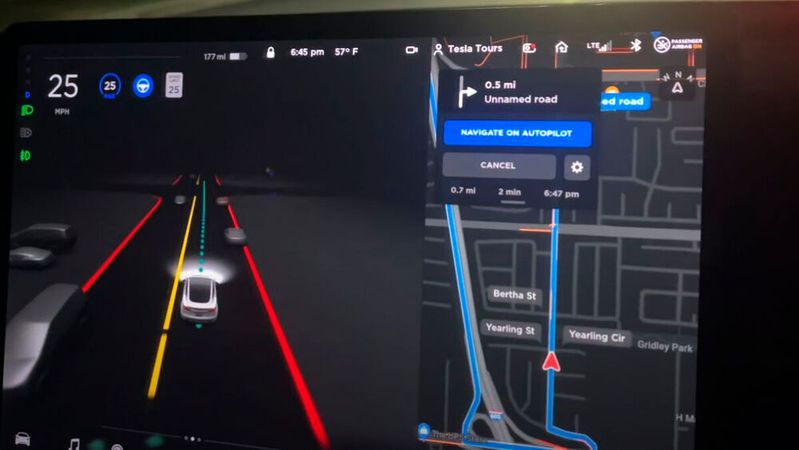
Tesla has received the first testing license for its FSD Autopilot in China. The American electric car manufacturer is allowed to test its software on the roads in the district of "Nanhui New Town" on the outskirts of Shanghai with initially ten vehicles, local media report citing local officials.
Tesla has received the first testing license for its FSD Autopilot in China.
(Image: Tesla)
With this test license, Elon Musk has taken an important step closer to marketing his product in the world's largest car market. And not a moment too soon, as Chinese competitors are increasingly successfully using similar ADAS driver assistance systems as a selling point.
Level 2 according to Chinese classification
Full Self Driving (FSD) is Tesla's driving assistance software. It enables automated driving functions up to level 2 according to the Chinese classification. This classification has six levels from 0 to 5, where vehicles can then be completely autonomous and travel without a driver.
With Tesla's FSD, a driver still has to sit in the cockpit and be able to intervene at any time. It is an assistance system that can take over things like lane centering, adaptive cruise control (ACC), and similar functions with "partial automation".
Launch in China
A source in the Shanghai municipal government confirmed to Chinese business newspaper Caixin a few days ago that Tesla is allowed to put ten test vehicles with FSD on the roads of the Xinhui New Town district. That's just a part of Shanghai in the far southeast of the city, not far from Tesla's Gigafactory there. In April, Elon Musk had unexpectedly visited Beijing and met with Chinese Prime Minister Li Qiang. Rumors had followed suggesting that the launch of FSD in China could happen as early as this year. "It might be possible very soon," Musk himself tweeted in April when he was asked about market access for FSD in China.
According to other media reports, FSD tests will also be carried out in Hangzhou, the city of millions located about two hours' drive southwest of Shanghai, in the near future. However, official confirmations of all these reports are still pending.
Commercialize automated driving
The approval of autopilot is important for Tesla if it wants to remain competitive in the fiercely contested market for Chinese electric vehicles, which are increasingly being equipped with advanced driver assistance systems. Since last year, the Chinese government has been accelerating the commercialization of autonomous driving in China, mainly to give its domestic auto industry a competitive edge in this new key technology worldwide.
On June 4, several ministries in Beijing issued test licenses for Level 3 autonomous driving to nine Chinese automakers in seven major Chinese cities, including Tesla competitors BYD and SAIC, as well as two manufacturers of commercial vehicles. This is intended to pave the way for "further commercialization of advanced autonomous driving technologies," the Ministry of Industry in Beijing explained.
Competition of technologies
These Chinese companies are currently a whole step ahead of Tesla with Level 3 tests on the path to fully autonomous driving. Beijing is friendly towards Tesla, whose car production in China is seen by the communist leadership as a successful example of economic cooperation between the US and the People's Republic. Nevertheless, Beijing ensures that domestic competitors have the best chances when a technological transformation is underway.
At this point in time, it is not clear how quickly Tesla's FSD could also be upgraded to level 3 in China, although there have apparently been great technical advancements at Tesla in recent times.
As soon as FSD is tested on China's roads, a direct competition between two technological routes for autonomous driving will also begin there. Unlike most Chinese and international manufacturers, which rely on a mix of lidar sensors, millimeter wave radar and cameras, FSD relies entirely on "computer vision" and cameras.
Competition is increasing.
After successful tests, Tesla can apply for permission from the Chinese Ministry of Industry and Information Technology (MIIT) to sell the product. Once Tesla is also allowed to sell cars with advanced autopilots in China, market observers expect the competition in the local car market to intensify even further. Particularly German and smaller Chinese manufacturers will face increased pressure to bring their car software up to date. (se)
Date: 08.12.2025
Naturally, we always handle your personal data responsibly. Any personal data we receive from you is processed in accordance with applicable data protection legislation. For detailed information please see our privacy policy.
Consent to the use of data for promotional purposes
I hereby consent to Vogel Communications Group GmbH & Co. KG, Max-Planck-Str. 7-9, 97082 Würzburg including any affiliated companies according to §§ 15 et seq. AktG (hereafter: Vogel Communications Group) using my e-mail address to send editorial newsletters. A list of all affiliated companies can be found here
Newsletter content may include all products and services of any companies mentioned above, including for example specialist journals and books, events and fairs as well as event-related products and services, print and digital media offers and services such as additional (editorial) newsletters, raffles, lead campaigns, market research both online and offline, specialist webportals and e-learning offers. In case my personal telephone number has also been collected, it may be used for offers of aforementioned products, for services of the companies mentioned above, and market research purposes.
Additionally, my consent also includes the processing of my email address and telephone number for data matching for marketing purposes with select advertising partners such as LinkedIn, Google, and Meta. For this, Vogel Communications Group may transmit said data in hashed form to the advertising partners who then use said data to determine whether I am also a member of the mentioned advertising partner portals. Vogel Communications Group uses this feature for the purposes of re-targeting (up-selling, cross-selling, and customer loyalty), generating so-called look-alike audiences for acquisition of new customers, and as basis for exclusion for on-going advertising campaigns. Further information can be found in section “data matching for marketing purposes”.
In case I access protected data on Internet portals of Vogel Communications Group including any affiliated companies according to §§ 15 et seq. AktG, I need to provide further data in order to register for the access to such content. In return for this free access to editorial content, my data may be used in accordance with this consent for the purposes stated here. This does not apply to data matching for marketing purposes.
Right of revocation
I understand that I can revoke my consent at will. My revocation does not change the lawfulness of data processing that was conducted based on my consent leading up to my revocation. One option to declare my revocation is to use the contact form found at https://contact.vogel.de. In case I no longer wish to receive certain newsletters, I have subscribed to, I can also click on the unsubscribe link included at the end of a newsletter. Further information regarding my right of revocation and the implementation of it as well as the consequences of my revocation can be found in the data protection declaration, section editorial newsletter.
*Henrik Bork, a longtime China correspondent for German Süddeutsche Zeitung and Frankfurter Rundschau, is the Managing Director at Asia Waypoint, a consulting agency based in Beijing that specializes in China.



:quality(80)/p7i.vogel.de/wcms/4c/af/4cafbff8a06028a7250e03626a7e6afb/0132939283v1.jpeg "Behind the acronym Clasco is a project based on laser processing techniques, aiming to enable the reliable and application-specific post-processing of even complex metal parts produced by 3D printers. TU Dresden took the lead... (Image:German Materials Society)")
:quality(80)/p7i.vogel.de/wcms/cf/fc/cffc25779317b5b1e42cba9cfcd52bbc/0132927530v1.jpeg "The analysts were wrong again, as Japan was able to increase its export volume far more than predicted. Here are some numbers and facts about Nippon's economic situation... (Image:AI-generated)")
:quality(80)/p7i.vogel.de/wcms/6f/12/6f122ac26fd08f621f7b14f421fc435c/0132930817v1.jpeg "The Federal Statistical Office has taken a closer look at the first half of 2026 in terms of trade. Among other findings, it revealed that China is once again Germany's top trading partner... (Image:AI-generated)")
:quality(80)/p7i.vogel.de/wcms/3c/26/3c2635fb73f283b2d0e6ede46a2c2f9f/0113143253v1.jpeg "In our China Market Insider, we regularly provide you with relevant information directly from China. (Image:© Eisenhans - stock.adobe.com)")
:quality(80)/p7i.vogel.de/wcms/05/e7/05e7017a2699ef15b513bfd2e18431fb/digitaler-planungszwilling-bildv1.png "The author explains here why the digital twin only becomes a planning tool when it follows a clear decision-making question. (Source: T&O Group/AI-generated)")
:quality(80)/p7i.vogel.de/wcms/07/b3/07b368b6d067acdbb49c1e88b0cd8e9d/0131022521v1.jpeg "The seven-axis collaborative robot from Yamaha Motor is equipped with Harting connectors. (Image:Yamaha Motor)")
:quality(80)/p7i.vogel.de/wcms/dc/64/dc64212882d6898cd5b44fcbeb5aedbb/image1v1.jpeg "The cobots from Rheinmetall Yardstick Robotics use all-in-one servo drives from Synapticon. (Image: Rheinmetall Yardstick Robotics) (Image:)")
:quality(80)/p7i.vogel.de/wcms/a7/38/a73840cb81da9dc3c503f4c04bf66b96/0132892768v1.jpeg "Unitree's IPO symbolizes the high expectations for humanoid robots and embodied AI. (Image:Dall-E / AI-generated)")
:quality(80)/p7i.vogel.de/wcms/c8/a1/c8a170f594765cecbdafbc139b96d91a/0132860586v1.jpeg "V-shaped grooves, known as riblets, are directly incorporated into the paint. They reduce overall drag by 50 percent, resulting in significant fuel savings. (Image:Trumpf)")
:quality(80)/p7i.vogel.de/wcms/c9/80/c98042b5898cde9670b4c3ae1efbc656/adobestock-165496610v1.jpeg "In just 45 days, the team from Stauff India completely renewed the hydraulic piping of a steel plant. The key factor here was the right pipe connection system. (Source: Stauff)")
:quality(80)/p7i.vogel.de/wcms/41/fc/41fc456ff1ff8f30807924663e8df127/img-0942v1.jpeg "In industrial additive manufacturing, the production strategy must influence the design from the very beginning. (Source: Materialise)")
:quality(80)/p7i.vogel.de/wcms/44/fe/44fe86a16c26c09bb363b3671bf0b930/0132847771v1.jpeg "CoreTechnologie (CT) points out that the 3D printing software 4D_Additive has been equipped with additional application possibilities. Here you can learn more about what the new version 1.8 can do – such as generating complex lattice structures or optimizing faulty data ... (Image:CT)")
:quality(80)/p7i.vogel.de/wcms/d1/42/d142e0e90738d0335c4ed7936f030e6a/0132948392v1.jpeg "Its production was long delayed, but now Tesla's electric truck Semi is being built in the USA. If the Elon Musk company has its way, it will soon also be seen on Europe's roads... (Image: Tesla)")
:quality(80)/p7i.vogel.de/wcms/a4/19/a419e31b91a2da68d3b59afed58dc31c/26c0194-001v1.jpeg "The Mercedes VLE will soon also be produced in China, local media report. (Image:Mercedes-Benz AG)")
:quality(80)/p7i.vogel.de/wcms/16/2f/162ff38606f0034832fbaadea1829933/precision-measurement-labv1.jpeg "In car manufacturing, much revolves around precision. This is evaluated, among other things, in the precision measurement laboratory. (Source: Geely)")
:quality(80)/p7i.vogel.de/wcms/5b/88/5b88d94e6a43f2b857462cd1921f7386/0132281427v1.jpeg "The eTurbo solves a well-known turbocharger problem: by combining an exhaust gas turbocharger and a permanently excited synchronous motor into a highly integrated core assembly, the compressor achieves sufficient speed even when the exhaust energy is actually not yet sufficient. (Image: BorgWarner)")
:quality(80)/p7i.vogel.de/wcms/65/74/6574fcb9fb6b589ef577767613f5397c/0132928076v1.jpeg "Compact and standardized: CubeSats enable cost-effective space missions and are increasingly serving as a platform for testing new technologies—from sensors and communications to innovative power supply systems. (Image:City Labs, Inc.)")
:quality(80)/p7i.vogel.de/wcms/07/f6/07f6c430c86bf0d5d915268b881ada49/0132895094v1.jpeg "FOUP wafer cassette for 300-mm semiconductor manufacturing in TSMC's Fab 12. (Image:TSMC)")
:quality(80)/p7i.vogel.de/wcms/59/25/59258a3771bf03dd3461d0378884464d/0132928076v1.jpeg "Compact and standardized: CubeSats enable cost-effective space missions and increasingly serve as platforms for testing new technologies—from sensors and communication to innovative energy supply systems. (Image: City Labs, Inc.)")
:quality(80)/p7i.vogel.de/wcms/22/82/22826566c11220ed61efac5982fb94a2/0132896083v1.jpeg "Electrodes made from paper and copper paste deliver comparable signal quality to the established gold standard. They perform significantly better in all environmental impact analyses. (Image:Screentec)")
:fill(fff,0)/p7i.vogel.de/companies/69/de/69de1b7403b0d/simtos-logo.jpeg "simtos-logo (SIMTOS)")
:quality(80)/p7i.vogel.de/wcms/fd/76/fd762d92095ab50fd8d82d1a1f52af0d/0118937625v1.jpeg "In China, they are certain: the vehicle of the future is AI-defined. (Image:freely licensed at Pixabay)")
:quality(80)/p7i.vogel.de/wcms/16/b4/16b47887697c8e2a3e7b2dc698c9b3f6/0131473091v1.jpeg "Tesla wants to bring its new version of the driver assistance system FSD to the streets in China later this year. (Image:Tesla)")
:quality(80)/p7i.vogel.de/wcms/ff/c1/ffc1457ec58153ed7cbec2db2b18325f/d-20changan-deepal-s07-4032x2266v1v1.jpeg "Logo of the Chinese car brand Changan. The manufacturer is one of only two in China to have received a license for level 3 assistance systems. (Image:Wehner/VCG)")