A CubeSat equipped with a tritium battery is on a mission in space. The battery doesn’t generate a great deal of power, but it accomplishes what solar cells and rechargeable batteries, by their very nature, cannot: it provides a continuous supply of energy over the course of years—regardless of where the sun happens to be.
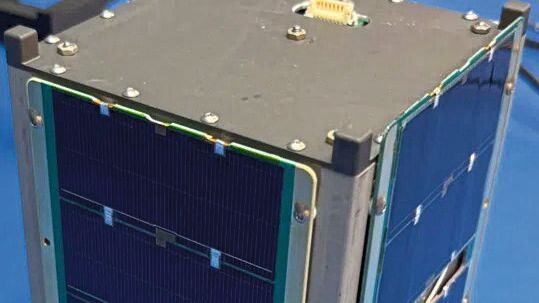
Compact and standardized: CubeSats enable cost-effective space missions and are increasingly serving as a platform for testing new technologies—from sensors and communications to innovative power supply systems.
(Image: City Labs, Inc.)
When the small BOHR satellite was launched into space aboard SpaceX Transporter-17 in July 2026, its electrical output was probably the least remarkable thing about it. No nuclear reactor, no kilowatt-class power source, no radioactive generator to power a space probe across interplanetary distances. Instead, the CubeSat demonstrates a technology whose output belongs more to the realm of extremely energy-efficient electronics: a tritium-based betavoltaic power source.
Nevertheless, this mission in particular could be more significant than its performance data might initially suggest. After all, BOHR is not just a technology demonstrator. The mission also serves as a test to determine whether nuclear micro-power can transition from the exclusive realm of government space programs to commercial spaceflight in the future.
City Labs describes BOHR as the first commercial nuclear-powered satellite and the first nuclear CubeSat. However, it is important to note a key distinction: The satellite bus itself continues to be powered conventionally by solar cells. The nuclear power source serves as an independent power supply for the payload and is intended to validate NanoTritium technology in orbit for the first time. It is precisely this hybrid architecture, however, that is of particular interest. It demonstrates how nuclear micropower can be used not as a replacement for solar energy, but as a supplement for those functions that can never do without sunlight.
A battery that doesn't need to be charged
The term “nuclear battery” inevitably brings to mind radioisotope generators and major space missions. In reality, however, a betavoltaic cell works fundamentally differently from an RTG.
A radioisotope generator uses the heat generated during radioactive decay. A thermoelectric converter then converts this heat into electrical energy. Betavoltaics bypasses this thermal step. Instead, its basic principle is more similar to that of a solar cell.
Instead of photons, however, beta particles strike a semiconductor. These high-energy electrons generate electron-hole pairs along their path. If these charge carriers are located within or close enough to a suitable p-n junction, the electric field of the junction can separate them from one another. A current is generated.
The basic sequence is therefore: radioactive decay → beta electrons → electron-hole pairs → charge separation → electrical energy
The idea is by no means new. Betavoltaic energy converters have been studied for decades. Their major advantage lies in an unusual combination of properties: They require neither light nor an external energy source and, by their very nature, can operate for very long periods of time. Their major weakness, however, is their low power output.
That is precisely why, until now, they have been of particular interest for applications that do not require much energy but where the energy source must be available for an extremely long time—such as autonomous sensors, hard-to-reach systems, or certain medical applications. The scientific literature accordingly describes betavoltaics as a niche technology with a potentially very long service life, whose practical use has so far been limited primarily by low power density and limited conversion efficiency.
Why tritium, of all things?
BOHR uses tritium, the radioactive isotope of hydrogen 3H. Tritium decays via beta-minus decay into helium-3: 3H → 3He+β-+antineutrino
The beta electrons emitted in this process have comparatively low energies. This is precisely what makes them interesting for betavoltaic applications. A fundamental problem arises with high-energy beta emitters: the particles can penetrate deep into the semiconductor and cause damage there. Furthermore, the structure of the converter must be designed so that as much of the decay energy as possible is actually deposited in the region from which the generated charge carriers can still be collected.
Date: 08.12.2025
Naturally, we always handle your personal data responsibly. Any personal data we receive from you is processed in accordance with applicable data protection legislation. For detailed information please see our privacy policy.
Consent to the use of data for promotional purposes
I hereby consent to Vogel Communications Group GmbH & Co. KG, Max-Planck-Str. 7-9, 97082 Würzburg including any affiliated companies according to §§ 15 et seq. AktG (hereafter: Vogel Communications Group) using my e-mail address to send editorial newsletters. A list of all affiliated companies can be found here
Newsletter content may include all products and services of any companies mentioned above, including for example specialist journals and books, events and fairs as well as event-related products and services, print and digital media offers and services such as additional (editorial) newsletters, raffles, lead campaigns, market research both online and offline, specialist webportals and e-learning offers. In case my personal telephone number has also been collected, it may be used for offers of aforementioned products, for services of the companies mentioned above, and market research purposes.
Additionally, my consent also includes the processing of my email address and telephone number for data matching for marketing purposes with select advertising partners such as LinkedIn, Google, and Meta. For this, Vogel Communications Group may transmit said data in hashed form to the advertising partners who then use said data to determine whether I am also a member of the mentioned advertising partner portals. Vogel Communications Group uses this feature for the purposes of re-targeting (up-selling, cross-selling, and customer loyalty), generating so-called look-alike audiences for acquisition of new customers, and as basis for exclusion for on-going advertising campaigns. Further information can be found in section “data matching for marketing purposes”.
In case I access protected data on Internet portals of Vogel Communications Group including any affiliated companies according to §§ 15 et seq. AktG, I need to provide further data in order to register for the access to such content. In return for this free access to editorial content, my data may be used in accordance with this consent for the purposes stated here. This does not apply to data matching for marketing purposes.
Right of revocation
I understand that I can revoke my consent at will. My revocation does not change the lawfulness of data processing that was conducted based on my consent leading up to my revocation. One option to declare my revocation is to use the contact form found at https://contact.vogel.de. In case I no longer wish to receive certain newsletters, I have subscribed to, I can also click on the unsubscribe link included at the end of a newsletter. Further information regarding my right of revocation and the implementation of it as well as the consequences of my revocation can be found in the data protection declaration, section editorial newsletter.
Tritium, on the other hand, is a relatively low-energy beta emitter. Its electrons have a short range and therefore require less shielding. In the scientific literature, tritium is considered, alongside nickel-63, one of the most promising candidates for long-lived betavoltaic energy sources. At the same time, tritium can be incorporated into metal hydrides or tritides, for example, which may be relevant for compact energy sources.
However, the low energy of the beta particles has a downside. The lower their energy, the smaller the potential for generating large amounts of electrical power from a compact converter. A tritium betavoltaic system is therefore not a competitor to a lithium-ion battery when watts or kilowatts are needed in the short term. It competes with something else—not with the battery itself, but with the problem that a battery eventually runs out of power.
The real problem is power density
This is the key difference between a spectacular technology and a universally applicable energy source. A betavoltaic cell can theoretically supply energy for years or decades. However, its current output remains low. This is not merely a development issue, but in part a direct consequence of the laws of physics.
Although a single beta emission can generate numerous electron-hole pairs in a semiconductor, the particle flux is low compared to the photon flux of a solar cell. Consequently, the power density is significantly lower than that of photovoltaic systems. In addition, there are several loss mechanisms.
First, the decay energy must actually reach the active semiconductor. If the geometry is unfavorable, the radioactive material absorbs part of its own beta radiation—an effect known as self-absorption. Then, the generated charge carriers must be collected before they recombine. The depth at which the beta electrons deposit their energy must therefore match the geometry of the barrier layer as closely as possible.
This gives rise to a challenging optimization problem between:
Activity and quantity of the radioactive material,
Range of beta particles,
Thickness of the semiconductor,
Depth and width of the active zone,
Doping profile,
Diffusion length of the charge carriers,
Surface geometry and
Radiation damage to the material.
A thicker semiconductor structure is not automatically better. If the energy is deposited too far from the collection region, electrons and holes recombine before they can contribute to the electric current. At the same time, the active structure must not be so thin that a significant portion of the decay energy passes through unused.
Simulations therefore show that even small changes in geometry and layer thickness can significantly affect the achievable efficiency. For tritium-silicon structures, theoretical and analytical efficiency limits in the single-digit to low double-digit percentage range have been discussed. However, real-world systems often fall well below these limits.
Why Modern Semiconductors Are Reviving Interest in the Technology
The reason betavoltaics is once again the subject of increased discussion right now is due to semiconductor technology. Microcontrollers can operate in deep sleep mode for long periods of time and become active for only a few milliseconds. Some sensors now require only micro- or milliwatts of power. Wireless transmissions can be buffered and sent at longer intervals. Energy from a continuous source can be stored in a capacitor or rechargeable battery and then used briefly for a power-intensive task.
As a result, the nuclear battery does not need to supply peak current, but rather must accumulate enough energy over hours or days to enable the next operating cycle.
For example, a sensor might require virtually no power most of the time. During this time, a continuous micropower source charges an energy storage device. After hours or days, the microcontroller is activated, takes a measurement, processes the data, and transmits a short radio signal. Then the cycle begins again. The nuclear battery simply must never stop supplying power.
From a Flat Chip to a Three-Dimensional Nuclear Cell
The classic betavoltaic cell has a geometric limitation. A flat radioactive source emits radiation in all directions. If the semiconductor is located on only one side, a significant portion of the beta radiation is lost. In addition, the range of the low-energy tritium electrons, in particular, is limited.
That is why the geometry of the detector is becoming increasingly important. Microstructured semiconductors with pores, pillars, trenches, or other three-dimensional structures can massively increase the active surface area. Instead of placing a radioactive source in front of a planar semiconductor surface, a three-dimensional architecture could integrate the source and the detector much more closely.
The goal with such cells is to deposit more decay energy within the active semiconductor volume without lengthening the path that the generated charge carriers must travel to reach the collection structure. As a result, betavoltaics is increasingly becoming a topic in micro- and nanofabrication.
How can three-dimensional p-n structures be fabricated? How deep can a structure be? Which surface maximizes energy absorption? How does recombination change? And how can a radioactive source be integrated in such a way as to minimize self-absorption, shielding, and radiation damage?
Recent work on high-volume, multistage betavoltaic structures shows that, in particular, more efficient utilization of the active volume can lead to significant improvements in power density. At the same time, the challenge remains of combining such concepts with realistic manufacturing, long-term reliability, and suitable encapsulation.
BOHR hasn't solved the performance problem yet—but it may have solved the certification problem
This is exactly where the BOHR mission gets interesting. From a technological standpoint, beta-voltaics in space isn't entirely revolutionary. Radioisotope power sources have been part of spaceflight for decades. Major interplanetary missions use RTGs or other radioisotope systems when solar energy is insufficient or unavailable.
The difference lies in scaling and commercialization. BOHR aims to demonstrate that a small tritium-based power source can be integrated into a commercial CubeSat and launched on a commercial rideshare mission. The regulatory path is at least as important in this context.
According to City Labs, the mission received FAA payload authorization in September 2025. The company thus views BOHR as a demonstration that commercial spaceflight companies can integrate tritium-based systems within the existing U.S. regulatory framework—provided that safety analyses, containment, and regulatory documentation meet the relevant requirements. In the long term, this could even be more important than the demonstrator’s electrical output.
After all, a technology can work from a physical standpoint and still remain commercially insignificant if every single application constitutes a protracted regulatory exception. BOHR could therefore be viewed as a kind of demonstrator.
Where the sun actually becomes a problem
In low Earth orbit, solar energy is an excellent solution for most satellites. It is readily available, well-established, and delivers high power densities. Beta-voltaics will not change this. Its potential significance begins where solar cells reach their physical or mission-related limits.
For example, on the dark side of the Moon. Or in deep craters near the poles. There are areas there that receive no direct sunlight for extremely long periods of time. At the same time, it is precisely these regions that are considered scientifically interesting, in part because of possible deposits of water ice. A conventional power supply there would require either an external power line, a large energy storage system, or an alternative energy source. Here, a nuclear micro-power source could provide a continuous supply of power to sensors, measurement systems, or extremely energy-efficient electronics.
The same applies to deep-space missions. As the distance from the Sun increases, the available solar power decreases proportionally to the square of the distance. At great distances, the required solar panels become correspondingly larger.
The real question now is: Will a niche turn into a market?
Rather than a nuclear revolution, BOHR represents a practical solution to a growing gap in space exploration: Thanks to miniaturized electronics, the energy requirements of autonomous systems have fallen into a range that is too long-lasting for batteries, too independent of light for solar energy, and too small for generators. Whether a commercial market will emerge for betavoltaics—despite physical limits on power density and efficiency—depends primarily on the regulatory precedent set. The mission’s decisive breakthrough therefore lies not in the amount of electricity generated, but in proving that a nuclear micro-power source can overcome the hurdles to commercial launches. (mr)



:quality(80)/p7i.vogel.de/wcms/14/43/1443db59695f7eed2a338d16d03a6257/26-09-30-st-ber-ab-hunger-games-bild-1v1.jpeg "For “The Hunger Games: On Stage,” drive systems lift and move grandstand sections with a dynamic load of up to 26 metric tons—each section can accommodate up to 112 spectators. (Source: Troubadour at the Canary Wharf Theatre)")
:quality(80)/p7i.vogel.de/wcms/5f/96/5f9606264f35f5979529286a887bbccf/0133859498v1.jpeg "Trumpf Expands Its Portfolio for 2D Laser Cutting (Image:TRUMPF GMBH + CO. KG)")
:quality(80)/p7i.vogel.de/wcms/6d/76/6d7682de33991e539956ed72f7d246a3/vibro-cutv1.jpeg "Hybrid machining uses ultrasonic and oscillation technologies to support traditional machining processes. (Source: VibroCut)")
:quality(80)/p7i.vogel.de/wcms/ed/78/ed786ed6b280ff6c692908f01f715e3d/0113143253v1.jpeg "In our China Market Insider, we regularly provide you with relevant information straight from China. (Image:© Eisenhans - stock.adobe.com)")
:quality(80)/p7i.vogel.de/wcms/a8/0d/a80d9eb978dd47dbd8f390181a039bfc/adobestock-2081783940--design-store-stock-adobe-com-ki-generiertv1.jpeg "We’re showcasing five of the latest innovations for virtual commissioning—from AI copilots and smart browser tools to deep PLC integration. (Source: © Design Store – stock.adobe.com_AI-generated)")
:quality(80)/p7i.vogel.de/wcms/87/88/8788e0b7fd98cca21a9c370ed0f0aa18/0133859688v1.jpeg "The software newly developed at Fraunhofer IWU helps employees reliably
identify parts that do not meet quality requirements. (Image:Fraunhofer IWU)")
:quality(80)/p7i.vogel.de/wcms/4b/7c/4b7c11f510878f154012d04c18a7c3cc/0133798118v1.jpeg "RobCo Becomes a Unicorn: The Munich-based robotics company has reached a valuation of more than one billion U.S. dollars and is driving the next generation of autonomous industrial robotics with Alfie. (Image:RobCo)")
:quality(80)/p7i.vogel.de/wcms/c8/a9/c8a96d5841d508c9e9c609c64168cbaa/0133758997v1.jpeg "Hospital Robotics: Neura Robotics' autonomous healthcare platform is designed to independently transport empty hospital beds between wards and floors. (Image:Neura Robotics)")
:quality(80)/p7i.vogel.de/wcms/8a/c8/8ac8eb7fc2b70f4b72771548e2e2e520/epfl-motor-3v1.jpeg "FiberMotor has a diameter of 1 to 3 mm and consists of two concentric hollow fibers. Each fiber is wrapped in tightly insulated copper wire electrodes that are only slightly thicker than a human hair. (Source: EPFL)")
:quality(80)/p7i.vogel.de/wcms/a7/8a/a78a582a42a96aaaff38bd6b8f97a015/vishal-lal-mit-kernuhrv1.jpeg "It's ticking: Researchers have stabilized the first atomic clock. (Source: PTB)")
:quality(80)/p7i.vogel.de/wcms/36/f9/36f96a206fc408c9a632ce849de1f7fa/newsimage428299v1.jpeg "Polystyrene is used in protective packaging for televisions and electronic devices, in decorative moldings and baseboards for interior home construction, and even in Petri dishes. (Source: Hereon/Marcel Schwickerath)")
:quality(80)/p7i.vogel.de/wcms/90/30/90300137452b00d22f95113eff065ac3/fliehkraftkupplungen-und-bremsen-montage-centrifugal-clutches-and-brakes-assembly-1v1.jpeg "Installation: Centrifugal clutches should always be precisely matched to the machine. (Source: Amsbeck Machine Technology)")
:quality(80)/p7i.vogel.de/wcms/a6/c1/a6c172d92327528ff2036d70ead65036/db2026au00899-largev1.jpeg "The new ID Tiguan will replace the existing ID 4 and ID 5 models. (Image:Volkswagen AG)")
:quality(80)/p7i.vogel.de/wcms/3c/e1/3ce13cf499573490d536bb5741f6fb7f/1-entev1.jpeg "Brand-new, yet quintessentially 2CV: The new 2CV is set to hit the road in two years at the latest. (Image:Citroën)")
:quality(80)/p7i.vogel.de/wcms/50/23/5023ffaefac8f9a47286b368143b88eb/0133801078v1.jpeg "Life isn't exactly a walk in the park for Porsche right now. And now Porsche management is saying that next year will be even worse. Read here to find out why that's supposed to be the case... (Image: Porsche)")
:quality(80)/p7i.vogel.de/wcms/2f/ab/2fabf62cdd2f57cb279e00931c91c869/0133794991v1.jpeg "The Atto 2 SUV is one of BYD's most popular plug-in hybrids. (Image:BYD)")
:quality(80)/p7i.vogel.de/wcms/4c/59/4c59ffe8ca03e2b17250ff39ac57d3a7/0133803993v1.jpeg "Making greater use of plant-based proteins would be beneficial, but they can contain bitter peptides. However, with a new AI, it is now possible to predict their taste in order to specifically produce the right peptides. The image shows the bitter taste receptor pocket with a bound tripeptide (yellowish). (Image:F. Bößl / Leibniz-LSB)")
:quality(80)/p7i.vogel.de/wcms/c4/11/c41181159e23eafeffe6c06b9e496859/0133788141v1.jpeg "Simplicity AI SDK: Silicon Labs has released its AI-powered developer SDK as a public beta, thereby integrating AI assistants into the embedded development process. (Image:Silicon Labs)")
:quality(80)/p7i.vogel.de/wcms/f5/22/f5221ac972f35e5befc24a040ce7b19e/0133841330v1.jpeg "Chip-on-Cell technology: The Dukosis DK8102 measurement chip measures cell voltage and temperature directly at the battery cell and transmits the data to the battery management system. (Image:Dukosi)")
:quality(80)/p7i.vogel.de/wcms/97/5e/975e764c44174e6091b169f1d4682dbf/0133820837v1.jpeg "In SiC superjunction devices, the trench geometry and epitaxial filling influence the trade-off between breakdown voltage and on-resistance. (Image:Dall-E / AI-generated)")
:fill(fff,0)/images.vogel.de/vogelonline/companyimg/76800/76895/65.jpg "FAULHABER_120mm.jpg ()")
:quality(80)/p7i.vogel.de/wcms/b7/e2/b7e2324dedc6c9c96d5f265f06aa409e/0132928076v1.jpeg "Compact and standardized: CubeSats enable cost-effective space missions and increasingly serve as a platform for testing new technologies – from sensors and communication to innovative energy supply systems. (Image:City Labs, Inc.)")
:quality(80)/p7i.vogel.de/wcms/47/a6/47a65bc9763ddfc99d52e7d9e48e8220/najwa-abdel-latif-shingle-matrix-fraunhofer-isev1.png "The project manager at Fraunhofer ISE, Najwa Abdel Latif, inspects the interconnected solar cells on the shingle matrix stringer at Fraunhofer ISE. (Source: Fraunhofer ISE / Sophia Bächle)")