The IPO of the Chinese robot manufacturer Unitree is oversubscribed thousands of times. The high valuation demonstrates confidence in embodied AI—and reveals how much future expectation is already priced in.
Unitree's IPO symbolizes the high expectations for humanoid robots and embodied AI.
(Image: Dall-E / AI-generated)
The robot manufacturer Unitree Robotics from Hangzhou is going public, and China's investors are lining up. On August 10, 2026, the company opened the subscription period for its listing on the STAR Market of the Shanghai Stock Exchange. According to the company, the retail tranche was more than 8,000 times oversubscribed. The chance of allocation was 0.02 percent, reported the Chinese tech portal 36Kr.
Unitree thus becomes the first manufacturer of humanoid robots on a Chinese mainland stock exchange. The company is offering 40.45 million shares at 150.80 yuan (approximately 19 euros / $21 USD) each and aims to raise about 6.1 billion yuan (approximately 760 million euros / $830 million USD). The initial application targeted 4.2 billion yuan.
At the issue price, Unitree is valued at around 61 billion yuan (approximately 7.6 billion euros / $8.3 billion USD). Investors are thus paying 219 times the 2025 earnings and 36 times the revenue, according to calculations by the Reuters news agency. In Unitree's official peer group, general mechanical engineering, the average price-to-earnings ratio is 38.56.
A Reasonable Valuation?
"No hardware company has ever received such intense public attention and valuation with an annual revenue of just over one billion yuan," writes 36Kr. Early backers still consider the price too low. "It is very reasonable for the market capitalization to exceed 200 billion yuan after the listing, and I think it could even reach 400 billion yuan in the short term. Compared to the valuation of similar companies overseas, that is not excessive," said Yu Wenchao, an early investor in Unitree and partner at Dunhong Asset, to the tech portal. 400 billion yuan would be approximately 50 billion euros (approx. $55 billion USD).
Other observers are more skeptical. They point out that these valuations reflect less of today's profits and more of the hope for future profitability. Some investors consider the valuation justifiable, while others warn of overvaluation. The rush for the stock primarily demonstrates how much investors now believe in physical AI. The combination of AI models with machines that move through the real world has definitively become its own boom.
China's opportunities lie more in energy, infrastructure, and physical AI, while American and Northeast Asian technology corporations dominate in semiconductors and AI models, wrote analysts from Goldman Sachs. Since robotics was included in the 15th Five-Year Plan of the People's Republic, significant state capital has also flowed into the field. In the first half of 2026 alone, embodied intelligence companies raised more than 34.5 billion yuan (around 4.3 billion euros / $4.7 billion USD), writes UBS. Strategic investors include the National Social Security Fund, the AI developer Deepseek, as well as investment arms or subsidiaries of China National Petroleum, China Southern Power Grid, China Telecom, Tencent, and CITIC Securities. A who's who of the Chinese economy.
Bright Prospects?
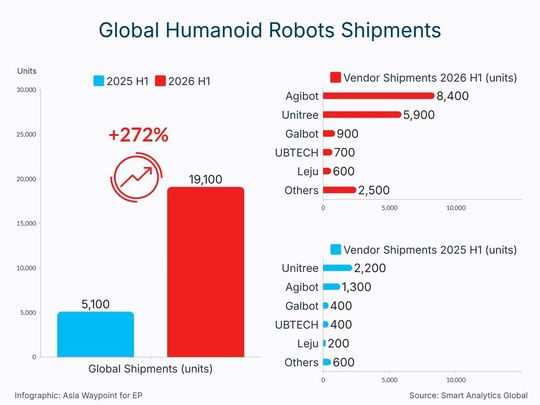
Deliveries of humanoids in the first half of 2025 compared to the first half of 2026.
(Image: Asia Waypoint)
Unitree's revenue more than quadrupled in 2025 to 1.7 billion yuan (around 210 million euros n / $230 million USD). The company is profitable, with an adjusted net profit of around 600 million yuan (around 75 million euros / $82 million USD), a rarity among humanoid start-ups. While the company originated in the robotics dog business, its most significant revenues now come from humanoid robots. From 2023 to 2025, Unitree sold 33,294 quadrupeds and 5,632 humanoids, according to the prospectus. However, the prospectus also warns that widespread commercial adoption remains uncertain.
Unitree has already lost the title of the world's largest provider of humanoids by shipments in 2025. In the first half of 2026, competitor Agibot from Shanghai delivered around 8,400 humanoid robots, a 562 percent increase compared to the same period last year, capturing 44 percent of the global market. Unitree fell to second place with around 5,900 units and 31 percent, according to the market research institute Smart Analytics Global. Agibot benefited from a broader range of products, from bipedal robots to robots on wheels, while Unitree primarily focuses on its G1 model.
Date: 08.12.2025
Naturally, we always handle your personal data responsibly. Any personal data we receive from you is processed in accordance with applicable data protection legislation. For detailed information please see our privacy policy.
Consent to the use of data for promotional purposes
I hereby consent to Vogel Communications Group GmbH & Co. KG, Max-Planck-Str. 7-9, 97082 Würzburg including any affiliated companies according to §§ 15 et seq. AktG (hereafter: Vogel Communications Group) using my e-mail address to send editorial newsletters. A list of all affiliated companies can be found here
Newsletter content may include all products and services of any companies mentioned above, including for example specialist journals and books, events and fairs as well as event-related products and services, print and digital media offers and services such as additional (editorial) newsletters, raffles, lead campaigns, market research both online and offline, specialist webportals and e-learning offers. In case my personal telephone number has also been collected, it may be used for offers of aforementioned products, for services of the companies mentioned above, and market research purposes.
Additionally, my consent also includes the processing of my email address and telephone number for data matching for marketing purposes with select advertising partners such as LinkedIn, Google, and Meta. For this, Vogel Communications Group may transmit said data in hashed form to the advertising partners who then use said data to determine whether I am also a member of the mentioned advertising partner portals. Vogel Communications Group uses this feature for the purposes of re-targeting (up-selling, cross-selling, and customer loyalty), generating so-called look-alike audiences for acquisition of new customers, and as basis for exclusion for on-going advertising campaigns. Further information can be found in section “data matching for marketing purposes”.
In case I access protected data on Internet portals of Vogel Communications Group including any affiliated companies according to §§ 15 et seq. AktG, I need to provide further data in order to register for the access to such content. In return for this free access to editorial content, my data may be used in accordance with this consent for the purposes stated here. This does not apply to data matching for marketing purposes.
Right of revocation
I understand that I can revoke my consent at will. My revocation does not change the lawfulness of data processing that was conducted based on my consent leading up to my revocation. One option to declare my revocation is to use the contact form found at https://contact.vogel.de. In case I no longer wish to receive certain newsletters, I have subscribed to, I can also click on the unsubscribe link included at the end of a newsletter. Further information regarding my right of revocation and the implementation of it as well as the consequences of my revocation can be found in the data protection declaration, section editorial newsletter.
Worldwide, around 19,100 humanoids were delivered in the six months, a 272 percent increase compared to the previous year. More than 97 percent of these came from China. Industrial and commercial customers accounted for over 70 percent of purchases, up from about 50 percent the previous year, according to market researchers. Humanoids are "increasingly being evaluated as production tools rather than exhibition pieces," states a UBS report. Agibot, too, has been preparing for an IPO in Hong Kong since July 2026, reported the South China Morning Post. Company founder Deng Taihua plans to increase revenue from just over one billion yuan last year tenfold by 2027. For now, however, the entire industry awaits Unitree's first trading day. If Unitree indeed achieves a market capitalization of several hundred billion yuan after its stock market debut, it would be a strong signal for the current boom surrounding embodied intelligence. A price below the issue price, on the other hand, would raise doubts about the high expectations.



:quality(80)/p7i.vogel.de/wcms/3e/7c/3e7c26f44c68545fc7318597b6b65903/0133649650v1.jpeg "The flexible Heller circular storage system can store and process pallets measuring both 630 millimeters by 630 millimeters and 800 millimeters by 800 millimeters—even in mixed-mode operation. This makes the entire production line particularly flexible. (Image:Brighter)")
:quality(80)/p7i.vogel.de/wcms/16/29/162983885950ec1df27ab441bfe88613/0133132549v1.jpeg "Bernd Hermeler is the CEO of Cemecon AG. He studied mechanical engineering at RWTH Aachen University (Germany)—the very university from which the company emerged as a spin-off 40 years ago. Today, Hermeler is responsible for the global strategy of the coating specialist, which, with branches in Europe, the U.S., China, Japan, and India, is considered the global technology leader in the coating of cutting tools. (Image: Cemecon AG)")
:quality(80)/p7i.vogel.de/wcms/af/81/af81b53cb4926dcadc20ba369a29d412/0132695968v1.jpeg "International venture capital is increasingly flowing into the machining industry. Here are the players that entrepreneurs and CEOs should keep an eye on right now. (Image: ©NDABCREATIVITY - stock.adobe.com)")
:quality(80)/p7i.vogel.de/wcms/ba/ec/baecd2e3783dee11913096f7d58e1232/bild-1-kammerer-kgt-f-r-elektrozylinder-300dpi-2000px-printv1.jpeg "Kammerer ball screw for use in an electric cylinder (Source: Kammerer)")
:quality(80)/p7i.vogel.de/wcms/c8/d0/c8d0c68a98e4eff417e2bacc58da92b7/aveva-world-media-kitv1.jpeg "Predictive maintenance should not be a matter of plant size or budget, but rather a matter of the proper integration of data collection, analysis, and feedback to operators. (Source: Aveva)")
:quality(80)/p7i.vogel.de/wcms/f2/3b/f23bff6710f706981c703b3110407075/geralt-traffic-signs-663368v1.jpeg "Nearly all of the manufacturing companies surveyed worldwide measure AI outcomes in some form, but only 49 percent rigorously calculate the ROI of AI. (Source: )")
:quality(80)/p7i.vogel.de/wcms/aa/3e/aa3e2603a812f8e7d33c00ba8ae28c9f/0133507886v1.jpeg "With the Iggy Rob, igus is bringing a humanoid robot into factories for a price of 47,999 euros ($54,718). (Image: igus)")
:quality(80)/p7i.vogel.de/wcms/92/64/92645c64ffbb6980976d39102388d120/0113143253v1.jpeg "In our China Market Insider, we regularly provide you with relevant information straight from China. (Image:© Eisenhans - stock.adobe.com)")
:quality(80)/p7i.vogel.de/wcms/9c/16/9c16e4aa02594fe4bf82ead736562b07/directhop1-scaledv1.jpeg "Light as a feather, but without feathers: The University of Washington's robot, which weighs just one gram, uses a bionic direct-drive system to catapult itself into the air with centimeter-level precision. (Source: Mark Stone/University of Washington)")
:quality(80)/p7i.vogel.de/wcms/e7/94/e794290f265afbd0ffc7a06c4fe9d425/adobestock-1887113836--hypnotics-14-stock-adobe-com-ki-generiertv1.jpeg "In both autonomous driving and industrial production, there is growing skepticism as to whether full autonomy is always desirable. (Source: © Hypnotics 14 – stock.adobe.com / AI-generated)")
:quality(80)/p7i.vogel.de/wcms/a8/71/a8712e5c6ef536228444ab5275cedfe2/adobestock-340905887--gorodenkoff-stock-adobe-comv1.jpeg "A new position paper outlines the conditions that the business community, academia, and policymakers must jointly establish in order to ensure the long-term viability of industry in Germany and Europe. (Source: © Gorodenkoff – stock.adobe.com)")
:quality(80)/p7i.vogel.de/wcms/7d/eb/7deb25ca674fa4c781a9d1fab083f7cf/parker-entwicklungszentrum-hresv1.jpeg "The centerpiece of the Parker Center for Drive and Control Technology in Offenbach is the exhibition area. (Source: Parker Hannifin)")
:quality(80)/p7i.vogel.de/wcms/62/22/6222a3ca663580238612c681f0492833/0133698820v1v1.jpeg "After Audi, Volkswagen, and Seat launched a recall due to a steering bolt that was not corrosion-resistant over time, Skoda is now also affected, with nearly two million cars worldwide reportedly involved ... (Image:Skoda)")
:quality(80)/p7i.vogel.de/wcms/8e/3a/8e3ab3a0abfad28bff5c118125846b75/0133699650v1v1.jpeg "Electric car pioneer Tesla has had its ups and downs in recent years. After a boom in orders, sales figures are now falling again, but things are going better than analysts had predicted ... (Image:AI-generated)")
:quality(80)/p7i.vogel.de/wcms/20/ac/20ac36a2fb2151cda6e078dd3aeb62ae/0133645903v1.jpeg "Tesla plans to offer autonomous driving throughout Europe. (Image:Tesla)")
:quality(80)/p7i.vogel.de/wcms/f8/90/f890fc4b08048472b9b4b436a2da442b/ai-catl-sodium-batteries-vs-lithium-revolutionv1.jpeg "CATL has often faced criticism because of its high market share. This time, a government ministry is stepping in—indirectly. (Image:CATL)")
:quality(80)/p7i.vogel.de/wcms/67/3d/673d8f6f14bd030b53b61800a0aeb06d/0133548286v1.jpeg "Overview: If even a single critical component is missing, the entire production process can come to a standstill. Proactive procurement is intended to mitigate such bottlenecks early on. (Image:Dall-E / AI-generated)")
:quality(80)/p7i.vogel.de/wcms/b3/8d/b38d7e914a0a51c24db7e93c8a8420e2/0133672676v1.jpeg "Figure 1: Today, the AT cut is most commonly used for quartz crystals. The double-twisted SC cut further enhances the stability and aging resistance of OCXO oscillators. (Image:Q-Tech)")
:quality(80)/p7i.vogel.de/wcms/40/34/4034915f85470ad8264659267e4f02d0/0133655653v1.jpeg "Cariad, Volkswagen's software subsidiary, continues to struggle. Now, another round of layoffs has been announced, which will result in the loss of many jobs ... (Image:Cariad)")
:quality(80)/p7i.vogel.de/wcms/e4/2a/e42af12e2a0816bb3d25fac9932903e9/0133646920v1.jpeg "TSMC's U.S. headquarters in Arizona: According to various media reports, the world's largest contract semiconductor manufacturer may be planning to build up to six additional fabs in the state of Texas. (Image:TSMC)")
:fill(fff,0)/p7i.vogel.de/companies/69/88/69882c428938e/tmts2026-ticec-banner-en-2000px.png "tmts2026-ticec-banner-en-2000px (https://www.tmts.tw/en)")
:fill(fff,0)/p7i.vogel.de/companies/69/de/69de1b7403b0d/simtos-logo.jpeg "simtos-logo (SIMTOS)")
:quality(80)/p7i.vogel.de/wcms/63/e9/63e9db3259a656cca88c5f7158af3fcb/0129385769v1.jpeg "The Agibot A2 at a Fortune China event in December 2025. (Image:Agibot)")
:quality(80)/p7i.vogel.de/wcms/88/86/88865040dd97ce19eeb5df398eb9f383/0113143253v1.jpeg "In our China Market Insider, we regularly provide you with relevant information straight from China. (Image:© Eisenhans - stock.adobe.com)")
:quality(80)/p7i.vogel.de/wcms/57/d2/57d2b75d884c18866b46e776126fb46b/org-blobs-user-response-file-output-dac07b02-0e97-4452-9a3a-26528da583b3-file-1787126178766-jpgv1.jpeg "The memory manufacturer CXMT has had an extremely successful IPO. Among the investors are several car manufacturers. (Image:KI-generiert)")