Over time, the aging of quartz oscillators causes an irreversible frequency drift and compromises timing accuracy. In precision applications, this effect must be minimized during the manufacturing process.
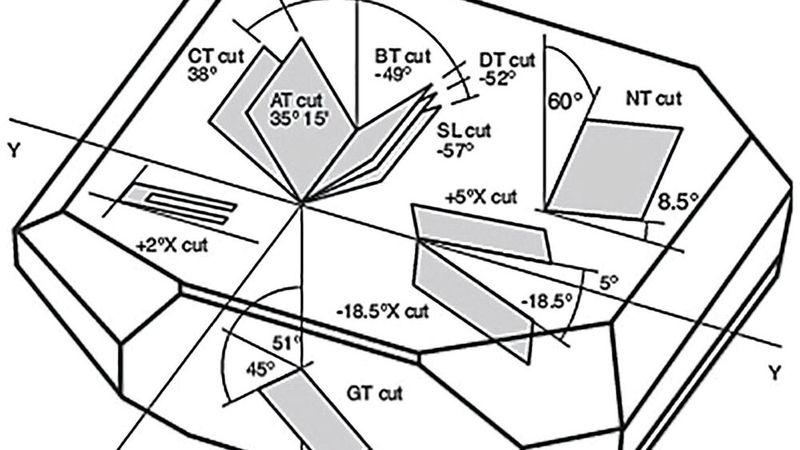
Figure 1: Today, the AT cut is most commonly used for quartz crystals. The double-twisted SC cut further enhances the stability and aging resistance of OCXO oscillators.
(Image: Q-Tech)
Why is the classic high-performance quartz oscillator still the best choice in many applications, given such a wide selection of electronic timing devices? Part of the answer lies in its advantages in high-performance environments where a service call is simply out of the question. Space is one such environment, ranging from low Earth orbit (LEO) to geostationary orbit to deep-space satellites. Another area is high-temperature applications, such as drilling.
Other areas where quartz time-keeping devices are the better choice include military and avionics applications, such as missile guidance and navigation systems, where temperature and frequency stability are of critical importance. Quartz oscillators are also a good choice for high-resolution video displays, where anything less than outstanding performance is clearly visible. Another area where quartz oscillators are used is in the control of high-frequency field-programmable gate arrays (FPGAs). In these applications, the lower jitter of quartz oscillators results in wider eye diagrams and lower bit error rates (BER). Another area is high-speed A/D converters, where the lower jitter of quartz oscillators leads to lower phase noise.
In all of these applications, nothing currently known will ever match the quality factor, spectral purity, and stability of quartz. Nevertheless, it is important to recognize and take into account the intrinsic aging effects of quartz oscillators on timing performance.
Causes and Effects of Aging in Quartz Oscillators
Aging processes in quartz oscillators directly affect timing applications by causing a gradual and irreversible deviation in the oscillator’s output frequency over time. Particularly in precision timing applications that require radiation tolerance, low noise and jitter, and/or operation at high temperatures, exceptional measures must be taken during the manufacturing process to minimize the effects of aging.
Aging refers to the gradual change in the output frequency of a quartz oscillator over time. This phenomenon is primarily due to physical and chemical changes within the quartz crystal and its environment. This drift, which is typically measured in either parts per million (ppm) or parts per billion (ppb) per year, can cause significant problems in applications that require precise and stable time references.
There are many causes of aging in quartz crystals. Two of the most important by far are mass loading and stress changes.
Mass loading refers to subtle changes in the mass of the quartz element due to the absorption or desorption of impurities on the crystal surface, which alter its mass and, consequently, its resonant frequency. Quartz crystals are processed in cleanrooms and sealed in very clean environments, either in a vacuum or in a non-reactive, inert nitrogen-helium atmosphere. Nevertheless, a certain amount of unwanted material always remains. Typically, this consists of a very small amount of water vapor, which can, however, lead to significant changes in stress, resulting in frequency drift.
Stress Changes—Even though great efforts are made to minimize the mechanical stress on the crystal, a certain amount of residual mechanical stress always remains. This is particularly true when the quartz element is mounted to its housing and within the oscillator circuit. This mounting structure typically consists of a metal strip with very low stress, which is bonded to the quartz using an epoxy resin or adhesive with very low outgassing. Nevertheless, over time, certain changes in the stress caused by this configuration will affect the quartz resonator and its frequency. Second, changes in the internal stresses within the crystal’s metal electrodes and even within the quartz itself may occur.
While mass loading and voltage changes are the main causes of aging in quartz oscillators, there are other causes as well, including outgassing, diffusion effects, chemical reactions, pressure changes, and the aging of the oscillator circuit (particularly changes in load reactance and drive level).
Date: 08.12.2025
Naturally, we always handle your personal data responsibly. Any personal data we receive from you is processed in accordance with applicable data protection legislation. For detailed information please see our privacy policy.
Consent to the use of data for promotional purposes
I hereby consent to Vogel Communications Group GmbH & Co. KG, Max-Planck-Str. 7-9, 97082 Würzburg including any affiliated companies according to §§ 15 et seq. AktG (hereafter: Vogel Communications Group) using my e-mail address to send editorial newsletters. A list of all affiliated companies can be found here
Newsletter content may include all products and services of any companies mentioned above, including for example specialist journals and books, events and fairs as well as event-related products and services, print and digital media offers and services such as additional (editorial) newsletters, raffles, lead campaigns, market research both online and offline, specialist webportals and e-learning offers. In case my personal telephone number has also been collected, it may be used for offers of aforementioned products, for services of the companies mentioned above, and market research purposes.
Additionally, my consent also includes the processing of my email address and telephone number for data matching for marketing purposes with select advertising partners such as LinkedIn, Google, and Meta. For this, Vogel Communications Group may transmit said data in hashed form to the advertising partners who then use said data to determine whether I am also a member of the mentioned advertising partner portals. Vogel Communications Group uses this feature for the purposes of re-targeting (up-selling, cross-selling, and customer loyalty), generating so-called look-alike audiences for acquisition of new customers, and as basis for exclusion for on-going advertising campaigns. Further information can be found in section “data matching for marketing purposes”.
In case I access protected data on Internet portals of Vogel Communications Group including any affiliated companies according to §§ 15 et seq. AktG, I need to provide further data in order to register for the access to such content. In return for this free access to editorial content, my data may be used in accordance with this consent for the purposes stated here. This does not apply to data matching for marketing purposes.
Right of revocation
I understand that I can revoke my consent at will. My revocation does not change the lawfulness of data processing that was conducted based on my consent leading up to my revocation. One option to declare my revocation is to use the contact form found at https://contact.vogel.de. In case I no longer wish to receive certain newsletters, I have subscribed to, I can also click on the unsubscribe link included at the end of a newsletter. Further information regarding my right of revocation and the implementation of it as well as the consequences of my revocation can be found in the data protection declaration, section editorial newsletter.
Key Effects of Aging on Time-Measurement Applications
Frequency drift: As an oscillator ages, its frequency may increase or decrease, causing the system clock to run slightly faster or slower than intended. This is particularly problematic in systems where even minor deviations can accumulate over hours, days, or years to result in significant time errors.
Holdover Performance: In critical timing systems—such as satellites, network infrastructures, and measuring instruments—oscillators often serve as backup clocks when external references (such as GPS) are unavailable. During this holdover period, the local oscillator must maintain accurate timing. Frequency drifts caused by aging can compromise the accuracy of time transfer and lead to synchronization errors in networks or data loss in time-critical applications.
Long-term reliability: During prolonged operation, the cumulative effect of aging can cause the oscillator's frequency to fall outside the limits acceptable for the application, requiring recalibration, replacement, or compensation mechanisms.
Environmental sensitivity: Aging effects can be exacerbated by environmental factors such as temperature fluctuations and power outages, which further destabilize time measurement.
Strategies for Minimizing Age-Related Risks
Strategies for minimizing risk include the use of oscillators with inherently low aging rates, the implementation of compensation algorithms, and the development of systems that allow for recalibration or redundancy in time sources.
Cleanliness and contamination control during processing are of the utmost importance for the production of quartz crystals with very low aging. Next, the quartz resonator must be sealed in an extremely hermetic environment, either in a resistance-welded or, even better, cold-welded housing. In addition, prolonged annealing at high temperatures can accelerate initial frequency shifts.
Another approach is pre-aging. Before shipment, precision crystals are often “pre-aged” at the factory to accelerate the initial rapid aging phase. This ensures that the oscillator reaches its specified aging rate more quickly during operation. High-quality SC-cut quartz crystals (stress-compensated) or AT-cut are selected for their superior long-term stability and lower intrinsic aging rates, with SC-cut crystals offering better aging behavior in quartz oscillators than the AT-cut types typically used (Figure 1).
The aging process of quartz crystals slows down and stabilizes over time, with more changes observed in the first few months and years than in subsequent periods. For example, in standard quartz oscillators, where the quartz resonator is housed in the same environment as the rest of the oscillator circuit, the typical aging rate may be ±1 to ±5 ppm in the first year and ±0.5 to ±2 ppm in subsequent years.
The military standard specification MIL-PRF-55310 (and its predecessor, MIL-O-55310), specifies the aging of quartz oscillators in detail and requires a 30-day aging test at an elevated temperature of at least 70 °C (158 °F), with strictly defined limits for permissible frequency change. In addition, the military specifications include mathematical equations that can be used to extrapolate data from 30 days of aging to predict the most unfavorable aging behavior over longer periods. At Q-Tech and Axtal, quartz oscillators intended for use in time-critical applications are tested for compliance with the MIL-PRF-55310 standard.
In timing applications that require even better performance, the quartz resonator is enclosed in its own separate hermetic environment, typically in a cold-welded (ColdWeld, CW) housing. Cold welding is a solid-state welding process in which the joint is formed at the interface of the two parts to be welded without melting or heating.
Unlike in fusion welding, there is no liquid or molten phase present in the joint. The low amount of heat input minimizes outgassing. With this type of quartz crystal, TCXOs (temperature-compensated XOs) can achieve typical aging rates of ±0.2 to ±1 ppm in the first year, and ±0.1 to ±0.5 ppm—or even better values—in subsequent years. For highly stable OCXOs, aging rates of ±0.03 to ±0.1 ppm are achieved in the first year and ±0.05 ppm or better thereafter.
The aging of quartz oscillators cannot be completely prevented, but it can be significantly reduced through appropriate design and controlled manufacturing processes. Key factors include low contamination, hermetic sealing of the resonator, low-stress fastenings, as well as tempering and pre-aging. For precision applications, these measures ensure low frequency drift and high long-term stability.
*Ron Stephens is the former president of Q-Tech Corporation.



:quality(80)/p7i.vogel.de/wcms/ba/ec/baecd2e3783dee11913096f7d58e1232/bild-1-kammerer-kgt-f-r-elektrozylinder-300dpi-2000px-printv1.jpeg "Kammerer ball screw for use in an electric cylinder (Source: Kammerer)")
:quality(80)/p7i.vogel.de/wcms/51/1b/511b420dbcc296aec09e3bffb051b8a8/0133581587v1.jpeg "The cables connect numerous machine components—often in confined spaces. (Image:Helu)")
:quality(80)/p7i.vogel.de/wcms/b5/67/b5676f3bfb36251ed31f9a0cccf650b6/0133167827v1.jpeg "Thanks to JumboFlex Generation 2, employees can effortlessly move wheelchairs weighing as much as 40 kilograms. (Image:Lard)")
:quality(80)/p7i.vogel.de/wcms/5e/c6/5ec615b7a51440f668259f2af9158cb9/0132654694v1.jpeg "Strategic Partnerships in Industry: As buyers and restructuring partners, Chinese investors are increasingly helping to preserve jobs in Germany. (Image: ©Anatolii Rymarchuk - stock.adobe.com)")
:quality(80)/p7i.vogel.de/wcms/aa/3e/aa3e2603a812f8e7d33c00ba8ae28c9f/0133507886v1.jpeg "With the Iggy Rob, igus is bringing a humanoid robot into factories for a price of 47,999 euros ($54,718). (Image: igus)")
:quality(80)/p7i.vogel.de/wcms/92/64/92645c64ffbb6980976d39102388d120/0113143253v1.jpeg "In our China Market Insider, we regularly provide you with relevant information straight from China. (Image:© Eisenhans - stock.adobe.com)")
:quality(80)/p7i.vogel.de/wcms/c7/05/c70542511e0824ee491f7b55e21fa429/0133598424v1.jpeg "In logistics, AI is often implemented only on a case-by-case basis; data is stored in separate systems, and inventory levels, status values, and priorities are not defined consistently. (Image: ©m-project - stock.adobe.com)")
:quality(80)/p7i.vogel.de/wcms/3a/9c/3a9c1fd546e1f041b86bb1d03cf39101/0133610524v1.jpeg "The Mason W-01 combines industrial-grade humanoid hardware, Physical AI-based perception, and autonomous task planning. (Image:Nova X Robotics)")
:quality(80)/p7i.vogel.de/wcms/9c/16/9c16e4aa02594fe4bf82ead736562b07/directhop1-scaledv1.jpeg "Light as a feather, but without feathers: The University of Washington's robot, which weighs just one gram, uses a bionic direct-drive system to catapult itself into the air with centimeter-level precision. (Source: Mark Stone/University of Washington)")
:quality(80)/p7i.vogel.de/wcms/e7/94/e794290f265afbd0ffc7a06c4fe9d425/adobestock-1887113836--hypnotics-14-stock-adobe-com-ki-generiertv1.jpeg "In both autonomous driving and industrial production, there is growing skepticism as to whether full autonomy is always desirable. (Source: © Hypnotics 14 – stock.adobe.com / AI-generated)")
:quality(80)/p7i.vogel.de/wcms/a8/71/a8712e5c6ef536228444ab5275cedfe2/adobestock-340905887--gorodenkoff-stock-adobe-comv1.jpeg "A new position paper outlines the conditions that the business community, academia, and policymakers must jointly establish in order to ensure the long-term viability of industry in Germany and Europe. (Source: © Gorodenkoff – stock.adobe.com)")
:quality(80)/p7i.vogel.de/wcms/7d/eb/7deb25ca674fa4c781a9d1fab083f7cf/parker-entwicklungszentrum-hresv1.jpeg "The centerpiece of the Parker Center for Drive and Control Technology in Offenbach is the exhibition area. (Source: Parker Hannifin)")
:quality(80)/p7i.vogel.de/wcms/78/ab/78abbfbab0565fabb19efe637aea30e8/nio-power-swap-station-4-china-guangzhou-2024-1400x933-jpgv1.webp "Nio and Geely are collaborating on battery replacement for electric cars. (Source: Nio)")
:quality(80)/p7i.vogel.de/wcms/2e/58/2e58c664e733dd182666606f850c5da4/0133400664v1.jpeg "The IM6 is sort of the crossover version of the IM5. (Image:MG Motor)")
:quality(80)/p7i.vogel.de/wcms/40/5f/405f41f4075e8798878011f0932a8195/0133509065v1.jpeg "Caruso has integrated Hyundai into its platform. (Image:Hyundai)")
:quality(80)/p7i.vogel.de/wcms/06/98/06989beb3f95b8fb06d71190c86cffde/tabletv1.jpeg "The cockpit view during a test drive in the simulator. (Source: Uccello et al., IEEE OJITS 2026)")
:quality(80)/p7i.vogel.de/wcms/67/3d/673d8f6f14bd030b53b61800a0aeb06d/0133548286v1.jpeg "Overview: If even a single critical component is missing, the entire production process can come to a standstill. Proactive procurement is intended to mitigate such bottlenecks early on. (Image:Dall-E / AI-generated)")
:quality(80)/p7i.vogel.de/wcms/b3/8d/b38d7e914a0a51c24db7e93c8a8420e2/0133672676v1.jpeg "Figure 1: Today, the AT cut is most commonly used for quartz crystals. The double-twisted SC cut further enhances the stability and aging resistance of OCXO oscillators. (Image:Q-Tech)")
:quality(80)/p7i.vogel.de/wcms/40/34/4034915f85470ad8264659267e4f02d0/0133655653v1.jpeg "Cariad, Volkswagen's software subsidiary, continues to struggle. Now, another round of layoffs has been announced, which will result in the loss of many jobs ... (Image:Cariad)")
:quality(80)/p7i.vogel.de/wcms/e4/2a/e42af12e2a0816bb3d25fac9932903e9/0133646920v1.jpeg "TSMC's U.S. headquarters in Arizona: According to various media reports, the world's largest contract semiconductor manufacturer may be planning to build up to six additional fabs in the state of Texas. (Image:TSMC)")
:fill(fff,0)/images.vogel.de/vogelonline/companyimg/76800/76895/65.jpg "FAULHABER_120mm.jpg ()")
:quality(80)/p7i.vogel.de/wcms/52/7d/527dd0b214b2312f369b0ed05d6423c2/0132794981v1.jpeg "The future of sensor technology lies in atomic physics: This illustration shows a micromechanically fabricated glass vapor cell in which trapped atoms serve as a high-precision reference for measuring high-frequency electric fields. (Image:Jennifer M. McCann / Penn State)")
:quality(80)/p7i.vogel.de/wcms/8d/f9/8df95d3f58408673986b3d643e6b63ba/0133252773v1.jpeg "TXC targets high-speed optical links in AI data centers with 312.5 MHz oscillators, among other solutions. As data rates increase, requirements for jitter and frequency stability become more demanding as well. (Bild: TXC)")