When should you use a hydraulic cylinder, and when should you use a lead screw? This question can only be answered by looking at the entire axis.
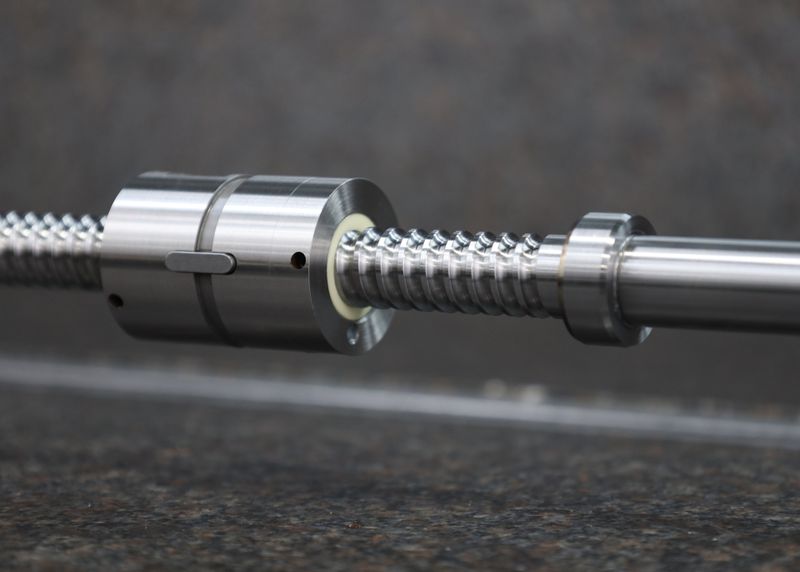
Kammerer ball screw for use in an electric cylinder
(Source: Kammerer)
The question of whether a hydraulic or an electromechanical drive is the better choice is now being asked more frequently in the design process. The reasons for this include increasing demands for energy efficiency, low-maintenance operation, and positioning accuracy, combined with servo drive technology that has become significantly more powerful and cost-effective in recent years.
Compare Properly: Systems, Not Components
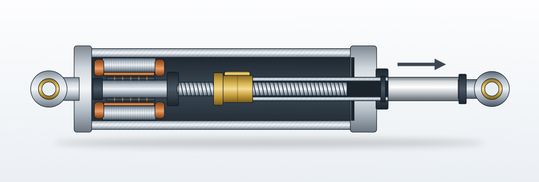
Schematic representation of an electric cylinder with a threaded drive
(Source: Kammerer)
Whether a ball screw can replace a hydraulic cylinder depends on the specific application and the load profile. A meaningful comparison begins with the system boundaries. After all, simply comparing a hydraulic cylinder to an electric cylinder amounts to comparing the smallest component of two very different systems. Only by considering the entire axis can energy consumption, installation space, maintenance requirements, and investment costs be meaningfully compared. At the heart of the electromechanical axis is the lead screw: It converts the motor’s rotation into linear motion and thus determines the efficiency, stiffness, positioning accuracy, and service life of the entire axis.
Efficiency and Energy Consumption
A precision-machined ball screw operates on rolling friction and typically achieves an efficiency of over 90 percent. A trapezoidal lead screw operates on sliding friction and, depending on the pitch and material pairing, has a significantly lower efficiency; however, it is self-locking at smaller pitches and holds the load without an energy supply.
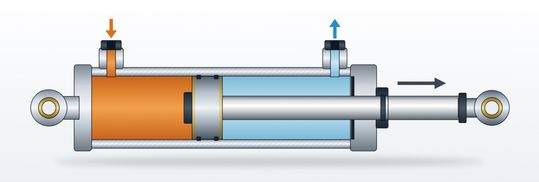
Schematic representation of a hydraulic cylinder
(Source: Kammerer / KI-generiert)
Hydraulic systems lose energy in several places at once: due to pump efficiency, throttling losses, leakage, and heat dissipation. In addition, many power units run continuously for response time reasons, even when the axle is at a standstill. The greater the proportion of downtime and partial-load operation, the greater the advantage of electromechanical systems.
When Hydraulic Cylinders Are the Right Choice
Hydraulic linear actuators remain the top choice in many applications. The following points are important when making design decisions:
Very high peak forces with a short duty cycle: Hydraulics generate force through surface area and pressure, almost independently of time. A lead screw must transmit the same force via rolling contacts and the nut. Installation space and costs increase accordingly.
Shock and overload conditions: Oil is compressible enough to absorb load spikes; pressure relief valves limit the force as an inherent feature of the system. A screw drive, on the other hand, requires a safety clutch, torque limiter, or a design with a margin above the static load capacity.
Long holding periods under full load: Without a self-locking mechanism or holding brake, an electromechanical drive shaft holds the load—which is energetically and thermally inefficient—solely through motor torque.
Harsh environments, high temperatures, vibrations: A cylinder can withstand conditions in which the motor, controller, and encoder require additional protective measures.
Existing infrastructure: If the generator is already in place and supplying power to other axes, the cost-benefit analysis changes significantly.
What Electromechanics Does Better
Screw drives, as drive elements, offer the following advantages:
Positioning Instead of Moving: Any intermediate position can be reached, is repeatable, and can be defined without mechanical stops.
Force-Displacement Control: Joining, Pressing, Testing—Force and precision can be controlled simultaneously and documented as process data.
Process Monitoring: Motor current and torque are process variables that can be measured directly. Condition monitoring is performed without the need for additional sensors.
Cleanliness: No leaks, no hydraulic fluid. Electromechanical systems can be advantageous in medical technology, food production, and cleanroom environments.
Estimated Service Life: The service life of a rolling-element system can be estimated mathematically based on the load rating and load profile.
The Transition Should Not Be Underestimated
A hydraulic cylinder cannot be replaced one-to-one with an electromechanical axis. Anyone making the switch must redesign the axis. These questions determine the outcome: What does the actual load profile look like? What is the duty cycle? How does the peak load relate to the static load rating? How long is the stroke? How is the load held in place when the system is at rest? What disturbances affect the axis? Does the connection geometry fit?
Once these questions have been clarified, the actual design work begins. The screw drive determines not only the force-displacement characteristics of the drive, but also its efficiency, service life, self-locking behavior, and achievable accuracy.
When high demands are placed on positioning accuracy, dynamics, and energy efficiency, the ball screw is the preferred drive element. Efficiency levels of up to 96 percent make it possible to move heavy payloads using small motors. Typical applications include machine tools, presses and forming machines, automated material handling, and medical technology.
The trapezoidal thread drive has lower efficiency and is self-locking when the pitch is sufficiently shallow. Trapezoidal thread drives are more robust under transverse loads, less expensive to purchase, and less sensitive to dirt and contamination. Typical applications include lifting systems with a holding function, actuators, or feed units that do not require high dynamic performance.
When is it Worth Switching from Hydraulics to Electromechanics?
The question of cost-effectiveness depends on the application. Based on the technical parameters, the following decision-making criteria can be identified:
Electromechanical systems are often preferable when positioning accuracy is less than 0.5 mm or reproducible force-displacement profiles are required; operation takes place in hygienically sensitive environments; low energy consumption over the life cycle is critical; flexibility is required for recipe changes or parameterization; or leak prevention is relevant from a design or regulatory perspective.
Date: 08.12.2025
Naturally, we always handle your personal data responsibly. Any personal data we receive from you is processed in accordance with applicable data protection legislation. For detailed information please see our privacy policy.
Consent to the use of data for promotional purposes
I hereby consent to Vogel Communications Group GmbH & Co. KG, Max-Planck-Str. 7-9, 97082 Würzburg including any affiliated companies according to §§ 15 et seq. AktG (hereafter: Vogel Communications Group) using my e-mail address to send editorial newsletters. A list of all affiliated companies can be found here
Newsletter content may include all products and services of any companies mentioned above, including for example specialist journals and books, events and fairs as well as event-related products and services, print and digital media offers and services such as additional (editorial) newsletters, raffles, lead campaigns, market research both online and offline, specialist webportals and e-learning offers. In case my personal telephone number has also been collected, it may be used for offers of aforementioned products, for services of the companies mentioned above, and market research purposes.
Additionally, my consent also includes the processing of my email address and telephone number for data matching for marketing purposes with select advertising partners such as LinkedIn, Google, and Meta. For this, Vogel Communications Group may transmit said data in hashed form to the advertising partners who then use said data to determine whether I am also a member of the mentioned advertising partner portals. Vogel Communications Group uses this feature for the purposes of re-targeting (up-selling, cross-selling, and customer loyalty), generating so-called look-alike audiences for acquisition of new customers, and as basis for exclusion for on-going advertising campaigns. Further information can be found in section “data matching for marketing purposes”.
In case I access protected data on Internet portals of Vogel Communications Group including any affiliated companies according to §§ 15 et seq. AktG, I need to provide further data in order to register for the access to such content. In return for this free access to editorial content, my data may be used in accordance with this consent for the purposes stated here. This does not apply to data matching for marketing purposes.
Right of revocation
I understand that I can revoke my consent at will. My revocation does not change the lawfulness of data processing that was conducted based on my consent leading up to my revocation. One option to declare my revocation is to use the contact form found at https://contact.vogel.de. In case I no longer wish to receive certain newsletters, I have subscribed to, I can also click on the unsubscribe link included at the end of a newsletter. Further information regarding my right of revocation and the implementation of it as well as the consequences of my revocation can be found in the data protection declaration, section editorial newsletter.
Hydraulics remain the better choice when very high forces must be applied within a very small installation space; when sudden load spikes or pressure surges are expected; when the budget for drive technology is strictly limited; and when positioning accuracy is not a critical factor.
Summary
The question is which application benefits from which principle. Hydraulics remains superior in applications where maximum power density, shock resistance, and ruggedness are the deciding factors. However, where positioning accuracy, energy efficiency, process data, and cleanliness are important, the electromechanical axis with a well-designed lead screw is the more cost-effective solution.



:quality(80)/p7i.vogel.de/wcms/ba/ec/baecd2e3783dee11913096f7d58e1232/bild-1-kammerer-kgt-f-r-elektrozylinder-300dpi-2000px-printv1.jpeg "Kammerer ball screw for use in an electric cylinder (Source: Kammerer)")
:quality(80)/p7i.vogel.de/wcms/51/1b/511b420dbcc296aec09e3bffb051b8a8/0133581587v1.jpeg "The cables connect numerous machine components—often in confined spaces. (Image:Helu)")
:quality(80)/p7i.vogel.de/wcms/b5/67/b5676f3bfb36251ed31f9a0cccf650b6/0133167827v1.jpeg "Thanks to JumboFlex Generation 2, employees can effortlessly move wheelchairs weighing as much as 40 kilograms. (Image:Lard)")
:quality(80)/p7i.vogel.de/wcms/5e/c6/5ec615b7a51440f668259f2af9158cb9/0132654694v1.jpeg "Strategic Partnerships in Industry: As buyers and restructuring partners, Chinese investors are increasingly helping to preserve jobs in Germany. (Image: ©Anatolii Rymarchuk - stock.adobe.com)")
:quality(80)/p7i.vogel.de/wcms/aa/3e/aa3e2603a812f8e7d33c00ba8ae28c9f/0133507886v1.jpeg "With the Iggy Rob, igus is bringing a humanoid robot into factories for a price of 47,999 euros ($54,718). (Image: igus)")
:quality(80)/p7i.vogel.de/wcms/92/64/92645c64ffbb6980976d39102388d120/0113143253v1.jpeg "In our China Market Insider, we regularly provide you with relevant information straight from China. (Image:© Eisenhans - stock.adobe.com)")
:quality(80)/p7i.vogel.de/wcms/c7/05/c70542511e0824ee491f7b55e21fa429/0133598424v1.jpeg "In logistics, AI is often implemented only on a case-by-case basis; data is stored in separate systems, and inventory levels, status values, and priorities are not defined consistently. (Image: ©m-project - stock.adobe.com)")
:quality(80)/p7i.vogel.de/wcms/3a/9c/3a9c1fd546e1f041b86bb1d03cf39101/0133610524v1.jpeg "The Mason W-01 combines industrial-grade humanoid hardware, Physical AI-based perception, and autonomous task planning. (Image:Nova X Robotics)")
:quality(80)/p7i.vogel.de/wcms/9c/16/9c16e4aa02594fe4bf82ead736562b07/directhop1-scaledv1.jpeg "Light as a feather, but without feathers: The University of Washington's robot, which weighs just one gram, uses a bionic direct-drive system to catapult itself into the air with centimeter-level precision. (Source: Mark Stone/University of Washington)")
:quality(80)/p7i.vogel.de/wcms/e7/94/e794290f265afbd0ffc7a06c4fe9d425/adobestock-1887113836--hypnotics-14-stock-adobe-com-ki-generiertv1.jpeg "In both autonomous driving and industrial production, there is growing skepticism as to whether full autonomy is always desirable. (Source: © Hypnotics 14 – stock.adobe.com / AI-generated)")
:quality(80)/p7i.vogel.de/wcms/a8/71/a8712e5c6ef536228444ab5275cedfe2/adobestock-340905887--gorodenkoff-stock-adobe-comv1.jpeg "A new position paper outlines the conditions that the business community, academia, and policymakers must jointly establish in order to ensure the long-term viability of industry in Germany and Europe. (Source: © Gorodenkoff – stock.adobe.com)")
:quality(80)/p7i.vogel.de/wcms/7d/eb/7deb25ca674fa4c781a9d1fab083f7cf/parker-entwicklungszentrum-hresv1.jpeg "The centerpiece of the Parker Center for Drive and Control Technology in Offenbach is the exhibition area. (Source: Parker Hannifin)")
:quality(80)/p7i.vogel.de/wcms/78/ab/78abbfbab0565fabb19efe637aea30e8/nio-power-swap-station-4-china-guangzhou-2024-1400x933-jpgv1.webp "Nio and Geely are collaborating on battery replacement for electric cars. (Source: Nio)")
:quality(80)/p7i.vogel.de/wcms/2e/58/2e58c664e733dd182666606f850c5da4/0133400664v1.jpeg "The IM6 is sort of the crossover version of the IM5. (Image:MG Motor)")
:quality(80)/p7i.vogel.de/wcms/40/5f/405f41f4075e8798878011f0932a8195/0133509065v1.jpeg "Caruso has integrated Hyundai into its platform. (Image:Hyundai)")
:quality(80)/p7i.vogel.de/wcms/06/98/06989beb3f95b8fb06d71190c86cffde/tabletv1.jpeg "The cockpit view during a test drive in the simulator. (Source: Uccello et al., IEEE OJITS 2026)")
:quality(80)/p7i.vogel.de/wcms/67/3d/673d8f6f14bd030b53b61800a0aeb06d/0133548286v1.jpeg "Overview: If even a single critical component is missing, the entire production process can come to a standstill. Proactive procurement is intended to mitigate such bottlenecks early on. (Image:Dall-E / AI-generated)")
:quality(80)/p7i.vogel.de/wcms/b3/8d/b38d7e914a0a51c24db7e93c8a8420e2/0133672676v1.jpeg "Figure 1: Today, the AT cut is most commonly used for quartz crystals. The double-twisted SC cut further enhances the stability and aging resistance of OCXO oscillators. (Image:Q-Tech)")
:quality(80)/p7i.vogel.de/wcms/40/34/4034915f85470ad8264659267e4f02d0/0133655653v1.jpeg "Cariad, Volkswagen's software subsidiary, continues to struggle. Now, another round of layoffs has been announced, which will result in the loss of many jobs ... (Image:Cariad)")
:quality(80)/p7i.vogel.de/wcms/e4/2a/e42af12e2a0816bb3d25fac9932903e9/0133646920v1.jpeg "TSMC's U.S. headquarters in Arizona: According to various media reports, the world's largest contract semiconductor manufacturer may be planning to build up to six additional fabs in the state of Texas. (Image:TSMC)")
:fill(fff,0)/images.vogel.de/vogelonline/companyimg/76800/76895/65.jpg "FAULHABER_120mm.jpg ()")
:fill(fff,0)/p7i.vogel.de/companies/69/88/69882c428938e/tmts2026-ticec-banner-en-2000px.png "tmts2026-ticec-banner-en-2000px (https://www.tmts.tw/en)")
:quality(80)/p7i.vogel.de/wcms/dd/92/dd928ba2e2956aa2bfff4888af8b08f8/photo--1v1.jpeg "Catalog product for extreme operating conditions: The new NRTVG guide carriage from Bosch Rexroth withstands extreme environmental conditions. (Source: Bosch Rexroth AG)")
:quality(80)/p7i.vogel.de/wcms/3f/32/3f3272843333b0e8215db84152362ba8/0132070616v1.jpeg "Linear guides combined with other components form complex systems for automation. (Image:IEF-Werner)")
:quality(80)/p7i.vogel.de/wcms/0f/56/0f566d957a53b5bdda658d3bcef90486/0127131321v1.jpeg "Modern injection molding machines come with either electric or hydraulic actuators, depending on the application. (Image: ©TongTa - stock.adobe.com)")