
















New GPU for AI and HPC Intel Challenges Nvidia Blackwell with the D270 GPU
Intel is bringing AI inference and scientific computing together with the D270 GPU. In its own benchmarks, the card outperforms Nvidia’s RTX Pro 6000 Blackwell by almost sixfold. Intel has also released new details about Diamond Rapids.
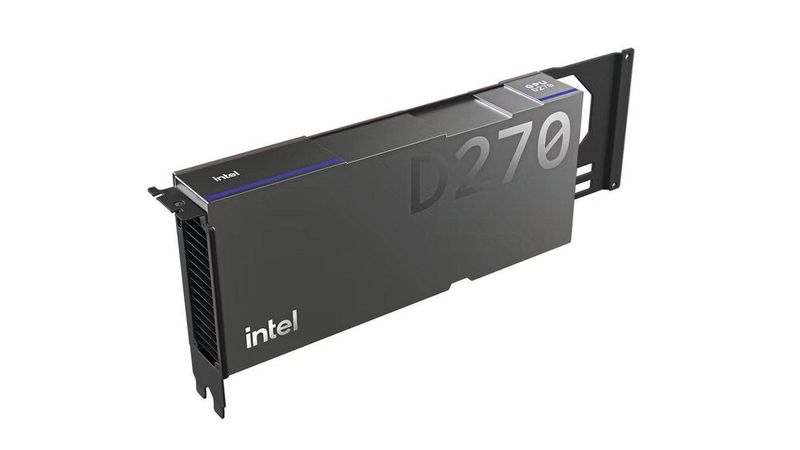
Scientific applications are increasingly combining simulations, data analysis, and AI into shared workflows. Intel wants to combine CPUs and specialized accelerators for this. At the center of Supercomputing 2026 (SC26) in Chicago is the GPU D270, which previously carried the codename Crescent Island.
The card is primarily designed for AI inference, but it also supports double-precision (FP64) calculations. According to Intel, this makes it suitable for selected simulations and financial models. At the trade show, the company wants to demonstrate how the GPU can be used with Xeon processors and accelerators from Sambanova.
160 GB of Memory and FP64 Computing Performance
The D270 is based on the Xe3P architecture and features 32 Xe cores as well as 256 XMX units for matrix computations. Intel’s own PCIe card offers 160 GB of LPDDR5X memory with 1.5 TB/s bandwidth. Partners can develop variants with up to 480 GB. The air-cooled design is rated for 350 watts.
The large memory is intended to reduce data transfers between the GPU and the host because more models and datasets can remain on the card directly. In Intel tests with pre-production hardware, the D270 achieved 1.92 to 5.9 times the throughput of an Nvidia RTX Pro 6000 Blackwell Server Edition in selected financial applications. The comparison applies only to the applications and systems tested.
In a seismic MiniMod test with one billion grid points, Intel says the D270 processed 45.91 billion grid points per second. An Intel Arc Pro B70 achieved 22.52 billion. Both results are manufacturer-provided measurements, not independent tests.
AI Inference Distributed Across Multiple Processors
At SC26, Intel plans to demonstrate a split AI inference setup with SambaNova: the D270 processes the model input (prefill), while SambaNova’s SN50 accelerators generate the output (decode). Xeon 6 and Xeon 6+ processors coordinate the workflows. This could enable AI agents to initiate simulations and evaluate results without replacing the physical calculations themselves.
Independently of this, Intel is providing details on the upcoming Xeon generation, Diamond Rapids: up to 256 performance cores, 1.6 TB/s memory bandwidth, and 1.28 GB of last-level cache. The architecture supports APX, AVX 10.2, and advanced matrix instructions (AMX). Intel also plans to further develop its MPI libraries, Fortran compiler, and oneAPI to keep existing HPC code usable on new hardware. (mc)