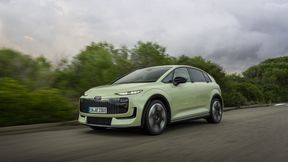
Omoda will expand its range in spring 2027 with the Omoda 4. The crossover will be available as a hybrid and an electric car. It was developed largely at Chery’s European development center in Raunheim near Frankfurt (Germany).
Omoda will expand its lineup in spring 2027 with the Omoda 4.
(Image: Omoda)
Driving through the megacity of Wuhu with its millions of inhabitants is a leisurely affair. The three-lane road has a 60 km/h (approx. 37 mph) speed limit, but the traffic is too dense to go that fast. At this pace, it is difficult to assess the suspension.
Fortunately, the engineers set up a cone course on the factory grounds. As known from the moose test, you accelerate the car and then swerve to avoid an obstacle. This is where the Omoda 4 can shine. Without too much body roll, it changes lanes.
The crossover model uses Chery’s T1X platform, just like the Omoda 5 and 7. In addition, Chery engineers have worked on it at the German development center in Raunheim near Frankfurt. They know the preferences of German drivers and have adjusted the suspension and steering accordingly.
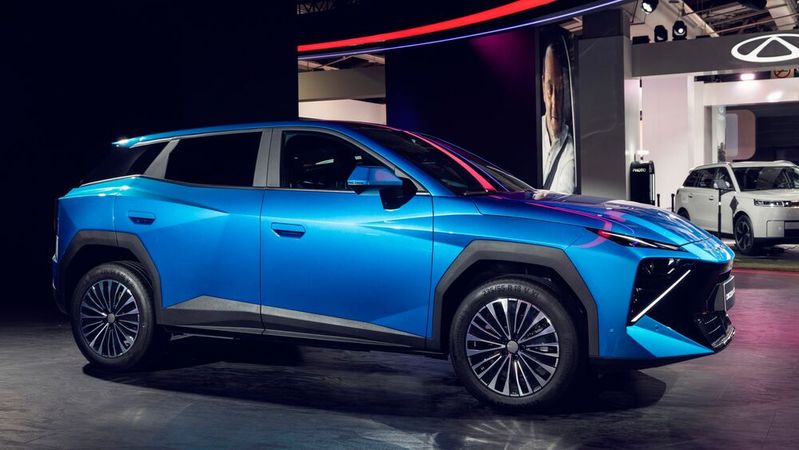
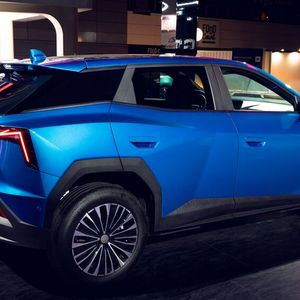
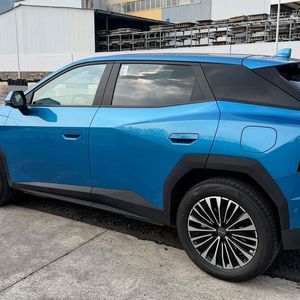
Outwardly, the Omoda 4 looks wild. It is aimed at a young audience. The car is meant to have a somewhat futuristic feel. The designers call their work “Cyber Mecha.” Mecha stands for mechanical. The inspiration comes from large walking robots from science-fiction films and comics that are controlled from the inside by humans. With the recent presentation of the off-road version Omoda X, the brand has taken the mecha concept a step further.
Practical Everyday Car
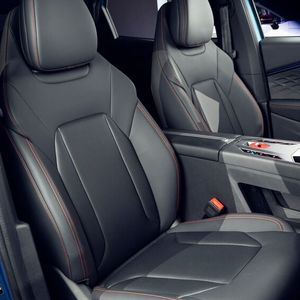
As a driver, you get the impression of sitting in a sports car. That starts with flipping open the red cover over the start button. But when accelerating from a standstill to 100 km/h (approx. 62 mph), the 8.1 seconds remind you that the Omoda is really more of a practical everyday car. The test car has a full-hybrid drivetrain with two electric motors and a 1.5-liter turbo gasoline engine. The purely electric version is a touch quicker at 7.9 seconds. In return, the hybrid version is allowed to accelerate up to 180 km/h (approx. 112 mph), while the EV tops out at 172 km/h (approx. 107 mph).
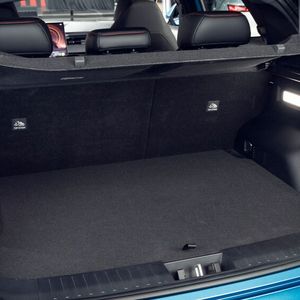
While driving through Wuhu, where the parent company Chery is headquartered, the question arises as to why Chinese car customers are so keen on large cars. In the city of 3.8 million inhabitants in Anhui province, space is scarce, as in any metropolis. That applies to traffic lanes just as much as to parking spaces. In that case, you are better off with a vehicle measuring 4.42 m (approx. 14.50 ft) in length, 1.87 m (approx. 6.14 ft) in width and 1.57 m (approx. 5.15 ft) in height. The wheelbase is 2.70 m (approx. 8.86 ft), which still allows passengers in the rear seat sufficient legroom. The trunk offers 400 liters of storage space, which grows to 1,100 liters if you fold down the rear seat backrest.
In the cockpit, the driver looks at a slim 8.8-inch instrument cluster. Most vehicle and infotainment settings are selected on the vertically oriented 13.2-inch touchscreen. The manufacturer largely does without physical buttons. The driver selects the most important settings using two ball-shaped buttons on the steering wheel that function as rollers and push-buttons. The smartphone charges inductively (50 watts) on a tray in the center console. The connection to Apple CarPlay and Android Auto is wireless. The glass panoramic roof creates a pleasant lighting ambience inside and is not a given in this vehicle class.
Special Hybrid Technology
Omoda calls its powertrain system the Super Hybrid System (SHS), which could be an idea from the marketing department. But technically, it really is unusual. At the front, a single assembly houses the four-cylinder turbocharged gasoline engine along with two electric motors. In series hybrid mode, the car drives electrically, with one e-motor driving the front wheels. The second e-motor is also driven by the combustion engine but acts as a generator. It produces electrical energy, which is stored in the 1.83 kWh battery. In parallel operation under high power demand, the combustion engine and the larger e-motor provide propulsion. At medium speeds, the Omoda 4 can also drive using only the gasoline engine. With the 51-liter tank, the total range is around 900 km (approx. 560 miles) according to the manufacturer.
The electric version of the Omoda 4 achieves around 450 km (approx. 280 miles). An lithium iron phosphate battery with 67 kWh is installed here. It can be charged either with 11 kW via the AC connection or with up to 120 kW DC at a fast charger.
Date: 08.12.2025
Naturally, we always handle your personal data responsibly. Any personal data we receive from you is processed in accordance with applicable data protection legislation. For detailed information please see our privacy policy.
Consent to the use of data for promotional purposes
I hereby consent to Vogel Communications Group GmbH & Co. KG, Max-Planck-Str. 7-9, 97082 Würzburg including any affiliated companies according to §§ 15 et seq. AktG (hereafter: Vogel Communications Group) using my e-mail address to send editorial newsletters. A list of all affiliated companies can be found here
Newsletter content may include all products and services of any companies mentioned above, including for example specialist journals and books, events and fairs as well as event-related products and services, print and digital media offers and services such as additional (editorial) newsletters, raffles, lead campaigns, market research both online and offline, specialist webportals and e-learning offers. In case my personal telephone number has also been collected, it may be used for offers of aforementioned products, for services of the companies mentioned above, and market research purposes.
Additionally, my consent also includes the processing of my email address and telephone number for data matching for marketing purposes with select advertising partners such as LinkedIn, Google, and Meta. For this, Vogel Communications Group may transmit said data in hashed form to the advertising partners who then use said data to determine whether I am also a member of the mentioned advertising partner portals. Vogel Communications Group uses this feature for the purposes of re-targeting (up-selling, cross-selling, and customer loyalty), generating so-called look-alike audiences for acquisition of new customers, and as basis for exclusion for on-going advertising campaigns. Further information can be found in section “data matching for marketing purposes”.
In case I access protected data on Internet portals of Vogel Communications Group including any affiliated companies according to §§ 15 et seq. AktG, I need to provide further data in order to register for the access to such content. In return for this free access to editorial content, my data may be used in accordance with this consent for the purposes stated here. This does not apply to data matching for marketing purposes.
Right of revocation
I understand that I can revoke my consent at will. My revocation does not change the lawfulness of data processing that was conducted based on my consent leading up to my revocation. One option to declare my revocation is to use the contact form found at https://contact.vogel.de. In case I no longer wish to receive certain newsletters, I have subscribed to, I can also click on the unsubscribe link included at the end of a newsletter. Further information regarding my right of revocation and the implementation of it as well as the consequences of my revocation can be found in the data protection declaration, section editorial newsletter.
In the dense city traffic of Wuhu, the Level 2 assistant with adaptive cruise control and lane keeping is a practical helper. An overly sporty driving style is not appropriate in the city. But even without showy starts, you still stand out: the angular design of the Omoda 4 attracts attention. In Germany, the car is expected to be available in hybrid and electric versions from spring 2027. The manufacturer has not yet announced an official price, but €25,000 (approx. 27,000 USD) should be a realistic starting point.