The European Transport Safety Council (ETSC) is calling for at least two features of Tesla's FSD not to be approved. The EU will discuss the matter again in October, with a vote scheduled for December at the earliest.
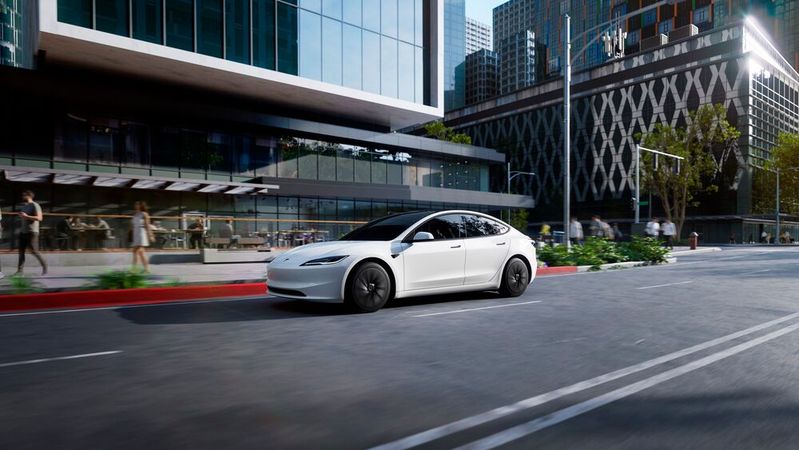
Tesla plans to offer autonomous driving throughout Europe.
(Image: Tesla)
The controversy surrounding Tesla's FSD Autopilot system is escalating. With further EU discussions imminent, the debate has long since shifted to the fundamental question of how Europe should deal with these new automated systems.
The discussion stems from and centers on Tesla’s “Full Self-Driving (Supervised)” assistance system. The technology allows the driver to take their hands off the steering wheel at times while the vehicle steers, brakes, and accelerates autonomously. European and Asian manufacturers already have similar systems on the road in Europe, but they are limited to use on highways. Tesla’s FSD, on the other hand, also works in cities and offers an unusually wide range of features, some of which go beyond existing EU regulations.
The non-profit European Transport Safety Council (ETSC) is now criticizing at least two of these features and is calling on the European Commission and member states not to approve them in their current form. One of them clearly violates existing UN regulations. However, the current dispute is only part of what has now become a fundamental debate on safety, approval, and regulation of advanced driver-assistance systems in Europe.
Significant Exceedance of the Speed Limit Is Possible
Specifically, the ETSC criticizes the “Speed Offset” feature. According to the Tesla manual, this feature allows the driver to set a permanent increase of up to 50 percent on the maximum speed detected by the system. For example, a speed of 50 km/h (31 mph) could thus become 75 km/h (47 mph). In the ETSC’s view, this contradicts the UN regulation for so-called Driver Control Assistance Systems (DCAS). This regulation expressly prohibits a preset that causes the system’s maximum speed to exceed the speed limit. Furthermore, the ETSC states that Tesla did not list this feature among the items for which an exemption from existing regulations was requested.
The organization also takes a critical view of the “Contextual Max Speed” feature. Among other factors, this feature can take into account how fast other road users are traveling when determining the speed. The ETSC generally considers contextual information to be useful but warns against using the speed of other cars as a reference: if they are driving too fast, the system could also use that as a basis for setting a higher speed.
The current criticism comes amid an already controversial history of vehicle approval. In April, the Dutch Vehicle and Registration Authority (RDW) initially approved Tesla’s technology for use in the Netherlands based on an exemption in the European Type-Approval Regulation. This provision allows for the introduction of new technologies that do not fully comply with existing regulations, provided that at least an equivalent level of safety is demonstrated. Other member states may adopt such a provisional approval. Belgium, the Czech Republic, Denmark, Estonia, Lithuania, and Slovenia have since done so. For EU-wide approval, however, a decision at the European level is required.
ETSC Criticizes the Approval Process
It is precisely this procedure that has drawn criticism from safety experts. The ETSC—whose members include Dekra, TÜV, and the ARCD automobile club—criticizes the fact that a regulation originally intended for technical exceptions could, in effect, pave the way for a fundamental expansion of automated driving functions. Under driver supervision, Tesla’s FSD can, among other things, steer, accelerate, brake, and initiate driving maneuvers autonomously—even off highways. In the organization’s view, EU-wide approval could therefore set a precedent for other manufacturers and for the future design of international regulations governing automated driving.
The Dutch regulatory agency defends its decision by citing extensive testing. Following approval, the agency also tightened the required monitoring and receives monthly reports. According to the RDW, by mid-June, nearly 40,000 vehicles equipped with the relevant technology had traveled approximately 24 million kilometers (14.9 million miles) in the Netherlands without any incidents deemed relevant by the agency.
Date: 08.12.2025
Naturally, we always handle your personal data responsibly. Any personal data we receive from you is processed in accordance with applicable data protection legislation. For detailed information please see our privacy policy.
Consent to the use of data for promotional purposes
I hereby consent to Vogel Communications Group GmbH & Co. KG, Max-Planck-Str. 7-9, 97082 Würzburg including any affiliated companies according to §§ 15 et seq. AktG (hereafter: Vogel Communications Group) using my e-mail address to send editorial newsletters. A list of all affiliated companies can be found here
Newsletter content may include all products and services of any companies mentioned above, including for example specialist journals and books, events and fairs as well as event-related products and services, print and digital media offers and services such as additional (editorial) newsletters, raffles, lead campaigns, market research both online and offline, specialist webportals and e-learning offers. In case my personal telephone number has also been collected, it may be used for offers of aforementioned products, for services of the companies mentioned above, and market research purposes.
Additionally, my consent also includes the processing of my email address and telephone number for data matching for marketing purposes with select advertising partners such as LinkedIn, Google, and Meta. For this, Vogel Communications Group may transmit said data in hashed form to the advertising partners who then use said data to determine whether I am also a member of the mentioned advertising partner portals. Vogel Communications Group uses this feature for the purposes of re-targeting (up-selling, cross-selling, and customer loyalty), generating so-called look-alike audiences for acquisition of new customers, and as basis for exclusion for on-going advertising campaigns. Further information can be found in section “data matching for marketing purposes”.
In case I access protected data on Internet portals of Vogel Communications Group including any affiliated companies according to §§ 15 et seq. AktG, I need to provide further data in order to register for the access to such content. In return for this free access to editorial content, my data may be used in accordance with this consent for the purposes stated here. This does not apply to data matching for marketing purposes.
Right of revocation
I understand that I can revoke my consent at will. My revocation does not change the lawfulness of data processing that was conducted based on my consent leading up to my revocation. One option to declare my revocation is to use the contact form found at https://contact.vogel.de. In case I no longer wish to receive certain newsletters, I have subscribed to, I can also click on the unsubscribe link included at the end of a newsletter. Further information regarding my right of revocation and the implementation of it as well as the consequences of my revocation can be found in the data protection declaration, section editorial newsletter.
That is not enough for the ETSC. It criticizes the fact that there is no institution at the EU level comparable to U.S. agencies such as the NTSB and NHTSA that systematically records and independently investigates accidents involving driver-assistance and automated driving systems. After all, a software error could affect not just a single vehicle, but potentially an entire fleet running the same software version.
Tesla, for its part, has been aggressively pushing for its European launch for some time now. As early as late 2025, for example, the company had called on its customers to express their support for the registration process to the Dutch RDW. The agency subsequently issued a public request asking people to refrain from contacting them in this manner.
EU vote in December at the Earliest
This means that the upcoming European decision involves more than just the approval of Tesla software. The debate also centers on how far driver-assistance systems are allowed to drive autonomously, how their safety must be demonstrated, and who will monitor them after approval. The issue is scheduled to be discussed again in early October by the EU’s Technical Committee on Motor Vehicles. A vote on EU-wide approval is expected in December at the earliest. The outcome remains to be seen.
The seven countries that have so far adopted the Dutch approval account for only about 12 percent of the votes needed for EU-wide approval. Major markets such as Germany, France, Italy, and Spain have not yet joined. France and Sweden have recently expressed concerns regarding the handling of speed limits.



:quality(80)/p7i.vogel.de/wcms/ba/ec/baecd2e3783dee11913096f7d58e1232/bild-1-kammerer-kgt-f-r-elektrozylinder-300dpi-2000px-printv1.jpeg "Kammerer ball screw for use in an electric cylinder (Source: Kammerer)")
:quality(80)/p7i.vogel.de/wcms/51/1b/511b420dbcc296aec09e3bffb051b8a8/0133581587v1.jpeg "The cables connect numerous machine components—often in confined spaces. (Image:Helu)")
:quality(80)/p7i.vogel.de/wcms/b5/67/b5676f3bfb36251ed31f9a0cccf650b6/0133167827v1.jpeg "Thanks to JumboFlex Generation 2, employees can effortlessly move wheelchairs weighing as much as 40 kilograms. (Image:Lard)")
:quality(80)/p7i.vogel.de/wcms/5e/c6/5ec615b7a51440f668259f2af9158cb9/0132654694v1.jpeg "Strategic Partnerships in Industry: As buyers and restructuring partners, Chinese investors are increasingly helping to preserve jobs in Germany. (Image: ©Anatolii Rymarchuk - stock.adobe.com)")
:quality(80)/p7i.vogel.de/wcms/aa/3e/aa3e2603a812f8e7d33c00ba8ae28c9f/0133507886v1.jpeg "With the Iggy Rob, igus is bringing a humanoid robot into factories for a price of 47,999 euros ($54,718). (Image: igus)")
:quality(80)/p7i.vogel.de/wcms/92/64/92645c64ffbb6980976d39102388d120/0113143253v1.jpeg "In our China Market Insider, we regularly provide you with relevant information straight from China. (Image:© Eisenhans - stock.adobe.com)")
:quality(80)/p7i.vogel.de/wcms/c7/05/c70542511e0824ee491f7b55e21fa429/0133598424v1.jpeg "In logistics, AI is often implemented only on a case-by-case basis; data is stored in separate systems, and inventory levels, status values, and priorities are not defined consistently. (Image: ©m-project - stock.adobe.com)")
:quality(80)/p7i.vogel.de/wcms/3a/9c/3a9c1fd546e1f041b86bb1d03cf39101/0133610524v1.jpeg "The Mason W-01 combines industrial-grade humanoid hardware, Physical AI-based perception, and autonomous task planning. (Image:Nova X Robotics)")
:quality(80)/p7i.vogel.de/wcms/9c/16/9c16e4aa02594fe4bf82ead736562b07/directhop1-scaledv1.jpeg "Light as a feather, but without feathers: The University of Washington's robot, which weighs just one gram, uses a bionic direct-drive system to catapult itself into the air with centimeter-level precision. (Source: Mark Stone/University of Washington)")
:quality(80)/p7i.vogel.de/wcms/e7/94/e794290f265afbd0ffc7a06c4fe9d425/adobestock-1887113836--hypnotics-14-stock-adobe-com-ki-generiertv1.jpeg "In both autonomous driving and industrial production, there is growing skepticism as to whether full autonomy is always desirable. (Source: © Hypnotics 14 – stock.adobe.com / AI-generated)")
:quality(80)/p7i.vogel.de/wcms/a8/71/a8712e5c6ef536228444ab5275cedfe2/adobestock-340905887--gorodenkoff-stock-adobe-comv1.jpeg "A new position paper outlines the conditions that the business community, academia, and policymakers must jointly establish in order to ensure the long-term viability of industry in Germany and Europe. (Source: © Gorodenkoff – stock.adobe.com)")
:quality(80)/p7i.vogel.de/wcms/7d/eb/7deb25ca674fa4c781a9d1fab083f7cf/parker-entwicklungszentrum-hresv1.jpeg "The centerpiece of the Parker Center for Drive and Control Technology in Offenbach is the exhibition area. (Source: Parker Hannifin)")
:quality(80)/p7i.vogel.de/wcms/20/ac/20ac36a2fb2151cda6e078dd3aeb62ae/0133645903v1.jpeg "Tesla plans to offer autonomous driving throughout Europe. (Image:Tesla)")
:quality(80)/p7i.vogel.de/wcms/f8/90/f890fc4b08048472b9b4b436a2da442b/ai-catl-sodium-batteries-vs-lithium-revolutionv1.jpeg "CATL has often faced criticism because of its high market share. This time, a government ministry is stepping in—indirectly. (Image:CATL)")
:quality(80)/p7i.vogel.de/wcms/78/ab/78abbfbab0565fabb19efe637aea30e8/nio-power-swap-station-4-china-guangzhou-2024-1400x933-jpgv1.webp "Nio and Geely are collaborating on battery replacement for electric cars. (Source: Nio)")
:quality(80)/p7i.vogel.de/wcms/2e/58/2e58c664e733dd182666606f850c5da4/0133400664v1.jpeg "The IM6 is sort of the crossover version of the IM5. (Image:MG Motor)")
:quality(80)/p7i.vogel.de/wcms/67/3d/673d8f6f14bd030b53b61800a0aeb06d/0133548286v1.jpeg "Overview: If even a single critical component is missing, the entire production process can come to a standstill. Proactive procurement is intended to mitigate such bottlenecks early on. (Image:Dall-E / AI-generated)")
:quality(80)/p7i.vogel.de/wcms/b3/8d/b38d7e914a0a51c24db7e93c8a8420e2/0133672676v1.jpeg "Figure 1: Today, the AT cut is most commonly used for quartz crystals. The double-twisted SC cut further enhances the stability and aging resistance of OCXO oscillators. (Image:Q-Tech)")
:quality(80)/p7i.vogel.de/wcms/40/34/4034915f85470ad8264659267e4f02d0/0133655653v1.jpeg "Cariad, Volkswagen's software subsidiary, continues to struggle. Now, another round of layoffs has been announced, which will result in the loss of many jobs ... (Image:Cariad)")
:quality(80)/p7i.vogel.de/wcms/e4/2a/e42af12e2a0816bb3d25fac9932903e9/0133646920v1.jpeg "TSMC's U.S. headquarters in Arizona: According to various media reports, the world's largest contract semiconductor manufacturer may be planning to build up to six additional fabs in the state of Texas. (Image:TSMC)")
:fill(fff,0)/images.vogel.de/vogelonline/companyimg/76800/76895/65.jpg "FAULHABER_120mm.jpg ()")
:quality(80)/p7i.vogel.de/wcms/31/06/3106223886c4da951ea4dba427b89113/0121854837v1.jpeg "Tesla has high hopes for robotaxis. However, the test drives appear to violate safety regulations. (Image:Tesla Motors)")
:quality(80)/p7i.vogel.de/wcms/16/b4/16b47887697c8e2a3e7b2dc698c9b3f6/0131473091v1.jpeg "Tesla wants to bring its new version of the driver assistance system FSD to the streets in China later this year. (Image:Tesla)")
:quality(80)/p7i.vogel.de/wcms/6b/63/6b635ddc12a03c966cc8c6e836dcdcb2/0130616488v1.jpeg "Keep your hands off the wheel, it may soon be said throughout Europe! Because Tesla wants to introduce its \"Full Self Driving\" (FDS) driver assistance system, at least in the \"Monitored\" version ... (Picture:Tesla)")