Ethernet Connection to the SDV EndpointsAutomotive Ethernet as a Unified SDV Network
By
Amir Bar-Niv * | Translated by AI
5 min Reading Time
Software-defined vehicles rely on deterministic, high-bandwidth communication to support ADAS, centralized computing architectures, and over-the-air updates. In zone-based SDV architectures, Automotive Ethernet serves as the central network connection for this purpose.
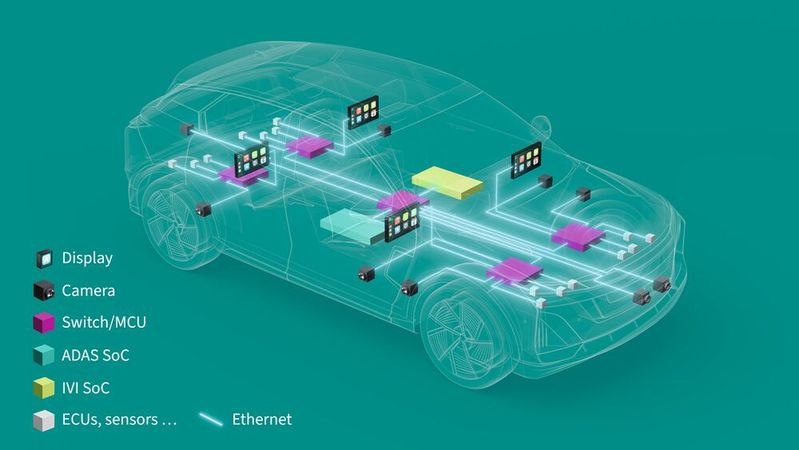
The Next Phase of Ethernet in Vehicles: End-to-end Ethernet integrates all high-data-rate devices into the network, including displays and central high-performance computing units.
(Image: Infineon Technologies)
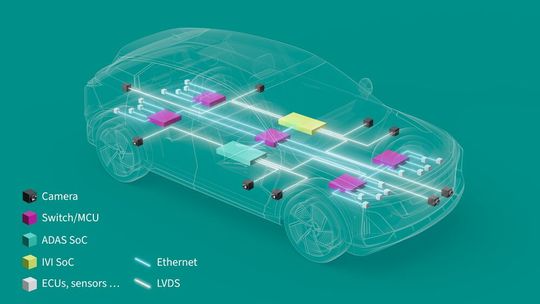
Even today, high-data-rate cameras (Figure 1) rely on proprietary point-to-point serialization links based on low-voltage differential signaling (LVDS) technologies such as Gigabit Multimedia Serial Link (GMSL) or Flat Panel Display Link (FPD-Link). These connections terminate directly on system-on-chip (SoC) devices and operate outside the Ethernet infrastructure. As a result, stream sharing, path redundancy, and dynamic bandwidth allocation for high-quality perceptual data are significantly limited.
Extending Ethernet all the way to the sensor level eliminates these limitations and enables a unified, programmable SDV network from the camera to the central processing unit.
Figure 1: Example of a typical zone-based vehicle network with cameras connected to the ADAS and infotainment (IVI) SoCs via a point-to-point connection.
(Image: Infineon Technologies)
Converting Visual Data at the Ethernet Edge
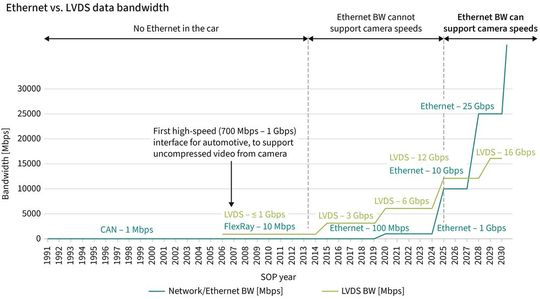
As shown in Figure 2, the introduction of MultiGig-capable single-pair Ethernet PHYs for the automotive sector, with data rates of 2.5, 5, and 10 Gbit/s, closes the bandwidth gap that has previously limited cameras to proprietary serialization connections. At these data rates, Ethernet enables the efficient, low-latency transmission of high-resolution video data directly from the sensor.
An Ethernet camera bridge converts the sensor data into standardized Ethernet frames right at the source. The IEEE 1722 standard defines the Audio Video Transport Protocol (AVTP), which encapsulates time-critical media streams at Layer 2. The bridge acts as an AVTP talker and segments each video frame into protocol data units that are tagged with stream identifiers and sequence numbers. Downstream processors act as listeners and reconstruct the frames deterministically.
Figure 2: Comparison of the data bandwidth of Ethernet and LVDS over time in automotive systems.
(Image: Infineon Technologies)
Each packet contains a presentation timestamp that is synchronized via the Generalized Precision Time Protocol (gPTP) in accordance with IEEE 802.1AS. This mechanism ensures precise temporal synchronization with radar, lidar, and inertial sensors. An exact temporal correlation between the sensors is crucial for sensor fusion and trajectory prediction.
Deterministic Transport and Resilience over Ethernet
Once video streams are encapsulated as Ethernet traffic, they are transmitted within deterministic networks. Time-Sensitive Networking (TSN) mechanisms—in particular, traffic shaping and time-sensitive scheduling—enable bandwidth guarantees across all traffic classes. Prioritization using Virtual Local Area Networks (VLANs) also ensures predictable data transmission even under high network load.
Unlike point-to-point serialization connections, Ethernet switching enables the multicast transmission of a single video stream to multiple compute nodes without requiring the source to be duplicated. Driver assistance systems, infotainment processors, and data logger subsystems can subscribe to the stream simultaneously. Cameras with native Ethernet output can be connected to central switches or zone switches via short cables. In this architecture, stream distribution is a configurable network parameter rather than a fixed physical connection.
Redundancy mechanisms further enhance reliability. The IEEE 802.1CB standard supports the redundant transmission of frames across different paths, followed by the elimination of duplicates. If a connection or a switch segment fails, the receiving node reconstructs the stream without interruption. This allows functional safety goals to be achieved without the need for parallel proprietary cabling.
Programmability, Control, and Ecosystem Integration
Ethernet camera streams are controlled and configured via IEEE 1722.1. Processors detect camera bridges, establish stream connections, and send commands such as changes to exposure or operating mode. General-purpose input/output (GPIO) events can be stamped with the network clock’s timestamps, enabling synchronized triggering across multiple sensors.
Date: 08.12.2025
Naturally, we always handle your personal data responsibly. Any personal data we receive from you is processed in accordance with applicable data protection legislation. For detailed information please see our privacy policy.
Consent to the use of data for promotional purposes
I hereby consent to Vogel Communications Group GmbH & Co. KG, Max-Planck-Str. 7-9, 97082 Würzburg including any affiliated companies according to §§ 15 et seq. AktG (hereafter: Vogel Communications Group) using my e-mail address to send editorial newsletters. A list of all affiliated companies can be found here
Newsletter content may include all products and services of any companies mentioned above, including for example specialist journals and books, events and fairs as well as event-related products and services, print and digital media offers and services such as additional (editorial) newsletters, raffles, lead campaigns, market research both online and offline, specialist webportals and e-learning offers. In case my personal telephone number has also been collected, it may be used for offers of aforementioned products, for services of the companies mentioned above, and market research purposes.
Additionally, my consent also includes the processing of my email address and telephone number for data matching for marketing purposes with select advertising partners such as LinkedIn, Google, and Meta. For this, Vogel Communications Group may transmit said data in hashed form to the advertising partners who then use said data to determine whether I am also a member of the mentioned advertising partner portals. Vogel Communications Group uses this feature for the purposes of re-targeting (up-selling, cross-selling, and customer loyalty), generating so-called look-alike audiences for acquisition of new customers, and as basis for exclusion for on-going advertising campaigns. Further information can be found in section “data matching for marketing purposes”.
In case I access protected data on Internet portals of Vogel Communications Group including any affiliated companies according to §§ 15 et seq. AktG, I need to provide further data in order to register for the access to such content. In return for this free access to editorial content, my data may be used in accordance with this consent for the purposes stated here. This does not apply to data matching for marketing purposes.
Right of revocation
I understand that I can revoke my consent at will. My revocation does not change the lawfulness of data processing that was conducted based on my consent leading up to my revocation. One option to declare my revocation is to use the contact form found at https://contact.vogel.de. In case I no longer wish to receive certain newsletters, I have subscribed to, I can also click on the unsubscribe link included at the end of a newsletter. Further information regarding my right of revocation and the implementation of it as well as the consequences of my revocation can be found in the data protection declaration, section editorial newsletter.
This architecture transforms cameras into programmable network endpoints. The software can reassign streams, add additional subscribers, and adjust bandwidth allocations without the need for rewiring. A camera is added by allocating bandwidth within the switch fabric, rather than redesigning the serialization chains. As capabilities evolve, the network can accommodate new sensor traffic without requiring structural changes.
Because the cameras operate within the Ethernet framework, they use standardized mechanisms for security, monitoring, and power supply. IEEE 802.1AE MACsec secures data during transmission. OAM (Operations, Administration, and Maintenance) functions provide transparency at the link layer, and Power over Data Line (PoDL) or Power over Coax (PoC) supply power to the end nodes. Established programs for Ethernet conformance testing, electromagnetic compatibility (EMC) testing, and manufacturer-verified interoperability also reduce reliance on proprietary validation processes.
End-to-End Ethernet with Native High-Speed Ethernet in SoCs
SoCs for the automotive industry are increasingly integrating native high-speed Ethernet interfaces that operate at 10 Gbit/s and are scalable up to 25 Gbit/s. This enables end-to-end Ethernet connectivity within the vehicle network. These interfaces reduce the reliance on external deserializers while also reducing the number of interface pins required on the SoC.
Integrated hardware engines decompress IEEE 1722 streams and transfer video directly to processors via Direct Memory Access (DMA) for image processing or graphics acceleration. Offloading these functions from the CPU reduces latency and frees up computational resources for perception algorithms.
High-speed Ethernet connections bundle bandwidth into fewer channels than parallel camera interfaces such as the Mobile Industry Processor Interface Camera Serial Interface-2 (MIPI CSI-2). A single 25 Gbit/s Ethernet interface can bundle multiple camera or radar streams, thereby reducing the number of pins, simplifying package routing, and lowering the complexity of the printed circuit board (PCB).
Because Ethernet supports switching and multicast functions, a single Ethernet switch can distribute a camera stream to multiple SoCs. Streams are added or redistributed via software configuration within the network fabric rather than by reconfiguring the hardware. The SoC thus functions as a time-synchronized, high-throughput node within a scalable communications infrastructure.
Optimization of Camera Connections with Asymmetric PHYs According to IEEE 802.3dm
Although the symmetric MultiGig PHYs defined in IEEE 802.3ch enable high-bandwidth data transmission, camera data traffic is fundamentally asymmetric. The video stream flows primarily from the sensor to the processor, while data traffic in the opposite direction consists mainly of control and status information.
IEEE 802.3dm addresses this imbalance by defining asymmetric single-pair Ethernet PHYs for automotive applications that provide high downstream data rates for uncompressed video while supporting low upstream bandwidth for control data. The design targets specify downstream rates of 2.5, 5, and 10 Gbit/s, as well as upstream rates of approximately 100 Mbit/s.
By adapting the link capacity to actual traffic patterns, it is possible to reduce chip area, lower power consumption, and alleviate thermal constraints in compact camera modules. Smaller PHY implementations enable more efficient sensor integration while maintaining deterministic transmission characteristics.
IEEE 802.3dm builds on existing automotive Ethernet frameworks and maintains Layer 2 compatibility with TSN. The standard is designed for cable lengths of approximately 15 meters and supports both shielded twisted-pair and coaxial media. Optional features such as PoDL and PoC remain available for edge devices as well.
From Isolated Connections to a Programmable Vehicle Network
Replacing proprietary serialization chains with a unified Ethernet fabric enables deterministic transport, precise synchronization, configurable redundancy, and standardized control along the entire communication path. The native integration of high-speed Ethernet into SoCs, combined with new asymmetric PHY specifications, improves efficiency at both the architectural and physical levels. These developments support scalable bandwidths, software-driven reconfiguration, and adaptive lifecycle management across the entire vehicle platform. Because SDV architectures consolidate computing power into zonal and central domains, environmental sensing functions are increasingly being shifted or adapted through software updates rather than by redesigning the hardware. A standards-based Ethernet fabric makes it possible to reassign, duplicate, prioritize, and secure video streams through configuration changes within the network infrastructure. This flexibility reduces structural dependencies between sensors and processors and supports long-term functional evolution. Instead of tying perception data to fixed serialization chains, Ethernet functions as a programmable communication infrastructure that flexibly supports new algorithms, updated security requirements, and increasing data rates.
*Amir Bar-Nivi is Vice President of Automotive Ethernet Strategic Marketing at Infineon Technologies



:quality(80)/p7i.vogel.de/wcms/8e/7e/8e7e0cda4c68699bcc48283a38739769/0133316747v1.jpeg "A little-known hidden champion! When people think of laser cutting, the first thing that comes to mind is the power of the laser beam—and it is impressive to see the sparks flying. But Air Liquide—an exhibitor at Euroblech, by the way—wants to make it clear that the process gas is also key to success. (Image:AI-generated)")
:quality(80)/p7i.vogel.de/wcms/20/fa/20fa35e0af203c3464f7e7fdbb57a685/0133281172v1.jpeg "Since 2003, Etzinger AG has been developing and manufacturing high-quality coffee grinders, pepper mills, and grinding mechanisms for professional and home use. (Image:Etzinger)")
:quality(80)/p7i.vogel.de/wcms/69/91/6991413943488b4a2f6fde9dcd88c5b0/0133256686v1.jpeg "The CMA-patented pendulum mount can compensate for radial tolerances of up to one millimeter. (Image:Schwiening)")
:quality(80)/p7i.vogel.de/wcms/0b/cd/0bcd6d502ffcd087c4fc12b7b760b3ce/0133317507v2v1.jpeg "The new Multi Center from J.G. Weisser. (Image:J.G. Weisser)")
:quality(80)/p7i.vogel.de/wcms/bd/4e/bd4ef09ab0f84932ea76ca0330ffe789/0133329802v1.jpeg "The robotics boom and its consequences: According to a study, a significant portion of value creation occurs in the electronics industry. (Image:Fraunhofer IPA)")
:quality(80)/p7i.vogel.de/wcms/35/81/35815f36be1b1c13f9abef4cea2a3e2b/0133171739v1.jpeg "Humanoid robots in industry: Despite impressive progress, many systems are still in the pilot phase. (Image:AI-generated)")
:quality(80)/p7i.vogel.de/wcms/81/dc/81dc63ed24c562521413023779495e7d/chris-kramerv1.jpeg "Chris Kramar, Director and General Manager of OEM Solutions for Germany, Austria, and Switzerland at Dell Technologies (Source: Dell Technologies)")
:quality(80)/p7i.vogel.de/wcms/bb/f5/bbf5342f532debc1bd7c09c2b9a0bf42/0133176497v1.jpeg "Over the past two years, AI has emerged as the most important growth driver in the industry. (Image: ©Gorodenkoff - stock.adobe.com)")
:quality(80)/p7i.vogel.de/wcms/e9/19/e91905d37afe605bc348a690a4fed72e/0133350592v1.jpeg "At Autodesk University, Autodesk is introducing new AI features for CAD and PLM. (Image:Autodesk)")
:quality(80)/p7i.vogel.de/wcms/98/73/98731d23cbd95ff22391993a74cfefbf/mit-bifurcatedcircuits-01-pressv1.jpeg "A sample of the variety of configurations that Bifur circuits can form. (Source: Courtesy of the researchers)")
:quality(80)/p7i.vogel.de/wcms/f4/3d/f43d1f4297d9ae0cd1b6d2adfcb5ffe1/0133276470v1.jpeg "Simulation: Electric arcs in the electrical industry, including associated field simulation. (Image:CADFEM)")
:quality(80)/p7i.vogel.de/wcms/3e/f1/3ef196715e1b291ec7ae84f02c875c63/0133310495v1.jpeg "The Next Phase of Ethernet in Vehicles: End-to-end Ethernet integrates all high-data-rate devices into the network, including displays and central high-performance computing units. (Image:Infineon Technologies)")
:quality(80)/p7i.vogel.de/wcms/b4/b8/b4b89c48bb797df7251706d4ee096a80/0133359349v1.jpeg "To advance modern rail transportation, Knorr-Bremse and CARS have signed a memorandum of understanding regarding the China Freight Cooperation Program. Pictured here is Rail Executive Board Member Nicolas Lange at the signing ceremony in Beijing. (Image: Knorr-Bremse)")
:quality(80)/p7i.vogel.de/wcms/99/8c/998cb26cfb3110e8444a4ecbfe2dc799/0133338279v1.jpeg "Electric car manufacturer Rivian is launching its R2 SUV in the U.S. (Image:Rivian)")
:quality(80)/p7i.vogel.de/wcms/cc/d1/ccd1607af856c9cff96c73a5ffccfcad/p90652283-highres-demonstrator-woodenv1.jpeg "The FSCM research project, which was recently completed, is delivering innovations close to production for plastics, metals, and design at BMW. (Source: BMW)")
:quality(80)/p7i.vogel.de/wcms/4c/53/4c534208d09a9b1ce597938715e7fc19/0133288763v1.jpeg "Logic Folding: In its latest Kirin 9050 Pro, Huawei uses hybrid bonding to distribute the computing units across two silicon layers in order to increase the effective transistor density without resorting to finer manufacturing processes. (Image:Huawei)")
:quality(80)/p7i.vogel.de/wcms/56/d1/56d131e0b5bd05ef47411e92ad740cb4/0133351029v1.jpeg "Researchers at DTU have developed a nanolaser in a semiconductor membrane. The structure concentrates charge carriers and the light field into a small area (shaded in blue). If data is transmitted on microchips using light instead of electrical signals, transmission speeds can be increased and energy losses reduced. (Image:Yi Yu, DTU)")
:quality(80)/p7i.vogel.de/wcms/5e/55/5e55101ddc6338f755fcf3244db1367f/0133331863v1.jpeg "For data center projects, it is becoming increasingly important to also obtain the consent of the affected community. (Image:Dall-E / AI-generated)")
:quality(80)/p7i.vogel.de/wcms/8d/f9/8df95d3f58408673986b3d643e6b63ba/0133252773v1.jpeg "TXC targets high-speed optical links in AI data centers with 312.5 MHz oscillators, among other solutions. As data rates increase, requirements for jitter and frequency stability become more demanding as well. (Bild: TXC)")
:quality(80)/p7i.vogel.de/wcms/2d/04/2d04cb1c6263f1ba76aceb1aa99cac10/0132497621v1.jpeg "In automotive applications, the need to network sensors and actuators consistently on an IP basis is growing. SPE offers a promising approach for this. (Image:paul_craft - stock.adobe.com)")
:quality(80)/p7i.vogel.de/wcms/4e/15/4e15d1c92ff2bc5169291db403dd86e2/0131594892v1.jpeg "Thanks in part to advances in the field of automotive Ethernet, car manufacturers can equip their vehicles with a wider range of functions. (Image:Texas Instruments)")
:quality(80)/p7i.vogel.de/wcms/64/72/64725890ef9aa0addc572b790a670f2b/0131737714v1.jpeg "Optical automotive camera from Hinge based on KD's KD7251 for data transmission at 10 Gbit/s (Image:kd)")