Vehicle NetworkingEthernet Accelerates the Transition to Software-Defined Vehicles
From
Madison Ecklund * | Translated by AI
9 min Reading Time
Zone architectures and Ethernet are shaping the future of networking in vehicles. In view of the fact that new vehicle features, such as the bundling of sensors and actuators in zone control units, rely on a broadband and low-latency on-board communication network, an Ethernet-based zone architecture enables the implementation of the increasing trend towards software-defined vehicles.
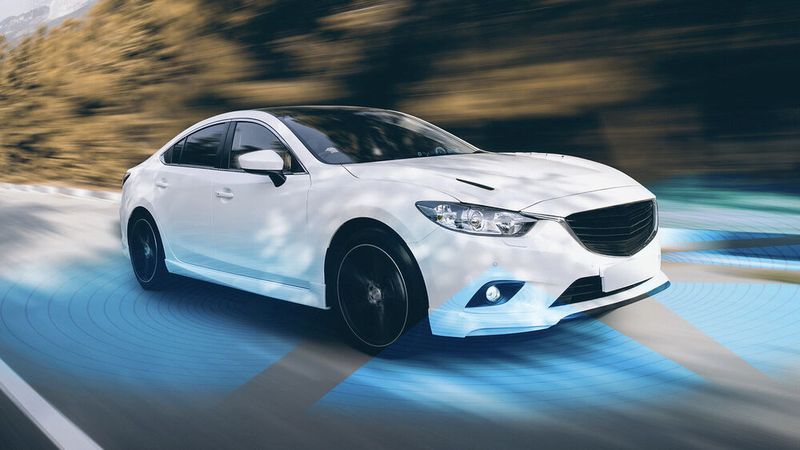
Thanks in part to advances in the field of automotive Ethernet, car manufacturers can equip their vehicles with a wider range of functions.
(Image: Texas Instruments)
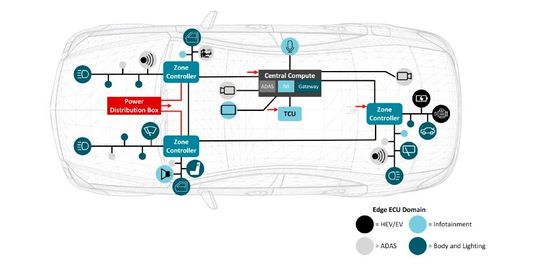
In most of today's vehicles, the wiring and electronic control units (ECUs) are structured in a domain architecture. The ECUs are grouped according to their respective functions—regardless of where they are installed in the vehicle.
In contrast to a domain architecture, the communication, power distribution and control of the individual consumers in a zone architecture are not organized according to their function, but depending on their arrangement in the vehicle (see Figure 1). A zone control module acts as a network data bridge between the computer system of the entire vehicle and locally positioned edge nodes, which include smart sensors and ECUs, for example. In order to reduce the amount of cabling in the vehicle, a zone control module not only distributes the power supply to the individual edge nodes (by implementing smart fuses with semiconductors), but also performs basic computing functions and controls local consumers such as motors and lighting elements.
Figure 1: Example of a zone architecture
(Image: Texas Instruments)
Zone control modules receive data from the various sensors and ECUs via an edge node communication network and forward the collected sensor data to the central computer system via a backbone communication network. Conversely, the zone control modules forward data that they receive from the central computer system to the various actuators. This also takes place via the backbone network and the edge node communication network. The bidirectional communication between the central computer and the zone control modules requires a broadband, low-latency communication backbone to handle the large amounts of data generated by functions such as multiple ADAS sensors, in-vehicle motion control and adaptive driving light systems.
How Much Bandwidth Do Zone Architectures Need?
In order to understand the benefits of Ethernet networks in vehicles, the individual applications will be broken down below. The recently defined single-pair Ethernet supports bandwidth requirements between 10 Mbit/s and 10 Gbit/s according to the IEEE standards 802.3cg (10 Mbit/s), 802.3bw (100 Mbit/s), 802.bu (1 GBbt/s) and 802.3ch (10 Gbit/s). All of these new Ethernet technologies are based on a single-pair cable and support transmission distances of up to 50 ft, which is sufficient for even the longest connections in a vehicle. Furthermore, Ethernet enables time synchronization of sensor data through timestamping via IEEE 802.1AS to achieve low latency.
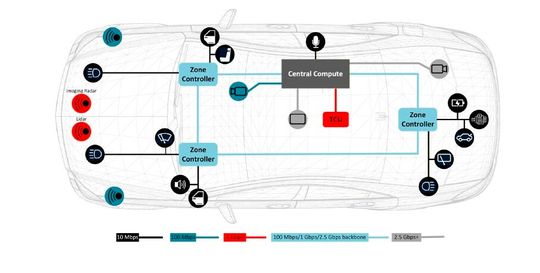
Ethernet enables extremely high transmission rates, but these are not absolutely necessary in every context. For example, communication with a door control module or the heating, ventilation and air conditioning system does not require a data rate of 100 Mbps. A PHY designed for 10 Mbit/s such as the DP83TD555J-Q1 or an alternative network protocol such as CAN is better suited for applications with lower transmission rates and less bandwidth requirements, while the higher transmission rates are reserved for transmitting bundled camera data and sensor data for autonomous driving between the zone control modules and the central computer system. Figure 2 shows where the different transmission rates are used in a zone architecture.
Figure 2 provides a closer look at the transfer rates used for radar, lidar, camera and body applications. When a radar or lidar SoC processes its data, the data is usually transferred to the zone control module via CAN or Ethernet (10 or 100 Mbit/s). If the data processing only takes place on a first or second level, the radar or lidar data is transferred to the zone control module or the central computer via Ethernet at 100 Mbit/s or 1 Gbit/s. However, as soon as the unprocessed radar or lidar data is transferred to the central computer for further processing, more information can be extracted by merging data from several sensors. However, the transfer of this very extensive raw data requires more bandwidth, usually with a SerDes protocol or 2.5 Gbit/s plus Ethernet.
Date: 08.12.2025
Naturally, we always handle your personal data responsibly. Any personal data we receive from you is processed in accordance with applicable data protection legislation. For detailed information please see our privacy policy.
Consent to the use of data for promotional purposes
I hereby consent to Vogel Communications Group GmbH & Co. KG, Max-Planck-Str. 7-9, 97082 Würzburg including any affiliated companies according to §§ 15 et seq. AktG (hereafter: Vogel Communications Group) using my e-mail address to send editorial newsletters. A list of all affiliated companies can be found here
Newsletter content may include all products and services of any companies mentioned above, including for example specialist journals and books, events and fairs as well as event-related products and services, print and digital media offers and services such as additional (editorial) newsletters, raffles, lead campaigns, market research both online and offline, specialist webportals and e-learning offers. In case my personal telephone number has also been collected, it may be used for offers of aforementioned products, for services of the companies mentioned above, and market research purposes.
Additionally, my consent also includes the processing of my email address and telephone number for data matching for marketing purposes with select advertising partners such as LinkedIn, Google, and Meta. For this, Vogel Communications Group may transmit said data in hashed form to the advertising partners who then use said data to determine whether I am also a member of the mentioned advertising partner portals. Vogel Communications Group uses this feature for the purposes of re-targeting (up-selling, cross-selling, and customer loyalty), generating so-called look-alike audiences for acquisition of new customers, and as basis for exclusion for on-going advertising campaigns. Further information can be found in section “data matching for marketing purposes”.
In case I access protected data on Internet portals of Vogel Communications Group including any affiliated companies according to §§ 15 et seq. AktG, I need to provide further data in order to register for the access to such content. In return for this free access to editorial content, my data may be used in accordance with this consent for the purposes stated here. This does not apply to data matching for marketing purposes.
Right of revocation
I understand that I can revoke my consent at will. My revocation does not change the lawfulness of data processing that was conducted based on my consent leading up to my revocation. One option to declare my revocation is to use the contact form found at https://contact.vogel.de. In case I no longer wish to receive certain newsletters, I have subscribed to, I can also click on the unsubscribe link included at the end of a newsletter. Further information regarding my right of revocation and the implementation of it as well as the consequences of my revocation can be found in the data protection declaration, section editorial newsletter.
Figure 2: Ethernet use in a zone architecture
(Image: Texas Instruments)
In the case of cameras, a SerDes protocol such as FPD-Link is the best choice if the entire volume of raw data from the front camera needs to be transmitted for further processing for driver assistance functions. If it is possible to compress the data from the front camera and the increased volume of ADAS data is not required, Ethernet at 100 Mbit/s is an alternative.
For modules in the body domain, such as door handle sensors, window regulator control modules or exterior mirror control modules, the CAN or LIN protocol is traditionally used for communication, as neither requires a large bandwidth. CAN and LIN will continue to be used, but the increasing use of Ethernet in vehicles also opens up opportunities for multidrop Ethernet (10BASE-T1S with 10 Mbit/s). Although Ethernet is traditionally a point-to-point topology, 10BASE-T1S is the first Ethernet standard that is suitable for a bus topology.
Multi-Gigabit Ethernet in A Zone Architecture
How will zone architectures potentially evolve? It will start with pooling data from the body domains, including the power supply, and centralizing computing resources. Over time, the zone architectures will then start to bring together data from other domains such as ADAS and infotainment. The ultimate goal is to integrate all domains into the zone architecture. Regardless of which domain the data belongs to, the zone control module and the central computer system use the same backbone network for its transmission. Audio functions are a prime candidate for relocation to zone control modules, as audio video bridging standards make it possible to transmit audio data via Ethernet.
Body domain functions usually get by with 10 Mbit/s or less. However, when ADAS and on-board infotainment functions such as radar, lidar, audio and cameras are incorporated into the zone architecture, the speed and bandwidth requirements increase and the topology of the Ethernet backbone may change from a star to a ring structure to accommodate the large amount of safety-critical and time-sensitive sensor data.
Audio generates around 1.5 Mbit/s per channel, a radar sensor between 0.1 and 15 Mbit/s and lidar between 20 and 100 Mbit/s. For cameras, the values are between 500 Mbit/s and 3.5 Gbit/s. Modern vehicles are usually equipped with four to six radar sensors, one to five lidar sensors, 15 to 20 loudspeakers, 12 to 16 microphones and six to twelve cameras. Table 1 provides an overview of the data volume of the various sensors.
Table 1: Data volume in a zone architecture
(Image: Texas Instruments)
It is this large volume of generated data that is prompting car manufacturers to switch to Ethernet at 2.5, 5 and 10 Gbit/s. A zone architecture requires a backbone communication network that can handle the enormous amounts of data that need to be transferred from ADAS sensors to the central computer. Uncompressed camera data already exceeds the capabilities of current Ethernet technology, and the resolution of the cameras continues to increase. The more vehicles are developed in the direction of autonomous driving, the more sensors are installed in them, so that the bandwidth requirements of the on-board networks increase accordingly.
The Ethernet transmission rates demanded by car manufacturers are likely to vary, as each manufacturer has its own plans for moving the various functions to the zone control module. Audio playback via the built-in speakers is likely to be one of the first cross-zone data types to be moved to the Ethernet backbone. This could be due to the comparatively low data volumes, as 20 audio channels only generate around 30 Mbit/s, meaning that an existing Ethernet backbone with 100 Mbit/s or 10 Gbit/s can easily cope with this audio data. Overall, the more functions with high data volumes are transferred to the zonal control modules, the greater the bandwidth requirement.
Ethernet as a backbone for a zone architecture enables vehicles to transmit more data via the on-board network when connected to the internet or the car manufacturer's servers. Subscription-based services or vehicle diagnostics can thus be implemented via firmware over-the-air (FOTA) updates. FOTA updates enable different update cycles for hardware and software, which can be carried out asynchronously thanks to the independence of the sensors and actuators from the central computer. FOTA updates can also be used to push additional features and safety improvements so that there is no need to wait for a model change or visit the workshop. This benefits manufacturers and end consumers alike: manufacturers can continue to upgrade their vehicles with additional features after delivery, while customers are spared the need to visit the workshop for firmware updates.
PHYs in A Zone Architecture
Ethernet requires PHYs to send and receive high-speed data. Ethernet PHYs designed for automotive applications eliminate many concerns about using Ethernet as a backbone in vehicles, such as poor signal quality in such a volatile environment. Texas Instruments Ethernet PHYs can operate at temperatures between −40°F to 260°F, which meets the requirements of AEC-Q100 Grade 1.
In addition, Ethernet PHYs must comply with Ethernet conformance standards to ensure that they meet interoperability and reliability requirements for electromagnetic compatibility (EMC) and electromagnetic interference (EMI). The same applies to IEEE conformity in accordance with Open Alliance TC1 and TC12 for use in vehicle environments. Advanced diagnostic features, including signal quality indication, time domain reflectometry and electrostatic discharge detection sensors, allow PHYs to detect and identify faults to enable the host system to respond proactively. For example, should an electrostatic discharge occur, the PHY sends an interrupt signal to the SoC and the Media Access Controller (MAC) and then checks other parts of the system.
Ethernet PHYs can also wake up remote ECUs over the single-pair Ethernet cable using Open Alliance TC10 wake and sleep technologies, eliminating the need for separate wires. IEEE 802.1AE Media Access Control Security (MACsec) can also be an important technology to support the authentication of network ECUs and the encryption and decryption of data to defend against cyber attacks. After all, cyber attacks are the biggest threat to vehicle networks.
Ethernet PHYs from TI
The DP83TC812-Q1, DP83TC815-Q1 and DP83TC814-Q1 100BASE-T1-PHYs are designed for luxury vehicles, while the smaller DP83TC813-Q1 100BASE-T1-PHY may be of interest for applications where PCB space is at a premium. The DP83TG720-Q1 and DP83TG721-Q1 can connect zone modules to data-intensive features such as the central computer system or the telematics control unit, which creates space for the integration of additional features in later models without having to make major changes to the cabling.
The portfolio of single-pair Ethernet PHYs is designed for footprint or pin compatibility with the company's 100BASE-T1 and 1000BASE-T1 PHYs. The use of a standardized PCB design allows the feature set or bandwidth to be upgraded in later versions without changes to the hardware. This concept allows development cycles to be shortened, the requirements of different car manufacturers to be met and time-to-market to be reduced, thereby lowering research and development costs.
The 10BASE-T1S Serial Peripheral Interface MAC PHY DP83TD555J-Q1 integrates into existing Ethernet backbones, eliminating the need for protocol converter gateways with their latencies and processing overhead when connecting traditional CAN/LIN edge nodes. Thanks to its support for Power over Data Line, the device can use the same twisted pair cable for data transmission and power supply, reducing cable weight and system costs. The built-in PHY Collision Avoidance also provides deterministic scheduling with guaranteed transmission opportunities for each network node, ensuring predictable communication timing. The larger payloads of the Ethernet frames allow larger amounts of data and more diverse data types to be extracted from the ECUs on the periphery of the vehicles, enabling advanced diagnostics and over-the-air updates while maintaining real-time characteristics. (se)



:quality(80)/p7i.vogel.de/wcms/8e/7e/8e7e0cda4c68699bcc48283a38739769/0133316747v1.jpeg "A little-known hidden champion! When people think of laser cutting, the first thing that comes to mind is the power of the laser beam—and it is impressive to see the sparks flying. But Air Liquide—an exhibitor at Euroblech, by the way—wants to make it clear that the process gas is also key to success. (Image:AI-generated)")
:quality(80)/p7i.vogel.de/wcms/20/fa/20fa35e0af203c3464f7e7fdbb57a685/0133281172v1.jpeg "Since 2003, Etzinger AG has been developing and manufacturing high-quality coffee grinders, pepper mills, and grinding mechanisms for professional and home use. (Image:Etzinger)")
:quality(80)/p7i.vogel.de/wcms/69/91/6991413943488b4a2f6fde9dcd88c5b0/0133256686v1.jpeg "The CMA-patented pendulum mount can compensate for radial tolerances of up to one millimeter. (Image:Schwiening)")
:quality(80)/p7i.vogel.de/wcms/0b/cd/0bcd6d502ffcd087c4fc12b7b760b3ce/0133317507v2v1.jpeg "The new Multi Center from J.G. Weisser. (Image:J.G. Weisser)")
:quality(80)/p7i.vogel.de/wcms/bd/4e/bd4ef09ab0f84932ea76ca0330ffe789/0133329802v1.jpeg "The robotics boom and its consequences: According to a study, a significant portion of value creation occurs in the electronics industry. (Image:Fraunhofer IPA)")
:quality(80)/p7i.vogel.de/wcms/35/81/35815f36be1b1c13f9abef4cea2a3e2b/0133171739v1.jpeg "Humanoid robots in industry: Despite impressive progress, many systems are still in the pilot phase. (Image:AI-generated)")
:quality(80)/p7i.vogel.de/wcms/81/dc/81dc63ed24c562521413023779495e7d/chris-kramerv1.jpeg "Chris Kramar, Director and General Manager of OEM Solutions for Germany, Austria, and Switzerland at Dell Technologies (Source: Dell Technologies)")
:quality(80)/p7i.vogel.de/wcms/bb/f5/bbf5342f532debc1bd7c09c2b9a0bf42/0133176497v1.jpeg "Over the past two years, AI has emerged as the most important growth driver in the industry. (Image: ©Gorodenkoff - stock.adobe.com)")
:quality(80)/p7i.vogel.de/wcms/e9/19/e91905d37afe605bc348a690a4fed72e/0133350592v1.jpeg "At Autodesk University, Autodesk is introducing new AI features for CAD and PLM. (Image:Autodesk)")
:quality(80)/p7i.vogel.de/wcms/98/73/98731d23cbd95ff22391993a74cfefbf/mit-bifurcatedcircuits-01-pressv1.jpeg "A sample of the variety of configurations that Bifur circuits can form. (Source: Courtesy of the researchers)")
:quality(80)/p7i.vogel.de/wcms/f4/3d/f43d1f4297d9ae0cd1b6d2adfcb5ffe1/0133276470v1.jpeg "Simulation: Electric arcs in the electrical industry, including associated field simulation. (Image:CADFEM)")
:quality(80)/p7i.vogel.de/wcms/3e/f1/3ef196715e1b291ec7ae84f02c875c63/0133310495v1.jpeg "The Next Phase of Ethernet in Vehicles: End-to-end Ethernet integrates all high-data-rate devices into the network, including displays and central high-performance computing units. (Image:Infineon Technologies)")
:quality(80)/p7i.vogel.de/wcms/b4/b8/b4b89c48bb797df7251706d4ee096a80/0133359349v1.jpeg "To advance modern rail transportation, Knorr-Bremse and CARS have signed a memorandum of understanding regarding the China Freight Cooperation Program. Pictured here is Rail Executive Board Member Nicolas Lange at the signing ceremony in Beijing. (Image: Knorr-Bremse)")
:quality(80)/p7i.vogel.de/wcms/99/8c/998cb26cfb3110e8444a4ecbfe2dc799/0133338279v1.jpeg "Electric car manufacturer Rivian is launching its R2 SUV in the U.S. (Image:Rivian)")
:quality(80)/p7i.vogel.de/wcms/cc/d1/ccd1607af856c9cff96c73a5ffccfcad/p90652283-highres-demonstrator-woodenv1.jpeg "The FSCM research project, which was recently completed, is delivering innovations close to production for plastics, metals, and design at BMW. (Source: BMW)")
:quality(80)/p7i.vogel.de/wcms/4c/53/4c534208d09a9b1ce597938715e7fc19/0133288763v1.jpeg "Logic Folding: In its latest Kirin 9050 Pro, Huawei uses hybrid bonding to distribute the computing units across two silicon layers in order to increase the effective transistor density without resorting to finer manufacturing processes. (Image:Huawei)")
:quality(80)/p7i.vogel.de/wcms/56/d1/56d131e0b5bd05ef47411e92ad740cb4/0133351029v1.jpeg "Researchers at DTU have developed a nanolaser in a semiconductor membrane. The structure concentrates charge carriers and the light field into a small area (shaded in blue). If data is transmitted on microchips using light instead of electrical signals, transmission speeds can be increased and energy losses reduced. (Image:Yi Yu, DTU)")
:quality(80)/p7i.vogel.de/wcms/5e/55/5e55101ddc6338f755fcf3244db1367f/0133331863v1.jpeg "For data center projects, it is becoming increasingly important to also obtain the consent of the affected community. (Image:Dall-E / AI-generated)")
:quality(80)/p7i.vogel.de/wcms/8d/f9/8df95d3f58408673986b3d643e6b63ba/0133252773v1.jpeg "TXC targets high-speed optical links in AI data centers with 312.5 MHz oscillators, among other solutions. As data rates increase, requirements for jitter and frequency stability become more demanding as well. (Bild: TXC)")

:quality(80)/p7i.vogel.de/wcms/b9/aa/b9aaea2caf16e6dc354c06c6ad00a918/0131354665v1.jpeg "The new 100/1000BASE-T1 single-pair Ethernet PHYs from Microchip combine MACsec security, time-critical networking and functional safety. (Image:Microchip)")
:quality(80)/p7i.vogel.de/wcms/3e/f1/3ef196715e1b291ec7ae84f02c875c63/0133310495v1.jpeg "The Next Phase of Ethernet in Vehicles: End-to-end Ethernet integrates all high-data-rate devices into the network, including displays and central high-performance computing units. (Image:Infineon Technologies)")
:quality(80)/p7i.vogel.de/wcms/64/72/64725890ef9aa0addc572b790a670f2b/0131737714v1.jpeg "Optical automotive camera from Hinge based on KD's KD7251 for data transmission at 10 Gbit/s (Image:kd)")