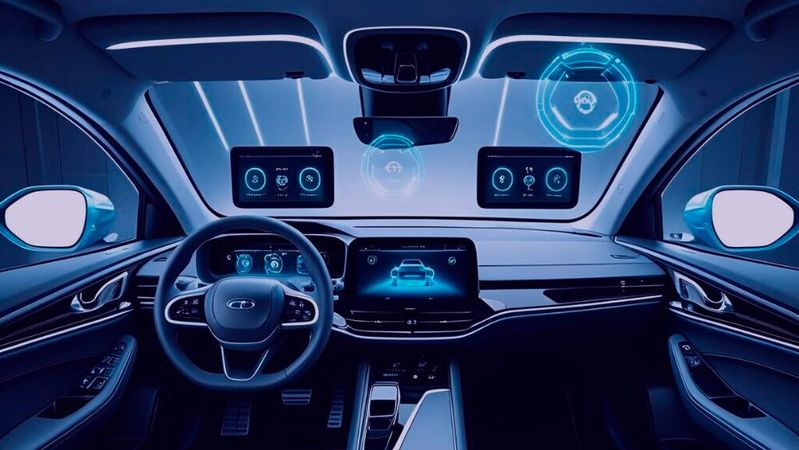
With increasing image quality, higher frame rates, and more data channels, traditional vehicle networks quickly reach their performance limits. This is precisely where BASE-AU comes in. Robust, scalable, and future-proof, the new optical Ethernet standard, developed according to IEEE 802.3cz, delivers the necessary bandwidth and performance to unlock the full potential of optical cameras.
With BASE-AU, an optical Ethernet solution is available that meets the strict mechanical, thermal, and electromagnetic requirements of the automotive industry.
(Image: MD)
Automated driving, intelligent assistance systems, connected mobility—modern vehicles are rolling data centers. At the heart of this evolution are high-resolution optical cameras. They are the eyes of the onboard artificial intelligence, providing critical real-time image data for object detection, driver monitoring, and decision-making. What began as a comfort feature is now indispensable for vehicle safety: modern cars integrate 8, 16, or even more cameras, ensuring a 360-degree view, digital mirrors, interior monitoring, and much more. These cameras are no longer merely passive image providers—they are highly precise sensors and essential components of advanced driver-assistance systems (ADAS) and autonomous driving functions. Their data determines braking distances, lane-keeping, or hazard avoidance in milliseconds—and thus the safety on the road.
For camera systems to fully deliver their benefits, they must transmit enormous amounts of data in real-time and without delay—especially for uncompressed video streams. This places the highest demands on the physical transmission layer:
Lossless transmission of uncompressed video for maximum image quality
Reliability and robustness under extreme conditions such as heat, vibration, or electromagnetic interference
Long distances between camera, control unit, and computing unit—without compromising quality
BASE-AU was designed for these challenges.
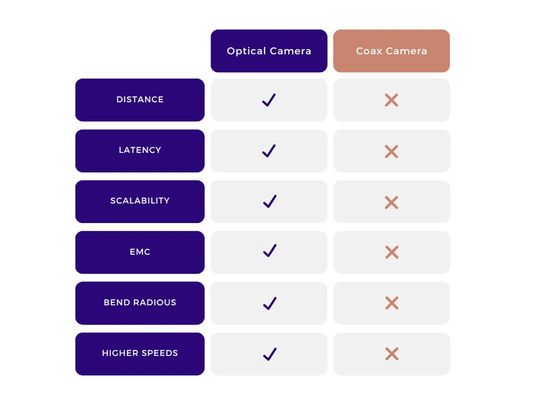
Advantages of optical (IEEE Std 802.3cz) over electrical (IEEE Std 802.3ch/cy) data transmission in vehicles
(Image: KD)
Ideal Solution for the Integration of Optical Cameras
BASE-AU offers various advantages that make the standard the ideal solution for the integration of optical cameras.
Developed for automotive environments
BASE-AU components are qualified for operation under extreme temperatures and vibrations, making them ideal for camera modules in mirrors, bumpers, or behind windshields.
Optimized for large optical connections
Using automotive-qualified multimode glass fibers and generous connection margins, BASE-AU enables transmissions of up to 40 meters (approx. 130 ft)—perfect for zonal architectures where cameras are farther away from central computing units.
Compact integration
In contrast to conventional SFP optics, BASE-AU transceivers can be directly integrated into camera PCBs or ECUs thanks to their compact single-chip design, which supports board-to-board or board-to-cable connections. This simplifies mechanical integration and reduces the overall complexity of the system. Integration into camera modules with an interior surface of 19 by 19 mm (approx. 0.7 by 0.7 inches) is thus possible.
Low power consumption
In terms of energy efficiency, the transceiver consumes no more than 1 W during bidirectional transmission of 10 Gbit/s, which represents a reduction of 30 to 50 percent compared to equivalent electrical solutions. This low power profile is essential to overcome the thermal constraints in compact and sealed enclosures within the vehicle.
Low latency
Real-time functions, such as emergency braking or pedestrian detection, rely on data from optical cameras. They benefit from deterministic BASE-AU communication with low latency, which meets strict functional safety requirements. BASE-AU offers a communication latency of less than 1 µs and an end-to-end video latency of less than 18 µs at 10 Gbit/s. As data rates increase, latency is further reduced thanks to the higher system clock frequency, enabling even faster response times for critical applications.
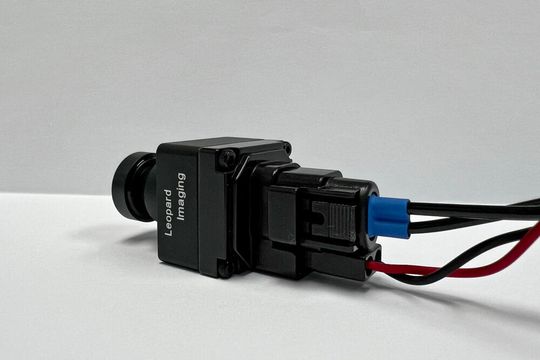
First optical camera from Leopard Imaging based on KD's KD7251 transceiver and new hybrid connectors from Corning for 10GBASE-AU Automotive Ethernet
(Image: KD)
Excursion Into Other Industries: Transition From Copper to Fiber Optics
The emergence of BASE-AU in the automotive industry mirrors a broader historical shift in other industries that have already transitioned from copper to optical systems. In telecommunications, switching from twisted-pair copper cables to optical fibers enabled a massive leap in bandwidth and distance, allowing ISPs to meet the demands of streaming and cloud computing.
Today, data centers that were previously reliant on copper connections almost universally use fiber optics for high-speed connections between servers, switches, and storage arrays. Optical networks enable hyperscale data centers to process terabits of data with low latency and high energy efficiency.
Even in industrial automation, sectors such as aerospace and the rail industry have turned to optical fibers to ensure signal integrity and reliability in harsh environments.
The automotive industry is currently at a similar turning point. With gigabit-level data from cameras, lidar, and radar, as well as increasing expectations for reliability, copper simply cannot keep up. BASE-AU delivers the same leap in performance and stability that fiber optics once brought to telecommunications and data centers, tailored specifically to the unique requirements of vehicles.
Date: 08.12.2025
Naturally, we always handle your personal data responsibly. Any personal data we receive from you is processed in accordance with applicable data protection legislation. For detailed information please see our privacy policy.
Consent to the use of data for promotional purposes
I hereby consent to Vogel Communications Group GmbH & Co. KG, Max-Planck-Str. 7-9, 97082 Würzburg including any affiliated companies according to §§ 15 et seq. AktG (hereafter: Vogel Communications Group) using my e-mail address to send editorial newsletters. A list of all affiliated companies can be found here
Newsletter content may include all products and services of any companies mentioned above, including for example specialist journals and books, events and fairs as well as event-related products and services, print and digital media offers and services such as additional (editorial) newsletters, raffles, lead campaigns, market research both online and offline, specialist webportals and e-learning offers. In case my personal telephone number has also been collected, it may be used for offers of aforementioned products, for services of the companies mentioned above, and market research purposes.
Additionally, my consent also includes the processing of my email address and telephone number for data matching for marketing purposes with select advertising partners such as LinkedIn, Google, and Meta. For this, Vogel Communications Group may transmit said data in hashed form to the advertising partners who then use said data to determine whether I am also a member of the mentioned advertising partner portals. Vogel Communications Group uses this feature for the purposes of re-targeting (up-selling, cross-selling, and customer loyalty), generating so-called look-alike audiences for acquisition of new customers, and as basis for exclusion for on-going advertising campaigns. Further information can be found in section “data matching for marketing purposes”.
In case I access protected data on Internet portals of Vogel Communications Group including any affiliated companies according to §§ 15 et seq. AktG, I need to provide further data in order to register for the access to such content. In return for this free access to editorial content, my data may be used in accordance with this consent for the purposes stated here. This does not apply to data matching for marketing purposes.
Right of revocation
I understand that I can revoke my consent at will. My revocation does not change the lawfulness of data processing that was conducted based on my consent leading up to my revocation. One option to declare my revocation is to use the contact form found at https://contact.vogel.de. In case I no longer wish to receive certain newsletters, I have subscribed to, I can also click on the unsubscribe link included at the end of a newsletter. Further information regarding my right of revocation and the implementation of it as well as the consequences of my revocation can be found in the data protection declaration, section editorial newsletter.
BASE-AU for Backbone: The Optical Nervous System in the Vehicle
While cameras are the "eyes" of the car, the backbone represents its nervous system. It connects zonal gateways, domain controllers, and central computing units throughout the vehicle. Here too, BASE-AU plays a crucial role.
In centralized and zonal architectures, where high-bandwidth data from various sensors converge and need to be processed efficiently, BASE-AU enables:
High-speed connections between processing zones (e.g., from the front zone to the central processing unit)
Optical redundancy paths to ensure fail-safe behavior in the event of a single point of failure
Use of the same cable harnesses to reduce weight and complexity at different speeds (10, 25, and up to 50 Gbit/s)
By supporting large connections and being EMI-immune, BASE-AU is ideal for installation in the vehicle chassis. It minimizes electromagnetic interference from high-voltage components and ensures clean communication between the main data processing areas.
Compared to traditional backbones based on coaxial or shielded twisted-pair cables, optical backbones with BASE-AU transceivers are lighter, thinner, more scalable, and future-proof. This is crucial for EV platforms, where reduced weight directly impacts range and performance.
BASE-AU Transceiver: Functional for Integration and Safety
BASE-AU transceivers not only perform optoelectronic conversion but also feature functions tailored to the specific requirements of the automotive industry. KD725X is a family of BASE-AU transceivers currently under development by the Spanish fabless semiconductor company KD.
Horizontal and vertical integration
The KD725X transceivers are available in both horizontal and vertical configurations, enabling integration into various form factors. Horizontal versions are ideal for camera modules, while vertical versions are optimal for backbone or zonal gateway applications. This mechanical flexibility allows Tier-1s and OEMs to standardize on a single transceiver platform.
Sensor aggregation
Via internal SerDes interfaces, the transceiver supports sensor aggregation. This enables multiple camera streams or sensor data sources to be combined on a single optical BASE-AU connection. The advantages are significant:
Fewer cables: The system requires fewer fibers and connectors, reducing the weight and complexity of the cable harness.
Simplified control units: A single ECU interface can manage multiple sensor inputs.
Cost and energy efficiency: One optical connection replaces multiple copper connections and saves I/O power and board space.
Aggregation enables a more scalable architecture. This is particularly beneficial in mirror replacement cameras or cabin monitoring systems, where data from multiple low-resolution cameras needs to be transmitted efficiently.
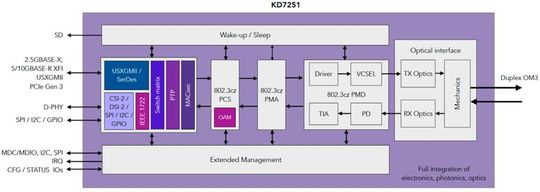
BASE-AU transceiver integration into the vehicle network
(Image: KD)
The KD7251 is the first optical transceiver that enables data transmission over automotive-qualified optical fibers according to IEEE Std 802.3cz.
(Image: KD)
Signal replication for redundancy
Another outstanding feature is signal replication. With the KD725X, the electrical output of the deserialized signal can be sent to another transceiver, which then regenerates the optical signal and transmits it over a second fiber. This function offers:
Optical path redundancy: essential for security applications that require fail-safe communication
Loop-through topologies: useful for linking control devices or camera modules in ring or mesh configurations
Testing and diagnostics: enables data streams to be tapped without interrupting the primary connection
From a pure transport layer, BASE-AU evolves into a smarter and more modular network component, benefiting dynamic vehicle architectures.
Smarter Eyes: Faster Reflexes
As the "eyes" of future vehicles, cameras can only be as powerful as the networks that connect them. With BASE-AU, automakers and suppliers have access to a specially developed optical Ethernet solution that meets the stringent mechanical, thermal, and electromagnetic requirements of the industry. Whether for driver monitoring, side mirrors, environmental perception, or backbone integration, BASE-AU enables visual real-time intelligence and robust zonal networking in the vehicle like never before. (se)



:quality(80)/p7i.vogel.de/wcms/d0/4c/d04c032c8e1e150bf33ba84def4ed9a6/0130721540v1.jpeg "Müller Precision Tools supports its customers with customized, application-specific tools. (Image: Müller)")
:quality(80)/p7i.vogel.de/wcms/f0/7a/f07aa6f8243048d3bc7156fa4fc263bb/0113143253v1.jpeg "In our China Market Insider, we regularly provide you with relevant information directly from China. (Image:© Eisenhans - stock.adobe.com)")
:quality(80)/p7i.vogel.de/wcms/c0/92/c0922365a230627bafa6a3ed7fbe15d7/0131573143v1v1.jpeg "The EU members of the European Parliament have voted by a majority in favor of the planned tariff agreement coming into effect. Trump's threats have clearly worked ... (Image: F. Schneidler)")
:quality(80)/p7i.vogel.de/wcms/81/22/8122583abe81b65e0590e99aa189b001/0131847826v1.jpeg "Rymoplast has invested in a recycling plant in Markranstädt, Saxony, near Leipzig. There, high-quality granulate is produced from plastic films. However, the thermal management of the processing systems must be optimal for this. Technotrans had the right solution ... (Image: Rymoplast)")
:quality(80)/p7i.vogel.de/wcms/72/a4/72a42738f6a899a841d4fa5961aca547/0131865780v1.jpeg "Siemens Industrial Edge enables customers to deploy and manage edge devices and apps directly at the production site. The app ecosystem ensures seamless connectivity to industrial systems, IT systems, and the cloud. (Image:Siemens)")
:quality(80)/p7i.vogel.de/wcms/bb/38/bb38b290715449fdcb977cb4a0c720be/0131850167v1.jpeg "To make manufacturing faster, more robust, and more flexible, production must be designed in a more IT-oriented manner. This also requires virtual controls. (Image: Audi AG)")
:quality(80)/p7i.vogel.de/wcms/ab/e8/abe8dd2398744832931a48d525b18acf/screenshot-202026-04-02-20163710v1.png "The interplay of horizontal and vertical grinding discs effortlessly creates a 2-mm radius with maximum efficiency. (Source: Teqram)")
:quality(80)/p7i.vogel.de/wcms/de/49/de496edc0815d63154eccc7d1341d696/0131501872v1.jpeg "Cybersecurity: is increasingly evolving from an isolated IT discipline to an integral part of industrial value creation. (Image: Designed by Freepik)")
:quality(80)/p7i.vogel.de/wcms/7d/f0/7df0df2c3fc0cd9cb7fd614412361aac/henkel-20ami-20pm-20anodis-uminium-bild-201-v1.jpeg "Henkel research in action: The development of Bonderite M-AD 2000A demonstrates how targeted additives can make anodizing processes more energy-efficient, sustainable, and economical. (Source: Henkel)")
:quality(80)/p7i.vogel.de/wcms/e3/01/e3018c55021f2a0ce0745124354eb96e/6000x4000v1.jpeg "Holographic projection of a model of a human ear. (Source: Adrien Buttier/EPFL)")
:quality(80)/p7i.vogel.de/wcms/2c/65/2c65057b446b0c6fd5f59a51af9081c1/ruderer-pm-sonderfahrzeugbau-caravan-cmyk-02v1.jpeg "Modern adhesives and sealants enable stable, tight, and economical connections in special vehicle construction – from vehicle structure to interior fittings to repairs. (Source: Ruderer)")
:quality(80)/p7i.vogel.de/wcms/dc/1e/dc1e164ca1e524e7cb48de6fd6a16a1c/hytank-ifam-pi-bilder-1-ad-plasmav1.png "Non-contact atmospheric pressure plasma pretreatment of a CFRP surface. (Source: Fraunhofer IFAM)")
:quality(80)/p7i.vogel.de/wcms/52/8f/528f5c85caa342eaa46e101351bbb1ee/a201486-largev1.jpeg "Permanent magnets from electric motors contain valuable raw materials. (Source: Audi)")
:quality(80)/p7i.vogel.de/wcms/5a/b6/5ab6a38b387b4f9d9f18e889588d85da/0131905522v1.jpeg "The Chinese are clever! After the EU introduced countervailing duties on electric cars, they quickly realized that plug-in hybrids, like the Sealing 6 Touring from BYD, were not affected. However, the EU Commission now wants to block these loopholes... (Image: BYD)")
:quality(80)/p7i.vogel.de/wcms/5c/46/5c4696dbe0c30e52f9cccb6b0aba1af9/b2026cw00206v1.jpeg "Oliver Blume has reaffirmed the automaker's cost-cutting strategy. (Source: Volkswagen)")
:quality(80)/p7i.vogel.de/wcms/49/d2/49d254cee8bf109b21ebe0012ab7b896/0131877440v1.jpeg "Press conference for the opening of the Schaeffler Automotive Symposium 2026 (from left): Klaus Rosenfeld, CEO of Schaeffler AG, together with Matthias Zink, Board Member Powertrain & Chassis, and Thomas Stierle, Board Member E-Mobility. (Image:Schaeffler | Daniel Karmann)")
:quality(80)/p7i.vogel.de/wcms/49/db/49dbdb906050c2ee2f12aca95a309599/0131907985v1.jpeg "System-wide context integration: AI agents consolidate isolated data from ALM, PLM, and ERP systems into well-founded decision templates. (Image: PTC)")
:quality(80)/p7i.vogel.de/wcms/a8/f7/a8f769adac577406bb0c56f5b7535564/0131874725v1.jpeg "Huge success: In 1983, the Controller Area Network was born. A revolution, as it reduced wiring efforts, is fail-safe, and real-time capable. (Image: ©Elena - stock.adobe.com / AI-generated)")
:quality(80)/p7i.vogel.de/wcms/d3/37/d337fde36d300515a0d679aa55fb5432/0131894777v1.jpeg "Mixed-signal and power semiconductors: The services of the Cosmic Group support customers from the initial design phase to the end-of-line test. (Image: Cosmic Group)")
:quality(80)/p7i.vogel.de/wcms/40/77/4077a0064066bde13aa0a8e2817c8858/0131879275v1.jpeg "Bosch location in Shanghai: Due to unauthorized deliveries to Huawei, Bosch must pay a multi-million dollar fine in the USA. (Image: Bosch)")
:fill(fff,0)/images.vogel.de/vogelonline/companyimg/76800/76895/65.jpg "FAULHABER_120mm.jpg ()")

:quality(80)/p7i.vogel.de/wcms/cf/21/cf21693f46907be0599dfa2f62060f18/0124131847v1.jpeg "Ethernet connectivity solutions are crucial for software-defined vehicles. They form the basis for high-performance E/E architectures consisting of central computing units, zones and endpoints. (Image:Infineon)")
:quality(80):fill(efefef,0)/p7i.vogel.de/wcms/67/ae/67ae0b9ac31f8/elatec-wp-universal-reader.png "Elatec WP Universal Reader")
:quality(80)/p7i.vogel.de/wcms/64/72/64725890ef9aa0addc572b790a670f2b/0131737714v1.jpeg "Optical automotive camera from Hinge based on KD's KD7251 for data transmission at 10 Gbit/s (Image:kd)")
:quality(80)/p7i.vogel.de/wcms/4e/15/4e15d1c92ff2bc5169291db403dd86e2/0131594892v1.jpeg "Thanks in part to advances in the field of automotive Ethernet, car manufacturers can equip their vehicles with a wider range of functions. (Image:Texas Instruments)")