Timing Components between AI and AutomotiveThe Clock Has to Run Faster—and Last Longer
From
Susanne Braun
| Translated by AI
8 min Reading Time
AI data centers are pushing frequencies, bandwidth and synchronization requirements higher. Automotive and industrial applications, meanwhile, demand stable products and supply over many years. TXC develops timing solutions for both worlds—and increasingly sees supply capability as part of the design.
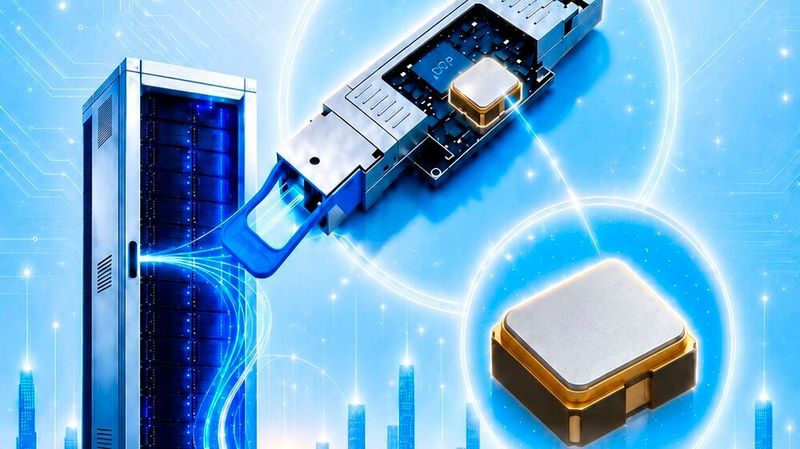
TXC targets high-speed optical links in AI data centers with 312.5 MHz oscillators, among other solutions. As data rates increase, requirements for jitter and frequency stability become more demanding as well.
(Bild: TXC)
A crystal or oscillator is not necessarily one of the components that attracts much attention in an AI data center. GPUs, switches and optical links are more visible and considerably more expensive. Yet all these components still have to operate to the right clock, and that clock is becoming more demanding. The more computing power is concentrated within a rack, and the more strongly individual racks and clusters communicate with one another, the more important not only the frequency itself becomes. Phase jitter, phase noise and synchronization all influence whether data arrives where it is needed at the right time.
“Precise synchronization used to take place mainly in mobile networks,” says Oak Yu, Marketing & Sales Center Director at TXC. “Today, we see synchronization everywhere—including in the data center.” TXC has been developing crystals and oscillators for more than four decades. Yu himself describes them during the conversation as “very simple products”. The physical principle behind them is old, but their applications are not becoming any simpler.
More Computing Power also Increases Synchronization Pressure
In conventional data centers, computing and communication tasks could be separated more clearly. AI clusters are changing that. GPUs need to exchange data with one another, processors communicate with memory and accelerators, and multiple racks are combined into larger computing units. Like the system manufacturers, TXC distinguishes between scale-up within a rack, scale-out between racks and scale-across between larger clusters.
For timing components, these are not simply three versions of the same problem. Depending on the architecture, connection technology and distance, the requirements for frequency, accuracy and jitter change. According to TXC, optical interconnects are growing particularly strongly. Computing power alone is of little use if data cannot move quickly enough between the different parts of an AI system, which means compute and bandwidth have to scale together. That has consequences for components whose role on a schematic may initially look rather unspectacular: it is not enough for a clock simply to be present. It has to remain stable enough under the relevant operating conditions.
156.25 MHz is not the End Point
One example is the frequency development of timing solutions for data centers. For a long time, 156.25 MHz was a typical frequency in this field. TXC is now seeing a shift toward 312.5 MHz and 625 MHz, and Yu expects these higher frequencies to account for a larger share as early as next year, in 2027.
Higher frequency, however, is only part of the development. With fast data links, phase jitter and phase noise also become more important. If the clock varies too much, the point in time at which a signal is evaluated shifts, and at high data rates there is increasingly little margin for such deviations. TXC is therefore not only working toward higher frequencies, but also toward lower jitter values and tighter specifications.
Yu cites PCIe as one example. For future generations, the company says it wants to develop timing solutions whose performance does not merely meet the current specification, but remains well below its limits. “We should not only meet our customers’ requirements,” Yu says. “We should be one step ahead of them.” There is a practical problem behind that strategy: if a timing component is only developed once a new interface has already been defined, it may arrive too late for early designs.
The Crystal Gets Smaller, but the Requirements do not
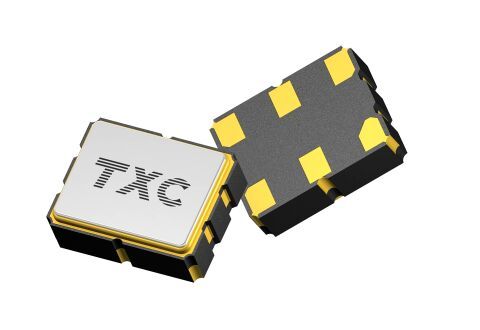
Programmable MHz oscillator from TXC. Timing components of this type are used where stable reference clocks and flexible frequency selection are required.
(Bild: TXC)
At the same time as frequencies rise, pressure on component size is increasing. TXC uses photolithographic processes to manufacture quartz blanks on a wafer basis. Compared with older mechanical processes, this is primarily intended to provide more uniform production. According to the company, TXC produces several tens of millions of quartz blanks per month in this way. Miniaturization is continuing as well, and the company is already working on package sizes below today’s very small variants.
Date: 08.12.2025
Naturally, we always handle your personal data responsibly. Any personal data we receive from you is processed in accordance with applicable data protection legislation. For detailed information please see our privacy policy.
Consent to the use of data for promotional purposes
I hereby consent to Vogel Communications Group GmbH & Co. KG, Max-Planck-Str. 7-9, 97082 Würzburg including any affiliated companies according to §§ 15 et seq. AktG (hereafter: Vogel Communications Group) using my e-mail address to send editorial newsletters. A list of all affiliated companies can be found here
Newsletter content may include all products and services of any companies mentioned above, including for example specialist journals and books, events and fairs as well as event-related products and services, print and digital media offers and services such as additional (editorial) newsletters, raffles, lead campaigns, market research both online and offline, specialist webportals and e-learning offers. In case my personal telephone number has also been collected, it may be used for offers of aforementioned products, for services of the companies mentioned above, and market research purposes.
Additionally, my consent also includes the processing of my email address and telephone number for data matching for marketing purposes with select advertising partners such as LinkedIn, Google, and Meta. For this, Vogel Communications Group may transmit said data in hashed form to the advertising partners who then use said data to determine whether I am also a member of the mentioned advertising partner portals. Vogel Communications Group uses this feature for the purposes of re-targeting (up-selling, cross-selling, and customer loyalty), generating so-called look-alike audiences for acquisition of new customers, and as basis for exclusion for on-going advertising campaigns. Further information can be found in section “data matching for marketing purposes”.
In case I access protected data on Internet portals of Vogel Communications Group including any affiliated companies according to §§ 15 et seq. AktG, I need to provide further data in order to register for the access to such content. In return for this free access to editorial content, my data may be used in accordance with this consent for the purposes stated here. This does not apply to data matching for marketing purposes.
Right of revocation
I understand that I can revoke my consent at will. My revocation does not change the lawfulness of data processing that was conducted based on my consent leading up to my revocation. One option to declare my revocation is to use the contact form found at https://contact.vogel.de. In case I no longer wish to receive certain newsletters, I have subscribed to, I can also click on the unsubscribe link included at the end of a newsletter. Further information regarding my right of revocation and the implementation of it as well as the consequences of my revocation can be found in the data protection declaration, section editorial newsletter.
Small dimensions are particularly important for mobile and compact edge devices, while other applications have different priorities. Automotive and data-center customers, for example, increasingly require operation at higher temperatures; Yu cites up to 125 °C (257 °F) as a requirement customers are now asking for. Communications and AI applications add demands for low jitter and low phase noise, while other applications require low ESR or low hysteresis over temperature. A smaller crystal is therefore not automatically a better crystal. The application simply determines which parameter becomes critical first.
Automotive Deliberately Moves More Slowly
While requirements in AI data centers can change significantly within only a few product generations, automotive works differently. Here, the slower pace is not a technological weakness but part of the business. Yu describes automotive as a market in which reliability, supply capability, flexibility and long-term stability carry more weight than the rapid introduction of every new technology.
Leo Kao knows this logic from the European market. He is the Director of the European Office for TXC in Frankfurt and supports European automotive customers, among others. European Tier 1 suppliers often work with product lifecycles of five to ten years, Kao explains, and a design does not disappear simply because a technically more attractive oscillator becomes available three years later.
For TXC, that initially represented a major barrier to entry. Japanese competitors had already been working with European automotive companies since the 1970s and 1980s in some cases. When TXC entered the market later, it lacked one thing above all: history. “We had no track record,” Kao says of that period. The necessary certifications were in place, but initially they merely created the conditions required to be considered at all.
According to TXC, faster-moving automotive markets in China and projects with newer EV manufacturers then helped the company build this experience. With that background, TXC approached established European Tier 1 suppliers again. That is a different path from AI: in the data center, a supplier has to be ready early enough for the next technical generation. In automotive, it also has to prove that it will still be there when that generation is no longer new.
Europe Looks beyond the Data Sheet
Kao sees the same principle outside the vehicle as well. Industrial automation, medical technology, energy infrastructure and other European applications often have long lifecycles. A component designed into a product today may still be required many years later, so the frequency and jitter of an oscillator are only part of the selection process.
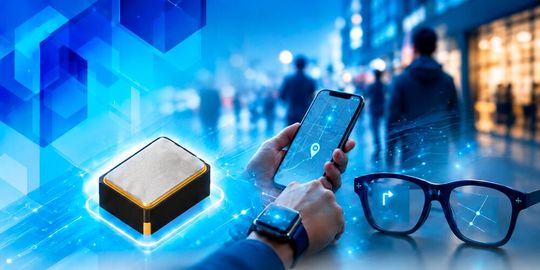
A compact TXC TCXO shown in the context of mobile and connected applications. In addition to size, low power consumption and stable frequency over changing temperatures are key requirements.
(Bild: TXC)
European customers expect local technical contacts, fast response times and support in their own language, Kao says. They also expect quality processes, long-term availability and transparent handling of changes and product discontinuations. For smaller and medium-sized companies in particular, direct sales focused only on a few major OEMs are not enough. TXC therefore also relies on technically oriented distributors and local stock in Europe.
For Kao, a distributor should do more than sell components. It should support design-ins, identify new applications and provide technical assistance. That may initially sound like a sales issue, but it touches on a technical reality: the longer a product is expected to remain in the field, the more important it becomes to know who will still be available when something changes.
A Discontinuation is not a Minor Event in a Ten-Year Product Cycle
This becomes particularly clear in change management. If an industrial, medical or automotive product remains on the market for many years, changing even a single timing component can trigger additional testing. In automotive, documented approval and qualification processes add another layer, which means a manufacturer cannot simply announce at some point that a component will disappear in six months.
Kao names stable quality, stable supply, transparent change management and long-term availability as central expectations among European customers. The price of a single crystal may be low. The cost of an unplanned redesign is not.
The Supply Chain Now Starts with the Engineer
Kao goes one step further. “Supply-chain stability is no longer purely a logistics or commercial issue,” he says. “It is part of engineering.” The question of future supply is therefore increasingly being asked before the engineer makes a final component choice: How long is the product expected to remain in production? Which locations can manufacture the component? What alternatives are available? Which qualifications would be required if production were moved?
TXC is responding to this pressure with a broader manufacturing base. In addition to its sites in Taiwan and China, the company now also manufactures in Japan and Indonesia. These additional locations are intended, among other things, to serve customers that want to reduce their dependence on individual countries. TXC has also expanded the number of sources for the ASICs used in its oscillators following the semiconductor shortages of 2021 and 2022.
Yu currently sees less risk around artificially grown quartz itself. According to him, TXC maintains more than 36 months of inventory and works with several Japanese suppliers. Such a long inventory range may initially seem unusual, but it is easier to achieve with a very small raw material than with high-volume components. That does not make the supply chain crisis-proof; it simply reduces one dependency.
Europe’s AI Opportunity May Be Closer to the Machine
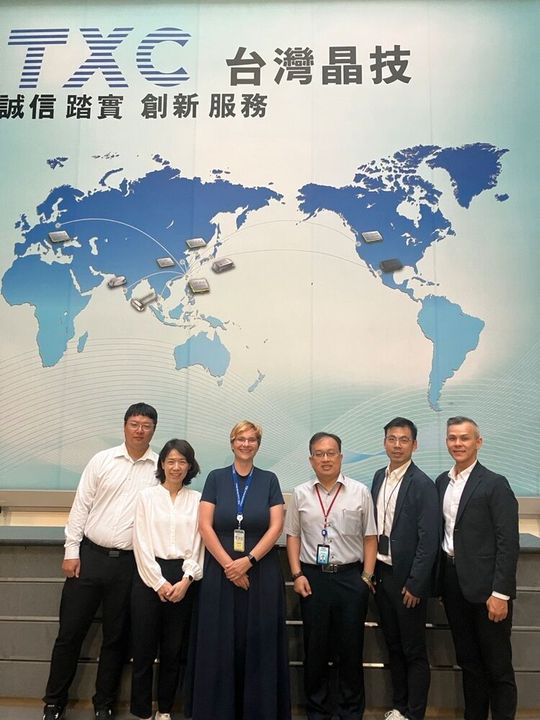
During a visit to TXC in Taiwan: Susanne Braun with members of the TXC team.
(Bild: VCG)
Kao sees another European market that brings these topics together: Edge AI. American and Asian companies have a clear lead in large cloud platforms, he says, while automotive, mechanical engineering, industrial automation, energy and specialized applications look different.
In these areas, data is generated directly in the application. At the same time, data protection, response time and control play a greater role. Kao therefore sees on-device AI as an area in which European companies could develop their own strengths. Automation is also becoming more attractive because of labor shortages and high production costs.
For timing components, this shifts the application landscape once again. The crystal is no longer found only in smartphones, base stations or servers. It also ends up in robots, controllers, sensors, vehicles, medical devices and other connected systems. Volumes may grow, but the requirements will not become more uniform as a result.
A Small Timing Component between Two Speeds
TXC describes AI and automotive internally as its two major growth drivers. Technically, their requirements could hardly be more different. AI infrastructure moves quickly because frequencies are increasing, optical links are expanding and timing specifications are becoming tighter. A component ideally has to be ready before the next standard has fully arrived in the market.
Automotive and European industry demand something else in addition: a product should remain qualified and available, and changes should trigger as little disruption as possible. Customers want to know what will happen in five or ten years. The timing component sits exactly between these two speeds. Its frequency is increasing, but its lifecycle does not automatically become shorter.



:quality(80)/p7i.vogel.de/wcms/20/fa/20fa35e0af203c3464f7e7fdbb57a685/0133281172v1.jpeg "Since 2003, Etzinger AG has been developing and manufacturing high-quality coffee grinders, pepper mills, and grinding mechanisms for professional and home use. (Image:Etzinger)")
:quality(80)/p7i.vogel.de/wcms/69/91/6991413943488b4a2f6fde9dcd88c5b0/0133256686v1.jpeg "The CMA-patented pendulum mount can compensate for radial tolerances of up to one millimeter. (Image:Schwiening)")
:quality(80)/p7i.vogel.de/wcms/0b/cd/0bcd6d502ffcd087c4fc12b7b760b3ce/0133317507v2v1.jpeg "The new Multi Center from J.G. Weisser. (Image:J.G. Weisser)")
:quality(80)/p7i.vogel.de/wcms/6a/ef/6aef8ea2d02622844db469c705a21222/0133322968v1v1.jpeg "Canada and the U.S. have been locked in a trade dispute ever since Donald Trump was re-elected as U.S. president. In the long run, however, Canada could end up being the loser. That is why the country is turning more toward its trading partner, the EU. Something very special is set to emerge... (Image:AI-generated)")
:quality(80)/p7i.vogel.de/wcms/35/81/35815f36be1b1c13f9abef4cea2a3e2b/0133171739v1.jpeg "Humanoid robots in industry: Despite impressive progress, many systems are still in the pilot phase. (Image:AI-generated)")
:quality(80)/p7i.vogel.de/wcms/81/dc/81dc63ed24c562521413023779495e7d/chris-kramerv1.jpeg "Chris Kramar, Director and General Manager of OEM Solutions for Germany, Austria, and Switzerland at Dell Technologies (Source: Dell Technologies)")
:quality(80)/p7i.vogel.de/wcms/bb/f5/bbf5342f532debc1bd7c09c2b9a0bf42/0133176497v1.jpeg "Over the past two years, AI has emerged as the most important growth driver in the industry. (Image: ©Gorodenkoff - stock.adobe.com)")
:quality(80)/p7i.vogel.de/wcms/01/61/01615a0939754c41e9d2c8971bf0b38a/web-image-kuka-kmf-1500p-300-dpi-1v1.jpeg "Thanks to its design, the KMF 1500P-CB is suitable for the stable and flexible handling of closed and open pallets. (Source: Kuka)")
:quality(80)/p7i.vogel.de/wcms/98/73/98731d23cbd95ff22391993a74cfefbf/mit-bifurcatedcircuits-01-pressv1.jpeg "A sample of the variety of configurations that Bifur circuits can form. (Source: Courtesy of the researchers)")
:quality(80)/p7i.vogel.de/wcms/f4/3d/f43d1f4297d9ae0cd1b6d2adfcb5ffe1/0133276470v1.jpeg "Simulation: Electric arcs in the electrical industry, including associated field simulation. (Image:CADFEM)")
:quality(80)/p7i.vogel.de/wcms/1d/fb/1dfbb415cd837102a33ce21ecf052ec3/0133277411v1.jpeg "LED drivers: LED circuit boards connect the light fixture to the electronics. During design, the operating current, forward voltage, and temperature must be taken into account across the entire operating range. (Image: ©Maria - stock.adobe.com)")
:quality(80)/p7i.vogel.de/wcms/80/8a/808a0eccf49a2a4fe560bd1998506ef9/0133308770v1.jpeg "Just like that, the supports are gone! High-speed footage of the automated, ultrasound-based process for removing optimized support structures from additively manufactured metal parts. It will be presented for the first time at Formnext from November 17 to 20. (Image:Fraunhofer IAPT)")
:quality(80)/p7i.vogel.de/wcms/73/06/7306146c5296cdd9bd77433f736c28e9/0133344456v1.jpeg "Tesla plans to bring its electric tractor-trailer to Europe in 2027. (Image:Tesla)")
:quality(80)/p7i.vogel.de/wcms/bf/fa/bffae31a7688e8c6721da41a7a6b502e/dsc00333-1536x864v1.jpeg "On August 10, 2026, Coolfly officially unveiled Urban, a flying vehicle designed for standing passengers. (Source: CoolFly)")
:quality(80)/p7i.vogel.de/wcms/fe/a8/fea8f62ea056f3c5334931f38cb80c76/0133324887v1v1.jpeg "It's flying off the shelves! The ID.Polo electric compact car seems to be living up to Volkswagen's expectations. After all, there are already more than 30,000 orders. The three sister models are also selling well... (Image:Volkswagen)")
:quality(80)/p7i.vogel.de/wcms/cb/00/cb0048b5a5df1a016d82aafa60aab9a9/35fa3e8bcf12df84fcc0b7ade728c03dv1.jpeg "Xiaomi has unveiled four new models. The large SUVs all have a gasoline engine to charge the battery. (Image:Xiaomi)")
:quality(80)/p7i.vogel.de/wcms/8d/f9/8df95d3f58408673986b3d643e6b63ba/0133252773v1.jpeg "TXC targets high-speed optical links in AI data centers with 312.5 MHz oscillators, among other solutions. As data rates increase, requirements for jitter and frequency stability become more demanding as well. (Bild: TXC)")
:quality(80)/p7i.vogel.de/wcms/b4/85/b48565f20a330043d0cd8c5f708f779f/0133316091v2v1.jpeg "The open Chiisai standard supports the cross-vendor development of HALs, middleware, and embedded software for small microcontrollers. (Image:Vector Informatics)")
:quality(80)/p7i.vogel.de/wcms/6c/a6/6ca6c6410e051401d5596d5cc6dfa277/0133283570v1.jpeg "From Core to Platform: With MIPS, ARC, and RISC-V, competition is shifting from individual processor IP blocks to integrated compute platforms for specialized applications. (Image:Dall-E / AI-generated)")
:quality(80)/p7i.vogel.de/wcms/73/17/73174a2afe684fa12d7d6a57b29b20e2/0133305506v1.jpeg "AI data centers are a key driver of direct current technologies. (Image:Pixabay / Brian Penny / AI-generated)")
:quality(80)/p7i.vogel.de/wcms/c4/9f/c49f5b8173f678f7ef071355b1fbbd7c/yamu-jay-ai-generated-9088888v1.jpeg "As part of a strategic partnership, Siemens and Reinhausen are advancing the future of energy supply solutions for AI data centers. (Symbol image) (Source: pixabay / AI-generated)")
:quality(80)/p7i.vogel.de/wcms/2d/46/2d4652baa2a877fe8732f4446f35b406/0127093746v1.jpeg "MEMS oscillators: As a quartz-free alternative, MEMS oscillators offer several advantages that make them ideal for future miniaturized applications. (Image:SiTime)")
:quality(80)/p7i.vogel.de/wcms/47/b1/47b176cd1561caa1bbdf7ca2f2f17f8b/0131917536v1.jpeg "With the help of this MID experimental station at European XFEL, new insights were gained into the emergence of vibrations in mixed material systems of copper and platinum. In the center is the AGIPD 1M detector used for this purpose. And here it is explained what was done ... (Image: European XFEL / A. Heimken)")