Researchers at Fraunhofer IVV, in collaboration with 51 partners from industry and academia in the Innovation Lab KIOptiPack, are developing AI-supported optimization tools to circulate plastic packaging in the future.
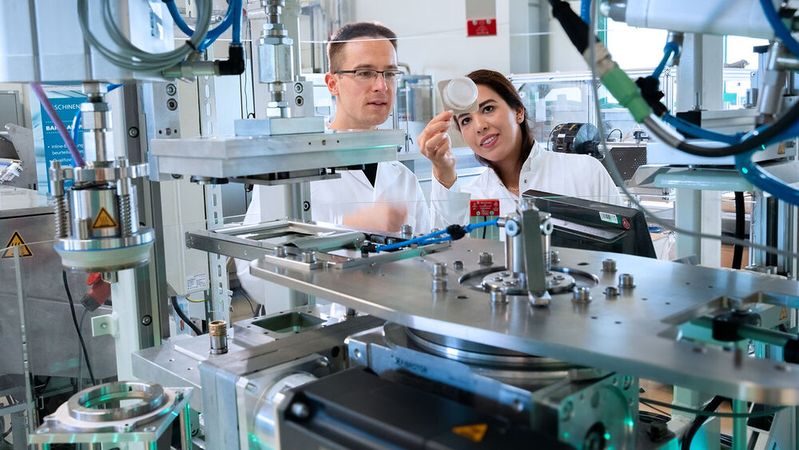
Experts from Fraunhofer IVV are optimizing a process for packaging production. As part of the KIOptiPack project, they are also developing AI tools to make plastic packaging ready for the circular economy.
(Image: Fraunhofer IVV)
In Germany, more than 60 percent of packaged goods are wrapped in plastic. Therefore, the plastics industry aims to promote the circular economy with the ideal packaging design (Design for Recycling). Ideally, packaging should have the highest possible recycled content. A new EU regulation also mandates that by 2030, packaging made of plastic must be produced with a minimum content of up to 35 percent recycled materials.
This is where the research of KIOptiPack comes in—together with project partners, researchers from the Fraunhofer Institute for Process Engineering and Packaging IVV are using artificial intelligence as a game-changer in recycling and for processing recyclate into packaging to meet the technical challenges and high demands of packaging production. The aim is to reduce plastic waste, create more sustainable packaging, and address the raw material demand through reuse as recyclate.
For this purpose, the researchers at Fraunhofer IVV have developed AI-based optimization tools and networked them using a data space. This makes it possible to circulate these packages and optimize them holistically. Besides the question of environmental compatibility and life cycle assessment, aspects of functionality, design, customer acceptance, and manufacturability are taken into account. Once all data is fully integrated, the AI tools propose the best possible packaging designs for a specific product while minimizing material usage. The data space captures all the necessary digital data on material properties, origins, and destinations and links them.
If recyclates are contaminated by undesirable substances such as foreign plastics, printing inks, or degradation products, this can significantly impair their quality and even render them unusable. Once plastics are circulated, they can essentially contain impurities.
Prof. Dr. Andrea Büttner
Uniform Terminology Needed for Dealing With Plastics
"To better incorporate recyclates into packaging solutions, a shared data space is essential," says Prof. Dr. Andrea Büttner, Director of the Fraunhofer IVV. "Recyclate is a valuable material. However, the quality of the recyclable plastic must be right. If recyclates are contaminated by undesirable substances such as foreign plastics, printing inks, or degradation products, this can significantly affect their quality and even render them unusable. Once plastics are kept in circulation, they can potentially contain impurities." This presents particular challenges for the industry. From recyclate manufacturers to companies producing packaging films, to the food industry, systematic data exchange and a uniform terminology for handling plastics are needed. This especially concerns polyolefins—the largest group of plastics, which can change significantly during their processing.
AI helps in choosing the right recycling method
"In order for recyclates to be processed to a high quality, AI-supported tools are needed. Our modular software solutions developed at Fraunhofer IVV support, among other things, the characterization and analysis of material properties and link information flows so that suitable application fields can be identified for recyclates with varying properties," says Dr. Matthias Reinelt, Head of the Shelf Life and Packaging Modeling Group at Fraunhofer IVV. "Our AI tool for packaging production uses as much information as possible about the recyclate to determine the optimal processing process, so that at the end of the process chain, for example, a sustainably manufactured yogurt cup with homogeneous wall thickness distribution and the desired shape can end up on the store shelf." The researchers also assess the quality of the recyclates using chromatographic analysis methods, which also utilize AI tools for improved substance identification. This is intended to prevent unsuitable or contaminated recyclates from entering the cycle despite good sorting.
The AI-based optimization tools and the interconnected data room of Fraunhofer IVV and the project partners are partially integrated directly into the production process of the respective manufacturers. Real-time suggestions for further processing depending on the recyclate used on the machines on-site are thus possible.
We cannot fill the recycling gap in the plastics sector in the long term with isolated solutions. Our AI-supported optimization tools, which interlink material and information flows, address the problem.
Prof. Dr. Andrea Büttner
AI Tools Address the Recyclate Gap
The use of recyclates in plastic products is steadily increasing, but despite this development, the amount of recycled plastics will not be sufficient to meet the mandated legal recyclate usage quotas. The gap between supply and demand for plastic recyclates will grow in the coming years. By 2030, the demand for recyclates is expected to exceed the supply by 30 percent. "With isolated solutions, we cannot fill the recycling gap in the plastics sector in the long term. Our AI-supported optimization tools, which integrate material and information flows, address the problem. We network actors from various industries and try to respond better to resource shortages," summarizes Prof. Büttner.
Date: 08.12.2025
Naturally, we always handle your personal data responsibly. Any personal data we receive from you is processed in accordance with applicable data protection legislation. For detailed information please see our privacy policy.
Consent to the use of data for promotional purposes
I hereby consent to Vogel Communications Group GmbH & Co. KG, Max-Planck-Str. 7-9, 97082 Würzburg including any affiliated companies according to §§ 15 et seq. AktG (hereafter: Vogel Communications Group) using my e-mail address to send editorial newsletters. A list of all affiliated companies can be found here
Newsletter content may include all products and services of any companies mentioned above, including for example specialist journals and books, events and fairs as well as event-related products and services, print and digital media offers and services such as additional (editorial) newsletters, raffles, lead campaigns, market research both online and offline, specialist webportals and e-learning offers. In case my personal telephone number has also been collected, it may be used for offers of aforementioned products, for services of the companies mentioned above, and market research purposes.
Additionally, my consent also includes the processing of my email address and telephone number for data matching for marketing purposes with select advertising partners such as LinkedIn, Google, and Meta. For this, Vogel Communications Group may transmit said data in hashed form to the advertising partners who then use said data to determine whether I am also a member of the mentioned advertising partner portals. Vogel Communications Group uses this feature for the purposes of re-targeting (up-selling, cross-selling, and customer loyalty), generating so-called look-alike audiences for acquisition of new customers, and as basis for exclusion for on-going advertising campaigns. Further information can be found in section “data matching for marketing purposes”.
In case I access protected data on Internet portals of Vogel Communications Group including any affiliated companies according to §§ 15 et seq. AktG, I need to provide further data in order to register for the access to such content. In return for this free access to editorial content, my data may be used in accordance with this consent for the purposes stated here. This does not apply to data matching for marketing purposes.
Right of revocation
I understand that I can revoke my consent at will. My revocation does not change the lawfulness of data processing that was conducted based on my consent leading up to my revocation. One option to declare my revocation is to use the contact form found at https://contact.vogel.de. In case I no longer wish to receive certain newsletters, I have subscribed to, I can also click on the unsubscribe link included at the end of a newsletter. Further information regarding my right of revocation and the implementation of it as well as the consequences of my revocation can be found in the data protection declaration, section editorial newsletter.
Secure and Compliant Authentication in Laboratories



:quality(80)/p7i.vogel.de/wcms/0b/1b/0b1b1bafe0e6a1059f5595f5d6f11339/geyser-2934-detail-15112787-bearbeitet-komprv1.jpeg "Robot-assisted high-pressure water jet deburring for targeted deburring and cleaning of complex components with holes, channels and functional areas. (Source: BvL)")
:quality(80)/p7i.vogel.de/wcms/66/8f/668fb85f23216f218cf3522b7ffb24a6/0130855591v1.jpeg "View inside the laser welding system. Left in the picture: a linear axis with two guides, the one on the right with integrated IMScompact position measuring system. (Image:RMA)")
:quality(80)/p7i.vogel.de/wcms/ed/8b/ed8b365dc82b2bdbe2efddca4089c79a/0130059646v1.jpeg "High-feed milling cutter in engagement and when reaching the maximum radial cutting depth. (Image:Walter)")
:quality(80)/p7i.vogel.de/wcms/a0/db/a0dbbf658663393c67520575f3a0e6b4/0131325829v1.jpeg "This is an example of a 3D-printed metal part that can be purchased via the Unionfab platform. The Shanghai-based service provider has now expanded its additive manufacturing capabilities ... (Image:Unionfab)")
:quality(80)/p7i.vogel.de/wcms/d7/ef/d7ef2b75402bad20038fe79dd55707d0/0131381195v1.jpeg "Enormous penetration: Thanks to the long range of LoRaWAN technology, even extensive and metal-heavy process plants can be monitored cost-effectively and completely wirelessly. (Image:Wika)")
:quality(80)/p7i.vogel.de/wcms/f3/8f/f38faf493aab4e05033cc999f1d00a16/dtm-founders-1280x719v1.png "Martin Schilling is a European tech ecosystem leader, entrepreneur, and startup operator known for scaling tech companies and supporting deep tech founders. (Source: DTM)")
:quality(80)/p7i.vogel.de/wcms/0a/22/0a22ee2682ff6c6907f78c6fb7e65667/0131215395v1.jpeg "The use of robots in day-to-day care is being tested and further developed in pilot projects such as this House of Generations. (Picture:APA-Images / dpa / Waltraud Grubitzsch)")
:quality(80)/p7i.vogel.de/wcms/0a/2c/0a2c8c41b29b1dfe6c1b4ec65a4be595/0131290447v1.jpeg "Quantum computing threatens most current encryption algorithms. (Picture: ©Jori - stock.adobe.com)")
:quality(80)/p7i.vogel.de/wcms/7d/b1/7db122e6de5f617d1342bb329eacf69d/adobestock-791450621--c2-a9-20imageflow-20-e2-80-93-20stock-adobe-com-5250x2952v1v1.jpeg "As the number of electric cars increases, so does the demand for lithium-ion batteries and the need for battery recycling technologies (symbolic image) (Image:ImageFlow - stock.adobe.com)")
:quality(80)/p7i.vogel.de/wcms/fc/b6/fcb6e8e646ca2cf11d6fc3d06479dbf5/2026-05-delo-building-photo-2400x1350v1v1.jpeg "Aerial view of the Delo site in Windach including the \"Forum\" and new laboratory building construction projects. (Image:Delo)")
:quality(80)/p7i.vogel.de/wcms/d4/65/d465ab0293db9125763560c71d900c73/adobestock-179817344--c2-a9-20industrieblick-20-e2-80-93-20stock-adobe-com-7611x4279v1v1.jpeg "The global kerosene market is around 100 billion gallons per year. How much influence the alternative aviation fuel could have on this remains to be seen over the next few years. (Image:industrieblick - stock.adobe.com)")
:quality(80)/p7i.vogel.de/wcms/78/10/7810cea1046df8ccf33db854c1bc73ae/img02-dual-monitor-setupv1.jpeg "The requirements for industrial automation solutions are changing rapidly. Systems are becoming more individualized, project lead times shorter - and international standards more complex. (Source: WSCAD)")
:quality(80)/p7i.vogel.de/wcms/b3/81/b3817656b1d9ba7e62af356c71aa2752/0131381600v1.jpeg "As part of the ongoing restructuring of its E division, ZF has decided to continue manufacturing electric motors and inverters itself in the future. (Image:ZF Group)")
:quality(80)/p7i.vogel.de/wcms/07/86/078634f1c74b37d42f11da9cd790244c/0131313804v1.jpeg "Sustainable materials are arriving in series production. For example wood, which replaces parts of the plastic structure. (Image:Stefan G. König 2026)")
:quality(80)/p7i.vogel.de/wcms/ce/a2/cea222df2dfcbbe47876a2a435b2628e/0131370363v1.jpeg "Jaguar is now showing pictures of an only slightly camouflaged prototype of the upcoming Type 01 (Image:Jaguar)")
:quality(80)/p7i.vogel.de/wcms/e8/4d/e84dc39f24681baa7568d259a602e4da/original-4967-693260-1-5-10858x6108v1v1.jpeg "Polestar uses magnetorheological shock absorbers. Originally developed in the USA, the patents are now located in China. (Image:Polestar)")
:quality(80)/p7i.vogel.de/wcms/7c/4b/7c4b0d4ee659d9c2c4d26d31395e4bdd/0131421069v1.jpeg "Industrial production of perovskite photovoltaics: Researchers develop scalable process. (Image:Alexander Diercks, KIT)")
:quality(80)/p7i.vogel.de/wcms/25/23/2523ba4192aebfda69ac39363d1d738a/0131397616v1.jpeg "With DARE SGA1, Europe wants to build its own supercomputing infrastructure based on open RISC-V technology. Chiplets, software stack and parallel debugging tools are intended to enable technological sovereignty and exascale performance for research, industry and AI. (Image:Dall-E / AI-generated)")
:quality(80)/p7i.vogel.de/wcms/4f/ef/4fefaa65bb3cf4165e759a280fbc49dd/0131368512v1.jpeg "Crescendo platform from Empower Semiconductor for \"Vertical Power Delivery\" (VPD). According to the news agency Bloomberg and Reuters, Analog Devices is interested in acquiring the manufacturer of power management chips for AI loads in data centers. (Image:Empower Semiconductor)")
:quality(80)/p7i.vogel.de/wcms/e9/72/e972c95b4a060cbd5e07bd2bc7e0a754/0131341947v1.jpeg "Strategic partnership: IONOS and Q.ANT want to work together on photonic computing in the future. (Image:Q.ANT)")
:fill(fff,0)/p7i.vogel.de/companies/69/88/69882c428938e/tmts2026-ticec-banner-en-2000px.png "tmts2026-ticec-banner-en-2000px (https://www.tmts.tw/en)")
:fill(fff,0)/p7i.vogel.de/companies/69/de/69de1b7403b0d/simtos-logo.jpeg "simtos-logo (SIMTOS)")
:quality(80):fill(efefef,0)/p7i.vogel.de/wcms/67/ac/67acb931a438c/elatec-wp-gmp.png "Elatec WP GMP")
:quality(80)/p7i.vogel.de/wcms/dc/9e/dc9e5002d3f508a0a92a1bddc3b8d38e/0128724232v1.jpeg "To obtain completely bio-based PBS for the first time, a specialized chemical is required. The researchers are working on an innovative technology. (Image:University of Oldenburg)")
:quality(80)/p7i.vogel.de/wcms/07/86/078634f1c74b37d42f11da9cd790244c/0131313804v1.jpeg "Sustainable materials are arriving in series production. For example wood, which replaces parts of the plastic structure. (Image:Stefan G. König 2026)")