What began as a niche tool for prototyping has evolved into an indispensable production technology. We are talking about additive manufacturing. According to the recruitment consultancy Kensington 360 and the online 3D printing service 3D-Druck-München, these are the key trends for this technology in 2026.
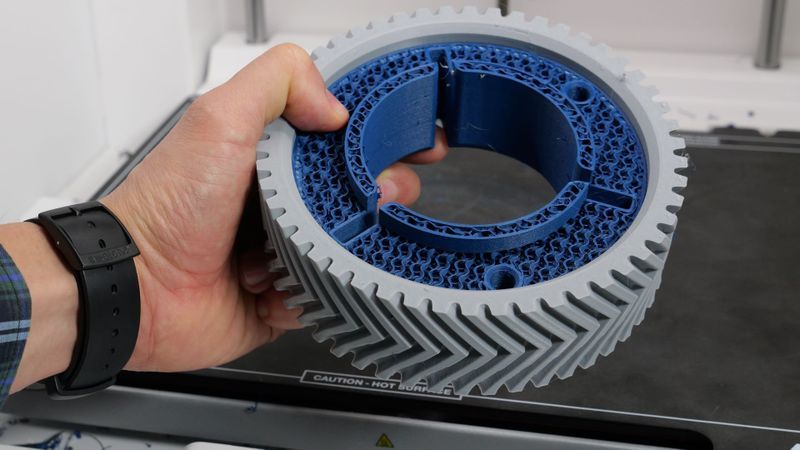
A trend in 2026: Multi-material printing – By combining different materials in a single print, advanced design possibilities can be unlocked, assembly steps reduced, part performance improved, and development times accelerated.
(Image: Ultimaker)
2026 marks the transition from "hype" to industrial maturity. Instead of individual prototypes, additive manufacturing now focuses on seamless, scalable applications with measurable benefits. Global forecasts reflect this rapid growth: the 3D printing market is expected to nearly triple by 2026, reaching around 44.5 billion US dollars. This means that industrial 3D printing in 2026 is evolving faster than many companies can plan for. Those who understand the new trends early can shorten delivery times, reduce supply chain risks, and accelerate projects—while competitors are still debating whether additive manufacturing is "already worth it."
1. From the Prototype Workshop to Serial Production
Additive manufacturing is definitively shifting its focus to applications: end-use parts, spare parts, tools, and fixtures are increasingly being produced additively—not as exceptions but as planned components of production. According to the recruitment consultancy Kensington 360 and the online 3D printing service 3D-Druck-München, reproducible processes, stable tolerances, and reliable delivery capabilities are crucial. For design and development, this means: Design for Additive Manufacturing becomes Design for Production—with clear specifications for target roughness, dimensional accuracy, and inspection concepts.
2. Automation and AI Along the Process Chain
By 2026, the question will no longer be "if" but "to what extent" AI will be used in 3D printing. Modern software automatically suggests support structures, part orientations, and fill structures, simulates critical areas, and reduces manual loops. The effect: designers and CAM specialists gain time for actual development work. At the same time, printer farms are becoming more automated: print jobs are distributed via queues, parts are automatically removed after printing, and machine statuses are monitored in real-time. Overall, the path from design-optimized part creation to a fully printed functional part is significantly shortened.
3. Post-processing as a Scaling Lever
Support removal, cleaning/de-powdering, and surface finishing remain the biggest time and cost drivers. By 2026, automated, closed post-processing solutions will become established—including standardized media/chemistry, defined target roughness, and integrated measurement and documentation. Those who consider finishing early in part design reduce rework, increase first-time pass rates, and accelerate approvals.
4. Materials and Sustainability as a Duo
Additive manufacturing has always been material-efficient, as material is only used where it is structurally needed. By 2026, it will take a step further: recyclates, bio-based polymers, and durable high-performance plastics will be specifically utilized to meet ecological and regulatory requirements. For many companies, the carbon footprint of components will become a negotiable factor—especially in supply chains with strict sustainability targets. Those who focus early on reliable data and suitable materials can gain an edge with customers while simultaneously achieving internal sustainability goals.
5. On-Demand and Distributed Manufacturing
Digital inventories are replacing physical stocks: files travel, parts are produced on demand close to the point of use—internally or through certified partners. This reduces tied-up capital, obsolescence, and delivery times. For spare parts, variant production, and small series, additive manufacturing thus becomes a supply chain tool. Requirements: IP protection, secure data rooms, traceability, and harmonized process windows across locations to ensure that parts from location A match the quality of those from location B.
Date: 08.12.2025
Naturally, we always handle your personal data responsibly. Any personal data we receive from you is processed in accordance with applicable data protection legislation. For detailed information please see our privacy policy.
Consent to the use of data for promotional purposes
I hereby consent to Vogel Communications Group GmbH & Co. KG, Max-Planck-Str. 7-9, 97082 Würzburg including any affiliated companies according to §§ 15 et seq. AktG (hereafter: Vogel Communications Group) using my e-mail address to send editorial newsletters. A list of all affiliated companies can be found here
Newsletter content may include all products and services of any companies mentioned above, including for example specialist journals and books, events and fairs as well as event-related products and services, print and digital media offers and services such as additional (editorial) newsletters, raffles, lead campaigns, market research both online and offline, specialist webportals and e-learning offers. In case my personal telephone number has also been collected, it may be used for offers of aforementioned products, for services of the companies mentioned above, and market research purposes.
Additionally, my consent also includes the processing of my email address and telephone number for data matching for marketing purposes with select advertising partners such as LinkedIn, Google, and Meta. For this, Vogel Communications Group may transmit said data in hashed form to the advertising partners who then use said data to determine whether I am also a member of the mentioned advertising partner portals. Vogel Communications Group uses this feature for the purposes of re-targeting (up-selling, cross-selling, and customer loyalty), generating so-called look-alike audiences for acquisition of new customers, and as basis for exclusion for on-going advertising campaigns. Further information can be found in section “data matching for marketing purposes”.
In case I access protected data on Internet portals of Vogel Communications Group including any affiliated companies according to §§ 15 et seq. AktG, I need to provide further data in order to register for the access to such content. In return for this free access to editorial content, my data may be used in accordance with this consent for the purposes stated here. This does not apply to data matching for marketing purposes.
Right of revocation
I understand that I can revoke my consent at will. My revocation does not change the lawfulness of data processing that was conducted based on my consent leading up to my revocation. One option to declare my revocation is to use the contact form found at https://contact.vogel.de. In case I no longer wish to receive certain newsletters, I have subscribed to, I can also click on the unsubscribe link included at the end of a newsletter. Further information regarding my right of revocation and the implementation of it as well as the consequences of my revocation can be found in the data protection declaration, section editorial newsletter.
6. Quality Assurance, Traceability, and Data Security
With the shift of function-critical components to 3D printing, the demands on quality assurance and digital security are increasing. By 2026, it will be standard to monitor printing processes, document parameters, and traceably label components. At the same time, design data must be protected: when CAD models and manufacturing parameters are exchanged between locations, partners, and service providers, access rights, encryption, and defined interfaces are a must. Additive manufacturing thus becomes part of the compliance and IT security strategy.
The exciting question in 2026 is no longer "3D printing or machining?" but rather: How can both be intelligently combined? Hybrid manufacturing leverages 3D printing for complex geometries and lightweight structures, complementing it with CNC machining for critical surfaces. This achieves tolerances that were previously only possible through traditional machining, while preserving the advantages of 3D printing—tool-free production, design freedom, rapid adaptation. Especially in fixture construction and functional prototypes, this opens up new possibilities. Companies that internalize this mindset can rethink components: fewer parts, less assembly effort, with targeted machining steps only where it truly matters.
8. New Processes and Multi-Material Printing
Innovations are leaving the lab: volumetric 3D printing (entire component in one step), ultra-fast SLA, or cold gas spraying for metals are addressing speed, material diversity, and geometric freedom. The shift from "one filament per component" to multi-material printing is in full swing. By 2026, components with integrated sealing elements, varying stiffnesses, or combined functions in a single print job will become significantly more common. For design teams, this means: expanding expertise in design-for-additive-manufacturing, understanding failure modes of new processes, and adjusting inspection protocols.
These trends clearly show: it's not about spectacular one-offs, but about scalable, economical applications. AI, sustainable materials, on-demand manufacturing, hybrid processes, and new materials all contribute to the same goal—faster developments, more stable supply chains, and more predictable costs. Those who consistently optimize for reproducibility, throughput, and data sovereignty use additive manufacturing where it has the greatest impact quickly, securely, and economically.



:quality(80)/p7i.vogel.de/wcms/9e/23/9e23111e49d73012e9e3b7c69428ad5c/0134019347v1.jpeg "The Dominant VA45 high-helix tap from Bass, made of lead-free brass. The long chips, which result from the absence of lead, are clearly visible. (Image:Bass, Inc.)")
:quality(80)/p7i.vogel.de/wcms/1d/09/1d0999956ef87709b72ab1d0402ba207/csf-minis-gruppe-final-01-outputv1.jpeg "Since mid-2026, Harmonic Drive has been offering its CSF Mini gearheads in size 7 as well, in six variants designed for different installation scenarios. (Source: Harmonic Drive)")
:quality(80)/p7i.vogel.de/wcms/ab/08/ab08675922c3a7edea45128248b45b00/0133857009v1.jpeg "In the aerospace industry—one of the most demanding sectors of all—the Shanghai-based company TOPNC has already made a name for itself. (Image:TOPNC)")
:quality(80)/p7i.vogel.de/wcms/ff/48/ff48b1154746e79128935f28bd73ba0e/0113143253v1.jpeg "In our China Market Insider, we regularly provide you with relevant information straight from China. (Image:© Eisenhans - stock.adobe.com)")
:quality(80)/p7i.vogel.de/wcms/ca/24/ca24d741a2fd714fa14d2a3e9db1c904/image1v1.jpeg "With 117,500 units sold, transportation and logistics will remain the leading application area for service robotics in 2025 as well. (Image:Innok Robotics)")
:quality(80)/p7i.vogel.de/wcms/b7/95/b795d5fb82459f8a526e880f0698dffa/1-maxon-mind-covershot-landscapev1.jpeg "Claude Jaquemet demonstrates the Maxon Mind demo system. (Source: Maxon)")
:quality(80)/p7i.vogel.de/wcms/be/66/be661616d5250d4c3814a25688f3904b/0133917202v1.jpeg "Neuron AI combines 3D vision, touch, hearing, proprioception, and language—along with memory—into a Perception-Language-Action (PLA) model. Robots can grasp objects they cannot see. (Image:Neura)")
:quality(80)/p7i.vogel.de/wcms/c7/12/c712b688dba2262fa3906e3a4c1d2f7d/humanoide-robotikv1.jpeg "“Find a job that the humanoid can actually do, and understand your processes”—that’s the advice robotics expert Sebastian Prinz gives companies so they can benefit from the technology in the long term. (Source: Fraunhofer IEM / Janosch Gruschczyk)")
:quality(80)/p7i.vogel.de/wcms/51/b8/51b8e08d2105fdd9952aff385f154192/graphic-2-adma1v1.png "The new surface hardening process enhances the performance of corrosion-resistant alloys by improving their tribological and mechanical surface properties, while preserving the properties of the base material. (Source: Bodycote)")
:quality(80)/p7i.vogel.de/wcms/96/ef/96effc239916cb7e0f396ab75627b8c0/image-space-testingv1.jpeg "Two scientists in front of a vacuum chamber used for testing: As technical instruments for spaceflight become more sensitive, the test facilities are becoming a critical system. (Source: Busch Group)")
:quality(80)/p7i.vogel.de/wcms/5a/12/5a1294a38a634f839f542c0055024d7a/jie-yin-feather-star-header-1500v1.jpeg "Underwater Acrobatics: The new soft robot mimics brittle stars—using minimal propulsion technology. (Source: North Carolina State University)")
:quality(80)/p7i.vogel.de/wcms/96/89/9689197f666e4aa9bc4a1f395c25d3ef/0133739635v1.jpeg "The 2026 Nobel Prize in Medicine laureates: Karl Deisseroth, Peter Hegemann, and Georg Nagel. (Image:Nobel Prize Outreach)")
:quality(80)/p7i.vogel.de/wcms/fe/f7/fef766ae8b8310ca6dd0852208923e4e/hendrik-malinowski-coo-01v1.png "Hendrik Malinowski Takes on New Role as CCO of BUGATTI RIMAC (Source: Bugatti)")
:quality(80)/p7i.vogel.de/wcms/d9/5f/d95fd82eb5368ce77a8bc9de3a085376/yoshihiro-nakatav1.jpeg "“We are a European manufacturer”: Yoshihiro Nakata, CEO of Toyota Motor Europe, at the corporate briefing in Brussels. (Image:Toyota)")
:quality(80)/p7i.vogel.de/wcms/e3/0b/e30b87c9b7a6c41b7e7336f34f0a8214/0133970831v1.jpeg "Tesla's planned expansion of vehicle and battery production capacity in Grünheide, near Berlin, appears to be gaining momentum, according to a recent announcement by the U.S. electric car manufacturer ... (Image: AI-generated)")
:quality(80)/p7i.vogel.de/wcms/23/5f/235fa4afabc57699636224d17e106b4b/kraemer-p2p-display-technologyv1.png "The cockpit display system from Krämer Automotive Systems shows driving-related information, infotainment, and vehicle functions. (Source: Krämer Automotive)")
:quality(80)/p7i.vogel.de/wcms/8b/35/8b35660420abba32fb891a4c5cc42fbd/0134018092v1.jpeg "Long-range UVC LED with lens and reflector: Close-up of a square LED with a transparent, dome-shaped lens on a dark base plate. The hermetically sealed housing ensures greater reliability and durability under demanding environmental conditions. (Image:FBH_Schurian)")
:quality(80)/p7i.vogel.de/wcms/a4/1c/a41cd52e0a26e5173bd4e1f834d4f7f4/0134025034v1.jpeg "As chips become more complex, the demands on semiconductor testing increase. Teradyne and FormFactor plan to combine their technologies for future applications. (Image:freely licensed)")
:quality(80)/p7i.vogel.de/wcms/7b/64/7b64e9fe595b88d2b01ed79e0f2baf94/pm-weidm-ller-elatec-substation-line-switchv1.jpeg "Caption: The Substation Line managed switches can accommodate up to three HSR/PRP modules. (Image:Weidmüller)")
:quality(80)/p7i.vogel.de/wcms/b3/bf/b3bf55a31510b319bb473f73aa205477/0133987448v1.jpeg "In court, Qualcomm achieved a partial victory in its legal dispute with Arm, but was awarded only a symbolic $2 in damages—for now. (Image:Dall-E / AI-generated)")
:fill(fff,0)/images.vogel.de/vogelonline/companyimg/76800/76895/65.jpg "FAULHABER_120mm.jpg ()")
:fill(fff,0)/p7i.vogel.de/companies/69/88/69882c428938e/tmts2026-ticec-banner-en-2000px.png "tmts2026-ticec-banner-en-2000px (https://www.tmts.tw/en)")
:fill(fff,0)/p7i.vogel.de/companies/69/de/69de1b7403b0d/simtos-logo.jpeg "simtos-logo (SIMTOS)")
:quality(80):fill(efefef,0)/p7i.vogel.de/wcms/67/af/67af6debad886/skz-whitepaper-future-trends-coverbild.png "SKZ Whitepaper_Future Trends_Coverbild")
:quality(80)/p7i.vogel.de/wcms/b4/9a/b49aaad0500e06e253f7d75ecb77338a/adobestock-4840668--dani-kreienb-hl-stock-adobe-comv1.jpeg "Metal processing in 2026 will be more digital, automated, and data-driven – but not automatically easier. (Image:© Dani Kreienbühl - stock.adobe.com)")
:quality(80)/p7i.vogel.de/wcms/5f/b9/5fb9d91a54917e7416c12f50d208ed21/0132441000v1.jpeg "Pjotr Horowitz, the CEO of Protolabs, was our interview partner to explore what defines prototyping today. A particular focus of the interview was on the possibilities of additive manufacturing with plastics. Learn more ... (Image:Protolabs)")