


:quality(80)/p7i.vogel.de/wcms/3f/cf/3fcfa390902944ffcf24e7fe973cc3ee/0133486258v1.jpeg "Do you need to create secure connections on structures using blind rivets, but space is tight? Then you should take a closer look at the Universalgrip from Gesipa ... (Image: Gesipa)")
:quality(80)/p7i.vogel.de/wcms/7d/e4/7de4d10508f689ec3d7fdf871ea2f598/0133075510v1.jpeg "Small, but designed for demanding applications: KSK demonstrates that the diameter of ball screws says nothing about their load-carrying capacity. (Image:Arkero)")
:quality(80)/p7i.vogel.de/wcms/d9/43/d943b0ce33bdf921f37f14655bb0c376/cuscinetto-a-sfere-di-leonardo-da-vinci-in-una-mostra-su-leonardo-da-vinci-al-mulino-di-mora-bassa---morabassa-croppedv1.jpeg "Replica of Leonardo da Vinci's ball bearing: The inventor used wooden balls. Spacers prevent the balls from rubbing against each other. (Source: Capricornis crispus)")
:quality(80)/p7i.vogel.de/wcms/17/b8/17b8af0cb725e0e1d3e8d72458bab260/siemens-meet-at-the-machinev1.jpeg "“Meet at the Machine” is Siemens’ new initiative, which aims to bring together machine builders, software, and automation technologies to accelerate innovation in the machine tool industry and help manufacturers become productive more quickly. (Source: Siemens)")
:quality(80)/p7i.vogel.de/wcms/2e/99/2e99726b522e4b35b690e25eb6a42643/0133463991v1.jpeg "Robotics: In AMR applications, connection technology must reliably transmit power, signals, and data despite vibration and shock loads—in very confined spaces and in a way that allows for regular maintenance. (Image:Hyperever)")
:quality(80)/p7i.vogel.de/wcms/d0/18/d01801e3d5dbd7bc9d0b4f60408b630c/0133468429v1.jpeg "Quality requirements for film packaging are on the rise. At the same time, many companies are turning to recyclable film materials, which, however, have their own challenges. Fraunhofer researchers have therefore developed a fast system that detects problems in real time. (Image:Fraunhofer IKTS)")
:quality(80)/p7i.vogel.de/wcms/b1/06/b106cf44923ce39565c3264982fd20eb/0133414574v1.jpeg "Robots Build Robots: At the new Ubtech factory, automated systems even handle parts of the material supply and logistics for the production of humanoid robots. (Image:Ubtech)")
:quality(80)/p7i.vogel.de/wcms/38/79/38799bfbbccd938b64c67068cfa68780/0133329362v1.jpeg "What exactly enables machines to act on their own? (Image:Shutterstock)")
:quality(80)/p7i.vogel.de/wcms/ca/46/ca462051dfb9a1fb37ca4053762af9df/org-blobs-user-response-file-output-908c701c-3b37-491e-bb5c-35fc3d336575-plugin-output-call-182851v1.png "Through extreme compression, high-energy lasers transform simple plastics into high-purity nanodiamonds. What was once used in planetary physics is now opening up entirely new possibilities for quantum sensors, novel catalysts, and extremely hard materials. (Illustrative image) (Source: VCG / AI-generated)")
:quality(80)/p7i.vogel.de/wcms/7c/7a/7c7a5eada63c7a36a365391c292f76d4/hot-fire-jarvisv1.jpeg "(Developed in record time: A “JARVIS-class” jet engine capable of up to 100 pounds of thrust. It was designed in a four-week sprint using generative AI and established CAD/CAE tools.MIT)")
:quality(80)/p7i.vogel.de/wcms/87/87/87870cf2b30aaef7b8a06212a4ef2c14/0133403885v1.jpeg "A digital twin and a real component demonstrate how closely simulation and manufacturing are converging. Stampack Xpress 2026.1 virtually models forming behavior and supports the validation of process and tool design. (Image:Stampack)")
:quality(80)/p7i.vogel.de/wcms/59/2a/592a7f2d0964e9e6846cae331f5daa3a/0133266065v1.jpeg "Perforated metal sheets are particularly well-suited for balcony railings, as they combine stability, privacy, and design versatility. (Image:Ripo Factory)")
:quality(80)/p7i.vogel.de/wcms/5d/70/5d70b7d3a05d5a99821b172db63569be/0133485094v1.jpeg "Volkswagen continues to face financial difficulties. Although cost-cutting measures are already underway, the situation hasn't improved much. Further layoffs may be on the horizon. In addition, the Wolfsburg-based company plans to accelerate the implementation of its overall measures. (Image:Volkswagen)")
:quality(80)/p7i.vogel.de/wcms/24/d5/24d546b8c00887feaef1cbc207b9e2af/0133433032v1.jpeg "Mahle CEO Arnd Franz was recently asked about his vision for the future of the commercial vehicle business—particularly regarding the industry's transition to electric vehicles... (Image:Kai R. Joachim / Mahle)")
:quality(80)/p7i.vogel.de/wcms/8b/c5/8bc5c0c40b6d706aca4e3f3ddcc99958/0133387335v1.jpeg "At InnoTrans, Stadler is unveiling for the first time its new four-axle EURO DuFour locomotive for freight service, which SBB Cargo has ordered. Compared to the existing fleet, it is expected to be significantly more energy-efficient in operation. (Image:Stadler)")
:quality(80)/p7i.vogel.de/wcms/49/97/49978469e969283ccb68531ebef1f412/klaus-zellmer-1v1.jpeg "Klaus Zellmer will become CEO of Volvo no later than October 2027. (Source: Volvo)")
:quality(80)/p7i.vogel.de/wcms/2f/19/2f1928ea68e2cf840ebba6313fc08201/0133462125v1.jpeg "Converters: Integrated GaN buck and boost converters for the medium-voltage range require 50% less space than silicon-based alternatives, without compromising efficiency. (Image:TI)")
:quality(80)/p7i.vogel.de/wcms/ad/1c/ad1c6bbdd95e8259df957681156871ad/0133464246v1.jpeg "More and more data must be modulated onto light waves and transmitted through the global fiber-optic network. Japanese researchers are now pushing the limits of the physics of this transmission even further. (Image:freely licensed)")
:quality(80)/p7i.vogel.de/wcms/f3/d9/f3d91ebfd703e24d4065b0ae7898e46b/0133177388v1.jpeg "The Evolution of Coding: In the past, programs were written by hand and fed into the computer using punch cards and switches. Today, in the age of “vibe coding,” computers can largely program themselves. (Image:Dall-E / AI-generated)")
:quality(80)/p7i.vogel.de/wcms/00/cd/00cd7c51cf41652dbb295c14634cd34f/0133438409v1.jpeg "Flash memory from Spansion dating back to 2004, before the company merged with Cypress. Infineon is divesting its NOR flash and FRAM memory business. Winbond, which is acquiring the division for $1.12 billion, plans to continue operating it as a separate company under the Spansion name starting next year. (Image:Raimond Spekking / CC BY-SA 4.0 / Wikimedia Commons)")
Milling Part Rough-Milling Drive Shafts in Just 12 Seconds
Related Vendors
:fill(fff,0)/images.vogel.de/vogelonline/companyimg/76800/76895/65.jpg "FAULHABER_120mm.jpg ()")
:fill(fff,0)/p7i.vogel.de/companies/69/88/69882c428938e/tmts2026-ticec-banner-en-2000px.png "tmts2026-ticec-banner-en-2000px (https://www.tmts.tw/en)")
:fill(fff,0)/p7i.vogel.de/companies/69/de/69de1b7403b0d/simtos-logo.jpeg "simtos-logo (SIMTOS)")
The roughing of output shafts made from heat-treated steel has presented WST Präzisionstechnik with major challenges: Short tool life, lack of stability and efficiency led to high costs and low productivity. With Iscar's Quickturn and a new machining strategy, the company got the process under control.
WST Präzisionstechnik GmbH in Germany specializes in milled and turned parts and supplies the industry with complex, high-quality solutions. In addition to general mechanical engineering, many components are used in the automotive and e-mobility sectors. The company was founded in 1993 and today employs more than 800 people who manufacture turned and milled parts from almost all machinable materials, for example chrome-nickel steels, tool and free-cutting steels as well as non-ferrous metals such as aluminum, brass and copper.
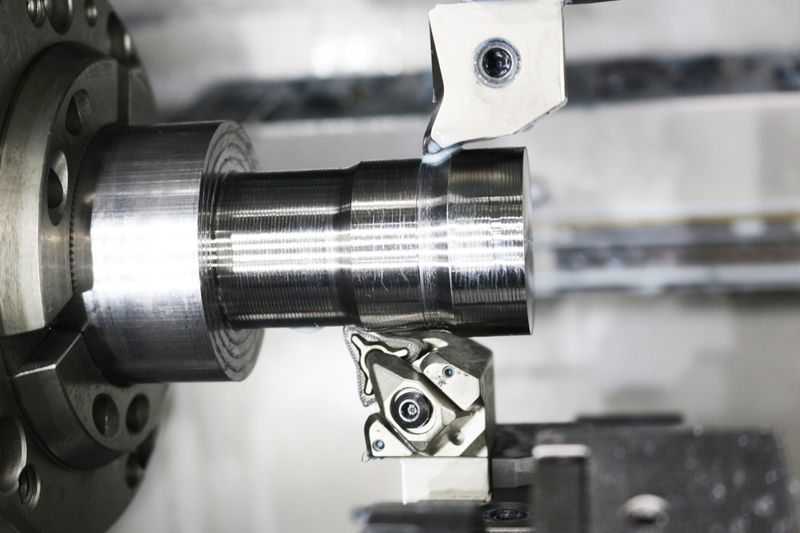
:quality(80)/p7i.vogel.de/wcms/2c/20/2c20e8e56ddc52d58a8cde7f1af2aa58/iscar-drehen-ab-wst-20-28quickturn-29-02v1.jpeg "WST manufactures the output shafts of three-meter rods with a diameter of 60 millimetres from C45E heat-treated steel.(Source: Iscar)")
:quality(80)/p7i.vogel.de/wcms/3f/18/3f18ce4edebec02bed5a975e45cf933f/iscar-drehen-ab-wst-20-28quickturn-29-03v1.jpeg "Instead of 26, WST now roughs the shaft in just twelve seconds.(Source: Iscar)")
:quality(80)/p7i.vogel.de/wcms/1d/12/1d12592e1c6539ef18de60c2ac48722a/iscar-drehen-ab-wst-20-28quickturn-29-04v1.jpeg "The robust clamping system of the Quickturn allows back and forth rotation without play at high feed rates.(Source: Iscar)")
:quality(80)/p7i.vogel.de/wcms/ae/66/ae668f57e7872107212af539dca69025/iscar-drehen-ab-wst-20-28quickturn-29-05v1.jpeg "To ensure a stable fit, the six-edged inserts are equipped with v-shaped raised sections on both sides. At WST, the inserts are used in the tough TiCN/Al2O3 MT-CVD-coated cutting material grade IC8250 for high-feed turning.(Source: Iscar)")
During the production of output shafts made from heat-treated steel C45E (1.1191) for customers in the electromobility sector, roughing was a source of frustration. The four-edged CNMG indexable inserts (indexable inserts) from a competitor of Iscar that were previously used for this purpose only offered a short tool life, insufficient process reliability and there was also room for improvement in terms of productivity. "We roughed the bars with a diameter of 60 millimetres simultaneously with both turrets, at a moderate feed rate and in the traditional way from front to back," explains Velibor Nisic from the set-up preparation center at WST. "The plates couldn't cope with this and we had a lot of tool breakages, sometimes after just 60 or 70 parts instead of the nominal 100." Alexander Weber, process optimizer and programmer at WST, adds: "In addition to the unstable process, the running time was also too long and sometimes inefficient. While the main spindle was still roughing, the secondary spindle had long since finished." As WST manufactures around 100,000 of these shafts per year, a more efficient solution was required.
The highlight of the Quickturn is its clamping system. This means that the plates fit like a glove and are extremely stable. This allows backlash-free forward and reverse rotation with a high feed rate - both on the x-axis and the y-axis.
"I knew that the WST team was unhappy with the external roughing of the output shafts, but until now I couldn't offer an economical solution," says Danny Schrödel, application engineer at Iscar, WST's long-standing tool partner. "Thanks to our new Logiquick campaign, I now had the right tool at hand to improve the process with the Quickturn." During one of their regular visits to WST, Danny Schrödel and his colleague Thomas Nopper, Consulting and Sales, presented the new six-edged Quickturn for high-feed and multidirectional turning."The highlight of the Quickturn is its clamping system," explains Thomas Nopper. The WSPs are equipped with V-shaped protrusions on both sides. Corresponding indentations in the holder accommodate these with a positive fit. In addition, a clamping claw secures them from the top. "This means the panels fit like a glove and are extremely stable. This allows backlash-free forward and reverse turning with a high feed rate - both on the x-axis and the y-axis." The tool holders also feature targeted jet cooling, which brings the coolant directly into the cutting zone and cools the cutting edge from two sides simultaneously. Users therefore benefit from very good heat dissipation, efficient chip evacuation, long tool life and high surface qualities with a large metal removal rate. For the task at WST, the inserts are used in the tough TiCN/Al2O3 MT-CVD-coated cutting material grade IC8250 for high-feed turning with cobalt enrichment in the surface layer. They are highly resistant to chipping, notch and crater wear and plastic deformation."With the Quickturn, we also had a new machining option - reverse high-feed roughing," says Danny Schrödel. "Instead of simply replacing the tool, we were able to create a completely new, faster and more tool-friendly process together.""We are always on the lookout for new ideas that make our work easier and advance our processes," says Velibor Nisic. "The proposal sounded sensible, which is why I immediately agreed to tests." Alexander Weber created a corresponding program and then we were ready to go. The team led by Velibor Nisic and Alexander Weber used to rough the outer contour with both turrets simultaneously in three cuts each. They turned from front to back with a cutting depth of 2.5 millimetres (approx. 0.098 in) and a moderate speed of 160 meters per minute (approx. 525 ft/min). This took around 26 seconds. With the Quickturn, WST can reliably turn backwards at a cutting speed of 240 meters per minute (approx. 790 ft/min). Although the tools then make five or six cuts with a cutting depth of 1.5 millimetres (approx. 0.059 in), they only need a total of twelve seconds."With the new solution, we have not only halved the time for roughing and freed up machine time, but have also doubled the service life of the tools and reduced our tool costs," says Velibor Nisic happily. "200 parts per cutting edge are possible with process reliability, tool breakage is no longer an issue and we work much more productively than before."New Process Makes the Difference: Reverse High-Feed Roughing
The new solution has not only halved the time required for roughing and freed up machine time, but has also doubled the service life of the tools and reduced our tool costs.
Tool Life Doubled, Process Time Halved
:quality(80)/p7i.vogel.de/wcms/71/98/719829d11b80bccd920fcb456e93b74d/0131508423v1.jpeg "With Iscar's Quickturn, WST Precision Technology machines output shafts significantly faster and more reliably than before. (Image:Iscar)")
:quality(80)/p7i.vogel.de/wcms/23/99/23992bf2dcdc432c9b7209c34a4a7c48/0129733089v1.jpeg "Stork relies on the modular Neoswiss turning system from Iscar to shorten the set-up times for its sliding headstock lathes and work more productively. (Image:Iscar)")