China adds more Japanese companies to export control and watch lists. Formally, the measure is targeted at Japan, but it can also be relevant in Germany. Export controls increasingly follow not only national borders but also materials, technologies, end customers, and supply chains.
Export controls no longer only influence which national borders a component, raw material, or end product may cross.
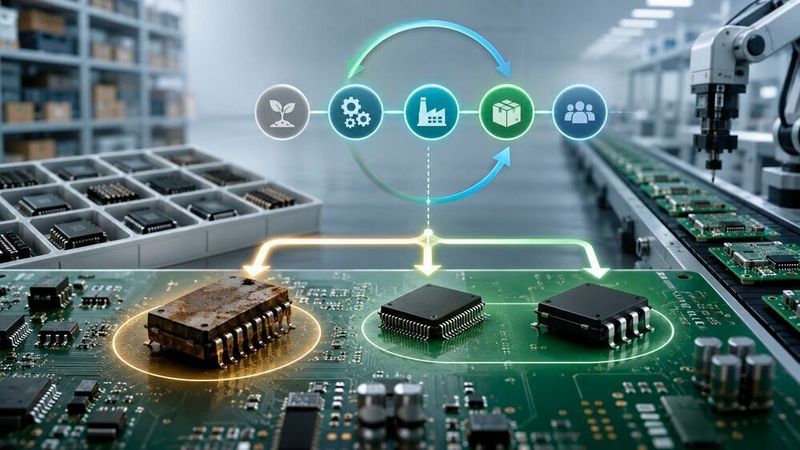
(Image: Dall-E / AI-generated)
China expanded its domestic export controls on Japanese companies and institutions at the end of June 2026, as reported by the German Raw Materials Agency (DERA). According to the information, China's Ministry of Commerce (MOFCOM) added more Japanese institutions to control and observation lists on June 29, 2026. DERA interprets this as a further tightening and expansion of Chinese export controls.
Reuters reports that China now lists a total of 40 Japanese entities on an export control list for dual-use goods. Chinese companies are no longer allowed to supply these entities without prior approval. Affected entities include subsidiaries and organizations from the defense and high-tech sectors, including those related to Mitsubishi Heavy Industries, Mitsubishi Electric, and Kawasaki Heavy Industries. An additional 40 Japanese entities have been placed on an observation list, requiring exporters to submit additional risk assessments and assurances regarding the end use.
According to the Chinese Ministry of Commerce, the measures are intended to prevent Chinese dual-use goods from contributing to the strengthening of Japan's military capabilities. Dual-use goods are items, software, or technologies that can be used for both civilian and military purposes. Particularly noteworthy is a provision that extends beyond China and Japan: not only Chinese exporters are affected. Foreign organizations and individuals are also prohibited from passing on dual-use goods of Chinese origin to the listed entities.
No Direct Supply Stop, but a Supply Chain Risk
This does not result in a supply stop for German companies, as the current measure is directed against Japanese entities. However, it shows how export controls are now affecting global value chains. The key factors are no longer just who exports from which country but also where pre-products come from, to whom they are delivered, and for what purpose the goods are ultimately used.
For German developers and manufacturers, this can have several implications. Those integrating Chinese materials, magnets, electronic components, machine parts, or software into their products must more carefully determine whether these goods are subject to export control regulations. Companies supplying Japanese customers or international corporations with ties to Japan must check whether listed end users, controlled goods, or Chinese-origin components are affected. Additionally, those manufacturing in China or involving Chinese subsidiaries in the supply chain may face additional licensing, documentation, and end-use verification requirements when exporting to third markets.
Rare Earths as a Strategic Lever
The current measures are also part of a broader context of China's raw materials and export control policies. As early as April 2025, China introduced export controls for certain medium and heavy rare earths. The MOFCOM announcement specifically mentions samarium, gadolinium, terbium, dysprosium, lutetium, scandium, and yttrium, as well as metals, alloys, oxides, compounds, mixtures, and permanent magnet materials based on these elements.
These materials are relevant for many high-tech applications like electric motors and power electronics. Dysprosium and terbium, in particular, are used to make high-performance magnets more temperature-stable. Thus, export controls affect not only raw materials in the strict sense but also pre-products deeply embedded in industrial systems.
For German companies, this is particularly sensitive because many critical dependencies are not visible on the first level of the supply chain. A developer might see a motor, a sensor package, a magnet module, or an assembly in the design. However, the export control-relevant dependency may lie several levels deeper—in the magnetic material, the rare earth element, the coating, the software, or the manufacturing technology.
Bosch Example Shows How Far Export Controls Can Extend
How costly such risks can become is illustrated by another case: Bosch had to pay a fine of around 36 million dollars in the U.S. because two non-U.S. subsidiaries delivered MEMS sensor products and automotive software worth more than 72 million dollars to Huawei and Huawei subsidiaries between September 2020 and September 2024. According to U.S. authorities, the goods were subject to the U.S. Export Administration Regulations due to the Foreign Direct Product Rule and would have required a U.S. license.
Date: 08.12.2025
Naturally, we always handle your personal data responsibly. Any personal data we receive from you is processed in accordance with applicable data protection legislation. For detailed information please see our privacy policy.
Consent to the use of data for promotional purposes
I hereby consent to Vogel Communications Group GmbH & Co. KG, Max-Planck-Str. 7-9, 97082 Würzburg including any affiliated companies according to §§ 15 et seq. AktG (hereafter: Vogel Communications Group) using my e-mail address to send editorial newsletters. A list of all affiliated companies can be found here
Newsletter content may include all products and services of any companies mentioned above, including for example specialist journals and books, events and fairs as well as event-related products and services, print and digital media offers and services such as additional (editorial) newsletters, raffles, lead campaigns, market research both online and offline, specialist webportals and e-learning offers. In case my personal telephone number has also been collected, it may be used for offers of aforementioned products, for services of the companies mentioned above, and market research purposes.
Additionally, my consent also includes the processing of my email address and telephone number for data matching for marketing purposes with select advertising partners such as LinkedIn, Google, and Meta. For this, Vogel Communications Group may transmit said data in hashed form to the advertising partners who then use said data to determine whether I am also a member of the mentioned advertising partner portals. Vogel Communications Group uses this feature for the purposes of re-targeting (up-selling, cross-selling, and customer loyalty), generating so-called look-alike audiences for acquisition of new customers, and as basis for exclusion for on-going advertising campaigns. Further information can be found in section “data matching for marketing purposes”.
In case I access protected data on Internet portals of Vogel Communications Group including any affiliated companies according to §§ 15 et seq. AktG, I need to provide further data in order to register for the access to such content. In return for this free access to editorial content, my data may be used in accordance with this consent for the purposes stated here. This does not apply to data matching for marketing purposes.
Right of revocation
I understand that I can revoke my consent at will. My revocation does not change the lawfulness of data processing that was conducted based on my consent leading up to my revocation. One option to declare my revocation is to use the contact form found at https://contact.vogel.de. In case I no longer wish to receive certain newsletters, I have subscribed to, I can also click on the unsubscribe link included at the end of a newsletter. Further information regarding my right of revocation and the implementation of it as well as the consequences of my revocation can be found in the data protection declaration, section editorial newsletter.
The case involves U.S. law and Huawei, not Chinese export controls. However, it is relevant as a cautionary example: export control regulations can also apply when shipments go through foreign subsidiaries, when products are manufactured outside the country of origin, or when the critical linkage lies in technology, software, or pre-products. Bosch voluntarily disclosed the violations and cooperated with authorities; nevertheless, the agreed penalty amounted to 36.18 million dollars.
For German companies, the lesson is not so much that every delivery to China or Japan is risky. Rather, the key point is that origin, technological linkage, end customer, and end use must be systematically reviewed. Export control thus becomes a cross-functional task: development, procurement, sales, compliance, and logistics must share the same information. Four practical questions arise from this: Do products or assemblies contain Chinese dual-use goods or Chinese-origin components? Do shipments go directly or indirectly to listed end users or security-related applications? Can suppliers reliably document the origin of critical materials and components? And are bill of materials, software components, and technical data maintained in such a way that export control checks don’t only start shortly before shipping?



:quality(80)/p7i.vogel.de/wcms/d1/ef/d1ef6b6f7d4543f7999980bacccaf22b/0133499261v1.jpeg "As the growing imbalance in trade relations with China continues to widen, the EU Chamber of Commerce foresees a day when trade with China will have to be seriously reevaluated ... (Image: AI-generated)")
:quality(80)/p7i.vogel.de/wcms/fe/1f/fe1fa5ee713f94deaba963dc24c3abc5/0133299273v1.jpeg "The Flexistar enables highly flexible production of laser-welded tubes thanks to its tool-free clamping system. (Image:Because Technology, LLC)")
:quality(80)/p7i.vogel.de/wcms/1b/5a/1b5ac72f83db4dbee3ff91e51bc398f4/0133496095v1.jpeg "BASF announces that it will take the next step toward producing the polyurethane precursor MDI in India ... (Image:BASF)")
:quality(80)/p7i.vogel.de/wcms/3f/cf/3fcfa390902944ffcf24e7fe973cc3ee/0133486258v1.jpeg "Do you need to create secure connections on structures using blind rivets, but space is tight? Then you should take a closer look at the Universalgrip from Gesipa ... (Image: Gesipa)")
:quality(80)/p7i.vogel.de/wcms/2e/99/2e99726b522e4b35b690e25eb6a42643/0133463991v1.jpeg "Robotics: In AMR applications, connection technology must reliably transmit power, signals, and data despite vibration and shock loads—in very confined spaces and in a way that allows for regular maintenance. (Image:Hyperever)")
:quality(80)/p7i.vogel.de/wcms/d0/18/d01801e3d5dbd7bc9d0b4f60408b630c/0133468429v1.jpeg "Quality requirements for film packaging are on the rise. At the same time, many companies are turning to recyclable film materials, which, however, have their own challenges. Fraunhofer researchers have therefore developed a fast system that detects problems in real time. (Image:Fraunhofer IKTS)")
:quality(80)/p7i.vogel.de/wcms/b1/06/b106cf44923ce39565c3264982fd20eb/0133414574v1.jpeg "Robots Build Robots: At the new Ubtech factory, automated systems even handle parts of the material supply and logistics for the production of humanoid robots. (Image:Ubtech)")
:quality(80)/p7i.vogel.de/wcms/38/79/38799bfbbccd938b64c67068cfa68780/0133329362v1.jpeg "What exactly enables machines to act on their own? (Image:Shutterstock)")
:quality(80)/p7i.vogel.de/wcms/66/a7/66a7b78159caeacce57136529688799f/0133503398v1.jpeg "Sunlight Makes Stone! These stone blocks weren't made the traditional way. Instead, they were additively manufactured from sand using a laser. In the future, however, the laser is set to be replaced by concentrated sunlight—if the startup Addisol is successful... (Image:Addisol / F. Fiedler)")
:quality(80)/p7i.vogel.de/wcms/72/b9/72b995c2c8d812c5e2115cbef31e035a/0133462727v1.jpeg "Eggl manufactures center hoods that are precisely tailored to each cooking island—whether standard size or custom shape. They are made entirely of stainless steel and are individually customized in terms of size and filter arrangement. (Image:SPI)")
:quality(80)/p7i.vogel.de/wcms/13/5d/135dfae6229ceaf5c55467a43e8f7257/adobestock-1879961393--ardi-stock-adobe-com-ki-generiertv1.jpeg "Annoying chatterboxes or awkward silences in response to questions—a moderator should specifically prepare for difficult situations in order to navigate them effectively. (Image:ardi - stock.adobe.com_AI-generated)")
:quality(80)/p7i.vogel.de/wcms/ca/46/ca462051dfb9a1fb37ca4053762af9df/org-blobs-user-response-file-output-908c701c-3b37-491e-bb5c-35fc3d336575-plugin-output-call-182851v1.png "Through extreme compression, high-energy lasers transform simple plastics into high-purity nanodiamonds. What was once used in planetary physics is now opening up entirely new possibilities for quantum sensors, novel catalysts, and extremely hard materials. (Illustrative image) (Source: VCG / AI-generated)")
:quality(80)/p7i.vogel.de/wcms/aa/a2/aaa2c6dd2daa24b485cddbf9297590c0/0133467318v1.jpeg "Battery Monitoring: Battery monitoring using electrochemical impedance spectroscopy offers several advantages. (Image:TI)")
:quality(80)/p7i.vogel.de/wcms/8a/bb/8abbb6217220595edc1549ac9b84f307/0133429906v1.jpeg "The IAA in Hanover showcased the ambitions of Chinese commercial vehicle manufacturers in Europe. (Image:Wehner - VCG)")
:quality(80)/p7i.vogel.de/wcms/0c/53/0c5313ef91c14b6df0d0996efc33c8ad/jpg03568-bearbeitetv1.jpeg "The category winners of the 2027 German Car of the Year award. (Source: GCOTY)")
:quality(80)/p7i.vogel.de/wcms/27/c9/27c917e021a143e590dee34a9f481978/0133504594v1.jpeg "In 2025, there were more electric cars among new registrations in the EU than ever before. (Image: ©Halfpoint - stock.adobe.com)")
:quality(80)/p7i.vogel.de/wcms/11/2e/112eabc5fb41e1a401f0e93e9326ef51/0133489329v1.jpeg "A sandbox limits the actions an AI agent can take, but it is not an impenetrable barrier. Only multiple independent layers of protection prevent an escape from immediately granting access to production systems. (Image:freely licensed)")
:quality(80)/p7i.vogel.de/wcms/18/ba/18bae45f9e6f7cacc203d56f3bc26e3c/0133455937v1.jpeg "Google did not make the incidents public until after receiving an inquiry from the “Wall Street Journal.” (Image:Google)")
:quality(80)/p7i.vogel.de/wcms/65/58/655895abe42a598e146fe47baf7c54db/0133441212v1.jpeg "Wukong, a 72-qubit quantum processor manufactured by Origin Quantum. (Image:Origin Quantum)")
:quality(80)/p7i.vogel.de/wcms/63/68/6368c6e0861d6e25bbd25a8878ca5973/newsimage427467v1.jpeg "How can individual manipulated AI agents influence the decisions of entire networks? A new theoretical model shows the conditions under which misinformation spreads. (Source: CISPA)")
:fill(fff,0)/images.vogel.de/vogelonline/companyimg/76800/76895/65.jpg "FAULHABER_120mm.jpg ()")
:fill(fff,0)/p7i.vogel.de/companies/69/88/69882c428938e/tmts2026-ticec-banner-en-2000px.png "tmts2026-ticec-banner-en-2000px (https://www.tmts.tw/en)")
:quality(80)/p7i.vogel.de/wcms/40/77/4077a0064066bde13aa0a8e2817c8858/0131879275v1.jpeg "Bosch location in Shanghai: Due to unauthorized deliveries to Huawei, Bosch must pay a multi-million dollar fine in the USA. (Image: Bosch)")
:quality(80)/p7i.vogel.de/wcms/c6/7c/c67cc8f3ab80147ed8aa59d1b98802f7/bmw-1490x838v1.png "The sixth generation of the BMW drive system also does not require magnets or rare earth elements. (Image: BMW)")
:quality(80)/p7i.vogel.de/wcms/34/41/34415124ecf859db85834277bc98af4d/0132181994v1.jpeg "In June 2026, Astemo announced that the electric drivetrain of the Nissan Leaf improves range through an efficient energy management system. This is enabled by the \"3-in-1\" drivetrain, which combines three key components: the motor, the inverter, and the reduction gearbox. (Image: Astemo)")