BMW is already production-ready, with Borg Warner and Mahle following suit: More and more manufacturers are developing electric drives without rare earths. The breakthrough could be closer than expected.
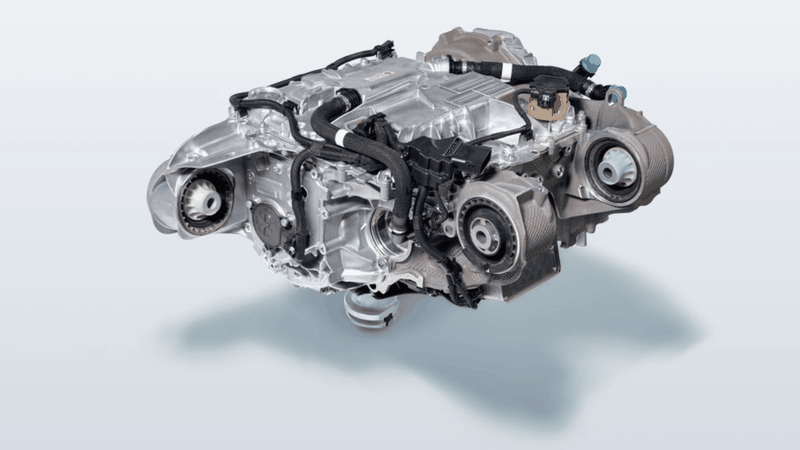
The sixth generation of the BMW drive system also does not require magnets or rare earth elements.
(Image: BMW)
Electric motors without rare earths are likely to have become more popular again. China has begun to implement real retaliation in the trade war with the USA. In response to boycotts of AI chips, software, and equipment for semiconductor manufacturing, as well as the recent threats from US President Donald Trump to increase tariffs by 100 percent against China, Beijing is now threatening its own export restrictions.
On October 9, China tightened the export approval process for five more rare earth elements (REE). Permits must now be applied for and approved for Holmium, Erbium, Thulium, Europium, and Ytterbium. This bureaucratic requirement now applies to a total of twelve out of the seventeen materials in the REE category. Additionally, alloys with these elements and technologies for processing REEs are affected.
Retaliation with a System: China Strikes Back
China has also banned the export of auto chips from Nexperia after the Dutch government took the bold step of placing the Chinese company's Dutch headquarters under state control. Whether in the realm of rare earths, chips, or several other sectors, China has begun to push back against Cold War tactics.
While applications for the export of rare earths are possible and are likely to be granted except in cases of military end use, the availability of REEs for the automotive industry will decrease. This will also impact the electronics, aerospace, defense, and several other industries, as REEs are required everywhere.
Bureaucracy as a Weapon: When Applications Become a Trap
This is due to the fact that even China, where paper was invented, does not have enough officials to process all the necessary applications quickly. The shelves in the warehouses of many automakers and suppliers are likely to empty relatively quickly wherever REEs are involved, especially in traction motors, which will heavily affect the production of electric vehicles. China dominates the processing of REEs to such an extent that alternatives cannot be found quickly.
Additionally, many so-called auxiliary components such as coolant or water pumps, power steering, even window lifts and windshield wipers no longer operate without REEs and could become scarce. Therefore, not only is the production of electric and hybrid vehicles at risk, but so is that of cars with internal combustion engines.
NdFeB: The Material of Choice for Electric Vehicles
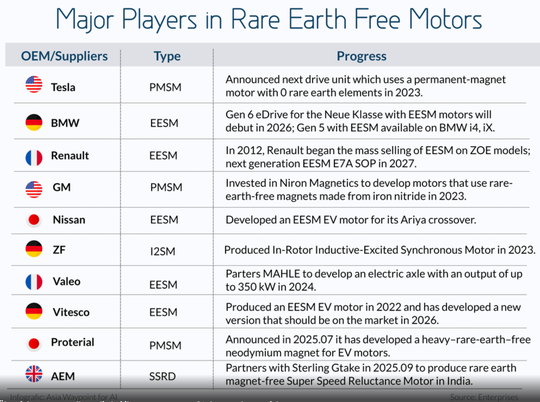
Overview of manufacturers who do not use rare earths in their electric motors.
(Image: VCG)
A particularly critical factor in the construction of motors for electric vehicles and hybrids is the fact that NdFeB (neodymium-iron-boron) is included on the new approval list in Beijing. This material is used for specialized, high-performance magnets, which in turn are used to construct permanent magnet synchronous motors, commonly referred to as "PSM" in the industry, based on their English name. About 95 percent of all electric motors produced today are some form of PSM.
PSMs, especially their magnets, contain large quantities of the three rare earth elements Neodymium, Praseodymium, and Dysprosium. In the e-drive of a passenger car, up to five kilograms of these materials may be required (less than the several hundred kilograms needed for wind turbines).
Their extraction and refinement are highly environmentally damaging, which is why the USA and Europe have voluntarily and happily delegated this task to China for decades. However, PSMs are proving to be a kind of Achilles' heel for the automotive industry when politicians like US President Donald Trump or Danish Minister of Trade Vincent Karremans want to play "hardball" with China, without considering the potential for retaliation from Beijing.
All NdFeB magnets alloyed with Dysprosium and Terbium are now on the Beijing list. Starting November 8, approximately half of all exports of rare earth permanent magnets from China must be individually checked for potential dual-use risks to ensure they do not fall into the hands of the US military.
Date: 08.12.2025
Naturally, we always handle your personal data responsibly. Any personal data we receive from you is processed in accordance with applicable data protection legislation. For detailed information please see our privacy policy.
Consent to the use of data for promotional purposes
I hereby consent to Vogel Communications Group GmbH & Co. KG, Max-Planck-Str. 7-9, 97082 Würzburg including any affiliated companies according to §§ 15 et seq. AktG (hereafter: Vogel Communications Group) using my e-mail address to send editorial newsletters. A list of all affiliated companies can be found here
Newsletter content may include all products and services of any companies mentioned above, including for example specialist journals and books, events and fairs as well as event-related products and services, print and digital media offers and services such as additional (editorial) newsletters, raffles, lead campaigns, market research both online and offline, specialist webportals and e-learning offers. In case my personal telephone number has also been collected, it may be used for offers of aforementioned products, for services of the companies mentioned above, and market research purposes.
Additionally, my consent also includes the processing of my email address and telephone number for data matching for marketing purposes with select advertising partners such as LinkedIn, Google, and Meta. For this, Vogel Communications Group may transmit said data in hashed form to the advertising partners who then use said data to determine whether I am also a member of the mentioned advertising partner portals. Vogel Communications Group uses this feature for the purposes of re-targeting (up-selling, cross-selling, and customer loyalty), generating so-called look-alike audiences for acquisition of new customers, and as basis for exclusion for on-going advertising campaigns. Further information can be found in section “data matching for marketing purposes”.
In case I access protected data on Internet portals of Vogel Communications Group including any affiliated companies according to §§ 15 et seq. AktG, I need to provide further data in order to register for the access to such content. In return for this free access to editorial content, my data may be used in accordance with this consent for the purposes stated here. This does not apply to data matching for marketing purposes.
Right of revocation
I understand that I can revoke my consent at will. My revocation does not change the lawfulness of data processing that was conducted based on my consent leading up to my revocation. One option to declare my revocation is to use the contact form found at https://contact.vogel.de. In case I no longer wish to receive certain newsletters, I have subscribed to, I can also click on the unsubscribe link included at the end of a newsletter. Further information regarding my right of revocation and the implementation of it as well as the consequences of my revocation can be found in the data protection declaration, section editorial newsletter.
"Given that US imports of NdFeB magnets were approximately 325 million units in 2024, this is a challenging undertaking," says Thomas Krümmer, a leading German expert on international trade in rare earths.
BMW Celebrates: Advantage Through Abstention
The few electric vehicle manufacturers that belong to the remaining five percent, whose drivetrains do not operate based on the PSM principle, are currently celebrating. BMW has been working since 2018 on the development of electric motors that are entirely free of rare earths. The Munich-based company uses externally excited synchronous machines (EESM) on the rear axle and asynchronous machines (ASM) on the front axle. Neither type requires rare earths, not even permanent magnets.
In the new sixth generation of BMW's electric drives, up to four of these motors can be employed instead of just two. This allows for increases in vehicle performance depending on the model, without incurring additional development costs for even more powerful motors.
The Great Exodus: Who is Still Working on Alternatives
Worldwide, several other automakers are working on various types of electric motors without rare earths. Some of them have already deployed them in limited instances, including Renault (EESM) and Nissan (EESM), while others are still in development, such as General Motors and Stellantis.
Some of these electric motors operate with permanent magnets but without rare earths. The challenge is that many of these developments will not be ready for mass production for several years. Other manufacturers are not as far along as BMW.
Inspired by the automakers, several major suppliers have also begun developing different types of electric motors without rare earths, including Borg Warner, Mahle, Valeo, Vitesco (now Schaeffler), and ZF. Some are operational, while others are still in the development phase.
The Tinkerer Challenge: Performance Without Luxurious Raw Materials
For engineers, this search for alternatives is an enticing task, as electric motors without rare earths typically experience performance losses compared to those with rare earths, or they vibrate more and are too expensive.
It hasn't been long since all motors had to operate without rare earths, which then marked a modernization that everyone followed. However, all the current development attempts for rare earth-poor or rare earth-free motors are likely to gain significant momentum.
Progress has been relatively slow, primarily due to insufficient investment. The Japanese company Proterial (formerly Hitachi Metals) has completed the pilot of a neodymium-free magnet motor and could have it ready for mass production by 2025, according to Japanese reports.
Chinese Suppliers are Also Seeking Alternatives
Chinese companies are also researching the development of electric motors without rare earths. The incentive here is less about the risk in the supply chain and more about avoiding the relatively high costs of rare earths. There is hope to find a more cost-effective alternative that is at least equally powerful as the PSM. BYD, Huawei, Quanten Technologies, InfiMotion, and Santroll Motors are all working on EESM technology.
According to the latest E-Drive market research report by Asia Waypoint, none of these companies have reached mass production yet. Some aim only to reduce the proportion of rare earths, not to eliminate their use entirely.
Only Zhejiang Zhiyuan Motor appears to be further along, claiming to have begun mass production of a “highly efficient electric motor without rare earths.” However, not much is currently known about the size of the production series.
The team is proud of a series of technical breakthroughs it has achieved to offset the disadvantages of forgoing rare earths. They have developed new materials and components, such as ferrite composite materials, highly flexible magnets, and highly permeable insulating materials, said CEO Li Yongbing in a recent interview with Chinese reporters.
India’s Response: Technology Transfer Instead of Imports from China
India is making particularly ambitious strides in the development of rare earth-free drives, as the political relations between New Delhi and Beijing are strained. The approval process for the rare earth licenses introduced in April of this year is moving particularly slowly once an Indian name appears on the form.
The company "Sterling Gtake E-Mobility," a major automotive supplier in India, has built a large facility in Faridabad in the northern part of the country. Utilizing British technology for which licenses have been obtained, it is working on the development of a rare earth-free electric motor. The Indian firm Sona Comstar also has plans to produce magnets without relying on Chinese imports.
The Great Race: Who Will Build the First Perfect Rare Earth-Free Motor?
The list of companies worldwide involved in the pursuit of a rare earth-free electric motor continues to grow. The British start-up AEM is opting to forgo magnets and copper. However, all agree that they must not only overcome technical hurdles but also ensure that their motors are cost-effective for commercialization. “The Chinese can always undercut them,” said Andy Leyland from SC Insights to Reuters.
According to Leyland, investing in the development of electric motors without rare earths is commercially very risky. As long as cheap PSMs from China are on the market, it remains difficult for automakers who cannot set prices like BMW to rely on rare earth-free solutions.



:quality(80)/p7i.vogel.de/wcms/eb/2b/eb2bd1b8487afe577b37363cd02f16ff/0113143253v1.jpeg "In our China Market Insider, we regularly provide you with relevant information straight from China. (Image:© Eisenhans - stock.adobe.com)")
:quality(80)/p7i.vogel.de/wcms/dd/b8/ddb8edc98c49b384734ab2432b297eb5/adobestock-1913662309--irene-stock-adobe-com-ki-generiertv1.jpeg "Rotary joints are used in grippers and swivel mechanisms to allow assemblies to rotate or swivel smoothly relative to one another, even under very high loads (illustrative image). (Source: Irene - stock.adobe.com / KI-generiert)")
:quality(80)/p7i.vogel.de/wcms/d1/ef/d1ef6b6f7d4543f7999980bacccaf22b/0133499261v1.jpeg "As the growing imbalance in trade relations with China continues to widen, the EU Chamber of Commerce foresees a day when trade with China will have to be seriously reevaluated ... (Image: AI-generated)")
:quality(80)/p7i.vogel.de/wcms/fe/1f/fe1fa5ee713f94deaba963dc24c3abc5/0133299273v1.jpeg "The Flexistar enables highly flexible production of laser-welded tubes thanks to its tool-free clamping system. (Image:Because Technology, LLC)")
:quality(80)/p7i.vogel.de/wcms/60/ef/60ef4f07e4829b2c2929befc0f353c58/0133511729v1.jpeg "Humanoid robots can match human performance in certain tasks. (Image:Gemini / AI-generated)")
:quality(80)/p7i.vogel.de/wcms/2e/99/2e99726b522e4b35b690e25eb6a42643/0133463991v1.jpeg "Robotics: In AMR applications, connection technology must reliably transmit power, signals, and data despite vibration and shock loads—in very confined spaces and in a way that allows for regular maintenance. (Image:Hyperever)")
:quality(80)/p7i.vogel.de/wcms/d0/18/d01801e3d5dbd7bc9d0b4f60408b630c/0133468429v1.jpeg "Quality requirements for film packaging are on the rise. At the same time, many companies are turning to recyclable film materials, which, however, have their own challenges. Fraunhofer researchers have therefore developed a fast system that detects problems in real time. (Image:Fraunhofer IKTS)")
:quality(80)/p7i.vogel.de/wcms/b1/06/b106cf44923ce39565c3264982fd20eb/0133414574v1.jpeg "Robots Build Robots: At the new Ubtech factory, automated systems even handle parts of the material supply and logistics for the production of humanoid robots. (Image:Ubtech)")
:quality(80)/p7i.vogel.de/wcms/c0/52/c052f405eb55fc3d08c4837e77206fc0/adobestock-2021845957--aucartstudio-stock-adobe-com-ki-generiertv1.jpeg "An innovation from China to combat extreme summer heat: A novel coating lowers temperatures. (Source: © AucArtStudio – stock.adobe.com_AI-generated)")
:quality(80)/p7i.vogel.de/wcms/66/a7/66a7b78159caeacce57136529688799f/0133503398v1.jpeg "Sunlight Makes Stone! These stone blocks weren't made the traditional way. Instead, they were additively manufactured from sand using a laser. In the future, however, the laser is set to be replaced by concentrated sunlight—if the startup Addisol is successful... (Image:Addisol / F. Fiedler)")
:quality(80)/p7i.vogel.de/wcms/72/b9/72b995c2c8d812c5e2115cbef31e035a/0133462727v1.jpeg "Eggl manufactures center hoods that are precisely tailored to each cooking island—whether standard size or custom shape. They are made entirely of stainless steel and are individually customized in terms of size and filter arrangement. (Image:SPI)")
:quality(80)/p7i.vogel.de/wcms/13/5d/135dfae6229ceaf5c55467a43e8f7257/adobestock-1879961393--ardi-stock-adobe-com-ki-generiertv1.jpeg "Annoying chatterboxes or awkward silences in response to questions—a moderator should specifically prepare for difficult situations in order to navigate them effectively. (Image:ardi - stock.adobe.com_AI-generated)")
:quality(80)/p7i.vogel.de/wcms/aa/a2/aaa2c6dd2daa24b485cddbf9297590c0/0133467318v1.jpeg "Battery Monitoring: Battery monitoring using electrochemical impedance spectroscopy offers several advantages. (Image:TI)")
:quality(80)/p7i.vogel.de/wcms/39/b2/39b21bf03be1683831862239a369987c/0133469638v1.jpeg "Data from autonomous vehicles and robots operating autonomously is in high demand, and Ruqi wants to capitalize on this. (Image:Ruqi Mobility)")
:quality(80)/p7i.vogel.de/wcms/8a/bb/8abbb6217220595edc1549ac9b84f307/0133429906v1.jpeg "The IAA in Hanover showcased the ambitions of Chinese commercial vehicle manufacturers in Europe. (Image:Wehner - VCG)")
:quality(80)/p7i.vogel.de/wcms/0c/53/0c5313ef91c14b6df0d0996efc33c8ad/jpg03568-bearbeitetv1.jpeg "The category winners of the 2027 German Car of the Year award. (Source: GCOTY)")
:quality(80)/p7i.vogel.de/wcms/48/15/4815da27c45973ca629a99b375ac3aef/0133509585v1.jpeg "Ventuno Q RoadTest: Designed to help the Element14 community gain practical insights from real-world tests using the Ventuno Q. (Image:Farnell/Element14)")
:quality(80)/p7i.vogel.de/wcms/17/2b/172bd132f9febdfcbcedba292ad0504d/aufmacherv1.jpeg "Micro-Epsilon offers a wide range of IO-Link-compatible sensors. (Source: Micro-Epsilon Messtechnik GmbH & Co. KG)")
:quality(80)/p7i.vogel.de/wcms/ca/b4/cab46fd26d19d6a2febca032048200b6/0133471827v1.jpeg "Photonics SDK for C and Python: Computational operations are now abstracted as standard mathematical functions. (Image:Q.ANT)")
:quality(80)/p7i.vogel.de/wcms/92/b2/92b2ed5299cde450c0764f4f64468395/0133505895v1.jpeg "The \"Iris 100\" test system for high-precision volume production of microLEDs uses a spectrometer and a high-resolution camera. (Image:Teradyne)")
:fill(fff,0)/images.vogel.de/vogelonline/companyimg/76800/76895/65.jpg "FAULHABER_120mm.jpg ()")
:quality(80)/p7i.vogel.de/wcms/94/13/9413d081ae14d2bbbea02b30710ee84b/0113143253v1.jpeg "In our China Market Insider, we regularly provide you with relevant information straight from China. (Image:© Eisenhans - stock.adobe.com)")
:quality(80)/p7i.vogel.de/wcms/8c/ac/8cacd1d41ac023ec1f2bf81c623d1776/tesla-cybercab-75-1v1.jpeg "Tesla plans to use an electric motor that does not contain rare earth elements in the Cybercab. (Image:Tesla)")