An 18-day strike at Samsung Electronics has been averted for the time being. The union and management reached a provisional agreement shortly before the start of the strike, which will now be voted on by the members. This is a relief for the memory chip market, but the fundamental conflict over profit sharing in the AI boom remains.
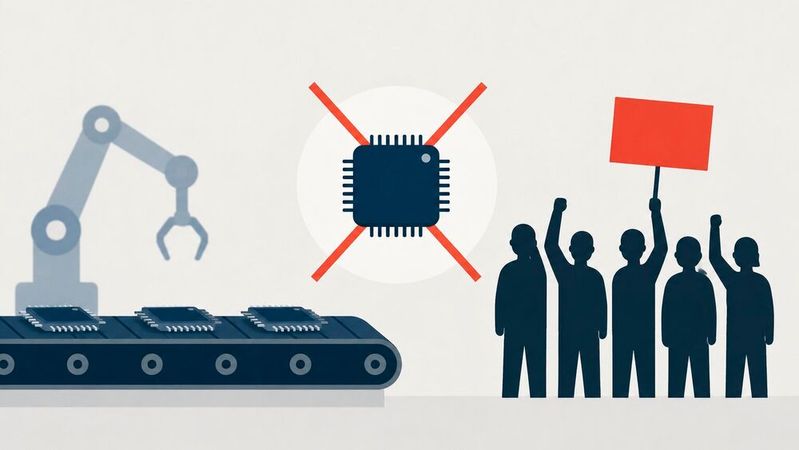
All signs point to a strike at Samsung's South Korean plants (symbolic image).
(Image: Dall-E / AI-generated)
Update from May 21, 2026, 09:00: The announced strike at Samsung Electronics has been averted for the time being, as Nikkei Asia reports. A few hours before the start, the union suspended the planned 18-day walkout after employee representatives and management reached a tentative agreement on wages and collective bargaining conditions. The more than 70,000 union members are now to vote on the compromise from Friday until May 27, 2026.
Neither side initially gave details of the agreed conditions. The union had demanded that 15 percent of operating profit be earmarked for employee bonuses and that the previous cap on bonuses of 50 percent of annual salary be lifted. The agreement was also reached under political pressure: the South Korean government had signaled that it would make use of emergency arbitration rights if necessary in the event of a full-scale strike. The suspension means initial relief for the tense memory chip market, but the underlying conflict over the distribution of profits from the AI and HBM boom remains.
Original report from May 20, 2026, 13:00:The planned general strike at Samsung Electronics can no longer be averted, as the editors of Nikkei Asia reported on May 20, 2026. After Samsung Group United Union had already announced the strike at the end of April, all attempts at mediation failed—most recently on May 20 before the National Arbitration Commission in Sejong. The strike will begin as planned on May 21, 2026 and is expected to last 18 days. According to estimates, tens of thousands of employees could take part.
Union leader Choi Seung-ho expressed his disappointment: "We deeply regret that the mediation process was concluded without a result." The union had agreed to the commission's mediation proposal, but the management had not, without publicly stating the reasons.
Dispute Over Bonuses And Profit Sharing
At the heart of the conflict are bonus payments. The union is demanding that 15 percent of operating profit be earmarked for employee bonuses and that an existing cap of 50 percent of annual salary be lifted. The management rejected this and instead offered higher bonuses than its competitors—but only on condition that Samsung achieves the highest turnover and operating profit in the industry. The company also offered a wage increase of 6.2 percent.
By comparison, competitor SK Hynix is offering its employees an average of around 700 million won for the coming year—the equivalent of around 500,000 dollars—which corresponds to ten percent of operating profit. The conflict is exemplary of a broader debate in South Korea about how the profits from the AI boom should be distributed among the company and its workforce.
Government Hesitates With Emergency Arbitration
The South Korean government had initially signaled that it would mediate if necessary. Following the failure of the negotiations, however, the government was cautious. "There is still time for dialog," said a representative of the Ministry of Labor. They wanted to keep all options open to support further negotiations.
A court in Suwon also largely ruled against Samsung's attempts to limit the strike: It only set minimum staffing levels for weekend and public holiday shifts and rejected Samsung's request to prohibit the union from mobilizing members via text message and video.
Production Losses And Market Consequences
The strike only affects Samsung's domestic plants in South Korea. According to TrendForce, Samsung is the world's largest memory manufacturer with a market share of 36% for DRAM and around a third for NAND. Even moderate production losses could act as a price driver in an already tight market—especially for high-bandwidth memory (HBM) chips, which are key for AI applications.
Fitch Ratings Director Shelly Jang nevertheless dampened short-term expectations (via Nikkei Asia): "Even if a strike were to occur in the short term, I believe Samsung Electronics has sufficient capacity to absorb the impact." However, prolonged production delays or missed delivery deadlines could cause lasting damage to the company's competitive position—beyond purely financial factors. (sb)
Date: 08.12.2025
Naturally, we always handle your personal data responsibly. Any personal data we receive from you is processed in accordance with applicable data protection legislation. For detailed information please see our privacy policy.
Consent to the use of data for promotional purposes
I hereby consent to Vogel Communications Group GmbH & Co. KG, Max-Planck-Str. 7-9, 97082 Würzburg including any affiliated companies according to §§ 15 et seq. AktG (hereafter: Vogel Communications Group) using my e-mail address to send editorial newsletters. A list of all affiliated companies can be found here
Newsletter content may include all products and services of any companies mentioned above, including for example specialist journals and books, events and fairs as well as event-related products and services, print and digital media offers and services such as additional (editorial) newsletters, raffles, lead campaigns, market research both online and offline, specialist webportals and e-learning offers. In case my personal telephone number has also been collected, it may be used for offers of aforementioned products, for services of the companies mentioned above, and market research purposes.
Additionally, my consent also includes the processing of my email address and telephone number for data matching for marketing purposes with select advertising partners such as LinkedIn, Google, and Meta. For this, Vogel Communications Group may transmit said data in hashed form to the advertising partners who then use said data to determine whether I am also a member of the mentioned advertising partner portals. Vogel Communications Group uses this feature for the purposes of re-targeting (up-selling, cross-selling, and customer loyalty), generating so-called look-alike audiences for acquisition of new customers, and as basis for exclusion for on-going advertising campaigns. Further information can be found in section “data matching for marketing purposes”.
In case I access protected data on Internet portals of Vogel Communications Group including any affiliated companies according to §§ 15 et seq. AktG, I need to provide further data in order to register for the access to such content. In return for this free access to editorial content, my data may be used in accordance with this consent for the purposes stated here. This does not apply to data matching for marketing purposes.
Right of revocation
I understand that I can revoke my consent at will. My revocation does not change the lawfulness of data processing that was conducted based on my consent leading up to my revocation. One option to declare my revocation is to use the contact form found at https://contact.vogel.de. In case I no longer wish to receive certain newsletters, I have subscribed to, I can also click on the unsubscribe link included at the end of a newsletter. Further information regarding my right of revocation and the implementation of it as well as the consequences of my revocation can be found in the data protection declaration, section editorial newsletter.



:quality(80)/p7i.vogel.de/wcms/43/bc/43bcc092db07947d7f240564e7d8549d/0133068647v1.jpeg "The C80 Giga inductive coupling system from SMW transmits power up to 75 W—and signals in real time at speeds of up to 1 GBit/s. (Image:SMW-Autoblok / SMW-electronics)")
:quality(80)/p7i.vogel.de/wcms/bd/b6/bdb6acbb7eafcbb21fcf66f8835ccb6d/0132925320v1.jpeg "Kyocera's MG90B Series (Image:Kyocera)")
:quality(80)/p7i.vogel.de/wcms/99/1e/991e3f401bd9a889b80c6b92506ecdf5/0132465976v1.jpeg "Above the gearbox is a stainless steel sealing flange designed to house the mechanical seal, which seals the agitator shaft. (Image:SEW)")
:quality(80)/p7i.vogel.de/wcms/90/2e/902e0c106fab72846b830855de1d4c4e/0113143253v1.jpeg "In our China Market Insider, we regularly provide you with relevant information straight from China. (Image:© Eisenhans - stock.adobe.com)")
:quality(80)/p7i.vogel.de/wcms/36/e2/36e249eb320302cb4292263b451a67de/613921630v1.jpeg "On August 21, a strike by 39,000 employees brought production to a standstill at three Hyundai plants in South Korea. (Image:picture alliance / REUTERS | Kim Soo-hyeon)")
:quality(80)/p7i.vogel.de/wcms/a2/11/a211bcc07ec547e0fa37965a078802a3/newsimage426357v1.jpeg "As part of the “AgriLoop” project, researchers at the University of Bonn are developing a system designed to control greenhouse robots using natural language and to map plant populations in three dimensions. (Source: University of Bonn)")
:quality(80)/p7i.vogel.de/wcms/bc/2d/bc2d1a3291bcdf3d41ae2088fbcaccd1/0133075989v1.jpeg "Universal Robots' parent company is suing Jaka for patent infringement (Image:Universal Robots)")
:quality(80)/p7i.vogel.de/wcms/54/fa/54fa8fce526b3ab8b00500a06498c7f8/image1v1.jpeg "Humanoid robot Figure 03 in action at the BMW Group plant in Spartanburg. (Image:BMW Group)")
:quality(80)/p7i.vogel.de/wcms/aa/96/aa96adace3d0396e169f3da7f7c9b85e/adobestock-107687632--dennisjacobsen-stock-adobe-comv1.jpeg "Electric eels have three electric organs that allow them to deliver electric shocks with voltages of up to 860 volts (illustration). (Source: dennisjacobsen - stock.adobe.com)")
:quality(80)/p7i.vogel.de/wcms/6e/ea/6eea0f7b13ed25685b67b4741883df7a/drohnev1.jpeg "Multi-Jet Fusion is frequently used for drone components because this process offers high mechanical strength and durability while also enabling the production of complex geometries that are difficult to achieve using conventional manufacturing methods. (Source: Protolabs)")
:quality(80)/p7i.vogel.de/wcms/aa/a5/aaa5d3c9a3e218667238db24730422dc/4--sonderteile-aus-nichtrostendem-edelstahl-verbindungstechnikv1.jpeg "In safety- and performance-critical designs, when using fasteners made of stainless steel, geometry, the manufacturing process, and operational loads—in addition to the material and corrosion resistance—play a crucial role in ensuring the safe design of the bolted joint. (Source: Güldner Screws)")
:quality(80)/p7i.vogel.de/wcms/24/91/24913072af80d22b62dffcec62e836de/tcartdesign-snails-757436v1.jpeg "An ordinary garden snail produces an astonishing variety of mucus types using just one molecular building block. (Source: TCartdesign)")
:quality(80)/p7i.vogel.de/wcms/a9/aa/a9aa13f2d6660db59a96d7b798ebb8dd/db2025au00413-largev1.jpeg "According to Spanish media, the electric Mini—initially unveiled as the production-ready ID Every1 concept—is set to debut in 2027 as the ID Up. (Source: Volkswagen)")
:quality(80)/p7i.vogel.de/wcms/3e/5b/3e5be3305df587911e12753bc1cadcae/0132957426v1.jpeg "Suppliers with a significant aftermarket presence achieve significantly higher EBIT and cash conversion rates than companies driven solely by original equipment manufacturing. (Image:AI-generated)")
:quality(80)/p7i.vogel.de/wcms/f5/bc/f5bc380a5039e96c0133de620f5631f7/0133092230v1.jpeg "Chinese automaker BYD is engaging in a fiercer price war on the German market when it comes to sales of plug-in hybrids ... (Image:BYD)")
:quality(80)/p7i.vogel.de/wcms/fa/7e/fa7e12a96d7ae84b09b5dcae86fe768f/0132969187v1.jpeg "Geely research facility in Hangzhou, China, dedicated to basic research, system integration, and component validation. (Image:Geely)")
:quality(80)/p7i.vogel.de/wcms/53/38/533875796f7f4a00cd3ff165652f3ce7/0132806622v1.jpeg "Next-generation packaging and testing solutions for high-density 3D power modules from JCET. (Image:JCET)")
:quality(80)/p7i.vogel.de/wcms/c5/77/c577c047d3ace675bbc29b1efa4a1050/0133057123v1.jpeg "Figure 1: Typical 2-level DC/DC topology. (Image:Renesas)")
:quality(80)/p7i.vogel.de/wcms/6c/0e/6c0eb42cb3976de378d71ae272745b61/0133056789v1.jpeg "We pay for systems that take over human labor without having yet determined how the resulting value created will be distributed in the future. (Image:freely licensed)")
:quality(80)/p7i.vogel.de/wcms/2a/2f/2a2fc1bb2a6941d1e5c795c047c969ce/0132945015v1.jpeg "Developers at the lab workplace: For WBG-based power converters and highly dynamic loads, precise efficiency and loss analysis require the time-synchronized acquisition of electrical, transient, and thermal parameters. (Image:Yokogawa)")
:fill(fff,0)/p7i.vogel.de/companies/69/88/69882c428938e/tmts2026-ticec-banner-en-2000px.png "tmts2026-ticec-banner-en-2000px (https://www.tmts.tw/en)")
:fill(fff,0)/p7i.vogel.de/companies/69/de/69de1b7403b0d/simtos-logo.jpeg "simtos-logo (SIMTOS)")
:quality(80)/p7i.vogel.de/wcms/43/a8/43a8f8408f937d3853e0ccc4e98bf2d5/0130943371v1.jpeg "The Samsung Group United Union has announced an 18-day general strike at Samsung Electronics. (Image:Samsung)")
:quality(80)/p7i.vogel.de/wcms/43/a8/43a8f8408f937d3853e0ccc4e98bf2d5/0130943371v1.jpeg "The Samsung Group United Union has announced an 18-day general strike at Samsung Electronics. (Image:Samsung)")
:quality(80)/p7i.vogel.de/wcms/60/16/6016b08dd6801f6c28c46087ecc51a2a/0130108881v1.jpeg "Jensen Huang, CEO of Nvidia (left) and Tae-won Chey, Chairman of SK Group (right) together at the Nvidia event GTC 2026. (Image:SK Group)")