Physical AI marks the transition from AI that primarily runs in data centers to intelligent systems that operate directly in the physical world. In technical terms, this involves machines that sense, think, act and communicate (STAC) with other systems, interpreting and reacting to their environment in real time.
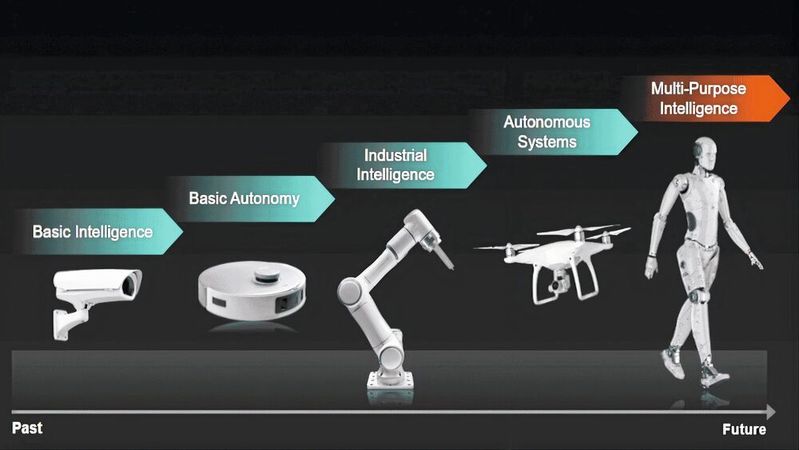
From networked cameras to vacuum robots, industrial robots, drones and humanoids, AI is moving ever closer to sensors and actuators as it develops from "basic intelligence" to "multi-purpose intelligence", while software-defined architectures make long-term systems flexibly upgradeable for new functions and AI models.
(Image: Globalfoundries)
The great technological leaps of recent years have been achieved in AI data centers, which today form the basis for training and hosting large models. However, the next step in value creation is taking place at the periphery: in billions of networked endpoints that bring intelligence directly into products and processes. Physical AI shifts computing and decision-making logic closer to the place where data is generated and actions are triggered - in vehicles, robots, machines and devices. This fundamentally changes the requirements: the decisive factor is no longer just maximum computing power, but the ability to work reliably in real time under tight energy, latency and cost budgets. At the same time, systems must remain updatable over many years in order to load new models and functions without replacing the hardware.
STAC: The Real-Time Operating Model of Physical AI
A practical framework model for physical AI is the STAC approach (sense - think - act - communicate), which describes how such systems work in the field.
Sense: Recording of environmental data using multimodal sensor technology - such as cameras, radar, lidar, audio, haptics and environmental sensors.
Think: Local processing and interpretation of this data, often with AI inferencing, to make deterministic, reliable decisions in real time.
Act: Conversion of these decisions into precise movements or switching operations via motors, actuators and control loops with tight feedback loops.
Communicate: Exchange of status, sensor data and models between device, edge and cloud to orchestrate fleets, roll out updates and continuously optimize systems.
From a semiconductor perspective, STAC derives three key requirements: high energy efficiency, deterministic latency and long-term reliability including security over the entire life cycle. Only if all four STAC functions can be mapped under these boundary conditions can physical AI applications be transferred from the pilot phase to safety-critical, scaled environments.
Convenient Semiconductor Platforms for Physical AI
The workloads described above mean that classic SoCs optimized purely for maximum computing power are reaching their limits. What is needed are purpose-built platforms that combine compute, sensing, actuation, memory and connectivity under a common energy and latency budget. Globalfoundries, for example, can address this need with several technology modules:
FDX and FinFET:
Ultra-low power CMOS with body bias capabilities and efficient FinFET nodes that combine high compute density with very low power consumption.
Integration of analog, mixed-signal and RF functionality on one die, enabling compact edge SoCs with integrated sensor connectivity.
Embedded non-volatile memory (eNVM):
Local storage of firmware, models and configuration data, allowing systems to be adapted in the field for years via OTA updates.
Basis for software-defined architectures that use hardware platforms for multiple generations of software and AI models.
Power Management Technologies:
Fine-grained voltage and clock domains, deep sleep states, and adaptive controllers to minimize both active and standby losses.
This is particularly relevant in battery-operated or passively cooled systems such as robotics, wearables, or connected sensors.
Silicon Photonics and RF:
High data rates and bandwidths for on-board and off-board connections to transmit large volumes of sensor data with minimal energy expenditure.
Scalable connectivity across billions of devices is a fundamental requirement for distributed physical AI fleets.
Advanced Packaging and Heterogeneous Integration:
2.5D and 3D approaches that integrate compute, memory, RF, and power chips into a logical system.
Optimized signal paths and energy flows to reduce latencies while simultaneously minimizing footprint and unit costs.
These building blocks enable physical AI systems to achieve more with less—meaning they can handle demanding STAC workloads within tight power, thermal, and compute limits. This opens up the possibility for the industry to bring intelligent behavior to a significantly broader range of device classes than would be economically feasible with purely high-end SoCs.
Software-Defined, Distributed Intelligence
A second structural transformation pertains to system architecture: instead of centralized compute blocks, distributed, software-defined systems are emerging. Intelligence is migrating closer to sensors and actuators to make decisions where they are needed—using short signal paths and reproducible latency. For semiconductors, this means:
Devices must cover broad, heterogeneous workloads—from classic control and signal processing to AI inferencing and safety functions.
Platforms are differentiated through software; hardware is deliberately designed to be generic enough to outlast multiple product cycles.
Embedded memory, secure boot and update mechanisms, and hardware security features become mandatory, not optional.
GlobalFoundries, for example, explicitly positions its platforms for such software-defined, distributed architectures and couples process technologies with IP, packaging, and manufacturing in a co-design approach. By integrating the MIPS portfolio—including real-time capable, multi-threaded RISC-V processors—the compute building blocks are supplemented to ensure deterministic real-time capability in such systems.
Application Areas: ADAS, Robotics, Humanoids
The impact of these technical developments is already evident in several segments:
Automotive / ADAS: Physical AI systems drive the next generation of Advanced Driver Assistance Systems and automated driving functions. They combine multimodal sensor technology (cameras, radar, lidar) with real-time processing and precise actuation to execute driving maneuvers under strict safety, power, and thermal requirements.
Industrial Automation and Logistics: Autonomous mobile robots, cobots, and driverless transport systems must navigate dynamic environments, recognize objects, plan paths, and interact safely with humans. Here, energy-efficient edge platforms with integrated sensor technology, connectivity, and secure control pay off.
Humanoids and Complex Robotics: For humanoid robots intended to work in human environments, high sensor density, distributed intelligence, deterministic latency, and robust communication are indispensable. Market forecasts suggest a very high long-term potential in this segment alone, further underscoring the relevance of scalable physical AI platforms.
With the transition from cloud-centric AI to physical AI, the focus is shifting towards reliable, energy-efficient, and adaptable systems in the field. Semiconductor platforms that holistically address STAC workloads while considering power, latency, connectivity, and updatability are becoming critical enablers for the next wave of automation. GlobalFoundries aims to fulfill this role with differentiated process technologies, advanced packaging, RF and connectivity solutions, and the integration of MIPS processor IP. For developers in automotive, industry, and robotics, this creates an ecosystem that allows physical AI systems to transition from initial demonstrators to widely deployed, critical applications. (sg)
Date: 08.12.2025
Naturally, we always handle your personal data responsibly. Any personal data we receive from you is processed in accordance with applicable data protection legislation. For detailed information please see our privacy policy.
Consent to the use of data for promotional purposes
I hereby consent to Vogel Communications Group GmbH & Co. KG, Max-Planck-Str. 7-9, 97082 Würzburg including any affiliated companies according to §§ 15 et seq. AktG (hereafter: Vogel Communications Group) using my e-mail address to send editorial newsletters. A list of all affiliated companies can be found here
Newsletter content may include all products and services of any companies mentioned above, including for example specialist journals and books, events and fairs as well as event-related products and services, print and digital media offers and services such as additional (editorial) newsletters, raffles, lead campaigns, market research both online and offline, specialist webportals and e-learning offers. In case my personal telephone number has also been collected, it may be used for offers of aforementioned products, for services of the companies mentioned above, and market research purposes.
Additionally, my consent also includes the processing of my email address and telephone number for data matching for marketing purposes with select advertising partners such as LinkedIn, Google, and Meta. For this, Vogel Communications Group may transmit said data in hashed form to the advertising partners who then use said data to determine whether I am also a member of the mentioned advertising partner portals. Vogel Communications Group uses this feature for the purposes of re-targeting (up-selling, cross-selling, and customer loyalty), generating so-called look-alike audiences for acquisition of new customers, and as basis for exclusion for on-going advertising campaigns. Further information can be found in section “data matching for marketing purposes”.
In case I access protected data on Internet portals of Vogel Communications Group including any affiliated companies according to §§ 15 et seq. AktG, I need to provide further data in order to register for the access to such content. In return for this free access to editorial content, my data may be used in accordance with this consent for the purposes stated here. This does not apply to data matching for marketing purposes.
Right of revocation
I understand that I can revoke my consent at will. My revocation does not change the lawfulness of data processing that was conducted based on my consent leading up to my revocation. One option to declare my revocation is to use the contact form found at https://contact.vogel.de. In case I no longer wish to receive certain newsletters, I have subscribed to, I can also click on the unsubscribe link included at the end of a newsletter. Further information regarding my right of revocation and the implementation of it as well as the consequences of my revocation can be found in the data protection declaration, section editorial newsletter.
*Ed Kaste is Senior Vice President of Ultra-Low Power CMOS Business at Globalfoundries.



:quality(80)/p7i.vogel.de/wcms/d1/ef/d1ef6b6f7d4543f7999980bacccaf22b/0133499261v1.jpeg "As the growing imbalance in trade relations with China continues to widen, the EU Chamber of Commerce foresees a day when trade with China will have to be seriously reevaluated ... (Image: AI-generated)")
:quality(80)/p7i.vogel.de/wcms/fe/1f/fe1fa5ee713f94deaba963dc24c3abc5/0133299273v1.jpeg "The Flexistar enables highly flexible production of laser-welded tubes thanks to its tool-free clamping system. (Image:Because Technology, LLC)")
:quality(80)/p7i.vogel.de/wcms/1b/5a/1b5ac72f83db4dbee3ff91e51bc398f4/0133496095v1.jpeg "BASF announces that it will take the next step toward producing the polyurethane precursor MDI in India ... (Image:BASF)")
:quality(80)/p7i.vogel.de/wcms/3f/cf/3fcfa390902944ffcf24e7fe973cc3ee/0133486258v1.jpeg "Do you need to create secure connections on structures using blind rivets, but space is tight? Then you should take a closer look at the Universalgrip from Gesipa ... (Image: Gesipa)")
:quality(80)/p7i.vogel.de/wcms/2e/99/2e99726b522e4b35b690e25eb6a42643/0133463991v1.jpeg "Robotics: In AMR applications, connection technology must reliably transmit power, signals, and data despite vibration and shock loads—in very confined spaces and in a way that allows for regular maintenance. (Image:Hyperever)")
:quality(80)/p7i.vogel.de/wcms/d0/18/d01801e3d5dbd7bc9d0b4f60408b630c/0133468429v1.jpeg "Quality requirements for film packaging are on the rise. At the same time, many companies are turning to recyclable film materials, which, however, have their own challenges. Fraunhofer researchers have therefore developed a fast system that detects problems in real time. (Image:Fraunhofer IKTS)")
:quality(80)/p7i.vogel.de/wcms/b1/06/b106cf44923ce39565c3264982fd20eb/0133414574v1.jpeg "Robots Build Robots: At the new Ubtech factory, automated systems even handle parts of the material supply and logistics for the production of humanoid robots. (Image:Ubtech)")
:quality(80)/p7i.vogel.de/wcms/38/79/38799bfbbccd938b64c67068cfa68780/0133329362v1.jpeg "What exactly enables machines to act on their own? (Image:Shutterstock)")
:quality(80)/p7i.vogel.de/wcms/66/a7/66a7b78159caeacce57136529688799f/0133503398v1.jpeg "Sunlight Makes Stone! These stone blocks weren't made the traditional way. Instead, they were additively manufactured from sand using a laser. In the future, however, the laser is set to be replaced by concentrated sunlight—if the startup Addisol is successful... (Image:Addisol / F. Fiedler)")
:quality(80)/p7i.vogel.de/wcms/72/b9/72b995c2c8d812c5e2115cbef31e035a/0133462727v1.jpeg "Eggl manufactures center hoods that are precisely tailored to each cooking island—whether standard size or custom shape. They are made entirely of stainless steel and are individually customized in terms of size and filter arrangement. (Image:SPI)")
:quality(80)/p7i.vogel.de/wcms/13/5d/135dfae6229ceaf5c55467a43e8f7257/adobestock-1879961393--ardi-stock-adobe-com-ki-generiertv1.jpeg "Annoying chatterboxes or awkward silences in response to questions—a moderator should specifically prepare for difficult situations in order to navigate them effectively. (Image:ardi - stock.adobe.com_AI-generated)")
:quality(80)/p7i.vogel.de/wcms/ca/46/ca462051dfb9a1fb37ca4053762af9df/org-blobs-user-response-file-output-908c701c-3b37-491e-bb5c-35fc3d336575-plugin-output-call-182851v1.png "Through extreme compression, high-energy lasers transform simple plastics into high-purity nanodiamonds. What was once used in planetary physics is now opening up entirely new possibilities for quantum sensors, novel catalysts, and extremely hard materials. (Illustrative image) (Source: VCG / AI-generated)")
:quality(80)/p7i.vogel.de/wcms/27/c9/27c917e021a143e590dee34a9f481978/0133504594v1.jpeg "In 2025, there were more electric cars among new registrations in the EU than ever before. (Image: ©Halfpoint - stock.adobe.com)")
:quality(80)/p7i.vogel.de/wcms/8c/ac/8cacd1d41ac023ec1f2bf81c623d1776/tesla-cybercab-75-1v1.jpeg "Tesla plans to use an electric motor that does not contain rare earth elements in the Cybercab. (Image:Tesla)")
:quality(80)/p7i.vogel.de/wcms/12/f0/12f022d493c7d7a39e2ab411953c37f3/mg-1253v1.jpeg "The Æthon solar cars in the foreground and the Adelie in the background on the racetrack in Zolder. (Source: Team Sonnenwagen)")
:quality(80)/p7i.vogel.de/wcms/5d/70/5d70b7d3a05d5a99821b172db63569be/0133485094v1.jpeg "Volkswagen continues to face financial difficulties. Although cost-cutting measures are already underway, the situation hasn't improved much. Further layoffs may be on the horizon. In addition, the Wolfsburg-based company plans to accelerate the implementation of its overall measures. (Image:Volkswagen)")
:quality(80)/p7i.vogel.de/wcms/11/2e/112eabc5fb41e1a401f0e93e9326ef51/0133489329v1.jpeg "A sandbox limits the actions an AI agent can take, but it is not an impenetrable barrier. Only multiple independent layers of protection prevent an escape from immediately granting access to production systems. (Image:freely licensed)")
:quality(80)/p7i.vogel.de/wcms/18/ba/18bae45f9e6f7cacc203d56f3bc26e3c/0133455937v1.jpeg "Google did not make the incidents public until after receiving an inquiry from the “Wall Street Journal.” (Image:Google)")
:quality(80)/p7i.vogel.de/wcms/65/58/655895abe42a598e146fe47baf7c54db/0133441212v1.jpeg "Wukong, a 72-qubit quantum processor manufactured by Origin Quantum. (Image:Origin Quantum)")
:quality(80)/p7i.vogel.de/wcms/63/68/6368c6e0861d6e25bbd25a8878ca5973/newsimage427467v1.jpeg "How can individual manipulated AI agents influence the decisions of entire networks? A new theoretical model shows the conditions under which misinformation spreads. (Source: CISPA)")
:fill(fff,0)/images.vogel.de/vogelonline/companyimg/76800/76895/65.jpg "FAULHABER_120mm.jpg ()")
:fill(fff,0)/p7i.vogel.de/companies/69/88/69882c428938e/tmts2026-ticec-banner-en-2000px.png "tmts2026-ticec-banner-en-2000px (https://www.tmts.tw/en)")
:fill(fff,0)/p7i.vogel.de/companies/69/de/69de1b7403b0d/simtos-logo.jpeg "simtos-logo (SIMTOS)")
:quality(80)/p7i.vogel.de/wcms/29/a8/29a8ea15ab38e4404bc1c6a3e425e454/adobestock-1550141473--leopard-stock-adobe-com-ki-generiertv1.jpeg "When Machines Understand What They're Doing—The Five Technologies Behind Physical AI. (Source: © Leopard – stock.adobe.com_AI-generated)")
:quality(80)/p7i.vogel.de/wcms/c9/c4/c9c4e42b9b054ec7ae0a3045170c07b6/0128162746v1.jpeg "Development workflow with Renesas e² studio: With Renesas e² studio, IoT applications can be downloaded from GitHub, configured, developed, and deployed on RA, RX, or RZ controllers – including connectivity to AWS and Microsoft Azure. (Image:Renesas Electronics Corporation)")