E/E architecture in transitionSoftware-less and intelligent endpoints in the software-defined vehicle
From
Tobias Otter and Daniel Mysliwitz *
| Translated by AI
7 min Reading Time
The centralization of vehicle software is changing not only the E/E architecture but also the requirements for the endpoints in the vehicle. Software-free and intelligent endpoints take on different tasks. Ethernet-based networks, including 10BASE-T1S, as well as the Remote Control Protocol, enable their integration into zonal and central computing architectures.
The electrical and electronic architecture (E/E architecture) of modern vehicles is undergoing change.
(Image: AI-generated)
Tobias Otter is Vice President Technical Marketing, Application and Platform at Infineon Technologies. Daniel Mysliwitz works as a system architect at Infineon Technologies.
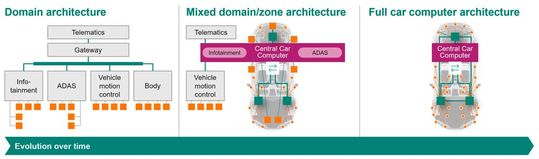
The electrical and electronic architecture (E/E architecture) of modern vehicles is undergoing change (Figure 1). For decades, the growing number of software-based functions led to more and more specialized electronic control units (ECUs) being integrated into the vehicle. The resulting distributed architecture was initially replaced by domain-oriented structures. In this approach, functions were grouped, for example, by powertrain, body, or infotainment and networked via domain controllers. In a further development step, the zonal architecture emerged. Unlike domain architecture, the arrangement of ECUs and communication links here is based more strongly on the physical position of the components in the vehicle. Zone controllers bundle connections to sensors and actuators, handle communication tasks, and can also control secondary power distribution. However, functions such as powertrain, steering, and braking often remain as independent domains. In practice, this results in hybrid architectures combining zonal and domain-oriented approaches.
Figure 1. Development of the E/E architecture
(Image: Infineon)
In a software-defined vehicle architecture, application software is shifted from the peripherals to zonal or central computing units in order to simplify software updates. From a software perspective, many domain functions are moved to the central vehicle computer. Nevertheless, the endpoints still serve to capture input signals and drive outputs, for example buttons, motors, and LEDs. Centralizing the software is intended to simplify the update process, reduce the number of control units to be updated, and save costs by reducing the maintenance effort for the numerous endpoints. However, this requires software-less and intelligent endpoints.
Endpoints as interfaces to the vehicle environment
Endpoints form the interface between the E/E architecture and the outside world. They capture input signals, control output functions such as motors, LEDs and valves, or provide interfaces for interaction with the user. These include displays, touchscreens, audio and voice systems as well as haptic feedback.
Depending on the use case, endpoints can be divided into two categories: softwareless and intelligent endpoints. Softwareless endpoints are designed for a limited number of standardized functions. Their implementation is based, for example, on a state machine or a fixed, hard-implemented protocol handler. Via the in-vehicle network, they can be configured using standardized communication interfaces and protocols. This also includes the OPEN Alliance TC18 Remote Control Protocol (RCP).
In contrast, intelligent endpoints have a freely programmable microcontroller. This enables them to support a broader range of applications. They offer sufficient flash and RAM as well as computing power for more complex tasks that require local software. In addition, they may include dedicated hardware such as gate drivers and analog-to-digital converters (ADC). The application software is usually provided by a Tier 1 supplier or the vehicle manufacturer. If the component is locked after the application software is installed, an intelligent endpoint can also be converted into a software-less endpoint.
Heterogeneous and homogeneous vehicle networks
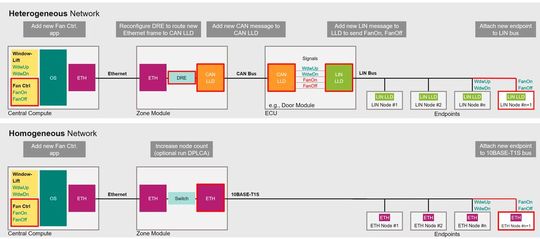
Today's in-vehicle networks are predominantly heterogeneous and use various communication technologies such as Ethernet, CAN, and LIN. To enable data exchange between the networks, gateways are required; however, these require software, which affects scalability and increases maintenance effort. Even if a network branch is expanded only by adding an endpoint, it may be necessary to update the communication stacks across the entire affected branch (Figure 2).
Figure 2. Unlike heterogeneous vehicle networks, a homogeneous Ethernet network does not require gateways between different network technologies.
(Image: Infineon)
In contrast, a homogeneous Ethernet-based network can do without gateways between different network technologies. Instead, Ethernet switches handle forwarding messages between the network segments, meaning no additional software is required. As a result, only minimal maintenance effort is needed when a new endpoint is added. The lower complexity therefore makes it easier to expand the network and improves its scalability.
Remote Control Protocol of the OPEN Alliance TC18
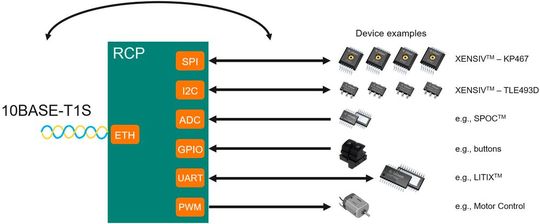
In an SDV, vehicle functions and properties are defined by software. For this, the software must be able to access hardware components at different locations in the vehicle and at different points in time. However, sensors, actuators, and buttons do not have an integrated Ethernet interface. The Remote Control Protocol of the OPEN Alliance TC18 defines how such components can be controlled from a zonal or central computer (Figure 3).
Date: 08.12.2025
Naturally, we always handle your personal data responsibly. Any personal data we receive from you is processed in accordance with applicable data protection legislation. For detailed information please see our privacy policy.
Consent to the use of data for promotional purposes
I hereby consent to Vogel Communications Group GmbH & Co. KG, Max-Planck-Str. 7-9, 97082 Würzburg including any affiliated companies according to §§ 15 et seq. AktG (hereafter: Vogel Communications Group) using my e-mail address to send editorial newsletters. A list of all affiliated companies can be found here
Newsletter content may include all products and services of any companies mentioned above, including for example specialist journals and books, events and fairs as well as event-related products and services, print and digital media offers and services such as additional (editorial) newsletters, raffles, lead campaigns, market research both online and offline, specialist webportals and e-learning offers. In case my personal telephone number has also been collected, it may be used for offers of aforementioned products, for services of the companies mentioned above, and market research purposes.
Additionally, my consent also includes the processing of my email address and telephone number for data matching for marketing purposes with select advertising partners such as LinkedIn, Google, and Meta. For this, Vogel Communications Group may transmit said data in hashed form to the advertising partners who then use said data to determine whether I am also a member of the mentioned advertising partner portals. Vogel Communications Group uses this feature for the purposes of re-targeting (up-selling, cross-selling, and customer loyalty), generating so-called look-alike audiences for acquisition of new customers, and as basis for exclusion for on-going advertising campaigns. Further information can be found in section “data matching for marketing purposes”.
In case I access protected data on Internet portals of Vogel Communications Group including any affiliated companies according to §§ 15 et seq. AktG, I need to provide further data in order to register for the access to such content. In return for this free access to editorial content, my data may be used in accordance with this consent for the purposes stated here. This does not apply to data matching for marketing purposes.
Right of revocation
I understand that I can revoke my consent at will. My revocation does not change the lawfulness of data processing that was conducted based on my consent leading up to my revocation. One option to declare my revocation is to use the contact form found at https://contact.vogel.de. In case I no longer wish to receive certain newsletters, I have subscribed to, I can also click on the unsubscribe link included at the end of a newsletter. Further information regarding my right of revocation and the implementation of it as well as the consequences of my revocation can be found in the data protection declaration, section editorial newsletter.
Figure 3. The Remote Control Protocol provides standardized communication interfaces and functions that can be used to control different components.
(Image: Infineon)
RCP is a signal-based request-response protocol. In this process, raw data, such as SPI data or values from analog-to-digital converters, are transmitted by the client, for example a zone controller, to the RCP server or requested from it. The RCP server is application-independent and forms a bridge between the Ethernet world and the non-Ethernet world without executing the respective application logic itself. This allows the RCP server to be implemented as a softwareless endpoint that provides standardized communication interfaces and functions. For connection to the higher-level network, for example, 10BASE-T1S can be used.
10BASE-T1S is designed to connect at least eight nodes to a shared transmission medium and supports all existing Ethernet protocols. Data transmission takes place at a fixed bit rate of 10 Mbit/s in half-duplex mode, which means that only one node can transmit at a time. To avoid collisions, the technology uses the Physical Layer Collision Avoidance (PLCA) method, in which each node is assigned a transmission time slot. During this period, the node in question may transmit data while the other nodes listen. The transmission time slots are cycled through, i.e., in a round-robin order.
Semiconductors for intelligent and software-free endpoints
By combining Ethernet, RCP, and softwareless or intelligent endpoints, new requirements arise for integrating sensors and actuators into a centralized vehicle architecture. Communication interfaces, computing functions, and power electronics must be tailored to the respective task. Various examples from engine and LED control illustrate the technical requirements.
In intelligent endpoints that control motors among other things, not only the microcontroller, such as the Traveo T2G, and the communication interface play a decisive role, but also the design and integration of the power stage. Depending on the required motor power, this can be implemented with discrete MOSFETs, integrated MOSFETs, or a power stage integrated directly into the system-on-chip (SoC). An example of this is Infineon’s Motix microcontrollers for driving DC motors and brushless DC motors (BLDC). The components are powered directly from the vehicle’s on-board electrical system. Depending on the version, communication takes place via LIN, for example with the TLE9879, or via CAN, for instance with the TLE9899.
The power stage can be configured differently depending on the motor power rating: for motors up to 1 kW, discrete MOSFETs can be used on the control unit. For motors up to 150 W, variants with integrated MOSFETs in a system-in-package (SiP) are available. For motors up to 15 W, the power stage can be integrated directly into the system-on-chip.
In contrast, for softwareless endpoints the focus is on providing a defined function via standardized communication interfaces. One example is the TLD7022 LED driver from Infineon’s LITIX™ family. It can control multiple LEDs and is suitable, among other things, for animated front and rear lighting. Communication takes place via UART over CAN and does not require programmable application software directly in the component. In addition, Infineon is currently exploring concepts for a configurable portfolio for softwareless endpoints.
Practical example: software distribution in a windshield wiper system
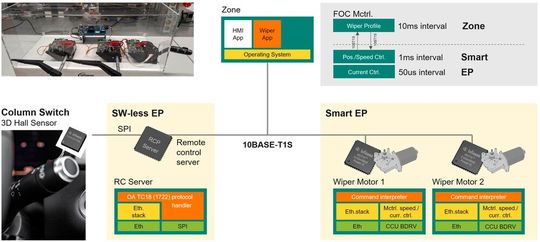
A demonstrator (Figure 4) based on a vehicle windshield wiper system illustrates how tasks can be distributed between central software and intelligent or softwareless endpoints. In this setup, the application software for the wiper function is moved from the dedicated wiper control unit to the zone controller. Communication between the zone controller and the three endpoints takes place via Ethernet using 10BASE-T1S. Thanks to the multidrop function, all three endpoints can be connected via a single twisted-pair cable.
Figure 4. The software partitioning in a windshield wiper system illustrates the interaction between software-less and intelligent endpoints.
(Image: Infineon)
The steering wheel switch is designed as a software-less endpoint in which SPI communication with the 3D Hall sensor is forwarded via RCP to the zone controller. By contrast, the two windshield wiper motors based on brushless DC motors (BLDC) are intelligent endpoints that communicate via 10BASE-T1S. The motor control software runs on an Arm Cortex-M3 microcontroller within the SoC and uses Infineon’s Motor Control Software Library.
The application logic for the windshield wiper function resides in the zone controller, while the motor endpoints perform the functions required for motor control. The steering wheel switch, by contrast, does not require its own freely programmable application software; its signals are transmitted to the zone controller via RCP. The demonstrator thus illustrates the interaction between software-less and intelligent endpoints: the application software is located in the zone controller, while the end devices provide standardized interfaces or take over local tasks such as motor control.
The role of the endpoints is changing.
With the centralization of vehicle software, the role of endpoints is also changing. While intelligent endpoints take on local tasks such as engine control, softwareless endpoints provide standardized functions, for example in the form of a protocol handler. With the help of Ethernet and RCP, both types can be integrated into a centralized vehicle architecture. This makes the division of tasks between central software and decentralized hardware an important design principle of software-defined vehicles. (se)