Michael Peter, CEO of Siemens Mobility, describes the evolution of the proven Vectron locomotive platform—which is in use throughout Europe—into the digitized and connected Vectron X as a “smartphone with 9,000 hp.” An app store will also be on board in the future.
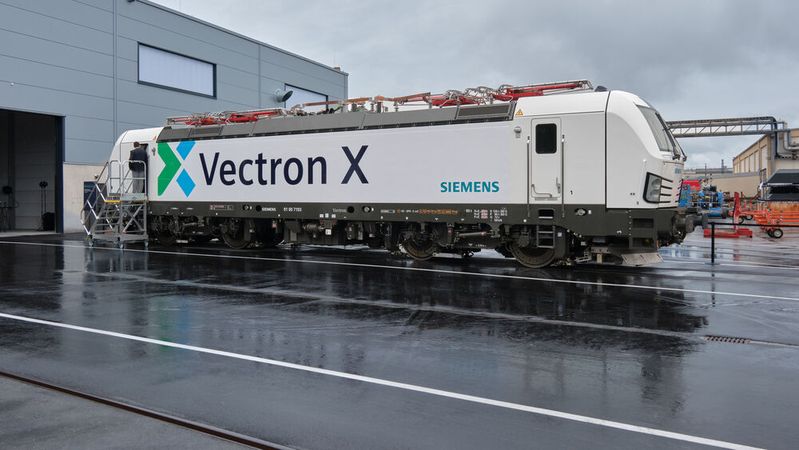
With the Vectron X, Siemens is expanding the proven Vectron platform into a digitally connected locomotive featuring an app store and integrated service processes.
(Image: Richard Oed)
First introduced in 2010 and put into service in 2012, Siemens Mobility’s Vectron locomotive platform has become a bestseller over the years. There are now more than 80 variants in operation across 20 countries. To date, Siemens has sold a total of nearly 3,000 locomotives of this type for rail freight and passenger transport. Every day, the locomotives already in service collectively cover two million kilometers. On June 10, 2026, the manufacturer unveiled the digital evolution of the product family—which Siemens calls the “Vectron X”—at its newly expanded Rail Service Center in Munich-Allach. However, the Vectron X is not a new development; rather, it is a transformation of the existing family into an open, software-based, digital, and connected locomotive platform. In the future, the locomotive will no longer be just a vehicle, but a digital workplace, a data hub, and part of an end-to-end ecosystem.
To achieve this, the Vectron X combines proven technologies with digital, app-based features and open interfaces for third-party partners, linking the vehicle, operations, service, and infrastructure. Thanks to its modular and software-based architecture, the Vectron X is part of the Siemens “Xcelerator” ecosystem, which was announced in 2022 at InnoTrans in Berlin. This allows the Vectron X to evolve alongside future customer requirements and be flexibly adapted.
“The Vectron X seamlessly bridges the real and digital worlds and brings digital features directly into the locomotive […],” explained Andre Rodenbeck, CEO of Rolling Stock at Siemens Mobility.
(Image: Richard Oed)
Connectivity creates an enormous database; according to Elmar Zeiler, CEO of Customer Services at Siemens Mobility, each vehicle generates one billion data points per year. As Michael Peter also noted during the presentation: “We no longer have individual locomotives. Our locomotives are maintained throughout their entire lifecycle, and 3,000 locomotives learn from one another within a large ecosystem, which benefits every single locomotive and every single customer.” Starting in June 2026, all orders will be delivered as Vectron X models, regardless of when they were placed.
The Smart Screen is the Heart of the System
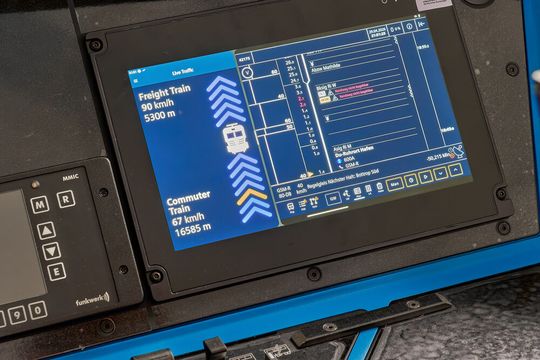
At the heart of the digital operating concept is the centrally located 11.6-inch smart screen, which complements the familiar Vectron driver’s console and consolidates key applications and information. This ranges from operational data and route information to third-party applications available in an app store. The “TrainPlay” app is a core feature of this digital ecosystem: This CarPlay-like solution allows train operators to mirror certain customer- and operator-specific applications—which they currently often use on smartphones or tablets—onto the touchscreen-enabled Smart Screen. Communication is bidirectional; drivers can also control the apps running on their mobile devices—for example, for scheduling, operational coordination, or retrieving information. With this, Siemens Mobility is launching the first CarPlay-like solution for locomotives.
With Live-Traffic, the train operator can view the distances to the trains ahead and behind.
(Image: Richard Oed)
Currently, six different software packages are available, all of which are installed from the start. One of these is the “Vectron Eco Cruise” package for energy efficiency, which helps train operators drive as energy-efficiently as possible. This system relies on the network operator’s schedules and infrastructure data—in Germany, that’s InfraGo—and, according to Siemens, is expected to result in energy savings of approximately 10 percent. In Germany, there is a similar system from Knorr-Bremse that analyzes the timetable data and, for example, switches to coasting mode in the event of early arrivals.
Remote Upgrades
Another package boosts vehicle productivity: This application, called “Remote Start,” allows a locomotive to be prepared for service remotely, which speeds up operational readiness and increases flexibility. Under normal circumstances, this saves employees 7 to 12 minutes; in winter, the time savings can be as high as 30 minutes. In addition, the app displays vehicle condition, status information, and consumables, and enables the locomotive engineer to quickly locate “his” locomotive: its parking location is marked on a map.
The “Live Traffic App” allows train operators to view the distance to trains ahead and behind and to adjust their driving accordingly. The other packages cover data processing, condition monitoring, and maintenance coordination.
Near-Real-Time Connectivity
Thanks to end-to-end connectivity—a central feature of Vectron X—the locomotive can transmit its operational data in near real time and securely connect to digital systems. This lays the foundation for early detection of anomalies, enabling more targeted maintenance measures and significantly reducing unplanned outages. This, in turn, stabilizes operations and improves availability.
Date: 08.12.2025
Naturally, we always handle your personal data responsibly. Any personal data we receive from you is processed in accordance with applicable data protection legislation. For detailed information please see our privacy policy.
Consent to the use of data for promotional purposes
I hereby consent to Vogel Communications Group GmbH & Co. KG, Max-Planck-Str. 7-9, 97082 Würzburg including any affiliated companies according to §§ 15 et seq. AktG (hereafter: Vogel Communications Group) using my e-mail address to send editorial newsletters. A list of all affiliated companies can be found here
Newsletter content may include all products and services of any companies mentioned above, including for example specialist journals and books, events and fairs as well as event-related products and services, print and digital media offers and services such as additional (editorial) newsletters, raffles, lead campaigns, market research both online and offline, specialist webportals and e-learning offers. In case my personal telephone number has also been collected, it may be used for offers of aforementioned products, for services of the companies mentioned above, and market research purposes.
Additionally, my consent also includes the processing of my email address and telephone number for data matching for marketing purposes with select advertising partners such as LinkedIn, Google, and Meta. For this, Vogel Communications Group may transmit said data in hashed form to the advertising partners who then use said data to determine whether I am also a member of the mentioned advertising partner portals. Vogel Communications Group uses this feature for the purposes of re-targeting (up-selling, cross-selling, and customer loyalty), generating so-called look-alike audiences for acquisition of new customers, and as basis for exclusion for on-going advertising campaigns. Further information can be found in section “data matching for marketing purposes”.
In case I access protected data on Internet portals of Vogel Communications Group including any affiliated companies according to §§ 15 et seq. AktG, I need to provide further data in order to register for the access to such content. In return for this free access to editorial content, my data may be used in accordance with this consent for the purposes stated here. This does not apply to data matching for marketing purposes.
Right of revocation
I understand that I can revoke my consent at will. My revocation does not change the lawfulness of data processing that was conducted based on my consent leading up to my revocation. One option to declare my revocation is to use the contact form found at https://contact.vogel.de. In case I no longer wish to receive certain newsletters, I have subscribed to, I can also click on the unsubscribe link included at the end of a newsletter. Further information regarding my right of revocation and the implementation of it as well as the consequences of my revocation can be found in the data protection declaration, section editorial newsletter.
“The new Munich-Allach Rail Service Center is our center of excellence for the maintenance of Vectron locomotives—from overhauls to post-accident repairs. […]”—Elmar Zeiler, CEO of Customer Services at Siemens Mobility.
(Image: Richard Oed)
Operators can thus better assess the condition of individual systems thanks to the expanded diagnostic, analytical, and condition-monitoring functions, a process further facilitated by a standardized data format and the ability to perform rule-based queries. As a result, maintenance is becoming increasingly proactive rather than reactive, which sustainably increases vehicle availability. Train operators can also view error messages and find out about corrective actions. If necessary, the responsible service representative can immediately create a work order for the repair shop. Behind these systems is the Siemens Mobility solution “Railigent X,” an IoT suite for service and applications, to which, according to Elmar Zeiler, AI-supported lifecycle management is expected to be added in the future.
The security architecture is crucial. TrainPlay and all App Store applications monitor the traction and braking systems but do not actively intervene. Siemens Mobility assures that all applications run only under strict authorization and are secured through encryption, software processes, and configuration management.
The Rail Service Center is Fully Digitized
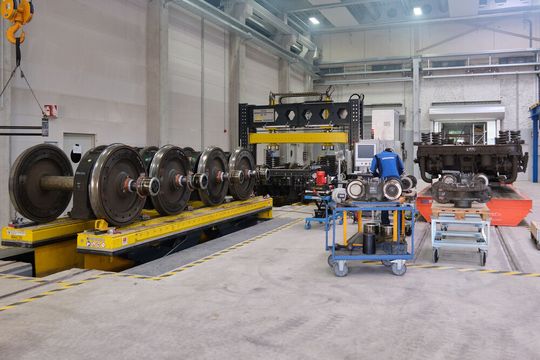
Along with the Vectron X, Siemens Mobility unveiled its expanded Rail Service Center (RSC) at its historic plant in Munich-Allach, where locomotives have been manufactured for over 100 years. Following the renovation and new construction, Siemens is now able to perform 80 overhauls and accident repairs per year—up from 25—and reduce the duration of major inspections to two weeks. To this end, four new workshop tracks were built, and bogie and wheel set refurbishment operations were each housed in their own separate halls.
The expanded Rail Service Center in Munich-Allach has six work tracks and separate facilities for bogie and wheel set refurbishment.
(Image: Richard Oed)
A key feature of the expanded RSC is its fully digital workshop processes. Workflows and documentation are paperless, and employees receive their work instructions on their handheld devices. Spare parts logistics rely on Siemens’ “MoBase” system, and thanks to the connectivity of the Vectron X, technicians know the locomotive’s condition even before it arrives, allowing them to order the necessary spare parts in advance.
In total, the company has invested more than $30 million in the renovation and partial reconstruction of the RSC and plans to employ approximately 80 people there by 2030. In total, Siemens has invested $300 million in the expansion of its Allach site in recent years and employs around 2,500 people there in development, manufacturing, and administration. Since 2025, Allach has also been home to the headquarters of Siemens Mobility. (se)



:quality(80)/p7i.vogel.de/wcms/eb/2b/eb2bd1b8487afe577b37363cd02f16ff/0113143253v1.jpeg "In our China Market Insider, we regularly provide you with relevant information straight from China. (Image:© Eisenhans - stock.adobe.com)")
:quality(80)/p7i.vogel.de/wcms/dd/b8/ddb8edc98c49b384734ab2432b297eb5/adobestock-1913662309--irene-stock-adobe-com-ki-generiertv1.jpeg "Rotary joints are used in grippers and swivel mechanisms to allow assemblies to rotate or swivel smoothly relative to one another, even under very high loads (illustrative image). (Source: Irene - stock.adobe.com / KI-generiert)")
:quality(80)/p7i.vogel.de/wcms/d1/ef/d1ef6b6f7d4543f7999980bacccaf22b/0133499261v1.jpeg "As the growing imbalance in trade relations with China continues to widen, the EU Chamber of Commerce foresees a day when trade with China will have to be seriously reevaluated ... (Image: AI-generated)")
:quality(80)/p7i.vogel.de/wcms/fe/1f/fe1fa5ee713f94deaba963dc24c3abc5/0133299273v1.jpeg "The Flexistar enables highly flexible production of laser-welded tubes thanks to its tool-free clamping system. (Image:Because Technology, LLC)")
:quality(80)/p7i.vogel.de/wcms/60/ef/60ef4f07e4829b2c2929befc0f353c58/0133511729v1.jpeg "Humanoid robots can match human performance in certain tasks. (Image:Gemini / AI-generated)")
:quality(80)/p7i.vogel.de/wcms/2e/99/2e99726b522e4b35b690e25eb6a42643/0133463991v1.jpeg "Robotics: In AMR applications, connection technology must reliably transmit power, signals, and data despite vibration and shock loads—in very confined spaces and in a way that allows for regular maintenance. (Image:Hyperever)")
:quality(80)/p7i.vogel.de/wcms/d0/18/d01801e3d5dbd7bc9d0b4f60408b630c/0133468429v1.jpeg "Quality requirements for film packaging are on the rise. At the same time, many companies are turning to recyclable film materials, which, however, have their own challenges. Fraunhofer researchers have therefore developed a fast system that detects problems in real time. (Image:Fraunhofer IKTS)")
:quality(80)/p7i.vogel.de/wcms/b1/06/b106cf44923ce39565c3264982fd20eb/0133414574v1.jpeg "Robots Build Robots: At the new Ubtech factory, automated systems even handle parts of the material supply and logistics for the production of humanoid robots. (Image:Ubtech)")
:quality(80)/p7i.vogel.de/wcms/c0/52/c052f405eb55fc3d08c4837e77206fc0/adobestock-2021845957--aucartstudio-stock-adobe-com-ki-generiertv1.jpeg "An innovation from China to combat extreme summer heat: A novel coating lowers temperatures. (Source: © AucArtStudio – stock.adobe.com_AI-generated)")
:quality(80)/p7i.vogel.de/wcms/66/a7/66a7b78159caeacce57136529688799f/0133503398v1.jpeg "Sunlight Makes Stone! These stone blocks weren't made the traditional way. Instead, they were additively manufactured from sand using a laser. In the future, however, the laser is set to be replaced by concentrated sunlight—if the startup Addisol is successful... (Image:Addisol / F. Fiedler)")
:quality(80)/p7i.vogel.de/wcms/72/b9/72b995c2c8d812c5e2115cbef31e035a/0133462727v1.jpeg "Eggl manufactures center hoods that are precisely tailored to each cooking island—whether standard size or custom shape. They are made entirely of stainless steel and are individually customized in terms of size and filter arrangement. (Image:SPI)")
:quality(80)/p7i.vogel.de/wcms/13/5d/135dfae6229ceaf5c55467a43e8f7257/adobestock-1879961393--ardi-stock-adobe-com-ki-generiertv1.jpeg "Annoying chatterboxes or awkward silences in response to questions—a moderator should specifically prepare for difficult situations in order to navigate them effectively. (Image:ardi - stock.adobe.com_AI-generated)")
:quality(80)/p7i.vogel.de/wcms/aa/a2/aaa2c6dd2daa24b485cddbf9297590c0/0133467318v1.jpeg "Battery Monitoring: Battery monitoring using electrochemical impedance spectroscopy offers several advantages. (Image:TI)")
:quality(80)/p7i.vogel.de/wcms/39/b2/39b21bf03be1683831862239a369987c/0133469638v1.jpeg "Data from autonomous vehicles and robots operating autonomously is in high demand, and Ruqi wants to capitalize on this. (Image:Ruqi Mobility)")
:quality(80)/p7i.vogel.de/wcms/8a/bb/8abbb6217220595edc1549ac9b84f307/0133429906v1.jpeg "The IAA in Hanover showcased the ambitions of Chinese commercial vehicle manufacturers in Europe. (Image:Wehner - VCG)")
:quality(80)/p7i.vogel.de/wcms/0c/53/0c5313ef91c14b6df0d0996efc33c8ad/jpg03568-bearbeitetv1.jpeg "The category winners of the 2027 German Car of the Year award. (Source: GCOTY)")
:quality(80)/p7i.vogel.de/wcms/48/15/4815da27c45973ca629a99b375ac3aef/0133509585v1.jpeg "Ventuno Q RoadTest: Designed to help the Element14 community gain practical insights from real-world tests using the Ventuno Q. (Image:Farnell/Element14)")
:quality(80)/p7i.vogel.de/wcms/17/2b/172bd132f9febdfcbcedba292ad0504d/aufmacherv1.jpeg "Micro-Epsilon offers a wide range of IO-Link-compatible sensors. (Source: Micro-Epsilon Messtechnik GmbH & Co. KG)")
:quality(80)/p7i.vogel.de/wcms/ca/b4/cab46fd26d19d6a2febca032048200b6/0133471827v1.jpeg "Photonics SDK for C and Python: Computational operations are now abstracted as standard mathematical functions. (Image:Q.ANT)")
:quality(80)/p7i.vogel.de/wcms/92/b2/92b2ed5299cde450c0764f4f64468395/0133505895v1.jpeg "The \"Iris 100\" test system for high-precision volume production of microLEDs uses a spectrometer and a high-resolution camera. (Image:Teradyne)")
:fill(fff,0)/p7i.vogel.de/companies/68/a4/68a47beec75ce/logo-cmyk-de.jpeg "logo-cmyk-de (https://www.datatec.eu/)")
:fill(fff,0)/p7i.vogel.de/companies/69/88/69882c428938e/tmts2026-ticec-banner-en-2000px.png "tmts2026-ticec-banner-en-2000px (https://www.tmts.tw/en)")
:fill(fff,0)/p7i.vogel.de/companies/69/de/69de1b7403b0d/simtos-logo.jpeg "simtos-logo (SIMTOS)")
![“The Vectron X seamlessly bridges the real and digital worlds and brings digital features directly into the locomotive […],” explained Andre Rodenbeck, CEO of Rolling Stock at Siemens Mobility.(Image: Richard Oed)](https://cdn1.vogel.de/44NWmGctG4fIKi7jsC2V0pcPP2w=/fit-in/540x0/smart/p7i.vogel.de/wcms/9c/63/9c6325dc7d1eabfd2185ed02aabd5823/0131924961v1.jpeg "“The Vectron X seamlessly bridges the real and digital worlds and brings digital features directly into the locomotive […],” explained Andre Rodenbeck, CEO of Rolling Stock at Siemens Mobility.(Image: Richard Oed)")
![“The new Munich-Allach Rail Service Center is our center of excellence for the maintenance of Vectron locomotives—from overhauls to post-accident repairs. […]”—Elmar Zeiler, CEO of Customer Services at Siemens Mobility.(Image: Richard Oed)](https://cdn1.vogel.de/mMtZUluDD0z0V97mCcCrSY-hCwA=/fit-in/540x0/smart/p7i.vogel.de/wcms/1e/fa/1efafe9e186c833cb985935a9e43ba5e/0131927305v1.jpeg "“The new Munich-Allach Rail Service Center is our center of excellence for the maintenance of Vectron locomotives—from overhauls to post-accident repairs. […]”—Elmar Zeiler, CEO of Customer Services at Siemens Mobility.(Image: Richard Oed)")
:quality(80)/p7i.vogel.de/wcms/89/b8/89b8cdb845628f075d919a2b28837f5a/0131558986v2v1.jpeg "Saving wildlife, avoiding accidents: That is the goal of the new system from Alstom and Flox Intelligence, which is now being tested. (Image:Image)")
:quality(80)/p7i.vogel.de/wcms/32/46/32463ff51682457b54a1a5f8725fd71d/0131210522v1.jpeg "From 2029, the Mireo Plus H will be operating on routes around Bucharest in Romania. (Image:Siemens Mobility)")
:quality(80)/p7i.vogel.de/wcms/45/8e/458e33005202daefb08dc3ddbbbb40e1/0131948187v1.jpeg "Siemens Mobility has created a new travel train platform, Vectouro, for flexible international use in Europe. For this, Knorr-Bremse supplies braking and boarding systems. (Image: Siemens Mobility)")
:quality(80)/p7i.vogel.de/wcms/8b/c5/8bc5c0c40b6d706aca4e3f3ddcc99958/0133387335v1.jpeg "At InnoTrans, Stadler is unveiling for the first time its new four-axle EURO DuFour locomotive for freight service, which SBB Cargo has ordered. Compared to the existing fleet, it is expected to be significantly more energy-efficient in operation. (Image:Stadler)")