Automakers need a software platform that allows them to manage software updates as well as the condition and status of their vehicles. They must be able to input and read data in and out of the vehicle and be capable of interacting securely with each individual vehicle. This article describes a holistic approach that goes far beyond a pure OTA solution.
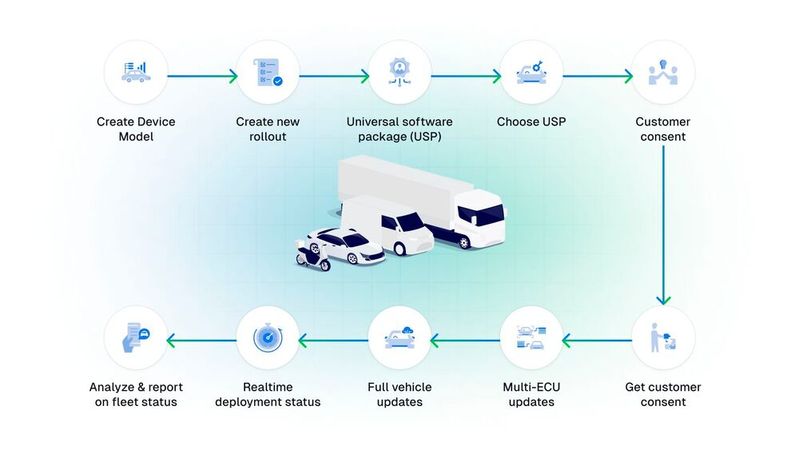
Car manufacturers rely on a software platform that allows them to manage software updates as well as the condition and status of the vehicle.
(Image: Sibros)
With the transition to software-defined vehicles (SDVs), complexity is increasing almost exponentially. Of course, car manufacturers and suppliers are generally in a position to develop the components required for communication between the vehicle and the cloud in the vehicle and on the backend server themselves and to support them over the entire service life of the vehicle. However, this requires not only a qualified internal team, but also a considerable development effort.
Sibros addresses the growing complexity with its Deep Connected Platform, which integrates over-the-air (OTA) updates, data logging and remote diagnostics into a unified vehicle-to-cloud system. This platform is designed to adapt to different vehicle architectures, including centralized and zonal designs, making it compatible with a wide range of vehicles.
The Basis: OTA Update System
The foundation of the platform is its OTA update system, which is essential in the age of SDVs. As vehicles increasingly rely on interconnected ECUs for critical operations, updating software is becoming an operational priority. Sibros' OTA solution enables accurate updates to the software that controls these ECUs without the need for a physical connection to the vehicle. The process is secure and uses multi-factor authentication, certificate validation and robust encryption protocols to ensure the integrity and authenticity of the updates. These measures mitigate risks such as unauthorized software tampering or data breaches and are essential for protecting vehicles from cyber threats.
In addition to its OTA capabilities, the platform is characterized by data collection and analysis. The system can collect extensive, detailed data from each vehicle, including parameters such as sensor outputs, engine performance, battery health and user interactions. Data is collected in near real-time, allowing car manufacturers to maintain a comprehensive overview of fleet performance and identify potential issues before they escalate. This is crucial for reducing vehicle downtime and increasing operational efficiency. Once collected, the data is processed by the platform's analytics tools, which use algorithms to detect anomalies, predict maintenance requirements and provide actionable insights to engineering and service teams.
Precise Updates
The update process itself is extremely dynamic. The platform offers the ability to address specific ECUs, modules or systems within a vehicle so that precise updates can be carried out without affecting other software functions. In addition, the solution also allows small software elements to be updated so that the vehicle is not at a standstill for several hours to perform a full update. Instead, the update of the small software component may only take a few minutes. If a car owner can't use their vehicle for 15 hours because of an update, that's basically a disaster. However, if the update runs smoothly in the background without restricting the usability of the vehicle, the car owner usually does not even notice the updates and can use new functions when needed. The service quality of the OTA functions is therefore of fundamental importance.
This targeted approach is beneficial for vehicles with complex architectures, such as those with a zonal or centralized design. In addition, the platform supports rollback prevention and ensures that outdated or compromised software cannot be restored. This is an important security measure for maintaining the operational integrity of vehicle systems.
Logging and Analysis in Real Time
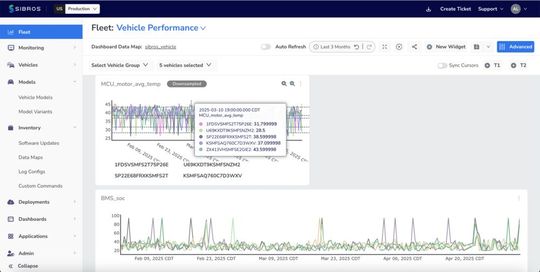
In addition to the OTA functions, the solution also has data logging and analysis functions. Vehicles already generate a huge amount of data, covering aspects such as performance metrics, sensor outputs, user interactions and environmental conditions. Managing and analyzing this data is a significant challenge for automotive manufacturers, especially given the variety and volume of information collected across fleets. Sibros addresses this challenge with an integrated system that collects, processes and interprets data in real time. Fleet management companies can use this software to optimize their fleet management and even carry out their maintenance work via a central platform.
Date: 08.12.2025
Naturally, we always handle your personal data responsibly. Any personal data we receive from you is processed in accordance with applicable data protection legislation. For detailed information please see our privacy policy.
Consent to the use of data for promotional purposes
I hereby consent to Vogel Communications Group GmbH & Co. KG, Max-Planck-Str. 7-9, 97082 Würzburg including any affiliated companies according to §§ 15 et seq. AktG (hereafter: Vogel Communications Group) using my e-mail address to send editorial newsletters. A list of all affiliated companies can be found here
Newsletter content may include all products and services of any companies mentioned above, including for example specialist journals and books, events and fairs as well as event-related products and services, print and digital media offers and services such as additional (editorial) newsletters, raffles, lead campaigns, market research both online and offline, specialist webportals and e-learning offers. In case my personal telephone number has also been collected, it may be used for offers of aforementioned products, for services of the companies mentioned above, and market research purposes.
Additionally, my consent also includes the processing of my email address and telephone number for data matching for marketing purposes with select advertising partners such as LinkedIn, Google, and Meta. For this, Vogel Communications Group may transmit said data in hashed form to the advertising partners who then use said data to determine whether I am also a member of the mentioned advertising partner portals. Vogel Communications Group uses this feature for the purposes of re-targeting (up-selling, cross-selling, and customer loyalty), generating so-called look-alike audiences for acquisition of new customers, and as basis for exclusion for on-going advertising campaigns. Further information can be found in section “data matching for marketing purposes”.
In case I access protected data on Internet portals of Vogel Communications Group including any affiliated companies according to §§ 15 et seq. AktG, I need to provide further data in order to register for the access to such content. In return for this free access to editorial content, my data may be used in accordance with this consent for the purposes stated here. This does not apply to data matching for marketing purposes.
Right of revocation
I understand that I can revoke my consent at will. My revocation does not change the lawfulness of data processing that was conducted based on my consent leading up to my revocation. One option to declare my revocation is to use the contact form found at https://contact.vogel.de. In case I no longer wish to receive certain newsletters, I have subscribed to, I can also click on the unsubscribe link included at the end of a newsletter. Further information regarding my right of revocation and the implementation of it as well as the consequences of my revocation can be found in the data protection declaration, section editorial newsletter.
Managing and analyzing data such as performance metrics, sensor outputs, user interactions and environmental conditions is a significant challenge for automotive manufacturers, especially given the variety and volume of information collected across fleets.
(Image: Sibros)
The platform uses edge computing to enable instant data processing in the vehicle itself, while also transmitting key insights to cloud servers for further analysis. This two-tiered approach ensures that key diagnostics and insights are immediately available to engineers and service teams, allowing them to better monitor vehicle performance and proactively address potential issues. For example, patterns identified in brake system performance data could indicate early signs of wear and tear and prompt preventative maintenance before the problem escalates. Such predictive analytics are invaluable for optimizing vehicle reliability and reducing operating costs for fleet operators.
Remote Diagnosis
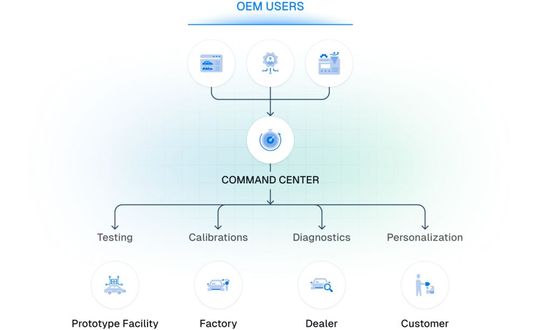
Remote diagnostics further extends the platform's capabilities and offers OEMs the ability to interact with a vehicle's systems remotely. This feature is particularly useful in fleet management, where maintaining operational efficiency is of paramount importance. Using the Deep Connected Platform, engineers can remotely run diagnostic commands, access vehicle logs and even troubleshoot issues without having to take the vehicle to a workshop. For example, a fleet operator could use remote diagnostics to detect an anomaly in an electric vehicle's battery system and take immediate corrective action.
Remote diagnostics further extends the platform's functions and offers OEMs the opportunity to interact with a vehicle's systems remotely.
(Image: Sibros)
Scalability
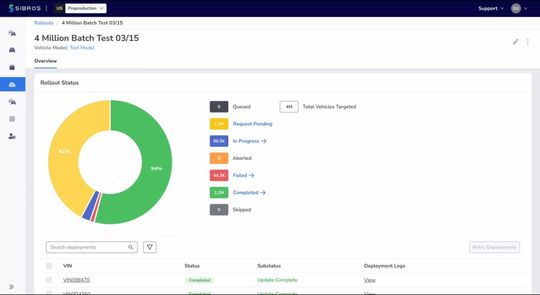
An important aspect of the platform's data management system is its scalability. Whether the fleet consists of a handful of vehicles or thousands, the platform's architecture is designed to handle large volumes of data without compromising processing speed or accuracy. This scalability is particularly beneficial for car manufacturers operating in multiple markets where data collection and management requirements can vary significantly.
Scalability played an important role for car manufacturers operating in multiple markets where data collection and management requirements can vary significantly.
(Image: Sibros)
Modular Architecture
The architecture of the Deep Connected Platform is modular and can therefore be adapted to a wide range of vehicle designs. Thanks to its modularity, the solution can be scaled and customized according to specific requirements, regardless of whether it is a fully electric vehicle or a hybrid. The system can be seamlessly integrated into existing vehicle electronic ecosystems, minimizing the need for extensive revisions or compatibility adjustments.
Secure Bootloader
Another important aspect of the platform is its secure bootloader technology. This bootloader ensures that software updates can be carried out without compromising the operational integrity of the control units. It prevents rollback attacks and enforces strict verification mechanisms during the update process. This is particularly important for compliance with the safety standards and regulations that apply to automotive electronics.
Development and Entire Service Life
The Sibros solution is designed to work across the entire lifecycle of a vehicle. During the design and development phase, it provides real-time diagnostics and compliance tools that enable manufacturers to effectively overcome challenges in the development phase. When the vehicle goes into production, the platform supports factory testing by verifying ECU configurations and optimizing supply chain logistics. Once the vehicle is in the hands of the end user, the platform's remote diagnostics and OTA capabilities ensure that it remains up to date and operational throughout its lifetime.
The platform also plays a crucial role in ensuring regulatory compliance. By continuously monitoring software versions and diagnostic data, it helps car manufacturers comply with regional and global standards, minimizing the risks associated with non-compliance. This is important because automotive electronics regulations are constantly evolving and imposing stricter requirements on manufacturers.
Seamless Digital Ecosystem
The key advantage of the Deep Connected Platform lies in its ability to create a seamless digital ecosystem within the vehicle. At its core, the platform serves as the backbone for software and data management and integrates functions that optimize operations across the entire lifecycle of a vehicle - from conception to after-sales service. This technological cohesion is critical at a time when vehicles are increasingly reliant on software for both basic functions and advanced features.
To understand how the platform works, you first need to look at the over-the-air update system. OTA updates represent a transformative approach to software management. In traditional systems, updating vehicle software often required manual intervention, necessitating a visit to the service center or the use of USB devices. This approach was not only time-consuming, but also prone to errors and security risks. The Sibros platform eliminates these inefficiencies by enabling secure remote updates directly to the vehicle's ECUs. The process includes sophisticated encryption techniques, secure bootloaders and multi-level authentication protocols that ensure only verified software is delivered to the vehicle.
Integration with Standardized Protocols
The platform's modular architecture ensures compatibility with different vehicle designs and electronics ecosystems. Sibros has designed the platform to integrate seamlessly with existing systems, eliminating the need for extensive modifications or customization. This modularity is achieved through standardized protocols and interfaces that allow the platform to function as a plug-and-play solution across different electronic architectures. For car manufacturers, this means reduced deployment time and lower integration costs, making the platform an economically viable choice. It also enables the vehicle to be securely connected to third-party providers such as car rental companies, as Sibros already provides powerful APIs for this.
Security is Crucial
Sibros is aware of the vulnerabilities inherent in connected vehicle systems. The platform includes comprehensive cybersecurity measures, including the use of frameworks such as Uptane. These measures protect against unauthorized access, data breaches and software tampering and ensure that vehicles remain secure throughout their lifecycle. In addition, the platform's secure bootloader technology prevents rollback attacks and enforces strict verification mechanisms during software updates, ensuring the integrity of critical systems.
The regulatory framework in the automotive industry is constantly evolving, with ever stricter compliance requirements being imposed on manufacturers. To this end, the manufacturer has tools to monitor and ensure compliance in all software processes. From emissions-related software updates to safety-critical diagnostics, the platform enables automotive manufacturers to maintain transparency and adhere to both regional and global standards. The Sibros solution complies with several standards such as ISO 26262 for ASIL-D or ISO 21434.
The Deep Connected Platform is designed to work at every stage of the vehicle lifecycle. During the design and development phase, it enables real-time diagnostics and conformance testing so that challenges can be identified and resolved early in the development process. In the production phase, the platform supports factory testing by verifying the configuration and functional scope of ECUs, optimizing supply chain logistics and ensuring quality control. Once the vehicles are on the road, the platform's OTA, data analysis and remote diagnostics functions ensure that they remain operationally optimized and safe.
The Three Pillars of the Platform
The Sibros solution is based on three pillars called Deep Logger, Deep Updater and Deep Commander. The Deep Logger software enables real-time monitoring of vehicles. It acts as an "ear" in the car and monitors all sensors and hardware components with an accuracy of up to 10 milliseconds. It offers the possibility to virtually listen to the vehicle in real time. The Deep Updater not only allows the vehicle software to be read out, but also updated via OTA to ensure that the vehicle is always up to date. Finally, the Deep Commander combines the functions of the two previous tools with additional options for special queries and remote vehicle maintenance. AI can also play an important role here.(se)
*Hemant Sikaria, CEO and co-founder of Sibros, spent five years at Tesla, where he was the technical lead for OTA updates and body/suspension firmware and helped launch three vehicle models.



:quality(80)/p7i.vogel.de/wcms/eb/2b/eb2bd1b8487afe577b37363cd02f16ff/0113143253v1.jpeg "In our China Market Insider, we regularly provide you with relevant information straight from China. (Image:© Eisenhans - stock.adobe.com)")
:quality(80)/p7i.vogel.de/wcms/dd/b8/ddb8edc98c49b384734ab2432b297eb5/adobestock-1913662309--irene-stock-adobe-com-ki-generiertv1.jpeg "Rotary joints are used in grippers and swivel mechanisms to allow assemblies to rotate or swivel smoothly relative to one another, even under very high loads (illustrative image). (Source: Irene - stock.adobe.com / KI-generiert)")
:quality(80)/p7i.vogel.de/wcms/d1/ef/d1ef6b6f7d4543f7999980bacccaf22b/0133499261v1.jpeg "As the growing imbalance in trade relations with China continues to widen, the EU Chamber of Commerce foresees a day when trade with China will have to be seriously reevaluated ... (Image: AI-generated)")
:quality(80)/p7i.vogel.de/wcms/fe/1f/fe1fa5ee713f94deaba963dc24c3abc5/0133299273v1.jpeg "The Flexistar enables highly flexible production of laser-welded tubes thanks to its tool-free clamping system. (Image:Because Technology, LLC)")
:quality(80)/p7i.vogel.de/wcms/60/ef/60ef4f07e4829b2c2929befc0f353c58/0133511729v1.jpeg "Humanoid robots can match human performance in certain tasks. (Image:Gemini / AI-generated)")
:quality(80)/p7i.vogel.de/wcms/2e/99/2e99726b522e4b35b690e25eb6a42643/0133463991v1.jpeg "Robotics: In AMR applications, connection technology must reliably transmit power, signals, and data despite vibration and shock loads—in very confined spaces and in a way that allows for regular maintenance. (Image:Hyperever)")
:quality(80)/p7i.vogel.de/wcms/d0/18/d01801e3d5dbd7bc9d0b4f60408b630c/0133468429v1.jpeg "Quality requirements for film packaging are on the rise. At the same time, many companies are turning to recyclable film materials, which, however, have their own challenges. Fraunhofer researchers have therefore developed a fast system that detects problems in real time. (Image:Fraunhofer IKTS)")
:quality(80)/p7i.vogel.de/wcms/b1/06/b106cf44923ce39565c3264982fd20eb/0133414574v1.jpeg "Robots Build Robots: At the new Ubtech factory, automated systems even handle parts of the material supply and logistics for the production of humanoid robots. (Image:Ubtech)")
:quality(80)/p7i.vogel.de/wcms/c0/52/c052f405eb55fc3d08c4837e77206fc0/adobestock-2021845957--aucartstudio-stock-adobe-com-ki-generiertv1.jpeg "An innovation from China to combat extreme summer heat: A novel coating lowers temperatures. (Source: © AucArtStudio – stock.adobe.com_AI-generated)")
:quality(80)/p7i.vogel.de/wcms/66/a7/66a7b78159caeacce57136529688799f/0133503398v1.jpeg "Sunlight Makes Stone! These stone blocks weren't made the traditional way. Instead, they were additively manufactured from sand using a laser. In the future, however, the laser is set to be replaced by concentrated sunlight—if the startup Addisol is successful... (Image:Addisol / F. Fiedler)")
:quality(80)/p7i.vogel.de/wcms/72/b9/72b995c2c8d812c5e2115cbef31e035a/0133462727v1.jpeg "Eggl manufactures center hoods that are precisely tailored to each cooking island—whether standard size or custom shape. They are made entirely of stainless steel and are individually customized in terms of size and filter arrangement. (Image:SPI)")
:quality(80)/p7i.vogel.de/wcms/13/5d/135dfae6229ceaf5c55467a43e8f7257/adobestock-1879961393--ardi-stock-adobe-com-ki-generiertv1.jpeg "Annoying chatterboxes or awkward silences in response to questions—a moderator should specifically prepare for difficult situations in order to navigate them effectively. (Image:ardi - stock.adobe.com_AI-generated)")
:quality(80)/p7i.vogel.de/wcms/aa/a2/aaa2c6dd2daa24b485cddbf9297590c0/0133467318v1.jpeg "Battery Monitoring: Battery monitoring using electrochemical impedance spectroscopy offers several advantages. (Image:TI)")
:quality(80)/p7i.vogel.de/wcms/39/b2/39b21bf03be1683831862239a369987c/0133469638v1.jpeg "Data from autonomous vehicles and robots operating autonomously is in high demand, and Ruqi wants to capitalize on this. (Image:Ruqi Mobility)")
:quality(80)/p7i.vogel.de/wcms/8a/bb/8abbb6217220595edc1549ac9b84f307/0133429906v1.jpeg "The IAA in Hanover showcased the ambitions of Chinese commercial vehicle manufacturers in Europe. (Image:Wehner - VCG)")
:quality(80)/p7i.vogel.de/wcms/0c/53/0c5313ef91c14b6df0d0996efc33c8ad/jpg03568-bearbeitetv1.jpeg "The category winners of the 2027 German Car of the Year award. (Source: GCOTY)")
:quality(80)/p7i.vogel.de/wcms/48/15/4815da27c45973ca629a99b375ac3aef/0133509585v1.jpeg "Ventuno Q RoadTest: Designed to help the Element14 community gain practical insights from real-world tests using the Ventuno Q. (Image:Farnell/Element14)")
:quality(80)/p7i.vogel.de/wcms/17/2b/172bd132f9febdfcbcedba292ad0504d/aufmacherv1.jpeg "Micro-Epsilon offers a wide range of IO-Link-compatible sensors. (Source: Micro-Epsilon Messtechnik GmbH & Co. KG)")
:quality(80)/p7i.vogel.de/wcms/ca/b4/cab46fd26d19d6a2febca032048200b6/0133471827v1.jpeg "Photonics SDK for C and Python: Computational operations are now abstracted as standard mathematical functions. (Image:Q.ANT)")
:quality(80)/p7i.vogel.de/wcms/92/b2/92b2ed5299cde450c0764f4f64468395/0133505895v1.jpeg "The \"Iris 100\" test system for high-precision volume production of microLEDs uses a spectrometer and a high-resolution camera. (Image:Teradyne)")
:fill(fff,0)/images.vogel.de/vogelonline/companyimg/76800/76895/65.jpg "FAULHABER_120mm.jpg ()")
:quality(80)/p7i.vogel.de/wcms/af/7c/af7cd87cd9c99f3ec21442f192992bae/0128044433v1.jpeg "In an SDV, software is the central product. It enables functions such as over-the-air updates, personalized driving experiences, and automated driving. To make this possible, the way vehicles are developed and designed must be fundamentally reimagined. (Image:Intellias)")
:quality(80)/p7i.vogel.de/wcms/14/e1/14e111999375605ccd9f83e5db2ad7f4/0130414750v1.jpeg "Software-defined vehicles have redefined expectations regarding the speed of innovation. (Image:Sonatus)")
:quality(80)/p7i.vogel.de/wcms/4e/15/4e15d1c92ff2bc5169291db403dd86e2/0131594892v1.jpeg "Thanks in part to advances in the field of automotive Ethernet, car manufacturers can equip their vehicles with a wider range of functions. (Image:Texas Instruments)")