The FCC makes the production location a market criterion: Newly foreign-produced inverters and advanced mobile robots are fundamentally not approved in the USA. This primarily affects Chinese providers—and puts supply chains and US manufacturing plans under pressure.
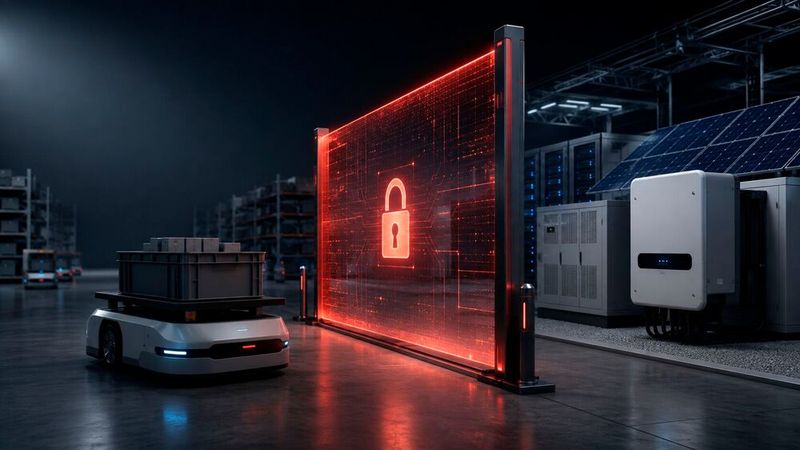
Symbolic image: New US rules could make market access more difficult for foreign providers of mobile robots and connected inverters.
(Image: Dall-E / AI-generated)
The USA is restricting the approval of new humanoid and quadruped robots from foreign production. Additionally, new connected inverters, such as those used to link solar systems, battery storage, and data centers to the power grid, may no longer be imported or sold. Although the Chinese government is not explicitly mentioned, several international news agencies have identified the country as the clear target of the new trade barriers.
The U.S. regulatory authority "Federal Communications Commission" (FCC) announced the new restrictions on FCC approval on July 28, 2026. According to Reuters, non-Chinese suppliers can expect to receive exemptions soon.
The FCC decides on the approval of radio and communication-capable electronic devices that are imported into and sold in the USA. This time, the agency has expanded its so-called "Covered List" to include two categories: advanced robots and connected inverters. New foreign-manufactured models will no longer receive approval. In the future, they may require conditional approval, preceded by a national security review by the Department of Defense or the Department of Homeland Security. Devices already approved may continue to be sold for the time being. However, the agency can also retroactively revoke their approvals.
A Matter of National Security
Certain foreign-manufactured robots and inverters pose "unacceptable risks to the national security of the USA," a panel convened by the White House in Washington found, according to the FCC. "Advanced robotic devices collect data that malicious actors could use to surveil Americans, enhance the capabilities of foreign intelligence services, or remotely hijack the robots," the FCC statement said.
Affected are mobile robots weighing more than two kilograms that use sensors, network or Bluetooth connections, and AI software for autonomous movement and navigation, various media report—including ELEKTRONIKPRAXIS.
Warehouse robots and two-armed robots on wheels may also fall under this category. Exceptions include underwater drones, surgical robots, prosthetics, walking aids, and industrial robotic arms. Network and Bluetooth connections are particularly emphasized as reasons for the import ban. "These vulnerabilities could enable foreign companies to shut down the inverters or use them to collect and extract data, facilitate remote access and surveillance by foreign governmental actors, or otherwise exploit them through a cyberattack," the FCC states.
American officials also made no secret of the fact that they aim to create an advantage for domestic companies in competition with Chinese manufacturers. "Following President Trump's leadership, the FCC will continue to do its part to secure America's critical supply chains," wrote FCC Chairman Brendan Carr on a social network.
Key Industries at Home
The US government also aims to make American AI development more self-sufficient with the bans and to bring back key industries to the country, which are currently predicted to experience explosive growth, commented Reuters.
"Advanced robotics and inverters are indispensable for reindustrialization and for our critical infrastructure," said Republican Senator Jim Banks, according to the South China Morning Post (SCMP).
The move protects the country and strengthens the nation's robotics industry, stated John Moolenaar, chairman of the China Committee in the House of Representatives. Under its chairman Carr, the FCC has quietly become one of Washington's most aggressive regulators of China, writes SCMP. The agency has previously imposed import bans on Chinese drones, restricted the approval of foreign routers, and pushed Chinese telecom companies out of American networks. The Chinese government has strongly protested against the new sanctions on Chinese high-tech products.
Date: 08.12.2025
Naturally, we always handle your personal data responsibly. Any personal data we receive from you is processed in accordance with applicable data protection legislation. For detailed information please see our privacy policy.
Consent to the use of data for promotional purposes
I hereby consent to Vogel Communications Group GmbH & Co. KG, Max-Planck-Str. 7-9, 97082 Würzburg including any affiliated companies according to §§ 15 et seq. AktG (hereafter: Vogel Communications Group) using my e-mail address to send editorial newsletters. A list of all affiliated companies can be found here
Newsletter content may include all products and services of any companies mentioned above, including for example specialist journals and books, events and fairs as well as event-related products and services, print and digital media offers and services such as additional (editorial) newsletters, raffles, lead campaigns, market research both online and offline, specialist webportals and e-learning offers. In case my personal telephone number has also been collected, it may be used for offers of aforementioned products, for services of the companies mentioned above, and market research purposes.
Additionally, my consent also includes the processing of my email address and telephone number for data matching for marketing purposes with select advertising partners such as LinkedIn, Google, and Meta. For this, Vogel Communications Group may transmit said data in hashed form to the advertising partners who then use said data to determine whether I am also a member of the mentioned advertising partner portals. Vogel Communications Group uses this feature for the purposes of re-targeting (up-selling, cross-selling, and customer loyalty), generating so-called look-alike audiences for acquisition of new customers, and as basis for exclusion for on-going advertising campaigns. Further information can be found in section “data matching for marketing purposes”.
In case I access protected data on Internet portals of Vogel Communications Group including any affiliated companies according to §§ 15 et seq. AktG, I need to provide further data in order to register for the access to such content. In return for this free access to editorial content, my data may be used in accordance with this consent for the purposes stated here. This does not apply to data matching for marketing purposes.
Right of revocation
I understand that I can revoke my consent at will. My revocation does not change the lawfulness of data processing that was conducted based on my consent leading up to my revocation. One option to declare my revocation is to use the contact form found at https://contact.vogel.de. In case I no longer wish to receive certain newsletters, I have subscribed to, I can also click on the unsubscribe link included at the end of a newsletter. Further information regarding my right of revocation and the implementation of it as well as the consequences of my revocation can be found in the data protection declaration, section editorial newsletter.
The Damage Lies within the Country
"China has always opposed the U.S. expanding the concept of national security to suppress Chinese companies," said Mao Ning, spokesperson of the Chinese Foreign Ministry, during a press conference in Beijing a day after the decision. "Protectionism cannot enhance the competitiveness of the U.S. and will only harm American companies and consumers," the Chinese government spokesperson added.
China's state media quoted analysts with similar assessments. "In emerging fields like humanoid robots, which are still far from a mature global mass application, such isolation prevents learning and comparison with others and harms development in the U.S.," the party-affiliated Global Times quoted Zhang Xiaorong, the head of an institute for future technologies in Beijing.
The Chinese telecommunications expert Xiang Ligang made a similar argument. Humanoid and quadruped robots were still in an early stage of development, the newspaper quoted him as saying. Imports allowed both sides to learn from each other. A ban forces American companies to work "behind closed doors" and reduces their capacity for innovation. Even the relatively independent Chinese business magazine Caixin criticized that the new U.S. bans could sever an important link in the global AI supply chain. American software developers have so far heavily relied on robots manufactured in China while working on their embodied AI, the magazine wrote.
Particularly for inverters, the USA has rather scored an own goal here, was the sentiment among Chinese analysts. "If Chinese inverters are not used, the other options either offer unstable supplies or inflated prices, which is clearly not a smart move," said Xiang Ligang. Already, a limited power supply is slowing down American AI development.
Who Really Benefits?
The FCC confidently claimed that the domestic industry in the United States was capable of meeting the demand for converters. However, on the day before the ban, the U.S. agency itself had released figures that called this interpretation into question. According to a statement from the day before the ban, only seven percent of the inverters delivered in the U.S. in 2020 came from manufacturers with American headquarters. The FCC also cited a 2024 analysis by the "Idaho National Laboratory," which stated that currently around 80 percent of the solar inverters in the U.S. are imported, primarily from China and Germany. It was noted that there is limited domestic manufacturing capacity amid rising demand.
It is certain that the construction of additional AI data centers will become more expensive without converters from China. China is the world's largest manufacturer of inverters, led by Sungrow Power Supply and the already heavily sanctioned Huawei. Around one-third of the inverters imported into the U.S. in 2024 came directly from China, according to data from the "US-China Economic and Security Review Commission," a commission of the U.S. Congress. Due to being cheaper but sufficiently functional, Chinese products have recently been gaining increasing shares in the global market.
In the case of humanoid robots, Chinese dominance is even greater. Around 16,000 of these machines were installed worldwide in 2025. More than 80 percent of them originated from China, according to a report by the market research firm Counterpoint Research from January.
Unitree in Focus
The new ban is likely to hit the Chinese robotics manufacturer Unitree the hardest. According to Counterpoint Research, the company from Hangzhou accounted for around 26 percent of global humanoid robot installations in 2025. Recently, it has been on a Pentagon list of companies allegedly close to the military.
A collaboration with Nvidia is attracting attention in this context. According to Reuters, this is not a comprehensive strategic partnership but rather a research or reference system: Unitree provides the robot body, Nvidia supplies the computing platform, and the Singapore-based company Sharpa contributes the robotic hands. According to Nvidia, the data from these research robots is to remain in the U.S. However, this commitment only applies to the specific project and cannot be extended to all Unitree robots. Whether the partnership can continue remains uncertain at this time.
Not only for Unitree but also for other Chinese robotics manufacturers, the USA has so far been an important target market. While Unitree generates more than 35 percent of its revenue abroad, its competitor Agibot expects around 30 percent of foreign revenue this year, SCMP reported.
And the American ban even extends to the living rooms and gardens of U.S. citizens. Even vacuum robots, lawn mowers, window cleaners, and pool cleaners, including their charging stations, could be affected. Chinese brands Roborock, Ecovacs, Dreame, Xiaomi, and Narwal Robotics accounted for 68 percent of the global vacuum robot market in 2025, according to market research firm IDC. By the end of July, five of the ten best-selling vacuum robots on Amazon came from Chinese brands.
The American competition is pleased. "American companies like Tesla, Figure, and Boston Dynamics are benefiting greatly from this news," said Soumen Mandal, a senior analyst at Counterpoint Research. However, in the long term, Washington's protectionist policies would not only hinder research and development within the country but also the competitiveness of American companies, according to the tone of Chinese reports. The U.S. approach is not an effective strategy to compete in the global market but rather "an erratic policy born out of insecurity," analyst Xiang Ligang is quoted as saying.



:quality(80)/p7i.vogel.de/wcms/eb/2b/eb2bd1b8487afe577b37363cd02f16ff/0113143253v1.jpeg "In our China Market Insider, we regularly provide you with relevant information straight from China. (Image:© Eisenhans - stock.adobe.com)")
:quality(80)/p7i.vogel.de/wcms/dd/b8/ddb8edc98c49b384734ab2432b297eb5/adobestock-1913662309--irene-stock-adobe-com-ki-generiertv1.jpeg "Rotary joints are used in grippers and swivel mechanisms to allow assemblies to rotate or swivel smoothly relative to one another, even under very high loads (illustrative image). (Source: Irene - stock.adobe.com / KI-generiert)")
:quality(80)/p7i.vogel.de/wcms/d1/ef/d1ef6b6f7d4543f7999980bacccaf22b/0133499261v1.jpeg "As the growing imbalance in trade relations with China continues to widen, the EU Chamber of Commerce foresees a day when trade with China will have to be seriously reevaluated ... (Image: AI-generated)")
:quality(80)/p7i.vogel.de/wcms/fe/1f/fe1fa5ee713f94deaba963dc24c3abc5/0133299273v1.jpeg "The Flexistar enables highly flexible production of laser-welded tubes thanks to its tool-free clamping system. (Image:Because Technology, LLC)")
:quality(80)/p7i.vogel.de/wcms/60/ef/60ef4f07e4829b2c2929befc0f353c58/0133511729v1.jpeg "Humanoid robots can match human performance in certain tasks. (Image:Gemini / AI-generated)")
:quality(80)/p7i.vogel.de/wcms/2e/99/2e99726b522e4b35b690e25eb6a42643/0133463991v1.jpeg "Robotics: In AMR applications, connection technology must reliably transmit power, signals, and data despite vibration and shock loads—in very confined spaces and in a way that allows for regular maintenance. (Image:Hyperever)")
:quality(80)/p7i.vogel.de/wcms/d0/18/d01801e3d5dbd7bc9d0b4f60408b630c/0133468429v1.jpeg "Quality requirements for film packaging are on the rise. At the same time, many companies are turning to recyclable film materials, which, however, have their own challenges. Fraunhofer researchers have therefore developed a fast system that detects problems in real time. (Image:Fraunhofer IKTS)")
:quality(80)/p7i.vogel.de/wcms/b1/06/b106cf44923ce39565c3264982fd20eb/0133414574v1.jpeg "Robots Build Robots: At the new Ubtech factory, automated systems even handle parts of the material supply and logistics for the production of humanoid robots. (Image:Ubtech)")
:quality(80)/p7i.vogel.de/wcms/c0/52/c052f405eb55fc3d08c4837e77206fc0/adobestock-2021845957--aucartstudio-stock-adobe-com-ki-generiertv1.jpeg "An innovation from China to combat extreme summer heat: A novel coating lowers temperatures. (Source: © AucArtStudio – stock.adobe.com_AI-generated)")
:quality(80)/p7i.vogel.de/wcms/66/a7/66a7b78159caeacce57136529688799f/0133503398v1.jpeg "Sunlight Makes Stone! These stone blocks weren't made the traditional way. Instead, they were additively manufactured from sand using a laser. In the future, however, the laser is set to be replaced by concentrated sunlight—if the startup Addisol is successful... (Image:Addisol / F. Fiedler)")
:quality(80)/p7i.vogel.de/wcms/72/b9/72b995c2c8d812c5e2115cbef31e035a/0133462727v1.jpeg "Eggl manufactures center hoods that are precisely tailored to each cooking island—whether standard size or custom shape. They are made entirely of stainless steel and are individually customized in terms of size and filter arrangement. (Image:SPI)")
:quality(80)/p7i.vogel.de/wcms/13/5d/135dfae6229ceaf5c55467a43e8f7257/adobestock-1879961393--ardi-stock-adobe-com-ki-generiertv1.jpeg "Annoying chatterboxes or awkward silences in response to questions—a moderator should specifically prepare for difficult situations in order to navigate them effectively. (Image:ardi - stock.adobe.com_AI-generated)")
:quality(80)/p7i.vogel.de/wcms/aa/a2/aaa2c6dd2daa24b485cddbf9297590c0/0133467318v1.jpeg "Battery Monitoring: Battery monitoring using electrochemical impedance spectroscopy offers several advantages. (Image:TI)")
:quality(80)/p7i.vogel.de/wcms/39/b2/39b21bf03be1683831862239a369987c/0133469638v1.jpeg "Data from autonomous vehicles and robots operating autonomously is in high demand, and Ruqi wants to capitalize on this. (Image:Ruqi Mobility)")
:quality(80)/p7i.vogel.de/wcms/8a/bb/8abbb6217220595edc1549ac9b84f307/0133429906v1.jpeg "The IAA in Hanover showcased the ambitions of Chinese commercial vehicle manufacturers in Europe. (Image:Wehner - VCG)")
:quality(80)/p7i.vogel.de/wcms/0c/53/0c5313ef91c14b6df0d0996efc33c8ad/jpg03568-bearbeitetv1.jpeg "The category winners of the 2027 German Car of the Year award. (Source: GCOTY)")
:quality(80)/p7i.vogel.de/wcms/48/15/4815da27c45973ca629a99b375ac3aef/0133509585v1.jpeg "Ventuno Q RoadTest: Designed to help the Element14 community gain practical insights from real-world tests using the Ventuno Q. (Image:Farnell/Element14)")
:quality(80)/p7i.vogel.de/wcms/17/2b/172bd132f9febdfcbcedba292ad0504d/aufmacherv1.jpeg "Micro-Epsilon offers a wide range of IO-Link-compatible sensors. (Source: Micro-Epsilon Messtechnik GmbH & Co. KG)")
:quality(80)/p7i.vogel.de/wcms/ca/b4/cab46fd26d19d6a2febca032048200b6/0133471827v1.jpeg "Photonics SDK for C and Python: Computational operations are now abstracted as standard mathematical functions. (Image:Q.ANT)")
:quality(80)/p7i.vogel.de/wcms/92/b2/92b2ed5299cde450c0764f4f64468395/0133505895v1.jpeg "The \"Iris 100\" test system for high-precision volume production of microLEDs uses a spectrometer and a high-resolution camera. (Image:Teradyne)")
:fill(fff,0)/images.vogel.de/vogelonline/companyimg/76800/76895/65.jpg "FAULHABER_120mm.jpg ()")
:fill(fff,0)/p7i.vogel.de/companies/69/88/69882c428938e/tmts2026-ticec-banner-en-2000px.png "tmts2026-ticec-banner-en-2000px (https://www.tmts.tw/en)")
:fill(fff,0)/p7i.vogel.de/companies/69/de/69de1b7403b0d/simtos-logo.jpeg "simtos-logo (SIMTOS)")
:quality(80)/p7i.vogel.de/wcms/9a/d8/9ad8c665b3bef8b84e39bb6d27bd1251/0132564098v1.jpeg "Humanoids as a threat to national security? Trump sees it that way and bans foreign robots. (Image:Gemini / AI-generated)")
:quality(80)/p7i.vogel.de/wcms/8e/b9/8eb9066e31655a551f25a256c949cc19/0130542642v1.jpeg "Symbolic image: Robotics manufacturers are on the way to mass production of humanoids. (Image:Dall-E / AI-generated)")