AI infrastructure and the electronics industryThe AI Bubble Doesn't Burst in the Algorithm
A comment by
Susanne Braun
| Translated by AI
9 min Reading Time
Even the fear of declining investments by hyperscalers in artificial intelligence infrastructure can destroy billions in market value and thus put pressure on the supply chain. We explain why the AI bubble looks different than often assumed.
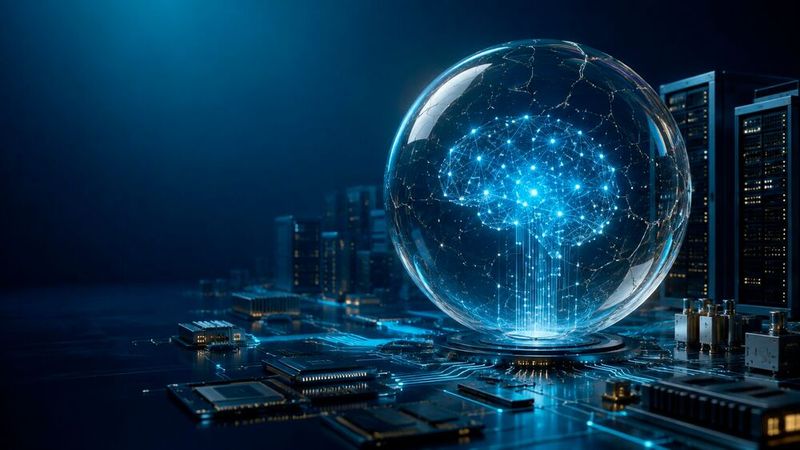
Symbolic image: Data centers, chips, and circuit boards represent the real AI infrastructure—the fragile bubble represents the high expectations for its continued growth.
(Image: Dall-E / AI-generated)
In the summer of 2026, one question is particularly pressing for financial investors and analysts: What will happen if major cloud and technology companies, so-called hyperscalers like Alphabet (Google), Meta, and Amazon, no longer invest in artificial intelligence at the same pace as before? The answer to this question was recently observed in the development of South Korea's benchmark index, Kospi. And the answer affects not only investors but also memory manufacturers, chip producers, circuit board and component suppliers, as well as the entire infrastructure surrounding data centers. In short: the global electronics industry.
What happened? At the end of July 2026, the Kospi benchmark index temporarily dropped by 12.6 percent. This was such a significant loss that trading had to be suspended. Within two days, according to Reuters, up to 2.18 trillion US dollars in market value was wiped out. SK Hynix shares lost 9.6 percent, and Samsung fell by 5.2 percent. What may not be widely known: In the summer of 2026, over 50 percent of the index is made up of SK Hynix and Samsung. If investors doubt the potential of both companies and sell their shares, it directly impacts the Kospi.
Stock Market Jitters Despite Record Figures
Meanwhile, SK Hynix had just reported record figures. The South Korean memory manufacturer increased its revenue in the second quarter of 2026 by 257 percent year-on-year and achieved an operating margin of 76 percent. This drop in stock price, therefore, did not indicate that demand for memory chips had suddenly disappeared. The market merely questioned whether the expected growth rate could be sustained permanently.
An explanation is important here. The mentioned 2.18 trillion US dollars is not an amount of money that has flowed out of companies or bank accounts at this scale, but the calculated loss in value of listed companies. If investors are now willing to pay significantly less for a share, the overall value of a company decreases accordingly. This can have financial consequences for the companies: capital becomes more expensive, lenders become more cautious, and new investments become harder to finance.
The Demand is Real—but the Expectations are Enormous
The current business figures of many tech companies contradict the thesis that artificial intelligence is merely an artificially created hype, as has often been assumed in recent years. Samsung also reported record figures in the memory sector in the second quarter of 2026, benefiting from demand for high-bandwidth memory, server DRAM, and storage for AI data centers.
Real impacts can also be seen in passive components. According to Trendforce's analyses, production capacity for traditional consumer capacitors is increasingly being shifted to higher-specified components for AI servers and data centers. Prices for certain MLCC types have risen significantly, while market inventories remain low.
The AI demand thus generates real revenues, real factory orders, and real bottlenecks. The problem lies elsewhere: in many areas, the response is not only to current demand but to the assumption of growth that must persist for years. Or, in the worst case, to the assumption that growth is infinite.
The Simple Cycle Behind the Boom
The mechanism can be simplified as follows: Investors provide capital. The hyperscalers build data centers and buy chips. Suppliers achieve high revenues. As a result, their stock prices and valuations rise. This facilitates further investments and makes additional capital available.
This cycle is not automatically flawed. As long as demand continues to grow and data centers are adequately utilized, it can reinforce itself. It becomes fragile when a central assumption is no longer convincing—for example, if it becomes apparent that the expected revenues will come later, be lower, or must be achieved at higher costs.
Date: 08.12.2025
Naturally, we always handle your personal data responsibly. Any personal data we receive from you is processed in accordance with applicable data protection legislation. For detailed information please see our privacy policy.
Consent to the use of data for promotional purposes
I hereby consent to Vogel Communications Group GmbH & Co. KG, Max-Planck-Str. 7-9, 97082 Würzburg including any affiliated companies according to §§ 15 et seq. AktG (hereafter: Vogel Communications Group) using my e-mail address to send editorial newsletters. A list of all affiliated companies can be found here
Newsletter content may include all products and services of any companies mentioned above, including for example specialist journals and books, events and fairs as well as event-related products and services, print and digital media offers and services such as additional (editorial) newsletters, raffles, lead campaigns, market research both online and offline, specialist webportals and e-learning offers. In case my personal telephone number has also been collected, it may be used for offers of aforementioned products, for services of the companies mentioned above, and market research purposes.
Additionally, my consent also includes the processing of my email address and telephone number for data matching for marketing purposes with select advertising partners such as LinkedIn, Google, and Meta. For this, Vogel Communications Group may transmit said data in hashed form to the advertising partners who then use said data to determine whether I am also a member of the mentioned advertising partner portals. Vogel Communications Group uses this feature for the purposes of re-targeting (up-selling, cross-selling, and customer loyalty), generating so-called look-alike audiences for acquisition of new customers, and as basis for exclusion for on-going advertising campaigns. Further information can be found in section “data matching for marketing purposes”.
In case I access protected data on Internet portals of Vogel Communications Group including any affiliated companies according to §§ 15 et seq. AktG, I need to provide further data in order to register for the access to such content. In return for this free access to editorial content, my data may be used in accordance with this consent for the purposes stated here. This does not apply to data matching for marketing purposes.
Right of revocation
I understand that I can revoke my consent at will. My revocation does not change the lawfulness of data processing that was conducted based on my consent leading up to my revocation. One option to declare my revocation is to use the contact form found at https://contact.vogel.de. In case I no longer wish to receive certain newsletters, I have subscribed to, I can also click on the unsubscribe link included at the end of a newsletter. Further information regarding my right of revocation and the implementation of it as well as the consequences of my revocation can be found in the data protection declaration, section editorial newsletter.
The market does not have to wait for an actual downturn. It is enough if investors adjust their expectations. This was precisely observed with the Kospi: it was not evidence of collapsing AI demand that triggered the sell-off, but the concern that the high valuations and investment plans might no longer be justified.
Money for Promises
In many AI projects today, capital is being spent on infrastructure whose economic success is only expected in the future. A new data center is tangible. A supply contract for chips or a long-term cloud agreement is also more than just a marketing statement. Nevertheless, an order is not yet a profit, and a contract is not yet revenue already earned.
This is also evident among the hyperscalers. Alphabet achieved an operating cash flow of around 39 billion US dollars in the second quarter of 2026. At the same time, the company invested nearly 45 billion US dollars in capital expenditures—primarily in data centers, servers, and networking technology. As a result, free cash flow was negative in this quarter.
Additional pressure comes from long-term commitments. For Microsoft, Meta, Oracle, Amazon, and Alphabet, yet-to-begin lease payments amount to approximately 1.09 trillion US dollars, according to Reuters. A large portion of this pertains to data centers. Such commitments are not automatically problematic but can become a burden if the expected utilization fails to materialize or if technology evolves faster than the infrastructure.
The Bank for International Settlements is therefore closely monitoring how much investments exceed current revenues. The BIS warns of potential overinvestment if companies simultaneously develop capacities whose returns are not yet certain.
What Happens if the Hyperscalers Slow Down?
The AI economy is not a classic pyramid scheme. However, it increasingly functions like a pyramid of expectations: each level assumes that the next will continue to invest. As long as that happens, revenues, valuations, and capacities grow. Once a central level—such as the hyperscalers—slows down, the cycle can work in the opposite direction.
Then several reactions would be possible:
The stock prices of hyperscalers and their suppliers could fall because investors expect lower future profits.
Orders for storage, processors, network components, and power supply could be postponed or renegotiated.
Manufacturers that have geared their capacities towards the AI boom could face overcapacity and falling prices.
Banks and investors could finance new data center projects only at higher interest rates.
Long-term rental and supply contracts would weigh more heavily if the facilities are not utilized as planned.
The U.S. Federal Reserve points out that a significant slowdown in AI investments could have various causes: demand may already be largely met, expected returns could decline, or financing might become more difficult. For the industry, it is particularly critical that these causes initially appear similar from the outside: orders decline.
Why the Financial Markets are Important for the Electronics Industry
For electronics companies, the stock market often seems far removed from daily manufacturing. However, it actually influences how much money is available for new factories, machinery, and development projects. High stock prices make it easier for companies to raise capital. Falling prices can lead to investment delays. Companies then have to rely more on current business operations or take out loans, both of which can slow growth.
In addition, some investors finance their stock purchases with loans. If prices drop significantly, they must sell positions to repay these loans. This can cause losses to trigger further losses. The Kospi, therefore, reflects not just a regional market movement. It is an example of how quickly expectations can shift in a highly concentrated market. A few large companies, especially Samsung and SK Hynix, carry significant weight in the South Korean index. When investors simultaneously perceive risks with these companies, the entire market drops particularly sharply.
It should be noted that not all AI revenue comes from end customers. For some AI labs and specialized cloud providers, it remains unclear whether revenues can sustainably cover the high costs of computing power and infrastructure. A portion of the money thus initially circulates within the AI supply chain. As long as this cycle grows, it appears like a boom. If it stops, it will reveal how much genuine end-customer demand underlies it.
What Manufacturers and Buyers Should Monitor
For the electronics industry, the key question is not whether AI will disappear. What matters more is whether the investment cycle continues at its current pace.
Meaningful early indicators are:
Are the investments of the hyperscalers continuing to rise—or are they growing more slowly?
Are long-term purchase agreements actually being converted into orders and revenues?
How are inventory levels, lead times, and prices developing for storage, MLCCs, network components, and power supply?
How heavily are suppliers concentrating on a few AI customers?
Are new data centers still being built under similar financing terms?
Are manufacturers beginning to repurpose capacities or postpone investments?
For buyers, one scenario is particularly relevant: Today, scarce AI components can be expensive and hard to obtain. If several hyperscalers simultaneously reduce their investments, the situation can reverse. Shortages turn into overcapacities, and long lead times turn into price pressure.
Germany has Lttle Buffer
For the German electronics industry, such a correction would come at an unfavorable time. The sector is not experiencing a broad boom but rather a cautious stabilization after several weak years. The ZVEI expects a real production increase of two percent for 2026. However, capacity utilization remains below the long-term average, and a large portion of recent order growth comes from abroad.
This makes the industry vulnerable to a global investment shock. If hyperscalers reduce their spending on data centers, servers, and networking technology, it would not immediately affect every German electronics company. However, the impacts could spread across multiple stages: fewer orders for machinery manufacturers and equipment suppliers, delayed projects for energy providers and data center operators, and reduced demand for assemblies, circuit boards, memory, and power electronics.
For EMS companies, such a setback would be particularly problematic. Many businesses are already operating with limited capacity utilization and short order lead times. If additional volumes are lost, the high fixed costs of manufacturing, personnel, and equipment are difficult to absorb. What begins as a financial sentiment shift could thus turn into a real drop in orders with a delay.
The German electronics industry would not be the trigger of a potential AI correction. However, it could be among the sectors where its effects are felt particularly quickly: not first through falling stock prices, but through delayed investments, declining utilization, margin pressure, and a new wave of consolidation. The AI investment cycle would thus not be an isolated financial issue for Germany. It could slow an already fragile industrial recovery — especially because the electronics industry is still heavily reliant on global demand and few new growth drivers.
AI is Not the Actual Bubble
Artificial intelligence generates real demand and will continue to transform the electronics industry. At the same time, many investments depend on the expectation that this demand will grow rapidly over the years. However, demand for individual chip generations, training capacities, and data centers can become saturated. Simultaneously, AI as a foundational technology can penetrate more and more applications—similar to the steam engine, electricity, or later the internet. A market correction would then not mark the end of the technology but rather a reassessment of the speed and scale of its expansion.
The Kospi has vividly demonstrated how sensitive this mechanism is: just the concern that expected growth might slow down was enough to destroy trillions of US dollars in market value within a short time. The money has not completely disappeared. However, the price at which companies and investors value their future can change rapidly. The crucial question, therefore, is not whether AI has a future, but how much infrastructure, manufacturing capacity, and financing this future can actually support.



:quality(80)/p7i.vogel.de/wcms/d1/ef/d1ef6b6f7d4543f7999980bacccaf22b/0133499261v1.jpeg "As the growing imbalance in trade relations with China continues to widen, the EU Chamber of Commerce foresees a day when trade with China will have to be seriously reevaluated ... (Image: AI-generated)")
:quality(80)/p7i.vogel.de/wcms/fe/1f/fe1fa5ee713f94deaba963dc24c3abc5/0133299273v1.jpeg "The Flexistar enables highly flexible production of laser-welded tubes thanks to its tool-free clamping system. (Image:Because Technology, LLC)")
:quality(80)/p7i.vogel.de/wcms/1b/5a/1b5ac72f83db4dbee3ff91e51bc398f4/0133496095v1.jpeg "BASF announces that it will take the next step toward producing the polyurethane precursor MDI in India ... (Image:BASF)")
:quality(80)/p7i.vogel.de/wcms/3f/cf/3fcfa390902944ffcf24e7fe973cc3ee/0133486258v1.jpeg "Do you need to create secure connections on structures using blind rivets, but space is tight? Then you should take a closer look at the Universalgrip from Gesipa ... (Image: Gesipa)")
:quality(80)/p7i.vogel.de/wcms/2e/99/2e99726b522e4b35b690e25eb6a42643/0133463991v1.jpeg "Robotics: In AMR applications, connection technology must reliably transmit power, signals, and data despite vibration and shock loads—in very confined spaces and in a way that allows for regular maintenance. (Image:Hyperever)")
:quality(80)/p7i.vogel.de/wcms/d0/18/d01801e3d5dbd7bc9d0b4f60408b630c/0133468429v1.jpeg "Quality requirements for film packaging are on the rise. At the same time, many companies are turning to recyclable film materials, which, however, have their own challenges. Fraunhofer researchers have therefore developed a fast system that detects problems in real time. (Image:Fraunhofer IKTS)")
:quality(80)/p7i.vogel.de/wcms/b1/06/b106cf44923ce39565c3264982fd20eb/0133414574v1.jpeg "Robots Build Robots: At the new Ubtech factory, automated systems even handle parts of the material supply and logistics for the production of humanoid robots. (Image:Ubtech)")
:quality(80)/p7i.vogel.de/wcms/38/79/38799bfbbccd938b64c67068cfa68780/0133329362v1.jpeg "What exactly enables machines to act on their own? (Image:Shutterstock)")
:quality(80)/p7i.vogel.de/wcms/66/a7/66a7b78159caeacce57136529688799f/0133503398v1.jpeg "Sunlight Makes Stone! These stone blocks weren't made the traditional way. Instead, they were additively manufactured from sand using a laser. In the future, however, the laser is set to be replaced by concentrated sunlight—if the startup Addisol is successful... (Image:Addisol / F. Fiedler)")
:quality(80)/p7i.vogel.de/wcms/72/b9/72b995c2c8d812c5e2115cbef31e035a/0133462727v1.jpeg "Eggl manufactures center hoods that are precisely tailored to each cooking island—whether standard size or custom shape. They are made entirely of stainless steel and are individually customized in terms of size and filter arrangement. (Image:SPI)")
:quality(80)/p7i.vogel.de/wcms/13/5d/135dfae6229ceaf5c55467a43e8f7257/adobestock-1879961393--ardi-stock-adobe-com-ki-generiertv1.jpeg "Annoying chatterboxes or awkward silences in response to questions—a moderator should specifically prepare for difficult situations in order to navigate them effectively. (Image:ardi - stock.adobe.com_AI-generated)")
:quality(80)/p7i.vogel.de/wcms/ca/46/ca462051dfb9a1fb37ca4053762af9df/org-blobs-user-response-file-output-908c701c-3b37-491e-bb5c-35fc3d336575-plugin-output-call-182851v1.png "Through extreme compression, high-energy lasers transform simple plastics into high-purity nanodiamonds. What was once used in planetary physics is now opening up entirely new possibilities for quantum sensors, novel catalysts, and extremely hard materials. (Illustrative image) (Source: VCG / AI-generated)")
:quality(80)/p7i.vogel.de/wcms/27/c9/27c917e021a143e590dee34a9f481978/0133504594v1.jpeg "In 2025, there were more electric cars among new registrations in the EU than ever before. (Image: ©Halfpoint - stock.adobe.com)")
:quality(80)/p7i.vogel.de/wcms/8c/ac/8cacd1d41ac023ec1f2bf81c623d1776/tesla-cybercab-75-1v1.jpeg "Tesla plans to use an electric motor that does not contain rare earth elements in the Cybercab. (Image:Tesla)")
:quality(80)/p7i.vogel.de/wcms/12/f0/12f022d493c7d7a39e2ab411953c37f3/mg-1253v1.jpeg "The Æthon solar cars in the foreground and the Adelie in the background on the racetrack in Zolder. (Source: Team Sonnenwagen)")
:quality(80)/p7i.vogel.de/wcms/5d/70/5d70b7d3a05d5a99821b172db63569be/0133485094v1.jpeg "Volkswagen continues to face financial difficulties. Although cost-cutting measures are already underway, the situation hasn't improved much. Further layoffs may be on the horizon. In addition, the Wolfsburg-based company plans to accelerate the implementation of its overall measures. (Image:Volkswagen)")
:quality(80)/p7i.vogel.de/wcms/11/2e/112eabc5fb41e1a401f0e93e9326ef51/0133489329v1.jpeg "A sandbox limits the actions an AI agent can take, but it is not an impenetrable barrier. Only multiple independent layers of protection prevent an escape from immediately granting access to production systems. (Image:freely licensed)")
:quality(80)/p7i.vogel.de/wcms/18/ba/18bae45f9e6f7cacc203d56f3bc26e3c/0133455937v1.jpeg "Google did not make the incidents public until after receiving an inquiry from the “Wall Street Journal.” (Image:Google)")
:quality(80)/p7i.vogel.de/wcms/65/58/655895abe42a598e146fe47baf7c54db/0133441212v1.jpeg "Wukong, a 72-qubit quantum processor manufactured by Origin Quantum. (Image:Origin Quantum)")
:quality(80)/p7i.vogel.de/wcms/63/68/6368c6e0861d6e25bbd25a8878ca5973/newsimage427467v1.jpeg "How can individual manipulated AI agents influence the decisions of entire networks? A new theoretical model shows the conditions under which misinformation spreads. (Source: CISPA)")
:quality(80)/p7i.vogel.de/wcms/b3/35/b335d3da40780bf7415e28698501ee59/0131690335v1.jpeg "CXMT appearance at IC China. (Image:CXMT)")
:quality(80)/p7i.vogel.de/wcms/02/36/02364f083b3023cee3b3f0893ea3f859/0129857003v1.jpeg "AI will continue to drive growth in the semiconductor market in 2026. (Image:Dall-E / AI-generated)")