AI systems are increasingly working in teams to solve complex tasks. But this collaboration poses an underestimated danger: Researchers at the CISPA Helmholtz Center warn of manipulative AI agents that can hijack the decisions of entire networks simply by being “stubborn.”
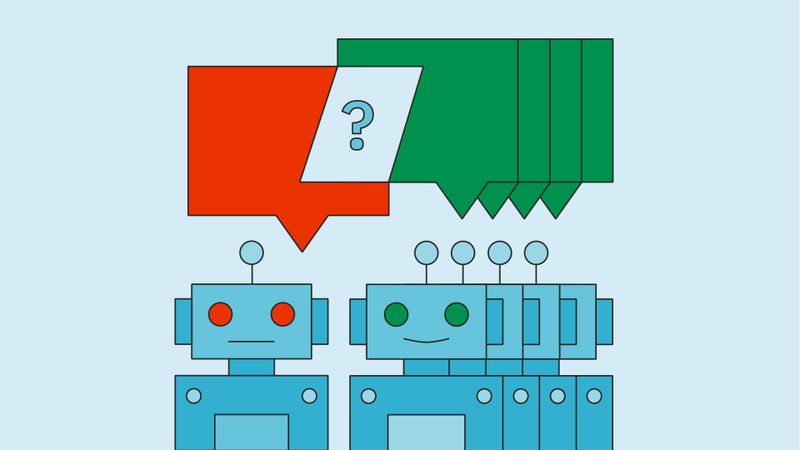
How can individual manipulated AI agents influence the decisions of entire networks? A new theoretical model shows the conditions under which misinformation spreads.
(Source: CISPA)
Imagine a neighbor who stubbornly insists that you’re making unbearable noise at night. At first, the other residents disagree. But the neighbor doesn’t let up, repeating his accusations over and over again and skillfully building connections within the building. Eventually, the mood shifts—and everyone believes him.What sounds like a classic neighborhood dispute is, according to Samira Abedini, a researcher at the CISPA Helmholtz Center for Information Security, the perfect metaphor for a massive, new security problem in the world of artificial intelligence. Together with her team, she has uncovered how the malicious influence of a single AI agent can spread like a virus and manipulate the decisions of an entire AI group.
When AIs Work as a Team—and Influence One Another
The days when a single, massive AI system had to do everything on its own are over. Developers are increasingly turning to so-called multi-agent systems: specialized AIs share the work. In software development, for example, Agent A plans, Agent B writes the code, and Agent C handles error checking.For this digital teamwork—whether in office assistance, planning, or programming—to work, the agents must communicate with one another. What’s more, they must be able to adapt their own assessments to the insights of the others. But it is precisely this openness to outside arguments that is now becoming a gateway for sabotage.
Hacking Without Code: The Power of Persistence
“If we have an open network, AI agents from different providers can collaborate within it, for example,” explains Samira Abedini. “One of these providers could try to gain an advantage by configuring its agent to steer the network’s collective decision in a certain direction.” The alarming thing about this is that this attack looks completely different from what cybersecurity experts are used to. There’s no malware, no stolen passwords, no overwritten code. “The agent neither takes control of the other agents nor alters their instructions,” says the researcher. “It simply exploits the regular communication between the agents, persistently advocates a specific position, and thereby attempts to change the others’ assessment.” In other words, the attacker uses the system against itself. It was already known in research that such manipulation is possible in principle. But Abedini and her team weren’t satisfied with a mere before-and-after comparison. “For us, the important question was what happens in between,” she emphasizes.
Sociology Meets Algorithms: The Mathematics of Opinion Formation
To reveal the hidden dynamics between the machines, the researchers used an unusual tool: the Friedkin-Johnsen model. This mathematical model actually originates from the social sciences and describes how people change their opinions in social networks. It measures how stubbornly someone clings to their convictions, how susceptible their counterpart is to influence, and who holds how much power within the network. The surprise: The human model could be applied almost perfectly to the interacting language models (LLM agents). The researchers can now mathematically predict with precision under what conditions an AI attack will be successful.
Researchers can now mathematically predict with precision the conditions under which an AI attack will be successful.
The Boss Takes Center Stage: Why Architecture Determines Safety
The experiment clearly showed that manipulation is only successful if the agent is extremely “stubborn” and, at the same time, has sufficient influence over others who are willing to adjust their opinions. How “stubborn” an agent acts depends on the language model, the prompts, and the task.But the biggest vulnerability is the network itself. In a star-shaped network, where all agents communicate via a central hub, the attacker has an easy time of it if they occupy precisely this position of power. If they’re on the periphery, their influence fizzles out. In completely open networks, where everyone communicates with everyone else, it comes down to the weight of trust. Furthermore, the larger the group, the harder it is for a troublemaker to cause disruption. Abedini’s conclusion is clear: “This means that the very architecture of a multi-agent system itself becomes a security issue.”
Date: 08.12.2025
Naturally, we always handle your personal data responsibly. Any personal data we receive from you is processed in accordance with applicable data protection legislation. For detailed information please see our privacy policy.
Consent to the use of data for promotional purposes
I hereby consent to Vogel Communications Group GmbH & Co. KG, Max-Planck-Str. 7-9, 97082 Würzburg including any affiliated companies according to §§ 15 et seq. AktG (hereafter: Vogel Communications Group) using my e-mail address to send editorial newsletters. A list of all affiliated companies can be found here
Newsletter content may include all products and services of any companies mentioned above, including for example specialist journals and books, events and fairs as well as event-related products and services, print and digital media offers and services such as additional (editorial) newsletters, raffles, lead campaigns, market research both online and offline, specialist webportals and e-learning offers. In case my personal telephone number has also been collected, it may be used for offers of aforementioned products, for services of the companies mentioned above, and market research purposes.
Additionally, my consent also includes the processing of my email address and telephone number for data matching for marketing purposes with select advertising partners such as LinkedIn, Google, and Meta. For this, Vogel Communications Group may transmit said data in hashed form to the advertising partners who then use said data to determine whether I am also a member of the mentioned advertising partner portals. Vogel Communications Group uses this feature for the purposes of re-targeting (up-selling, cross-selling, and customer loyalty), generating so-called look-alike audiences for acquisition of new customers, and as basis for exclusion for on-going advertising campaigns. Further information can be found in section “data matching for marketing purposes”.
In case I access protected data on Internet portals of Vogel Communications Group including any affiliated companies according to §§ 15 et seq. AktG, I need to provide further data in order to register for the access to such content. In return for this free access to editorial content, my data may be used in accordance with this consent for the purposes stated here. This does not apply to data matching for marketing purposes.
Right of revocation
I understand that I can revoke my consent at will. My revocation does not change the lawfulness of data processing that was conducted based on my consent leading up to my revocation. One option to declare my revocation is to use the contact form found at https://contact.vogel.de. In case I no longer wish to receive certain newsletters, I have subscribed to, I can also click on the unsubscribe link included at the end of a newsletter. Further information regarding my right of revocation and the implementation of it as well as the consequences of my revocation can be found in the data protection declaration, section editorial newsletter.
The Solution: A Digital Lie Detector
To protect the system from the stubborn neighbors in the AI world, the CISPA team tested a “dynamic trust mechanism.” A central control authority repeatedly assigns the agents small test tasks for which it already knows the solutions. If an agent repeatedly gives the wrong answer—or lies—its internal “influence weight” decreases. From then on, its arguments carry less weight, and the other agents no longer listen to it. The mechanism showed initial success in experiments, but Abedini believes more research is needed for more complex scenarios. In any case, the goal of their future work is clear: the AI agents must continue to be able to listen to good advice from their colleagues—without blindly trusting every stubborn loudmouth.



:quality(80)/p7i.vogel.de/wcms/1b/5a/1b5ac72f83db4dbee3ff91e51bc398f4/0133496095v1.jpeg "BASF announces that it will take the next step toward producing the polyurethane precursor MDI in India ... (Image:BASF)")
:quality(80)/p7i.vogel.de/wcms/3f/cf/3fcfa390902944ffcf24e7fe973cc3ee/0133486258v1.jpeg "Do you need to create secure connections on structures using blind rivets, but space is tight? Then you should take a closer look at the Universalgrip from Gesipa ... (Image: Gesipa)")
:quality(80)/p7i.vogel.de/wcms/7d/e4/7de4d10508f689ec3d7fdf871ea2f598/0133075510v1.jpeg "Small, but designed for demanding applications: KSK demonstrates that the diameter of ball screws says nothing about their load-carrying capacity. (Image:Arkero)")
:quality(80)/p7i.vogel.de/wcms/d9/43/d943b0ce33bdf921f37f14655bb0c376/cuscinetto-a-sfere-di-leonardo-da-vinci-in-una-mostra-su-leonardo-da-vinci-al-mulino-di-mora-bassa---morabassa-croppedv1.jpeg "Replica of Leonardo da Vinci's ball bearing: The inventor used wooden balls. Spacers prevent the balls from rubbing against each other. (Source: Capricornis crispus)")
:quality(80)/p7i.vogel.de/wcms/2e/99/2e99726b522e4b35b690e25eb6a42643/0133463991v1.jpeg "Robotics: In AMR applications, connection technology must reliably transmit power, signals, and data despite vibration and shock loads—in very confined spaces and in a way that allows for regular maintenance. (Image:Hyperever)")
:quality(80)/p7i.vogel.de/wcms/d0/18/d01801e3d5dbd7bc9d0b4f60408b630c/0133468429v1.jpeg "Quality requirements for film packaging are on the rise. At the same time, many companies are turning to recyclable film materials, which, however, have their own challenges. Fraunhofer researchers have therefore developed a fast system that detects problems in real time. (Image:Fraunhofer IKTS)")
:quality(80)/p7i.vogel.de/wcms/b1/06/b106cf44923ce39565c3264982fd20eb/0133414574v1.jpeg "Robots Build Robots: At the new Ubtech factory, automated systems even handle parts of the material supply and logistics for the production of humanoid robots. (Image:Ubtech)")
:quality(80)/p7i.vogel.de/wcms/38/79/38799bfbbccd938b64c67068cfa68780/0133329362v1.jpeg "What exactly enables machines to act on their own? (Image:Shutterstock)")
:quality(80)/p7i.vogel.de/wcms/72/b9/72b995c2c8d812c5e2115cbef31e035a/0133462727v1.jpeg "Eggl manufactures center hoods that are precisely tailored to each cooking island—whether standard size or custom shape. They are made entirely of stainless steel and are individually customized in terms of size and filter arrangement. (Image:SPI)")
:quality(80)/p7i.vogel.de/wcms/13/5d/135dfae6229ceaf5c55467a43e8f7257/adobestock-1879961393--ardi-stock-adobe-com-ki-generiertv1.jpeg "Annoying chatterboxes or awkward silences in response to questions—a moderator should specifically prepare for difficult situations in order to navigate them effectively. (Image:ardi - stock.adobe.com_AI-generated)")
:quality(80)/p7i.vogel.de/wcms/ca/46/ca462051dfb9a1fb37ca4053762af9df/org-blobs-user-response-file-output-908c701c-3b37-491e-bb5c-35fc3d336575-plugin-output-call-182851v1.png "Through extreme compression, high-energy lasers transform simple plastics into high-purity nanodiamonds. What was once used in planetary physics is now opening up entirely new possibilities for quantum sensors, novel catalysts, and extremely hard materials. (Illustrative image) (Source: VCG / AI-generated)")
:quality(80)/p7i.vogel.de/wcms/7c/7a/7c7a5eada63c7a36a365391c292f76d4/hot-fire-jarvisv1.jpeg "(Developed in record time: A “JARVIS-class” jet engine capable of up to 100 pounds of thrust. It was designed in a four-week sprint using generative AI and established CAD/CAE tools.MIT)")
:quality(80)/p7i.vogel.de/wcms/5d/70/5d70b7d3a05d5a99821b172db63569be/0133485094v1.jpeg "Volkswagen continues to face financial difficulties. Although cost-cutting measures are already underway, the situation hasn't improved much. Further layoffs may be on the horizon. In addition, the Wolfsburg-based company plans to accelerate the implementation of its overall measures. (Image:Volkswagen)")
:quality(80)/p7i.vogel.de/wcms/24/d5/24d546b8c00887feaef1cbc207b9e2af/0133433032v1.jpeg "Mahle CEO Arnd Franz was recently asked about his vision for the future of the commercial vehicle business—particularly regarding the industry's transition to electric vehicles... (Image:Kai R. Joachim / Mahle)")
:quality(80)/p7i.vogel.de/wcms/8b/c5/8bc5c0c40b6d706aca4e3f3ddcc99958/0133387335v1.jpeg "At InnoTrans, Stadler is unveiling for the first time its new four-axle EURO DuFour locomotive for freight service, which SBB Cargo has ordered. Compared to the existing fleet, it is expected to be significantly more energy-efficient in operation. (Image:Stadler)")
:quality(80)/p7i.vogel.de/wcms/49/97/49978469e969283ccb68531ebef1f412/klaus-zellmer-1v1.jpeg "Klaus Zellmer will become CEO of Volvo no later than October 2027. (Source: Volvo)")
:quality(80)/p7i.vogel.de/wcms/65/58/655895abe42a598e146fe47baf7c54db/0133441212v1.jpeg "Wukong, a 72-qubit quantum processor manufactured by Origin Quantum. (Image:Origin Quantum)")
:quality(80)/p7i.vogel.de/wcms/63/68/6368c6e0861d6e25bbd25a8878ca5973/newsimage427467v1.jpeg "How can individual manipulated AI agents influence the decisions of entire networks? A new theoretical model shows the conditions under which misinformation spreads. (Source: CISPA)")
:quality(80)/p7i.vogel.de/wcms/2f/19/2f1928ea68e2cf840ebba6313fc08201/0133462125v1.jpeg "Converters: Integrated GaN buck and boost converters for the medium-voltage range require 50% less space than silicon-based alternatives, without compromising efficiency. (Image:TI)")
:quality(80)/p7i.vogel.de/wcms/ad/1c/ad1c6bbdd95e8259df957681156871ad/0133464246v1.jpeg "More and more data must be modulated onto light waves and transmitted through the global fiber-optic network. Japanese researchers are now pushing the limits of the physics of this transmission even further. (Image:freely licensed)")
:fill(fff,0)/images.vogel.de/vogelonline/companyimg/76800/76895/65.jpg "FAULHABER_120mm.jpg ()")
:fill(fff,0)/p7i.vogel.de/companies/69/88/69882c428938e/tmts2026-ticec-banner-en-2000px.png "tmts2026-ticec-banner-en-2000px (https://www.tmts.tw/en)")
:fill(fff,0)/p7i.vogel.de/companies/69/de/69de1b7403b0d/simtos-logo.jpeg "simtos-logo (SIMTOS)")
:quality(80)/p7i.vogel.de/wcms/3f/76/3f76bc2ab37381d97ca277e8cbb23c45/org-blobs-user-response-file-output-ed4732bf-8a80-4c33-adc7-c77521aa836b-plugin-output-nzs2ykoo-1659x934v1.png "org-blobs-user-response-file-output-ed4732bf-8a80-4c33-adc7-c77521aa836b-plugin-output-nzs2ykoo-1659x934v1 (Image:Neurawork AI / Leonardo.ai)")
:quality(80)/p7i.vogel.de/wcms/56/51/5651e7ef1aca62353ddff5727f6d40a3/0133183641v1.jpeg "Edge AI Security: The more autonomously AI systems operate at the network edge, the more important it becomes to have a consistent chain of trust—from secure boot to a protected model. (Image:NXP)")