Qualcomm aims to grow with AI chips in China and, according to media reports, is working with Bytedance to bypass US trade restrictions legally. At the same time, the company is strengthening its software base for AI inference and acquiring AI startup Modular for nearly $4 million.
Qualcomm is going on the AI offensive: With the Dragonfly C1000 CPU, the company aims to position itself as a strong provider of processors for AI workloads in data centers. At the same time, it plans to expand its China business by partnering with TikTok parent company Bytedance to produce ASICs for AI inference that do not fall under US trade restrictions. Additionally, the AI software startup Modular Technologies was acquired for $3.9 billion.
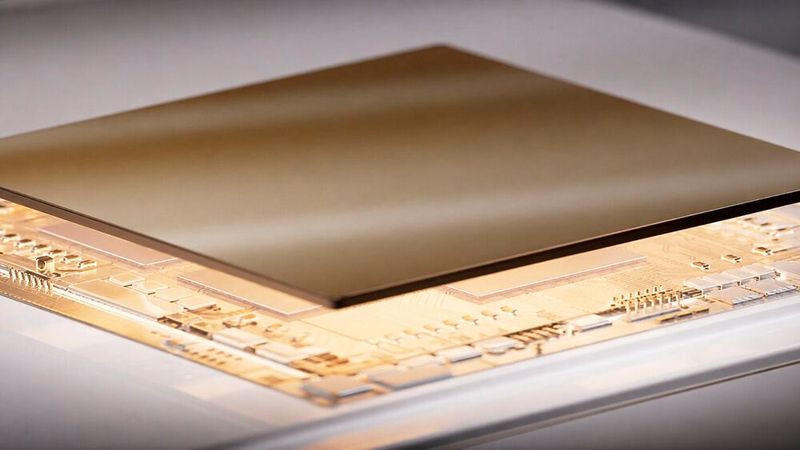
(Image: Qualcomm)
Qualcomm is advancing its shift towards AI data centers with two strategic moves: According to media reports, the US chip company is working on custom AI chips for the Chinese market and aims to strengthen its position in the inference business through the acquisition of the AI software company Modular Technologies. Both initiatives are aimed at making Qualcomm less dependent on the smartphone business and establishing itself in the growing market for AI infrastructure.
At an investor day on June 25, Qualcomm presented a broad data center portfolio. This includes the Dragonfly C1000 CPU, HBC technology to reduce the so-called memory wall, the Dragonfly AI300 inference accelerator, connectivity solutions, and custom semiconductors. With this, Qualcomm targets not only traditional cloud providers but also customers with their own AI workloads and specific requirements for energy efficiency, bandwidth, and cost per token.
China Remains a Key Market Despite Regulation
China plays a central role in this strategy. According to the business newspaper Nikkei Asia, Qualcomm plans to offer its four data center product lines there as well, including specially tailored AI accelerators designed to comply with US export controls for advanced AI chips. The market remains of great importance to Qualcomm: in 2025, 46 percent of the company's revenue reportedly came from China, primarily through smartphone chips so far.
Qualcomm aims to reduce its reliance on the mobile business. The company is one of the world's leading providers of smartphone modem chips and Snapdragon processors but faces pressure from a weaker device market and rising memory prices. Entering the market for data center CPUs, inference accelerators, and custom ASICs is intended to open up new revenue streams.
Bytedance appears to be at the center of Qualcomm's China plans. Bloomberg reported back in May that Qualcomm had reached an agreement to supply the company, which owns the social network TikTok among other ventures, with millions of custom ASICs for AI data centers. Additionally, Qualcomm is set to assist Bytedance in bringing its own internal chip design into volume production. Reuters later reported that Qualcomm is negotiating with Bytedance over chip design services, which may also involve technologies from the acquired connectivity specialist Alphawave Semi.
Details about the planned components are only partially known so far. According to Reuters, the focus is partly on video processors, with mass production potentially targeted by the end of the year. At the same time, sources emphasized that the talks would not necessarily lead to a finalized chip design or production. Qualcomm and Bytedance reportedly did not comment on the reports.
ASICs Below Export Control Limits
The regulatory framework is strategically crucial. The Qualcomm ASICs intended for Bytedance are designed to remain within the current performance limits of US export controls. Bytedance's own chip design is also set to be developed in a way that ensures it does not exceed these thresholds. This approach makes the project economically significant but politically more secure than the direct sale of advanced AI GPUs to China.
The regulatory risks remain significant. Nikkei points out that Qualcomm is likely to face similar challenges as Nvidia and other chip providers. The US government has tightened export rules for AI chips; reportedly, the US Department of Commerce requires licenses for Chinese companies headquartered in China, even if they operate overseas. For US corporations, China remains a large but increasingly complex market.
For Bytedance, such a deal would be a way to secure AI computing power beyond Nvidia. The company requires accelerators for inference and agentic AI applications while operating in an environment of increasing scrutiny from both Washington and Beijing. Qualcomm could thereby emerge as an additional Western provider alongside Nvidia and the internal chip programs of major hyperscalers.
Date: 08.12.2025
Naturally, we always handle your personal data responsibly. Any personal data we receive from you is processed in accordance with applicable data protection legislation. For detailed information please see our privacy policy.
Consent to the use of data for promotional purposes
I hereby consent to Vogel Communications Group GmbH & Co. KG, Max-Planck-Str. 7-9, 97082 Würzburg including any affiliated companies according to §§ 15 et seq. AktG (hereafter: Vogel Communications Group) using my e-mail address to send editorial newsletters. A list of all affiliated companies can be found here
Newsletter content may include all products and services of any companies mentioned above, including for example specialist journals and books, events and fairs as well as event-related products and services, print and digital media offers and services such as additional (editorial) newsletters, raffles, lead campaigns, market research both online and offline, specialist webportals and e-learning offers. In case my personal telephone number has also been collected, it may be used for offers of aforementioned products, for services of the companies mentioned above, and market research purposes.
Additionally, my consent also includes the processing of my email address and telephone number for data matching for marketing purposes with select advertising partners such as LinkedIn, Google, and Meta. For this, Vogel Communications Group may transmit said data in hashed form to the advertising partners who then use said data to determine whether I am also a member of the mentioned advertising partner portals. Vogel Communications Group uses this feature for the purposes of re-targeting (up-selling, cross-selling, and customer loyalty), generating so-called look-alike audiences for acquisition of new customers, and as basis for exclusion for on-going advertising campaigns. Further information can be found in section “data matching for marketing purposes”.
In case I access protected data on Internet portals of Vogel Communications Group including any affiliated companies according to §§ 15 et seq. AktG, I need to provide further data in order to register for the access to such content. In return for this free access to editorial content, my data may be used in accordance with this consent for the purposes stated here. This does not apply to data matching for marketing purposes.
Right of revocation
I understand that I can revoke my consent at will. My revocation does not change the lawfulness of data processing that was conducted based on my consent leading up to my revocation. One option to declare my revocation is to use the contact form found at https://contact.vogel.de. In case I no longer wish to receive certain newsletters, I have subscribed to, I can also click on the unsubscribe link included at the end of a newsletter. Further information regarding my right of revocation and the implementation of it as well as the consequences of my revocation can be found in the data protection declaration, section editorial newsletter.
Qualcomm ties these plans to ambitious revenue targets. According to Reuters, the company expects around 15 billion US dollars in revenue from data center chips by 2029. For the fiscal year 2027, CFO Akash Palkhiwala has already projected 5 billion US dollars, including approximately 1 billion US dollars from new custom silicon projects.
In parallel with its hardware offensive, Qualcomm is acquiring the AI infrastructure company Modular Technologies. The transaction is expected to close in the second half of 2026, subject to customary closing conditions and regulatory approvals. Qualcomm initially did not disclose financial details; however, Reuters calculations and media reports estimate the predominantly stock-based transaction to be valued at around 3.9 to 4 billion US dollars.
Modular is developing an open, AI-native software platform designed to efficiently run models across different hardware architectures. Supported architectures include CPUs, GPUs, NPUs, custom ASICs, and other accelerators. Developers will not need to rewrite models for each target platform but can deploy them across various systems using a shared software foundation.
For Qualcomm, this is strategically important because success in the data center depends not solely on hardware. Inference costs, energy efficiency, and portability are increasingly determined at the software level. Modular is expected to enhance Qualcomm's ability to offer an optimized AI compute layer from edge devices to data centers, providing customers with an alternative to highly proprietary ecosystems.
Qualcomm CEO Cristiano Amon envisions the industry heading toward disaggregated, cross-manufacturer architectures that require a more open software foundation. With Modular, Qualcomm is complementing its hardware roadmap with a developer and platform proposition: the company aims not only to supply chips for AI inference but also to create an ecosystem that efficiently integrates models, software, and heterogeneous accelerators.



:quality(80)/p7i.vogel.de/wcms/68/a5/68a5ce0896756c1dcf48dbeceefafbd3/0132300990v1.jpeg "Christoph Geigges is President and CEO of Walter AG. Headquartered in Tübingen (Germany), the company is one of the world’s leading suppliers of precision tools for metalworking. Under Geigges’ leadership, this long-established company is increasingly transforming itself from a tool manufacturer into an engineering partner that supports the entire manufacturing process. (Image: Walter AG)")
:quality(80)/p7i.vogel.de/wcms/3e/7c/3e7c26f44c68545fc7318597b6b65903/0133649650v1.jpeg "The flexible Heller circular storage system can store and process pallets measuring both 630 millimeters by 630 millimeters and 800 millimeters by 800 millimeters—even in mixed-mode operation. This makes the entire production line particularly flexible. (Image:Brighter)")
:quality(80)/p7i.vogel.de/wcms/16/29/162983885950ec1df27ab441bfe88613/0133132549v1.jpeg "Bernd Hermeler is the CEO of Cemecon AG. He studied mechanical engineering at RWTH Aachen University (Germany)—the very university from which the company emerged as a spin-off 40 years ago. Today, Hermeler is responsible for the global strategy of the coating specialist, which, with branches in Europe, the U.S., China, Japan, and India, is considered the global technology leader in the coating of cutting tools. (Image: Cemecon AG)")
:quality(80)/p7i.vogel.de/wcms/af/81/af81b53cb4926dcadc20ba369a29d412/0132695968v1.jpeg "International venture capital is increasingly flowing into the machining industry. Here are the players that entrepreneurs and CEOs should keep an eye on right now. (Image: ©NDABCREATIVITY - stock.adobe.com)")
:quality(80)/p7i.vogel.de/wcms/88/dc/88dc38a1a0b5e016192ab83b0850fbd0/0133514708v1.jpeg "Scalable data sovereignty is the foundation for the transition from computationally intensive AI processing and growing data streams to sustainable, energy-efficient storage systems. (Image:Gemini / AI-generated)")
:quality(80)/p7i.vogel.de/wcms/1c/ef/1cef66e13c5cc02c5731fefcc99c00d2/0133697754v1.jpeg "Embodied AI in Industry: FMC³ Robotics combines AI-based perception and adaptation with traditional robot control to prepare robots for use in industrial manufacturing. (Image:FMC³/processed by AI)")
:quality(80)/p7i.vogel.de/wcms/db/ca/dbcae78eb8853b53fe122832fe3b2cba/0132914918v1.jpeg "Robotics in Flexible Manufacturing: As connectivity increases, so do the requirements for functional safety. (Image: Delta Electronics)")
:quality(80)/p7i.vogel.de/wcms/ea/18/ea18e84aed24bbe1c91937f30c2f7301/image1v1.jpeg "Kassow Robots' new product portfolio now includes seven 7-axis cobots. (Image: Kassow Robots (Image:)")
:quality(80)/p7i.vogel.de/wcms/90/30/90300137452b00d22f95113eff065ac3/fliehkraftkupplungen-und-bremsen-montage-centrifugal-clutches-and-brakes-assembly-1v1.jpeg "Installation: Centrifugal clutches should always be precisely matched to the machine. (Source: Amsbeck Machine Technology)")
:quality(80)/p7i.vogel.de/wcms/93/84/9384230e840a99a2015fdd3e0af11e2b/newsimage428236v1.jpeg "The crutch replicates the natural, biomechanical movement pattern of the human body. (Source: Leon Kast)")
:quality(80)/p7i.vogel.de/wcms/5b/a2/5ba21b3e5fcdd91f6bfe806f745ea723/isc-physioink-bild-3v1.jpeg "In the PhysioINK project, Fraunhofer researchers are developing bio-printing inks from the most common tissue proteins. Under the microscope, the living tissue cells (fibroblasts) are visible in the printed lattice structure: blue represents the cell nucleus, and green represents the cytoskeleton. (Source: Tobias Weigel/Fraunhofer ISC)")
:quality(80)/p7i.vogel.de/wcms/9c/16/9c16e4aa02594fe4bf82ead736562b07/directhop1-scaledv1.jpeg "Light as a feather, but without feathers: The University of Washington's robot, which weighs just one gram, uses a bionic direct-drive system to catapult itself into the air with centimeter-level precision. (Source: Mark Stone/University of Washington)")
:quality(80)/p7i.vogel.de/wcms/0a/50/0a50938be0b598b36efc4e5457ed56dd/forvia-siege-zen-massage-16-9-06v1.jpeg "Seat with massage function by Forvia. (Source: Forvia)")
:quality(80)/p7i.vogel.de/wcms/99/61/9961719acb89bc87fdecb1bba140481c/0133725593v1.jpeg "Ultrason (PSU, PESU, PPSU) is suitable for E&E components used in electric mobility or AI infrastructure, such as connectors for fiber-optic cables. (Image:BASF)")
:quality(80)/p7i.vogel.de/wcms/42/9b/429badd88cd4a74edb6491d10310349c/wayve-london-05v1.jpeg "Wayve is developing an AI software stack for automated driving. It appears that the Volkswagen Group has now opted for this technology. (Source: Wayve)")
:quality(80)/p7i.vogel.de/wcms/14/9f/149f934f87e5418748fa41a611586a4f/rawdon-gloverv1.jpeg "Rowdon Glover, Managing Director of Jaguar: “We are willing to accept polarization.” (Image:JLR)")
:quality(80)/p7i.vogel.de/wcms/36/f0/36f0472d20227013871aa790f4d48ac6/0133726018v1.jpeg "Ion beams can ablate, coat, or smooth surfaces down to the atomic level. Such processes are used, among other things, in optical chips, precision optics, and superconducting materials. (Image:AI-generated)")
:quality(80)/p7i.vogel.de/wcms/1f/47/1f47da6ee12c38a745eb478a04157a65/0133726100v1.jpeg "The schematic diagram shows the structure of a 3D NAND memory device with memory cells stacked on top of one another and vertical connections for high storage density. (Image:Dall-E / AI-generated)")
:quality(80)/p7i.vogel.de/wcms/70/59/7059db055d4eeb8dea752651a071f360/geralt-handshake-4608297v1.jpeg "The deal between Schneider Electric and PTC is intended to create end-to-end data flows for the industry. (Source: )")
:quality(80)/p7i.vogel.de/wcms/67/3d/673d8f6f14bd030b53b61800a0aeb06d/0133548286v1.jpeg "Overview: If even a single critical component is missing, the entire production process can come to a standstill. Proactive procurement is intended to mitigate such bottlenecks early on. (Image:Dall-E / AI-generated)")
:fill(fff,0)/p7i.vogel.de/companies/68/a4/68a47beec75ce/logo-cmyk-de.jpeg "logo-cmyk-de (https://www.datatec.eu/)")
:fill(fff,0)/p7i.vogel.de/companies/69/88/69882c428938e/tmts2026-ticec-banner-en-2000px.png "tmts2026-ticec-banner-en-2000px (https://www.tmts.tw/en)")
:fill(fff,0)/p7i.vogel.de/companies/69/de/69de1b7403b0d/simtos-logo.jpeg "simtos-logo (SIMTOS)")
:quality(80)/p7i.vogel.de/wcms/db/f2/dbf2c55b293f5bb762d87a283f0e5db2/0131909060v1.jpeg "High-NA EUV system from ASML: High-end manufacturing technology from the Dutch equipment manufacturer is said to have reached China despite export bans. ASML denies the allegations. (Image:ASML)")
:quality(80)/p7i.vogel.de/wcms/a4/6a/a46ad22b3de9ea56320405b63ead0250/0131913830v1.jpeg "Renesas has acquired Pictorus to simplify and accelerate software development for embedded applications within the Renesas 365 platform. The purchase price was not disclosed in the available information. (Image:Reneas)")
:quality(80)/p7i.vogel.de/wcms/5c/6b/5c6b52f55eced3f21a82b49b4d29972c/0129641027v1.jpeg "Bytedance has popularized the short video format with the TikTok app, among other things. AI is used in many of the Group's products. (Image:Bytedance)")
:quality(80)/p7i.vogel.de/wcms/13/20/13204ad5819ee751393c71b8bdc6a2df/0128673059v1.jpeg "Nvidia's HGX-H200 system board as a server component in the form of an integrated mainboard. The H200 products were considered the company's most powerful AI solution by the end of 2023. (Image:Nvidia)")