


:quality(80)/p7i.vogel.de/wcms/16/29/162983885950ec1df27ab441bfe88613/0133132549v1.jpeg "Bernd Hermeler is the CEO of Cemecon AG. He studied mechanical engineering at RWTH Aachen University (Germany)—the very university from which the company emerged as a spin-off 40 years ago. Today, Hermeler is responsible for the global strategy of the coating specialist, which, with branches in Europe, the U.S., China, Japan, and India, is considered the global technology leader in the coating of cutting tools. (Image: Cemecon AG)")
:quality(80)/p7i.vogel.de/wcms/af/81/af81b53cb4926dcadc20ba369a29d412/0132695968v1.jpeg "International venture capital is increasingly flowing into the machining industry. Here are the players that entrepreneurs and CEOs should keep an eye on right now. (Image: ©NDABCREATIVITY - stock.adobe.com)")
:quality(80)/p7i.vogel.de/wcms/ba/ec/baecd2e3783dee11913096f7d58e1232/bild-1-kammerer-kgt-f-r-elektrozylinder-300dpi-2000px-printv1.jpeg "Kammerer ball screw for use in an electric cylinder (Source: Kammerer)")
:quality(80)/p7i.vogel.de/wcms/51/1b/511b420dbcc296aec09e3bffb051b8a8/0133581587v1.jpeg "The cables connect numerous machine components—often in confined spaces. (Image:Helu)")
:quality(80)/p7i.vogel.de/wcms/f2/3b/f23bff6710f706981c703b3110407075/geralt-traffic-signs-663368v1.jpeg "Nearly all of the manufacturing companies surveyed worldwide measure AI outcomes in some form, but only 49 percent rigorously calculate the ROI of AI. (Source: )")
:quality(80)/p7i.vogel.de/wcms/aa/3e/aa3e2603a812f8e7d33c00ba8ae28c9f/0133507886v1.jpeg "With the Iggy Rob, igus is bringing a humanoid robot into factories for a price of 47,999 euros ($54,718). (Image: igus)")
:quality(80)/p7i.vogel.de/wcms/92/64/92645c64ffbb6980976d39102388d120/0113143253v1.jpeg "In our China Market Insider, we regularly provide you with relevant information straight from China. (Image:© Eisenhans - stock.adobe.com)")
:quality(80)/p7i.vogel.de/wcms/2d/93/2d932057bd43e135ff99a3562ca33f4b/adobestock-1941073737--mang-stock-adobe-com-ki-generiertv1.jpeg "Intelligence is increasingly moving from the cloud directly into the machine. (Source: © Mang – stock.adobe.com_AI-generated)")
:quality(80)/p7i.vogel.de/wcms/9c/16/9c16e4aa02594fe4bf82ead736562b07/directhop1-scaledv1.jpeg "Light as a feather, but without feathers: The University of Washington's robot, which weighs just one gram, uses a bionic direct-drive system to catapult itself into the air with centimeter-level precision. (Source: Mark Stone/University of Washington)")
:quality(80)/p7i.vogel.de/wcms/e7/94/e794290f265afbd0ffc7a06c4fe9d425/adobestock-1887113836--hypnotics-14-stock-adobe-com-ki-generiertv1.jpeg "In both autonomous driving and industrial production, there is growing skepticism as to whether full autonomy is always desirable. (Source: © Hypnotics 14 – stock.adobe.com / AI-generated)")
:quality(80)/p7i.vogel.de/wcms/a8/71/a8712e5c6ef536228444ab5275cedfe2/adobestock-340905887--gorodenkoff-stock-adobe-comv1.jpeg "A new position paper outlines the conditions that the business community, academia, and policymakers must jointly establish in order to ensure the long-term viability of industry in Germany and Europe. (Source: © Gorodenkoff – stock.adobe.com)")
:quality(80)/p7i.vogel.de/wcms/7d/eb/7deb25ca674fa4c781a9d1fab083f7cf/parker-entwicklungszentrum-hresv1.jpeg "The centerpiece of the Parker Center for Drive and Control Technology in Offenbach is the exhibition area. (Source: Parker Hannifin)")
:quality(80)/p7i.vogel.de/wcms/62/22/6222a3ca663580238612c681f0492833/0133698820v1v1.jpeg "After Audi, Volkswagen, and Seat launched a recall due to a steering bolt that was not corrosion-resistant over time, Skoda is now also affected, with nearly two million cars worldwide reportedly involved ... (Image:Skoda)")
:quality(80)/p7i.vogel.de/wcms/8e/3a/8e3ab3a0abfad28bff5c118125846b75/0133699650v1v1.jpeg "Electric car pioneer Tesla has had its ups and downs in recent years. After a boom in orders, sales figures are now falling again, but things are going better than analysts had predicted ... (Image:AI-generated)")
:quality(80)/p7i.vogel.de/wcms/20/ac/20ac36a2fb2151cda6e078dd3aeb62ae/0133645903v1.jpeg "Tesla plans to offer autonomous driving throughout Europe. (Image:Tesla)")
:quality(80)/p7i.vogel.de/wcms/f8/90/f890fc4b08048472b9b4b436a2da442b/ai-catl-sodium-batteries-vs-lithium-revolutionv1.jpeg "CATL has often faced criticism because of its high market share. This time, a government ministry is stepping in—indirectly. (Image:CATL)")
:quality(80)/p7i.vogel.de/wcms/67/3d/673d8f6f14bd030b53b61800a0aeb06d/0133548286v1.jpeg "Overview: If even a single critical component is missing, the entire production process can come to a standstill. Proactive procurement is intended to mitigate such bottlenecks early on. (Image:Dall-E / AI-generated)")
:quality(80)/p7i.vogel.de/wcms/b3/8d/b38d7e914a0a51c24db7e93c8a8420e2/0133672676v1.jpeg "Figure 1: Today, the AT cut is most commonly used for quartz crystals. The double-twisted SC cut further enhances the stability and aging resistance of OCXO oscillators. (Image:Q-Tech)")
:quality(80)/p7i.vogel.de/wcms/40/34/4034915f85470ad8264659267e4f02d0/0133655653v1.jpeg "Cariad, Volkswagen's software subsidiary, continues to struggle. Now, another round of layoffs has been announced, which will result in the loss of many jobs ... (Image:Cariad)")
:quality(80)/p7i.vogel.de/wcms/e4/2a/e42af12e2a0816bb3d25fac9932903e9/0133646920v1.jpeg "TSMC's U.S. headquarters in Arizona: According to various media reports, the world's largest contract semiconductor manufacturer may be planning to build up to six additional fabs in the state of Texas. (Image:TSMC)")
Digital Engineering How Simulation Reduces Development Risks Early
Related Vendors
:fill(fff,0)/p7i.vogel.de/companies/68/a4/68a47beec75ce/logo-cmyk-de.jpeg "logo-cmyk-de (https://www.datatec.eu/)")
:fill(fff,0)/p7i.vogel.de/companies/69/88/69882c428938e/tmts2026-ticec-banner-en-2000px.png "tmts2026-ticec-banner-en-2000px (https://www.tmts.tw/en)")
:fill(fff,0)/p7i.vogel.de/companies/69/de/69de1b7403b0d/simtos-logo.jpeg "simtos-logo (SIMTOS)")
Errors during commissioning cost time and money—but they can often be avoided during development. Simulations make it possible to test machines virtually before a prototype is created. How designers use this to reduce risks and make projects safer.
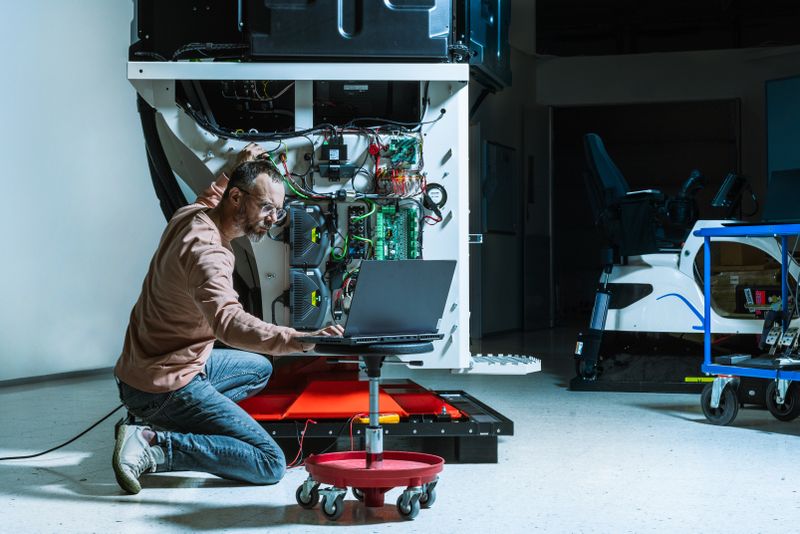
If errors only occur at the test bench or during commissioning, it quickly becomes expensive in mechanical and plant engineering. Deadlines come under pressure, test capacities are blocked, and changes extend into the late project phases. At the same time, the complexity of machines is increasing: more software, more sensors, and higher requirements for automation and networking. For designers and developers, this means that decisions need to be secured much earlier—often long before a prototype exists. This is where simulation comes into play, as is well known: it allows machines and systems to be represented virtually and functions to be realistically tested in the early stages of development. Mechanics, electronics, and software can thus be developed and validated together.
Sign in or register and read on
Please log in or register and read this article. To be able to read this article in full, you must be registered. Free registration gives you access to exclusive specialist information.
Already registered? Log in here
:quality(80)/p7i.vogel.de/wcms/26/59/265958ddfec669ba075bb02b73a49688/0127467050v1.jpeg "With model-based design, more efficiency in production. (Image:Mathworks)")
:quality(80)/p7i.vogel.de/wcms/22/51/2251748fafd987efbe200ddfe44ed0f4/0130698661v1.jpeg "Using Emerson's NI CHESS software and PXI hardware, real satellite and aerospace RF channels, including Doppler effect and fading, can be simulated directly in the lab. (Image:Emerson)")