Up to 2,048 bytes of payload and 20 Mbit/s: With the TCAN6062, Texas Instruments is launching the first commercially available CAN XL transceiver. This makes the now standardized successor to CAN FD a directly usable hardware platform for the first time.
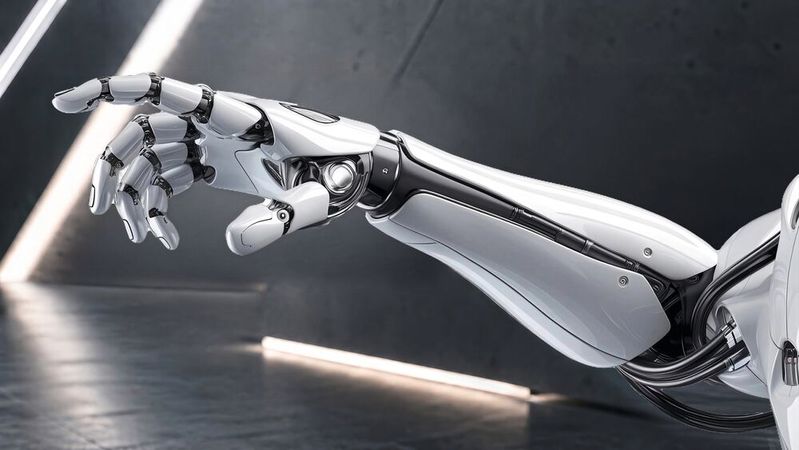
Industrial high-speed communication: The CAN XL transceiver TCAN6062 transfers more data at higher speeds, making it suitable for applications such as humanoid robots, industrial robots, and HMI systems.
(Image: Texas Instruments)
Humanoid robots are evolving from mechanically complex machines to connected cyber-physical systems. With every additional sensor, joint, and integrated computing and AI function, the demands on their communication network also increase.
Processors, sensors, and actuators must exchange ever-larger amounts of data with minimal latency and deterministic behavior. When a robot needs to correct its balance or adjust a movement in a fraction of a second, fast and reliably transmitted control and safety data are crucial.
This is precisely where Texas Instruments comes in with the TCAN6062, which it claims to be the first commercially available CAN-XL transceiver. The component is designed to provide developers of humanoid and industrial robots with a communication network offering significantly higher bandwidth while maintaining the proven features of CAN-based architectures. CAN XL extends the payload to up to 2,048 bytes per frame and achieves data rates of up to 20 Mbit/s.
CAN XL responds to a development that goes beyond robotics: industrial systems are generating more and more data, while deterministic communication for motion control, sensor feedback, and safety-critical functions remains necessary. Where CAN FD, with a maximum of 64 bytes of payload, is increasingly reaching its limits, CAN XL aims to bridge the gap between traditional CAN and more powerful Ethernet networks.
The key technical factor is not just the higher bit rate. With 2,048 bytes of payload per frame, CAN XL significantly reduces protocol overhead, especially for larger data blocks. At the same time, the CAN-typical prioritization is preserved: critical messages can prevail over less time-critical data during arbitration. This makes CAN XL particularly interesting for applications where large amounts of data and deterministic behavior coincide, such as in robotics, motion control, or distributed sensor systems.
CAN Gets faster, but not simply Ethernet
CAN XL takes a hybrid approach. CAN is not only extended in terms of data rate and payload but also enables the tunneling of Ethernet or TCP/IP. This allows diagnostic, sensor, and control data to be transmitted over a shared infrastructure. CAN XL can thus serve as an intermediate layer between traditional CAN and Ethernet, used in scenarios where Ethernet provides the necessary bandwidth, but its infrastructure and protocol stack are not required for every segment.
Technical specifications
CAN XL up to 20 Mbit/s, payload up to 2048 bytes per frame, support for CAN FD and CAN SIC, SIC to improve signal integrity, ringing reduction by up to 80 percent according to TI, fault voltage tolerance up to ±58 V.
This very feature makes CAN XL interesting for future heterogeneous network architectures. Instead of setting up separate networks for different data classes, control messages, diagnostic information, and larger data blocks can be merged onto a shared communication infrastructure.
One challenge of higher data rates, however, lies on the hardware level. With increasing edge steepness, reflections and ringing on the bus become more critical. For this reason, the TCAN6062 integrates "Signal Improvement Capability" (SIC). According to the manufacturer, the SIC function is designed to reduce ringing in complex networks by up to 80 percent. This simplifies signal integrity analysis and validation, especially in networks with many nodes.
The component also remains committed to the CAN tradition in terms of robustness. The semiconductor specialist specifies fault voltage tolerance of up to ±58 V and supports a wide range of input and output voltages. This makes the transceiver suitable for various industrial power supply concepts and demanding environmental conditions.
CAN XL is Standardized, now the Hardware Is coming
The real step by TI lies in transferring the communication protocol to a commercially available hardware platform. The CAN XL specification has been under development for years and is now embedded in the current ISO standards. TI was involved in developing the physical layer through technical collaboration with CAN in Automation (CiA), which is specified in ISO 11898-2:2024.
With the TCAN6062, CAN XL is now available for the first time as a directly accessible transceiver technology for series development. This is more important for the adoption of the standard than another protocol specification on paper: Only with available PHYs, controllers, and development tools can developers actually integrate CAN XL into new architectures.
Date: 08.12.2025
Naturally, we always handle your personal data responsibly. Any personal data we receive from you is processed in accordance with applicable data protection legislation. For detailed information please see our privacy policy.
Consent to the use of data for promotional purposes
I hereby consent to Vogel Communications Group GmbH & Co. KG, Max-Planck-Str. 7-9, 97082 Würzburg including any affiliated companies according to §§ 15 et seq. AktG (hereafter: Vogel Communications Group) using my e-mail address to send editorial newsletters. A list of all affiliated companies can be found here
Newsletter content may include all products and services of any companies mentioned above, including for example specialist journals and books, events and fairs as well as event-related products and services, print and digital media offers and services such as additional (editorial) newsletters, raffles, lead campaigns, market research both online and offline, specialist webportals and e-learning offers. In case my personal telephone number has also been collected, it may be used for offers of aforementioned products, for services of the companies mentioned above, and market research purposes.
Additionally, my consent also includes the processing of my email address and telephone number for data matching for marketing purposes with select advertising partners such as LinkedIn, Google, and Meta. For this, Vogel Communications Group may transmit said data in hashed form to the advertising partners who then use said data to determine whether I am also a member of the mentioned advertising partner portals. Vogel Communications Group uses this feature for the purposes of re-targeting (up-selling, cross-selling, and customer loyalty), generating so-called look-alike audiences for acquisition of new customers, and as basis for exclusion for on-going advertising campaigns. Further information can be found in section “data matching for marketing purposes”.
In case I access protected data on Internet portals of Vogel Communications Group including any affiliated companies according to §§ 15 et seq. AktG, I need to provide further data in order to register for the access to such content. In return for this free access to editorial content, my data may be used in accordance with this consent for the purposes stated here. This does not apply to data matching for marketing purposes.
Right of revocation
I understand that I can revoke my consent at will. My revocation does not change the lawfulness of data processing that was conducted based on my consent leading up to my revocation. One option to declare my revocation is to use the contact form found at https://contact.vogel.de. In case I no longer wish to receive certain newsletters, I have subscribed to, I can also click on the unsubscribe link included at the end of a newsletter. Further information regarding my right of revocation and the implementation of it as well as the consequences of my revocation can be found in the data protection declaration, section editorial newsletter.
Between CAN FD and Ethernet
CAN XL is not intended to replace CAN FD. Instead, it creates a technology level between CAN FD and Ethernet. CAN FD remains sufficient for many traditional control tasks, while CAN XL addresses applications where CAN FD's 64-byte payload is no longer adequate. Ethernet, on the other hand, offers significantly higher bandwidths but comes with a different system architecture and different requirements for determinism and network management.
This is precisely where the strategic importance of CAN XL lies: more data rate and significantly larger frames without abandoning the fundamental characteristics of CAN. For industrial and robotic systems, CAN XL could become a cost-effective complement to existing CAN infrastructures, particularly where data volumes are increasing but strict real-time requirements still apply.
The CAN transceiver marks the transition of CAN XL from a standard specification to a readily available network technology. The key now will be how quickly CAN XL controllers, software stacks, and further transceivers reach the market. Only then can it be assessed whether CAN XL can truly fill the gap between CAN FD and Ethernet.



:quality(80)/p7i.vogel.de/wcms/a4/4c/a44ce96743685179c9e0fc31f35b1686/0132816576v1.jpeg "Laser Dicing: From the recoil force of the laser pulse upon impact on the semiconductor, a reproducible process signal can be derived in real time, enabling automated control of wafer dicing. (Image:Ciba University / CC BY-SA 4.0 / sciencedirect.com)")
:quality(80)/p7i.vogel.de/wcms/fe/c1/fec12ad4ec9ef66b02eb90f93c9b39f8/0113143253v1.jpeg "In our China Market Insider, we regularly provide you with relevant information directly from China. (Image:© Eisenhans - stock.adobe.com)")
:quality(80)/p7i.vogel.de/wcms/1f/59/1f5902056602846c4594d929d43a70a3/rose-tragarmsystem-gt-hd-print-20-28002-29v1.jpeg "The GT-HD support arm system from Rose was developed for use in particularly hygiene-critical areas (Source: Rose Systemtechnik)")
:quality(80)/p7i.vogel.de/wcms/25/51/2551b61097c77bc1001804d51b3b3adb/0132795572v1.jpeg "A five-axis milling machine no longer necessarily has to be located in a production hall. If it fits through a standard door and can be operated without specialized training, numerous possibilities open up. (Image:Gemini / LBR Manufacturing / AI-generated)")
:quality(80)/p7i.vogel.de/wcms/f8/f1/f8f1c458e77657803454f0a7c7b45ec9/0131615052v1.jpeg "The R-C2 automation from Gressel enables fully automatic complete machining of components with dimensions up to 217 millimeters x 217 millimeters x 217 millimeters. (Image:Spinner automation)")
:quality(80)/p7i.vogel.de/wcms/15/32/153251dffcb464d900d3cb0901ce9345/zimmer--cbps--sall--apr--v1v1.jpeg "Braking pneumatic cylinders: With safety certification according to DIN EN ISO 13849-1/-2, the clamping and braking elements of the CBPS series from Zimmer are suitable for safety-critical applications. (Source: Zimmer)")
:quality(80)/p7i.vogel.de/wcms/c7/8a/c78a9436a949192db665cbb6023ea27f/0132539338v1.jpeg "Many manufacturers meet all compliance requirements—yet remain vulnerable to cyberattacks. The problem does not lie in a lack of tools but in fragmented security strategies. (Image: ©solom - stock.adobe.com)")
:quality(80)/p7i.vogel.de/wcms/6b/70/6b70cd2fc515dee01219b578d82eb419/0132755946v1.jpeg "Artificial intelligence can help detect quality issues earlier and turn the 8D report into an efficiency booster. (Image:AI-generated)")
:quality(80)/p7i.vogel.de/wcms/b4/9a/b49aaad0500e06e253f7d75ecb77338a/adobestock-4840668--dani-kreienb-hl-stock-adobe-comv1.jpeg "Metal processing in 2026 will be more digital, automated, and data-driven – but not automatically easier. (Image:© Dani Kreienbühl - stock.adobe.com)")
:quality(80)/p7i.vogel.de/wcms/1a/59/1a59392a5924d433a9bf21e34ecad8ce/ed2456-ferry-boat-123059v1.jpeg "New project brings hydrogen to passenger ships. (Source: Meyer Werft)")
:quality(80)/p7i.vogel.de/wcms/dc/0b/dc0bb45fae3c250a7e75c1d9a1f5e041/thyssenkrupp-profile-aus-zm-beschichteten-bandstahlv1.jpeg "With ZM Ecoprotect Solar, thyssenkrupp Steel offers a variant developed for PV mounting systems. The coating is applied to the steel strip before forming, allowing profiles to be produced without the disadvantages of subsequent batch galvanizing. (Source: Thyssenkrupp Steel)")
:quality(80)/p7i.vogel.de/wcms/ca/90/ca90a13919cdade100d393bb3d2f4b3a/0132724138v1.jpeg "Improved cooling concept: Thanks to the cavity microstructure, known as vascular metamaterials, not only are volume and weight reduced, but the cooling capacity is also increased. (Image:Automoteam)")
:quality(80)/p7i.vogel.de/wcms/01/6a/016a20552c41084d80300e5eb073d192/0132817472v1.jpeg "The Chinese government plans to ban the so-called \"Automated Driving System Marker Lamps\" on new vehicles. They are distracting and can, among other things, dazzle other drivers. (Image:created with AI)")
:quality(80)/p7i.vogel.de/wcms/e4/ed/e4ed2843e0cfab50eb97a6d51601fc8f/org-blobs-user-response-file-output-a0911f41-dcc8-463c-a199-cab8094308fe-file-1786616125332-jpgv1.jpeg "In a survey by Capgemini, two-thirds of respondents from car manufacturers stated that they had already significantly accelerated their concept phases using AI. (Image:KI-generiert)")
:quality(80)/p7i.vogel.de/wcms/ac/28/ac28570a9050963fb4cbb06c848692e7/569208-new-h-mark-symbolv1.jpeg "According to a media report, Honda is having a vehicle platform developed by the engineering service provider Tata Technologies. (Image:Honda)")
:quality(80)/p7i.vogel.de/wcms/45/22/45224d2c4ca757cdafd7037a01ed9529/image-2000-ae137bf7998e6b4aa4e525c83c24f3e0v1.jpeg "The new modular concept aims to bring road and rail traffic closer together. (Source: Pods4Rail project group, ©moodley)")
:quality(80)/p7i.vogel.de/wcms/93/40/9340a3a1088dd79fce6bda5c73b7dd2f/0132818390v1.jpeg "Already in 1980, Intel exited the production of DRAM chips, and in 2022, the Optane series, manufactured using the 3D XPoint process, marked the company's last commercial venture in the field of memory technologies. However, in light of the memory crisis and the growing demand for fast memory chips, Intel CEO Lip-Bu Tan now appears to be considering a possible return to the memory business. (Image: Intel)")
:quality(80)/p7i.vogel.de/wcms/b5/2a/b52a740bb2b6e48b2e530a9bb03fcd3b/0132819357v1.jpeg "Industrial high-speed communication: The CAN XL transceiver TCAN6062 transfers more data at higher speeds, making it suitable for applications such as humanoid robots, industrial robots, and HMI systems. (Image:Texas Instruments)")
:quality(80)/p7i.vogel.de/wcms/e6/2b/e62bcec6fb21127dd59cb4d79c04381e/0132806622v1.jpeg "Next-generation packaging and testing solutions for high-density 3D power modules by JCET. (Image:JCET)")
:quality(80)/p7i.vogel.de/wcms/9c/5a/9c5a68d580224bc84742336a0fc89d9f/0132805637v1.jpeg "GM exits the SynergyCells joint venture with Samsung SDI. However, both companies plan to jointly work on a prismatic battery cell. (Image:Samsung SDI)")
:fill(fff,0)/p7i.vogel.de/companies/69/de/69de1b7403b0d/simtos-logo.jpeg "simtos-logo (SIMTOS)")
:quality(80)/p7i.vogel.de/wcms/4e/15/4e15d1c92ff2bc5169291db403dd86e2/0131594892v1.jpeg "Thanks in part to advances in the field of automotive Ethernet, car manufacturers can equip their vehicles with a wider range of functions. (Image:Texas Instruments)")
:quality(80)/p7i.vogel.de/wcms/ca/24/ca24836a35a09444f959cfc0bee1c556/0130771489v1.jpeg "In contrast to WLAN and other wireless technologies, Li-Fi Grathus uses light signals. This has a decisive advantage: the transmission is insensitive to electromagnetic interference (EMC). The picture shows two modules of the evaluation kit. (Image:Fraunhofer IPMS)")