Edge Computing Meets LoRaWANPredictive Maintenance Without Cable Clutter
From
Manuel Christa | Translated by AI
8 min Reading Time
Continuous monitoring of rotating machines often fails due to the immense cabling costs. A new generation of multi-sensors elegantly avoids this problem: the combination of intelligent edge data processing, local ultrasonic analysis and private LoRaWAN networks means that fault detection is shifted directly to the machine.
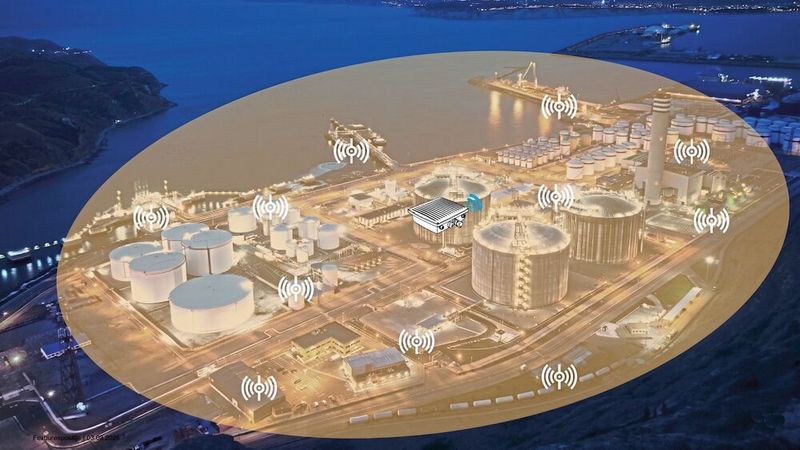
Enormous penetration: Thanks to the long range of LoRaWAN technology, even extensive and metal-heavy process plants can be monitored cost-effectively and completely wirelessly.
(Image: Wika)
In the process industry and in traditional discrete manufacturing, countless rotating machines such as pumps, fans, agitators, centrifuges, turbines and compressors are in operation. Efficient and smooth operation of these machines is crucial, as unplanned downtime is extremely expensive. Michael Heider, Head of IIoT Engineering at Wika, explained in his presentation at the rbs trade press days that the absolutely process-critical main units are usually already hardwired into the control technology. The so-called auxiliary units, on the other hand, are often neglected for cost reasons. In practice, condition monitoring here is usually limited to time-controlled, manual rounds by maintenance personnel equipped with handheld measuring devices.
The reason for this glaring automation gap is mainly a financial one: the preparation and cabling costs for installing hundreds of additional sensors, possibly even across potentially explosive ATEX areas, supplying them with power and physically routing them into the company network very quickly exceed the budget for auxiliary units. A completely new architecture is required in order to economically transfer masses of assets to automated condition monitoring: it must be wireless, extremely energy-efficient, offer strong local data pre-processing (edge computing) and, above all, be easy to retrofit during operation.
Gallery
Robust Hardware and Clever Retrofit Installation
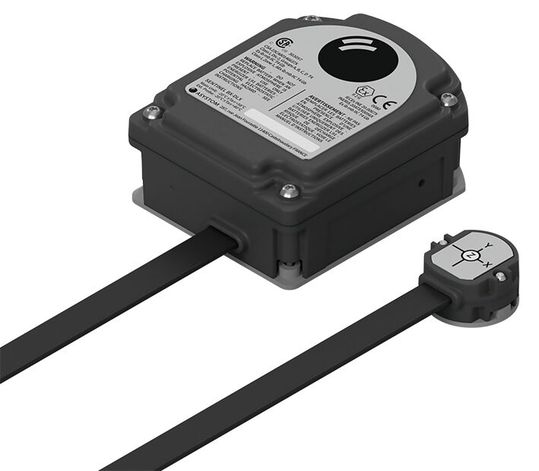
Two-part IIoT multi-sensors such as the AsystomSentinel, which measurement technology specialist Wika uses for its condition monitoring solution, are ideal for precisely this demanding requirement profile. In contrast to bulky all-in-one devices, the actual, very compact sensor head is placed directly on the machine - as precisely as possible where the vibration to be monitored occurs. The slightly larger transmitter and computer unit, which also houses the battery, can be mounted remotely using a flat connecting cable. This protects the sensitive radio electronics from strong heat sources or extreme machine vibrations.
Figure 1: The AsystomSentinel multisensor (Asystom/WIKA) detects triaxial vibrations, temperature and (ultra) sound. The sensor unit is bonded close to the vibration source, while the battery-operated transmitter and computing unit is set slightly apart.
(Image: WIKA)
A major obstacle in many retrofit projects is the physical fastening: Drilling and tapping on existing motors or pump housings is extremely time-consuming, often requires plant shutdowns and is simply prohibited in many areas. The IIoT sensors, which are specially designed for these purposes and certified in accordance with ATEX directives for hazardous areas, are instead fixed in place using special, high-strength industrial adhesive pads. The fact that this connection technology is absolutely reliable even under the harshest environmental conditions is proven by its use in the harsh offshore sector, where the bonded sensors have been monitoring so-called top drives (power heads) and gigantic mud pumps on drilling platforms for several years.
Edge Intelligence: 50 Parameters and Local FFT Calculation
The real bottleneck in wireless condition monitoring is and remains data transmission. In order to manage hundreds or even thousands of sensors in an industrial wireless network without interference, huge amounts of high-resolution raw data cannot be permanently streamed to the cloud. Signal processing must be relocated as close as possible to the source, i.e. to the edge level.
The microcontroller in the remote sensor module not only records the pure surface temperature of the unit, the ambient temperature and triaxial vibrations via its sensor technology. No, it is also equipped with a highly sensitive acoustic sensor for sound and ultrasound. Around 50 different mathematical parameters are calculated directly on the microcontroller (Edge) from this continuous raw data. These include classic RMS values (Root Mean Square), acceleration, peak values and kurtosis (curvature), which reacts particularly sensitively to shock-like events in rolling bearings. Alternatively, the hardware can also calculate a complete Fast Fourier Transformation (FFT) directly on the chip and then transmit only the finished, highly compressed frequency spectrum to the control system.
Date: 08.12.2025
Naturally, we always handle your personal data responsibly. Any personal data we receive from you is processed in accordance with applicable data protection legislation. For detailed information please see our privacy policy.
Consent to the use of data for promotional purposes
I hereby consent to Vogel Communications Group GmbH & Co. KG, Max-Planck-Str. 7-9, 97082 Würzburg including any affiliated companies according to §§ 15 et seq. AktG (hereafter: Vogel Communications Group) using my e-mail address to send editorial newsletters. A list of all affiliated companies can be found here
Newsletter content may include all products and services of any companies mentioned above, including for example specialist journals and books, events and fairs as well as event-related products and services, print and digital media offers and services such as additional (editorial) newsletters, raffles, lead campaigns, market research both online and offline, specialist webportals and e-learning offers. In case my personal telephone number has also been collected, it may be used for offers of aforementioned products, for services of the companies mentioned above, and market research purposes.
Additionally, my consent also includes the processing of my email address and telephone number for data matching for marketing purposes with select advertising partners such as LinkedIn, Google, and Meta. For this, Vogel Communications Group may transmit said data in hashed form to the advertising partners who then use said data to determine whether I am also a member of the mentioned advertising partner portals. Vogel Communications Group uses this feature for the purposes of re-targeting (up-selling, cross-selling, and customer loyalty), generating so-called look-alike audiences for acquisition of new customers, and as basis for exclusion for on-going advertising campaigns. Further information can be found in section “data matching for marketing purposes”.
In case I access protected data on Internet portals of Vogel Communications Group including any affiliated companies according to §§ 15 et seq. AktG, I need to provide further data in order to register for the access to such content. In return for this free access to editorial content, my data may be used in accordance with this consent for the purposes stated here. This does not apply to data matching for marketing purposes.
Right of revocation
I understand that I can revoke my consent at will. My revocation does not change the lawfulness of data processing that was conducted based on my consent leading up to my revocation. One option to declare my revocation is to use the contact form found at https://contact.vogel.de. In case I no longer wish to receive certain newsletters, I have subscribed to, I can also click on the unsubscribe link included at the end of a newsletter. Further information regarding my right of revocation and the implementation of it as well as the consequences of my revocation can be found in the data protection declaration, section editorial newsletter.
The combination of edge computing and ultrasound offers a massive diagnostic advantage over purely conventional vibration measurement: high-frequency vibrations, for example in the 40 kHz range, which are caused by a lack of lubrication or the onset of metal-on-metal friction, can be evaluated locally. They signal impending wear long before the heavy steel housing of the machine even begins to vibrate noticeably and measurably.
High Energy Efficiency For a 10-year Service Life
As the sensors aggregate and evaluate the data locally instead of transmitting it continuously, they are extremely energy-efficient. For rotating machines, it is typically sufficient to send a compact data set every 30 to 60 minutes to monitor the machine's condition closely and reliably. A major motor failure usually builds up over weeks and does not occur every second with this industrial equipment.
In combination with intelligent sleep modes ("wake-up on event"), in which the sensor only wakes up in the event of significant changes, the IIoT nodes achieve operating times of up to ten years. A decisive advantage for subsequent maintenance: instead of permanently installed, proprietary special rechargeable batteries, the Wika system uses four standard AA lithium cells. After simply loosening four screws on the housing, these can be easily and, above all, cost-effectively replaced directly on the machine anywhere in the world.
Wika Multisensor AsystomSentinel
Sensors (multi-sensor)
WertTri-axial vibration measurement Sound and ultrasonic measurement Measurement of surface and ambient temperature 2
Data processing (edge computing)
Calculation and provision of raw data or frequency analyses (FFT) directly on the device Four configurable operating modes (e.g., wake-up on event when thresholds are exceeded)
Power supply
Battery-powered sensor with up to 10 years of service life Power supply via 4 replaceable standard AA lithium batteries
Wireless interface
LoRaWAN wireless technology with a typical range of 5 to 10 kilometers (approx. 3.1 to 6.2 mi) Bidirectional communication for data uplink and configuration downlink
Certification
Explosion protection certification (Ex) for use in ATEX zones
Private LoRaWAN and Seamless IT/OT Integration
The open wireless standard LoRaWAN (Long Range Wide Area Network) is used for data transfer from the edge device to the central gateway. This energy-efficient LPWAN technology offers massive architectural advantages in harsh industrial environments:
The system impresses with its long range and penetration. Data can be reliably transmitted over 5 to 10 kilometers (approx. 3.1 to 6.2 mi) to a single gateway, even in environments with heavy metal structures in the process industry. The gateways themselves can be installed in just a few minutes and only require power and a connection via Ethernet or LTE mobile radio.
Users benefit from a completely independent infrastructure. They build their own private LoRaWAN network and are therefore completely independent of public telecommunications infrastructures or expensive 5G campus licenses.
The system supports genuine bidirectional communication. Sensors not only send their data packets (uplink), but can also receive configuration commands (downlink), for example to temporarily increase the measuring intervals "over-the-air" if a machine behaves conspicuously.
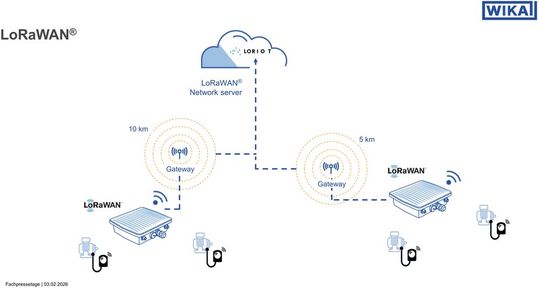
Scalable wireless infrastructure: The edge sensors communicate wirelessly with the gateways, which forward the data packets to the central LoRaWAN network server (e.g. from LORIOT).
(Image: Wika)
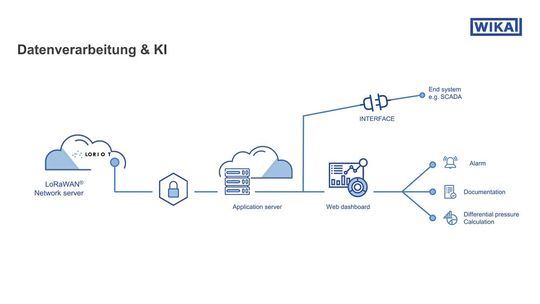
On the IT side, the gateways send their encrypted packets to a central network server (e.g. from LORIOT). From there, the decoded data flows into the application server, which can run either on-premises in the company's own data center or in the cloud. The processed diagnostic data can be seamlessly integrated into existing ERP or SCADA systems via standard interfaces (such as REST-API or MQTT). This IT-centric approach also enables globally distributed teams: gateways can be installed at a production site in France, while a central vibration expert at the headquarters in Germany monitors the data volumes in real time and provides precise instructions to the maintenance team on site.
Machine Learning: From Raw Value to "Anomaly Score"
Seamless IT/OT integration: The decoded status data flows from the application server to the web dashboard for AI evaluation or directly to existing SCADA systems via standard interfaces.
(Image: Wika)
However, simply recording all these parameters does not solve the fundamental problem of data overload for maintenance staff. Instead of setting rigid, error-prone threshold values for hundreds of different motors, the integrated software solution learns the exact normal behavior of each individual measuring point in an initial training phase. This phase usually lasts two to three weeks, during which the machine runs in its normal operating conditions.
During operation, the machine learning algorithm then constantly compares the newly arriving parameters with this individually trained reference model. The result is a user-friendly anomaly score from 0 to 100 percent that visualizes deviations at a glance. However, the system goes a decisive step further: the AI uses static machine data (a so-called identity card with values such as power and speed), classifies the deviating symptoms in the spectrum and calculates a percentage similarity score. It automatically identifies probable sources of error - such as gearbox wear (67 percent probability) or loose rotor bars (36 percent). This gives technicians a direct, actionable diagnosis instead of just raw frequency graphs.
Practical Example 1: Ultrasonic Analysis Prevents Reactor Failure
How massively superior this automated AI approach is to manual control was impressively demonstrated at an Italian plastics manufacturer. The Wika solution was installed on a large stirred tank reactor. Sensors were located at the motor output, at the rear of the gearbox and on the drive shaft directly above the mechanical seal to ensure seamless monitoring of the power transmission.
As early as May 2025, the software recorded a steady increase in the anomaly score due to significantly increased ultrasonic levels in the 40 kHz range. A technician then checked the machine with a classic, hand-held vibration measuring device, found no noticeable vibrations and incorrectly classified the message as a false alarm. However, the AI was right: in mid-June 2025, the now advanced wear was reflected in massive, low-frequency housing vibrations shortly before the rolling elements of the ball bearing in the reactor broke completely. It was only thanks to the very early ultrasonic warning that the plant operator was able to plan the timely replacement of components for the next regular plant shutdown and avoid an expensive, potentially dangerous unplanned shutdown.
Practical Example 2: Mining Rollout Delivers Measurable ROI
A global mining group introduced the system in parallel at seven pilot sites to monitor heavy-duty equipment such as large ventilation systems, cooling pumps, winches, vibrating screens and huge rock crushers. Previously, maintenance at these sites was based on reactive measures or fixed maintenance intervals, which often led to unnecessary inspections without any findings.
The radio-based condition monitoring system delivered measurable improvements throughout the entire process chain within just a few months:
Reduction in downtime: Unplanned downtime at the absolutely critical crushers and mills fell by a significant 40 to 60 percent across all sites.
Cost savings: The Group saves an estimated 100,000 to 300,000 euros per month (approx. USD 118,000 to 354,000 per month) at the seven pilot sites thanks to the avoided plant downtimes and the higher OEE.
Return on Experience (REX): The so-called "conversion rate" for maintenance tickets tripled. The mechanics and electricians are now only called out in the event of genuine anomalies that have been confirmed in advance by the AI. This minimizes frustrating false alarms and massively increases acceptance of the digital system among the workforce on site.
The Group easily achieved its commercial target of a return on investment (ROI) of less than six months and is now using the architecture as a blueprint for global scaling.
Scalability Through Edge Intelligence and Radio
The clever combination of local edge data processing and energy-efficient LoRaWAN radio solves the fundamental scaling problem of condition monitoring in existing systems. Instead of extremely expensive and rigid hardwiring, predictive maintenance can be set up quickly, flexibly and budget-friendly via wireless retrofit. Plant operators reduce unplanned downtimes and at the same time relieve their specialist staff of routine manual checks. When the intelligent sensor AI presents the most likely cause of the fault directly to the maintenance staff on the screen, the concept of predictive maintenance becomes a measurable and highly profitable reality on the store floor.(mc)



:quality(80)/p7i.vogel.de/wcms/ed/78/ed786ed6b280ff6c692908f01f715e3d/0113143253v1.jpeg "In our China Market Insider, we regularly provide you with relevant information straight from China. (Image:© Eisenhans - stock.adobe.com)")
:quality(80)/p7i.vogel.de/wcms/68/a5/68a5ce0896756c1dcf48dbeceefafbd3/0132300990v1.jpeg "Christoph Geigges is President and CEO of Walter AG. Headquartered in Tübingen (Germany), the company is one of the world’s leading suppliers of precision tools for metalworking. Under Geigges’ leadership, this long-established company is increasingly transforming itself from a tool manufacturer into an engineering partner that supports the entire manufacturing process. (Image: Walter AG)")
:quality(80)/p7i.vogel.de/wcms/3e/7c/3e7c26f44c68545fc7318597b6b65903/0133649650v1.jpeg "The flexible Heller circular storage system can store and process pallets measuring both 630 millimeters by 630 millimeters and 800 millimeters by 800 millimeters—even in mixed-mode operation. This makes the entire production line particularly flexible. (Image:Brighter)")
:quality(80)/p7i.vogel.de/wcms/16/29/162983885950ec1df27ab441bfe88613/0133132549v1.jpeg "Bernd Hermeler is the CEO of Cemecon AG. He studied mechanical engineering at RWTH Aachen University (Germany)—the very university from which the company emerged as a spin-off 40 years ago. Today, Hermeler is responsible for the global strategy of the coating specialist, which, with branches in Europe, the U.S., China, Japan, and India, is considered the global technology leader in the coating of cutting tools. (Image: Cemecon AG)")
:quality(80)/p7i.vogel.de/wcms/4b/7c/4b7c11f510878f154012d04c18a7c3cc/0133798118v1.jpeg "RobCo Becomes a Unicorn: The Munich-based robotics company has reached a valuation of more than one billion U.S. dollars and is driving the next generation of autonomous industrial robotics with Alfie. (Image:RobCo)")
:quality(80)/p7i.vogel.de/wcms/c8/a9/c8a96d5841d508c9e9c609c64168cbaa/0133758997v1.jpeg "Hospital Robotics: Neura Robotics' autonomous healthcare platform is designed to independently transport empty hospital beds between wards and floors. (Image:Neura Robotics)")
:quality(80)/p7i.vogel.de/wcms/88/dc/88dc38a1a0b5e016192ab83b0850fbd0/0133514708v1.jpeg "Scalable data sovereignty is the foundation for the transition from computationally intensive AI processing and growing data streams to sustainable, energy-efficient storage systems. (Image:Gemini / AI-generated)")
:quality(80)/p7i.vogel.de/wcms/1c/ef/1cef66e13c5cc02c5731fefcc99c00d2/0133697754v1.jpeg "Embodied AI in Industry: FMC³ Robotics combines AI-based perception and adaptation with traditional robot control to prepare robots for use in industrial manufacturing. (Image:FMC³/processed by AI)")
:quality(80)/p7i.vogel.de/wcms/a7/8a/a78a582a42a96aaaff38bd6b8f97a015/vishal-lal-mit-kernuhrv1.jpeg "It's ticking: Researchers have stabilized the first atomic clock. (Source: PTB)")
:quality(80)/p7i.vogel.de/wcms/36/f9/36f96a206fc408c9a632ce849de1f7fa/newsimage428299v1.jpeg "Polystyrene is used in protective packaging for televisions and electronic devices, in decorative moldings and baseboards for interior home construction, and even in Petri dishes. (Source: Hereon/Marcel Schwickerath)")
:quality(80)/p7i.vogel.de/wcms/90/30/90300137452b00d22f95113eff065ac3/fliehkraftkupplungen-und-bremsen-montage-centrifugal-clutches-and-brakes-assembly-1v1.jpeg "Installation: Centrifugal clutches should always be precisely matched to the machine. (Source: Amsbeck Machine Technology)")
:quality(80)/p7i.vogel.de/wcms/93/84/9384230e840a99a2015fdd3e0af11e2b/newsimage428236v1.jpeg "The crutch replicates the natural, biomechanical movement pattern of the human body. (Source: Leon Kast)")
:quality(80)/p7i.vogel.de/wcms/50/23/5023ffaefac8f9a47286b368143b88eb/0133801078v1.jpeg "Life isn't exactly a walk in the park for Porsche right now. And now Porsche management is saying that next year will be even worse. Read here to find out why that's supposed to be the case... (Image: Porsche)")
:quality(80)/p7i.vogel.de/wcms/2f/ab/2fabf62cdd2f57cb279e00931c91c869/0133794991v1.jpeg "The Atto 2 SUV is one of BYD's most popular plug-in hybrids. (Image:BYD)")
:quality(80)/p7i.vogel.de/wcms/e9/6e/e96e34d467ca1017f2a689275ae07302/0133815122v1.jpeg "Porsche CEO Leiters has shared new information about the company's model plans. (Image:Porsche)")
:quality(80)/p7i.vogel.de/wcms/0a/50/0a50938be0b598b36efc4e5457ed56dd/forvia-siege-zen-massage-16-9-06v1.jpeg "Seat with massage function by Forvia. (Source: Forvia)")
:quality(80)/p7i.vogel.de/wcms/4d/eb/4debf44ac7c0349544c70033bb9a182c/0133750488v1.jpeg "AI-enabled hardware: is a prerequisite for successful AI projects. (Image:Tung Lam)")
:quality(80)/p7i.vogel.de/wcms/36/f0/36f0472d20227013871aa790f4d48ac6/0133726018v1.jpeg "Ion beams can ablate, coat, or smooth surfaces down to the atomic level. Such processes are used, among other things, in optical chips, precision optics, and superconducting materials. (Image:AI-generated)")
:quality(80)/p7i.vogel.de/wcms/1f/47/1f47da6ee12c38a745eb478a04157a65/0133726100v1.jpeg "The schematic diagram shows the structure of a 3D NAND memory device with memory cells stacked on top of one another and vertical connections for high storage density. (Image:Dall-E / AI-generated)")
:quality(80)/p7i.vogel.de/wcms/b6/06/b6060e0b986e103e442b3971b6c0724c/0133731535v1.jpeg "Rendering of the planned Terafab facility in Texas (presumably generated using AI). Elon Musk does not seem to be making progress with his plans to operate his own semiconductor manufacturing facility. The SpaceX CEO has confirmed that he is currently in talks with TSMC regarding a stake in the Terafab project. (Image:SpaceX)")
:quality(80)/p7i.vogel.de/wcms/9f/98/9f98baee8c1651b3a2fa89f0ef56d992/0131356152v1.jpeg "Image 2: Michael Heider talks about IIoT condition monitoring at the Stutensee editorial office's trade press days.(Image: rbs)")
:quality(80)/p7i.vogel.de/wcms/09/e0/09e065d9d356301a8b88c41fbe9ad9b3/0131381218v1.jpeg "Enormous penetration: Thanks to the long range of LoRaWAN technology, even extensive and metal-heavy process plants can be monitored cost-effectively and completely wirelessly.(Image: Wika)")
:quality(80)/p7i.vogel.de/wcms/92/24/92246d8f056439c37c7f919efab3c29e/0131381211v1.jpeg "Fast setup: The LoRaWAN gateways for the private wireless network can be installed within a few minutes and cover large parts of the factory premises.(Image: Wika)")
:quality(80)/p7i.vogel.de/wcms/5a/d1/5ad1366f16d2d5a46c6ad2835acb2f97/abb-1-lowres-2000x1125v1v1.jpeg "IPF's system for energy monitoring and production/process data acquisition: The IIoT gateway (left), the energy measurement module (center), and the I/O module, which can be used to expand the gateway's analog and digital interfaces. (Image:IPF Electronic, Inc.)")
:quality(80)/p7i.vogel.de/wcms/c8/d0/c8d0c68a98e4eff417e2bacc58da92b7/aveva-world-media-kitv1.jpeg "Predictive maintenance should not be a matter of plant size or budget, but rather a matter of the proper integration of data collection, analysis, and feedback to operators. (Source: Aveva)")