The traditional gunsmith Carl Walther GmbH develops and produces sporting equipment that enjoys an excellent reputation worldwide. For manufacturing, Walther relies on a state-of-the-art machinery park and precision tools from Paul Horn GmbH.
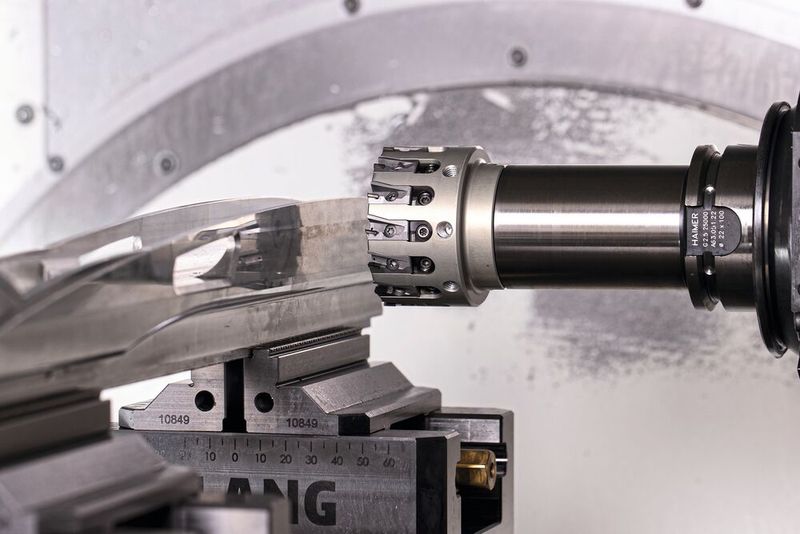
Switching to the Horn PKD cutter DTM 1710 saved ten minutes of processing time.
(Image: Horn/Sauermann)
Kneeling, prone, and standing: These are the shooting positions for the Olympic three-position rifle event in small-bore shooting. For precise shots, a steady hand and correct shooting technique, as well as a very accurate sporting rifle, are crucial for a successful competition.
"We have been relying on Horn's tool systems for a very long time. These include, for example, slot cutters, end mills, and PCD cutters, as well as various turning tools," says Walther process planner Ronny Buchholz. For the finishing of the system housing of the KK rifles, the Walther team uses the Horn PCD face mill DTM 1710. The system housing is the central component of the rifle. All other parts, such as the trigger unit, barrel, and shoulder stock, are mounted on it. Particular attention is paid to the surface quality. "All external surfaces of the system housing are visible surfaces. This is where the shooter loads the weapon, and all attention is focused on this component. A correspondingly good surface is our quality standard," says Buchholz.
Gallery
Reflective Surfaces
Before switching to the PCD cutter, the team used a solid carbide end mill for finishing. The surface quality was not bad, but depending on the finish desired by the customer, it always required additional rework. Horn technician Thomas Kisch suggested testing the PCD finishing cutter of type DTM 1710 for the finishing process.
"The task was to increase the efficiency of the finishing process, reduce cycle times, and improve surface quality to minimize rework," says Kisch. However, it was not just about a new tool. The production of the system housing was completely restructured. For the complete machining of the component, Walther acquired a new Grob G550. "By reorganizing the production of the system housing, we were able to optimize numerous milling processes and significantly reduce production time," says Buchholz.
The shorter production time was also achieved thanks to the Horn finishing mill. With the high achievable feed rates, the tool system enables a high level of productivity and efficiency. The precision-lasered PCD cutting inserts produce very high surface qualities in the finishing process. This is ensured by the quality of the PCD cutting edge, the PCD substrate, and the micrometer-precise adjustment of the planar runout. The milling body, made of an aluminum alloy, ensures a spindle-friendly, lightweight design. As long-term protection against the abrasive attack of chips, the milling body is specially surface-treated. To achieve high surface qualities and operate in the upper speed range, the tool must be finely balanced with the tool holder. For optimal balance quality, balancing holes are provided on the milling body. To achieve the best possible results, the entire machine environment must be considered and brought to the highest possible stability level. The structure of the machine, guides, spindles, and clamping systems for both the workpiece and the milling tool have a decisive influence on the outcome.
The Horn high-performance PCD cutting material consists of a sophisticated mixture of different sizes of diamond grains. The volume fraction of diamond increases, along with effective hardness, toughness, and cutting edge quality. Strict quality standards and their control are, of course, in place and ensure strong performance. For the DTM 1710 milling system, Horn offers the cutting cassettes in two different PCD substrates, depending on the material to be machined.
The results impressed the Walther team. With cutting speeds of vc = 3100 meters per minute (~10,000 feet per minute) and surface qualities of Ra = 0.4 micrometers (~0.000016 inches), the milling system operates at the required speed and achieves nearly mirror-like surfaces. The time savings after switching the finishing process amount to approximately eleven minutes. "We are very satisfied with the system's performance. This satisfies us, our quality assurance, and ultimately, of course, the shooter," says Buchholz.
Olympic Siscipline
Among small-bore shooters are hobbyists as well as Olympians. Among other disciplines, the three-position event is one of the most well-known. In this Olympic discipline, athletes shoot at a distance of 50 meters (~164 feet). A competition is conducted in the kneeling, prone, and standing positions. The shooter fires 40 shots per position. The allotted times per position range between 60 and 90 minutes. The competitor with the most points wins the competition. The caliber is 5.6 millimeters (~0.22 inches).
Date: 08.12.2025
Naturally, we always handle your personal data responsibly. Any personal data we receive from you is processed in accordance with applicable data protection legislation. For detailed information please see our privacy policy.
Consent to the use of data for promotional purposes
I hereby consent to Vogel Communications Group GmbH & Co. KG, Max-Planck-Str. 7-9, 97082 Würzburg including any affiliated companies according to §§ 15 et seq. AktG (hereafter: Vogel Communications Group) using my e-mail address to send editorial newsletters. A list of all affiliated companies can be found here
Newsletter content may include all products and services of any companies mentioned above, including for example specialist journals and books, events and fairs as well as event-related products and services, print and digital media offers and services such as additional (editorial) newsletters, raffles, lead campaigns, market research both online and offline, specialist webportals and e-learning offers. In case my personal telephone number has also been collected, it may be used for offers of aforementioned products, for services of the companies mentioned above, and market research purposes.
Additionally, my consent also includes the processing of my email address and telephone number for data matching for marketing purposes with select advertising partners such as LinkedIn, Google, and Meta. For this, Vogel Communications Group may transmit said data in hashed form to the advertising partners who then use said data to determine whether I am also a member of the mentioned advertising partner portals. Vogel Communications Group uses this feature for the purposes of re-targeting (up-selling, cross-selling, and customer loyalty), generating so-called look-alike audiences for acquisition of new customers, and as basis for exclusion for on-going advertising campaigns. Further information can be found in section “data matching for marketing purposes”.
In case I access protected data on Internet portals of Vogel Communications Group including any affiliated companies according to §§ 15 et seq. AktG, I need to provide further data in order to register for the access to such content. In return for this free access to editorial content, my data may be used in accordance with this consent for the purposes stated here. This does not apply to data matching for marketing purposes.
Right of revocation
I understand that I can revoke my consent at will. My revocation does not change the lawfulness of data processing that was conducted based on my consent leading up to my revocation. One option to declare my revocation is to use the contact form found at https://contact.vogel.de. In case I no longer wish to receive certain newsletters, I have subscribed to, I can also click on the unsubscribe link included at the end of a newsletter. Further information regarding my right of revocation and the implementation of it as well as the consequences of my revocation can be found in the data protection declaration, section editorial newsletter.
Switching to the finishing cutter was a complete success. Plans to convert additional finishing processes as well as new projects are underway. "Thanks to the ability to adjust the insert seats, the tools are versatile. We are already looking forward to the next projects with Horn," said Buchholz.



:quality(80)/p7i.vogel.de/wcms/eb/2b/eb2bd1b8487afe577b37363cd02f16ff/0113143253v1.jpeg "In our China Market Insider, we regularly provide you with relevant information straight from China. (Image:© Eisenhans - stock.adobe.com)")
:quality(80)/p7i.vogel.de/wcms/dd/b8/ddb8edc98c49b384734ab2432b297eb5/adobestock-1913662309--irene-stock-adobe-com-ki-generiertv1.jpeg "Rotary joints are used in grippers and swivel mechanisms to allow assemblies to rotate or swivel smoothly relative to one another, even under very high loads (illustrative image). (Source: Irene - stock.adobe.com / KI-generiert)")
:quality(80)/p7i.vogel.de/wcms/d1/ef/d1ef6b6f7d4543f7999980bacccaf22b/0133499261v1.jpeg "As the growing imbalance in trade relations with China continues to widen, the EU Chamber of Commerce foresees a day when trade with China will have to be seriously reevaluated ... (Image: AI-generated)")
:quality(80)/p7i.vogel.de/wcms/fe/1f/fe1fa5ee713f94deaba963dc24c3abc5/0133299273v1.jpeg "The Flexistar enables highly flexible production of laser-welded tubes thanks to its tool-free clamping system. (Image:Because Technology, LLC)")
:quality(80)/p7i.vogel.de/wcms/60/ef/60ef4f07e4829b2c2929befc0f353c58/0133511729v1.jpeg "Humanoid robots can match human performance in certain tasks. (Image:Gemini / AI-generated)")
:quality(80)/p7i.vogel.de/wcms/2e/99/2e99726b522e4b35b690e25eb6a42643/0133463991v1.jpeg "Robotics: In AMR applications, connection technology must reliably transmit power, signals, and data despite vibration and shock loads—in very confined spaces and in a way that allows for regular maintenance. (Image:Hyperever)")
:quality(80)/p7i.vogel.de/wcms/d0/18/d01801e3d5dbd7bc9d0b4f60408b630c/0133468429v1.jpeg "Quality requirements for film packaging are on the rise. At the same time, many companies are turning to recyclable film materials, which, however, have their own challenges. Fraunhofer researchers have therefore developed a fast system that detects problems in real time. (Image:Fraunhofer IKTS)")
:quality(80)/p7i.vogel.de/wcms/b1/06/b106cf44923ce39565c3264982fd20eb/0133414574v1.jpeg "Robots Build Robots: At the new Ubtech factory, automated systems even handle parts of the material supply and logistics for the production of humanoid robots. (Image:Ubtech)")
:quality(80)/p7i.vogel.de/wcms/c0/52/c052f405eb55fc3d08c4837e77206fc0/adobestock-2021845957--aucartstudio-stock-adobe-com-ki-generiertv1.jpeg "An innovation from China to combat extreme summer heat: A novel coating lowers temperatures. (Source: © AucArtStudio – stock.adobe.com_AI-generated)")
:quality(80)/p7i.vogel.de/wcms/66/a7/66a7b78159caeacce57136529688799f/0133503398v1.jpeg "Sunlight Makes Stone! These stone blocks weren't made the traditional way. Instead, they were additively manufactured from sand using a laser. In the future, however, the laser is set to be replaced by concentrated sunlight—if the startup Addisol is successful... (Image:Addisol / F. Fiedler)")
:quality(80)/p7i.vogel.de/wcms/72/b9/72b995c2c8d812c5e2115cbef31e035a/0133462727v1.jpeg "Eggl manufactures center hoods that are precisely tailored to each cooking island—whether standard size or custom shape. They are made entirely of stainless steel and are individually customized in terms of size and filter arrangement. (Image:SPI)")
:quality(80)/p7i.vogel.de/wcms/13/5d/135dfae6229ceaf5c55467a43e8f7257/adobestock-1879961393--ardi-stock-adobe-com-ki-generiertv1.jpeg "Annoying chatterboxes or awkward silences in response to questions—a moderator should specifically prepare for difficult situations in order to navigate them effectively. (Image:ardi - stock.adobe.com_AI-generated)")
:quality(80)/p7i.vogel.de/wcms/aa/a2/aaa2c6dd2daa24b485cddbf9297590c0/0133467318v1.jpeg "Battery Monitoring: Battery monitoring using electrochemical impedance spectroscopy offers several advantages. (Image:TI)")
:quality(80)/p7i.vogel.de/wcms/39/b2/39b21bf03be1683831862239a369987c/0133469638v1.jpeg "Data from autonomous vehicles and robots operating autonomously is in high demand, and Ruqi wants to capitalize on this. (Image:Ruqi Mobility)")
:quality(80)/p7i.vogel.de/wcms/8a/bb/8abbb6217220595edc1549ac9b84f307/0133429906v1.jpeg "The IAA in Hanover showcased the ambitions of Chinese commercial vehicle manufacturers in Europe. (Image:Wehner - VCG)")
:quality(80)/p7i.vogel.de/wcms/0c/53/0c5313ef91c14b6df0d0996efc33c8ad/jpg03568-bearbeitetv1.jpeg "The category winners of the 2027 German Car of the Year award. (Source: GCOTY)")
:quality(80)/p7i.vogel.de/wcms/28/28/2828c5261714321afb0bab67bf771823/0133353387v1.jpeg "The 130-meter-long China Zorrilla draws its power from a battery system with a capacity of more than 40 MWh. Eight electric motors drive an equal number of water jets. (Image:Incat Australia Pty Ltd)")
:quality(80)/p7i.vogel.de/wcms/48/15/4815da27c45973ca629a99b375ac3aef/0133509585v1.jpeg "Ventuno Q RoadTest: Designed to help the Element14 community gain practical insights from real-world tests using the Ventuno Q. (Image:Farnell/Element14)")
:quality(80)/p7i.vogel.de/wcms/17/2b/172bd132f9febdfcbcedba292ad0504d/aufmacherv1.jpeg "Micro-Epsilon offers a wide range of IO-Link-compatible sensors. (Source: Micro-Epsilon Messtechnik GmbH & Co. KG)")
:quality(80)/p7i.vogel.de/wcms/ca/b4/cab46fd26d19d6a2febca032048200b6/0133471827v1.jpeg "Photonics SDK for C and Python: Computational operations are now abstracted as standard mathematical functions. (Image:Q.ANT)")
:fill(fff,0)/images.vogel.de/vogelonline/companyimg/76800/76895/65.jpg "FAULHABER_120mm.jpg ()")
:fill(fff,0)/p7i.vogel.de/companies/69/de/69de1b7403b0d/simtos-logo.jpeg "simtos-logo (SIMTOS)")
:quality(80)/p7i.vogel.de/wcms/ea/46/ea46cf4de02d672ea7846bd72806ecfa/0127573164v1.jpeg "The radial runout of the cutting inserts can be adjusted with micrometer precision.(Image: Horn/Sauermann)")
:quality(80)/p7i.vogel.de/wcms/20/14/201409177ceec16f01ac5ec95a677043/0127574106v1.jpeg "A successful collaboration: Ronny Buchholz in conversation with Horn technician Thomas Kisch and Walther machine operator David Engel.(Image: Horn/Sauermann)")
:quality(80)/p7i.vogel.de/wcms/48/14/481410e3ce8136d52368dd429a6545b5/0127573426v1.jpeg "The high achievable surface quality eliminates the need for polishing work.(Image: Horn/Sauermann)")
:quality(80)/p7i.vogel.de/wcms/4d/a6/4da6962099d4b99351694ac8795601af/0127573953v1.jpeg "The Walther KK500: World record rifle and the first choice for Olympians and professional athletes worldwide.(Image: Carl Walther GmbH)")
:quality(80)/p7i.vogel.de/wcms/b0/41/b041264d931df4347bc760fff1c7cb7b/0129439236v1.jpeg "The circular milling system proves to be a problem solver in the numerous standard variants, as well as in special shapes for some other milling processes. (Image:Horn/Sauermann)")
:quality(80)/p7i.vogel.de/wcms/22/21/222188d6bb12615d57768ba523fc4462/0129282193v1.jpeg "With the special milling cutter from Iscar's Multi-Master series, Eisele saves almost 200 seconds of machining time per component. (Image:Iscar)")