E-mobilityMercedes unveils the powertrain of the new CLA
From
Claus-Peter Köth* | Übersetzt von KI
5 min Reading Time
With a new drive unit, 800-volt system, and silicon carbide inverter, Mercedes aims to set new benchmarks in efficiency for the MMA models. The new CLA thus achieves a range of more than 750 kilometers (470 miles).
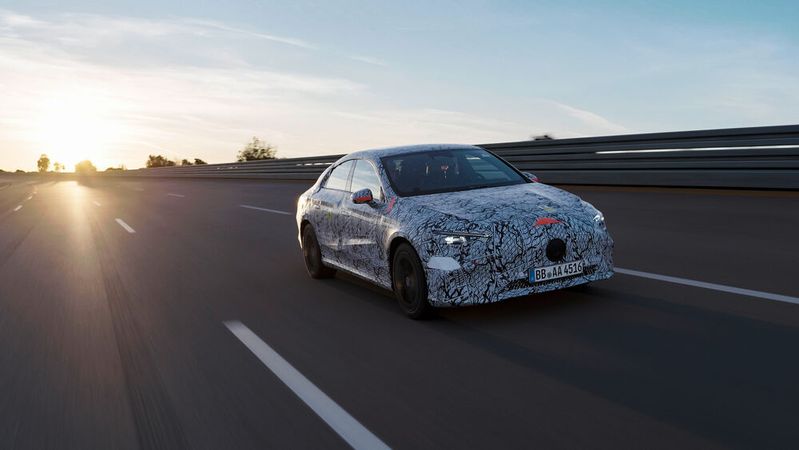
Efficiency is an important topic at Mercedes: A prototype of the CLA covered exactly 3,717 kilometers within 24 hours.
(Image: Mercedes-Benz Group AG)
The new Mercedes-Benz CLA will be launched next year as an electric vehicle and as a hybrid. In doing so, Mercedes brings its findings from the technology carrier Vision EQXX. The CLA is the first model to be based on the Mercedes-Benz Modular Architecture, or MMA for short. The core of this flexible vehicle architecture is the so-called skateboard chassis, a platform primarily designed for electric cars with the corresponding drive and suspension components. The body, on the other hand, varies: In the newly defined entry-level segment, Mercedes-Benz plans a family of four models in total. In addition to the CLA as a four-door sedan, these include a Shooting Brake and two SUVs.
Parts of the development and testing of the new MMA models took place in the Electric Software Hub (ESH). In this building at the Mercedes-Benz Technology Center (MTC) in Sindelfingen, numerous functions related to software, hardware, system integration, and testing are combined under one roof. Inside the ESH, the entire electrical/electronic integration process of vehicle development is reflected. This is how Mercedes intends to ensure that all new hardware and software components work together smoothly.
The electric drive unit EDU 2.0
According to the announcement, the new powertrain embodies the brand's longstanding engineering excellence. This applies equally to high-voltage components and to mechanical parts such as the transmission. The new electric drive unit (Electric Drive Unit—EDU 2.0) is a modular system of various highly integrated units. Furthermore, EDU 2.0 represents the first system of a new generation of electric drive units from Mercedes-Benz.
With the main drive on the rear axle, Mercedes-Benz is adopting a drive layout known from the mid-range and upper class in the entry-level segment. The 200 kW e-axle with a permanently excited synchronous machine (PSM) on the rear axle was completely developed by Mercedes. The power electronics are equipped with a silicon carbide (SiC) inverter for particularly efficient energy use. The transmission control and inverter are combined in one component. The drive unit is produced in Untertürkheim/Stuttgart (Germany).
According to Mercedes, the EDU 2.0 resolves the trade-off between maximum torque, top speed, and high efficiency, especially in real driving conditions. The high torque not only ensures dynamic driving performance but is also helpful for tackling gradients on mountain passes or towing loads. Another strength is the compactness of the EDU 2.0.
Markus Schäfer: Close to the "one-liter vehicle of the electric age"
The all-wheel drive models additionally feature an 80 kW drive unit on the front axle. This is also equipped with a SiC inverter and designed as a permanently excited synchronous machine. The front e-motor acts as a "boost" drive. Depending on the driving situation or program, it is only engaged when there is a corresponding power demand or traction requirement. This task is performed by the so-called Disconnect Unit (DCU), which Mercedes is now using for the first time in the entry-level segment.
In favor of higher efficiency, the DCU can decouple the e-machine at the front axle under low load, causing the e-motor and parts of the transmission to stand still. This reduces the front axle losses by 90 percent and increases the range. For the "Concept CLA Class," this corresponds to a range of more than 750 kilometers/466 miles (WLTP) with an energy consumption of 12 kWh/100 km (62 miles).
"With the upcoming MMA vehicles, we are getting closer to the idea of the one-liter vehicle of the electric age," says Markus Schäfer, Member of the Board of Management of Mercedes-Benz Group AG and Chief Technology Officer, Development & Procurement.
Mercedes brings 800-volt architecture
For the first time, Mercedes-Benz is relying on an 800-volt electrical architecture. The system can significantly shorten charging time in conjunction with the new battery generation. Within ten minutes, the "Concept CLA Class" can recharge a range of up to 300 kilometers (190 miles) using DC fast charging with up to 320 kW. For AC charging, the architecture offers options for an 11 kW or 22 kW AC charger.
Date: 08.12.2025
Naturally, we always handle your personal data responsibly. Any personal data we receive from you is processed in accordance with applicable data protection legislation. For detailed information please see our privacy policy.
Consent to the use of data for promotional purposes
I hereby consent to Vogel Communications Group GmbH & Co. KG, Max-Planck-Str. 7-9, 97082 Würzburg including any affiliated companies according to §§ 15 et seq. AktG (hereafter: Vogel Communications Group) using my e-mail address to send editorial newsletters. A list of all affiliated companies can be found here
Newsletter content may include all products and services of any companies mentioned above, including for example specialist journals and books, events and fairs as well as event-related products and services, print and digital media offers and services such as additional (editorial) newsletters, raffles, lead campaigns, market research both online and offline, specialist webportals and e-learning offers. In case my personal telephone number has also been collected, it may be used for offers of aforementioned products, for services of the companies mentioned above, and market research purposes.
Additionally, my consent also includes the processing of my email address and telephone number for data matching for marketing purposes with select advertising partners such as LinkedIn, Google, and Meta. For this, Vogel Communications Group may transmit said data in hashed form to the advertising partners who then use said data to determine whether I am also a member of the mentioned advertising partner portals. Vogel Communications Group uses this feature for the purposes of re-targeting (up-selling, cross-selling, and customer loyalty), generating so-called look-alike audiences for acquisition of new customers, and as basis for exclusion for on-going advertising campaigns. Further information can be found in section “data matching for marketing purposes”.
In case I access protected data on Internet portals of Vogel Communications Group including any affiliated companies according to §§ 15 et seq. AktG, I need to provide further data in order to register for the access to such content. In return for this free access to editorial content, my data may be used in accordance with this consent for the purposes stated here. This does not apply to data matching for marketing purposes.
Right of revocation
I understand that I can revoke my consent at will. My revocation does not change the lawfulness of data processing that was conducted based on my consent leading up to my revocation. One option to declare my revocation is to use the contact form found at https://contact.vogel.de. In case I no longer wish to receive certain newsletters, I have subscribed to, I can also click on the unsubscribe link included at the end of a newsletter. Further information regarding my right of revocation and the implementation of it as well as the consequences of my revocation can be found in the data protection declaration, section editorial newsletter.
Thanks to its focus on time efficiency, the CLA has already surpassed other production-based electric vehicles in a record attempt: During a 24-hour test drive in Nardò, southern Italy, a pre-production model covered exactly 3,717 kilometers (2,309 miles) within 24 hours. The two-speed transmission on the main drive at the rear axle contributes not only to efficiency but also enables very dynamic driving performance.
Two types of batteries with different cell chemistries
Customers will be able to choose between batteries with two cell chemistries. The cells of the top variant, with a usable energy content of a total of 85 kWh, feature anodes where silicon oxide is mixed with graphite. Compared to the previous battery with conventional graphite anodes, the gravimetric energy density has been increased by up to 20 percent. At the cell level, the volumetric energy density of the cell chemistry is 680 Wh/l. The use of raw materials has been improved and reduced. In particular, the proportion of cobalt has been decreased.
For the all-electric entry-level variant of the CLA, a battery with lithium iron phosphate cathodes (LFP) is planned. There, the usable energy content is 58 kWh and the volumetric energy density of the cell chemistry is 450 Wh/l.
Hybrids with 48-volt technology
The vehicles of the MMA architecture will also be available as hybrids with 48-volt technology (mild hybrid). The electric motor with 20 kW of drive power, along with an inverter, has been integrated into a new electrified eight-speed dual-clutch transmission (8F-eDCT). The electrical energy of up to 1.3 kWh is provided by a new 48-volt battery with lithium-ion technology in a flatpack design.
The engine and transmission design are very compact due to the small cylinder spacing and side-by-side arrangement of the e-machine. According to Mercedes, this powertrain is particularly efficient through recuperation and the ability to drive purely electrically at urban speeds. This is further enhanced by electric sailing at speeds of up to around 100 km/h (62 mph).
"Our new hybrid drive with an electric transmission also sets new standards in terms of efficiency," says Markus Schäfer.
A new four-cylinder gasoline engine with a displacement of 1.5 liters is used as the combustion engine. The unit, with the designation M 252, belongs to the modular engine family FAME (Family of Modular Engines). Initially, three output levels will be available with 100, 120, or 140 kW. In addition, 20 kW of electric drive power is provided.
*Claus-Peter Köth is Editor-in-Chief of 'Automobil Industrie' (German Edition)



:quality(80)/p7i.vogel.de/wcms/81/d4/81d47ab5407c961b55233009313ac9d2/0133075510v1.jpeg "Small, but designed for demanding applications: KSK demonstrates that the diameter of ball screws says nothing about their load-carrying capacity. (Image:Arkero)")
:quality(80)/p7i.vogel.de/wcms/6b/80/6b80bac3b1b33a0e3bc17849bef4ba59/0133171618v1.jpeg "With its portal solution for the MAK 4 Evolution UD swivel-bending machine, Schröder enables the fully automated production of sheet-metal enclosures. (Image:Schröder Group)")
:quality(80)/p7i.vogel.de/wcms/a0/1d/a01ddede6a787a4844122c2f42cfbce9/0133067101v1.jpeg "In solar module manufacturing, lasers are used for tasks such as patterning, drilling, and cutting delicate layers. Precise energy delivery is crucial to avoid damaging adjacent areas. (Image:Dall-E / AI-generated)")
:quality(80)/p7i.vogel.de/wcms/6c/98/6c98f4dd0780456713eee6379b3f534f/0132999605v1.jpeg "This specific project involved a similar surgical screw. (Image:KLS Martin)")
:quality(80)/p7i.vogel.de/wcms/ff/45/ff451109015c2f01b67ad3b0bad321ea/werma-success-story-skanska-1v1.webp "WeAssist combines traditional signal towers with a smart cloud solution. This allows the different colors of the signal towers to facilitate clear and intuitive communication during operations. (Source: Werma)")
:quality(80)/p7i.vogel.de/wcms/86/b1/86b14463fdbf6e77cafa6709433114bf/0132830551v1.jpeg "A look inside the automated testing lab at Amag Austria Metall AG's SmartFactory. (Image:Amag Austria Metall AG)")
:quality(80)/p7i.vogel.de/wcms/29/a8/29a8ea15ab38e4404bc1c6a3e425e454/adobestock-1550141473--leopard-stock-adobe-com-ki-generiertv1.jpeg "When Machines Understand What They're Doing—The Five Technologies Behind Physical AI. (Source: © Leopard – stock.adobe.com_AI-generated)")
:quality(80)/p7i.vogel.de/wcms/a0/0c/a00c9b7242fa38414b3281a9cd6dcc39/0133127938v1.jpeg "Demand for electronics and semiconductor products is expected to continue growing, prompting manufacturers to innovate and ramp up production while overcoming challenges. (Image:Siemens)")
:quality(80)/p7i.vogel.de/wcms/45/20/45208dbb0868aa49d32ded081173ebdb/siemens-sarla-aviation-01v1.jpeg "To ensure that data does not remain isolated in individual departments or systems, three companies are leveraging the Digital Thread with Siemens solutions. (Source: Sarla Aviation)")
:quality(80)/p7i.vogel.de/wcms/92/e9/92e9f029ef416e02b6f0b772b39c30df/limbitless-stratasys-zacharyv1.jpeg "The renewed focus of the expanded partnership between Stratasys and Limbitless is on sustainability, education, and improved access to 3D-printed prosthetics. (Source: Stratasys)")
:quality(80)/p7i.vogel.de/wcms/01/f1/01f16ebdc19b9cbde5bc1a7f421f9174/csm-a264340-web-1440-d0360d8de9v1.webp "At the 2026 Dutch Grand Prix in late August, two filtration systems developed by TU Berlin were used in top-level motorsports for the first time. (Source: Audi Revolut F1 Team)")
:quality(80)/p7i.vogel.de/wcms/00/c3/00c3f0f623f1b22935c99a2d364e2b6f/4082x2406v1.jpeg "EPFL researchers have unveiled ScaFi (short for “Scalable Fish”), a robot modeled after fish such as cod and mackerel. Its size can be adjusted as needed. (2026 CREATE Lab EPFL)")
:quality(80)/p7i.vogel.de/wcms/f3/d5/f3d5d5a330ab5425c90e6a37d23627ba/jag-f-type-heritage60edition-21my-091220-09v1.jpeg "Jaguar Land Rover is cutting 4,000 jobs. (Source: Jaguar Land Rover)")
:quality(80)/p7i.vogel.de/wcms/9e/6e/9e6eadbb44711dca055482f29b651ca9/0133192930v1.jpeg "At Automechanika, Stellantis' SUSTAINera business unit is introducing a remanufactured NOx sensor. (Image:Stellantis)")
:quality(80)/p7i.vogel.de/wcms/8d/f0/8df02ef9301116199dd602a1b3ffa976/0133198864v1.jpeg "Open System Protocol: The concept of a vehicle interior with distributed, dynamic RGB lighting. (Image:AMS Osram)")
:quality(80)/p7i.vogel.de/wcms/3a/52/3a524cf069c88cbd661c88d4a49f864f/db2022fa00082-largev1.jpeg "How much longer will VW models continue to be built in Emden? (Source: Volkswagen AG)")
:quality(80)/p7i.vogel.de/wcms/a4/4e/a44e89f5d47d037ca5d0c870b8dabc65/0133203720v1.jpeg "Transparent DC charging connector from Lapp featuring the vSECC.InPlug communication controller board from Vector (Image:Vector Informatics)")
:quality(80)/p7i.vogel.de/wcms/56/51/5651e7ef1aca62353ddff5727f6d40a3/0133183641v1.jpeg "Edge AI Security: The more autonomously AI systems operate at the network edge, the more important it becomes to have a consistent chain of trust—from secure boot to a protected model. (Image:NXP)")
:quality(80)/p7i.vogel.de/wcms/22/32/223265897c761a5ec2207a53151d2a36/adobestock-2168933153--zmaj88-stock-adobe-com-ki-generiertv1.jpeg "The 800-VDC power distribution system has established itself as a practical way to efficiently supply power to racks, even at the megawatt level. (Source: © zmaj88 – stock.adobe.com / AI-generated)")
:quality(80)/p7i.vogel.de/wcms/7d/a3/7da3623df87775722e9ba4fda7e16dc7/0133164888v1.jpeg "Z.ai told ChatGPT how it would like to be portrayed. (Image:Dall-E / AI-generated)")
:quality(80)/p7i.vogel.de/wcms/69/90/699054426b5d3368d3268cd2ea23723c/0121776331v1.jpeg "Torsten Eder, Vice President Development Electrified Drive Systems Mercedes-Benz.(Image: Mercedes-Benz Group AG)")
:quality(80)/p7i.vogel.de/wcms/94/1f/941fbd30f2233d9044ab0d17eb2c6bcb/0121776334v1.jpeg "In the Electric Software Hub (ESH) in Sindelfingen, Mercedes-Benz combines software, hardware, system integration, and testing under one roof.(Image: © Mercedes-Benz Group AG)")
:quality(80)/p7i.vogel.de/wcms/83/10/8310b16675496fd97b6dbf702a38d719/0121777061v1.jpeg "Hybrid powertrain of the MMA platform.(Image: Mercedes-Benz Group AG)")
:quality(80)/p7i.vogel.de/wcms/55/33/5533a4d6266615368364270c8935b2ed/0121776343v1.jpeg "MMA powertrain for all-electric vehicles.(Image: Mercedes-Benz Group AG)")
:quality(80)/p7i.vogel.de/wcms/15/75/1575ab89b889911c692bbb7e7b956697/0127487457v1.jpeg "The new hybrid concept from Horse also includes heat pumps and the use of the refrigerant R290. (Image:Horse Powertrain)")
:quality(80)/p7i.vogel.de/wcms/22/9b/229b8ca7e02e5f72a4e1f867b95a1721/0127487457v1.jpeg "The new hybrid concept from Horse also includes heat pumps and the use of the refrigerant R290. (Image:Horse Powertrain)")