In automation, the trend is toward cloud-based controls: as a specialist in HMI complete systems, Rose knows where the greatest savings potentials lie in outsourced control solutions. Device design plays a key role.
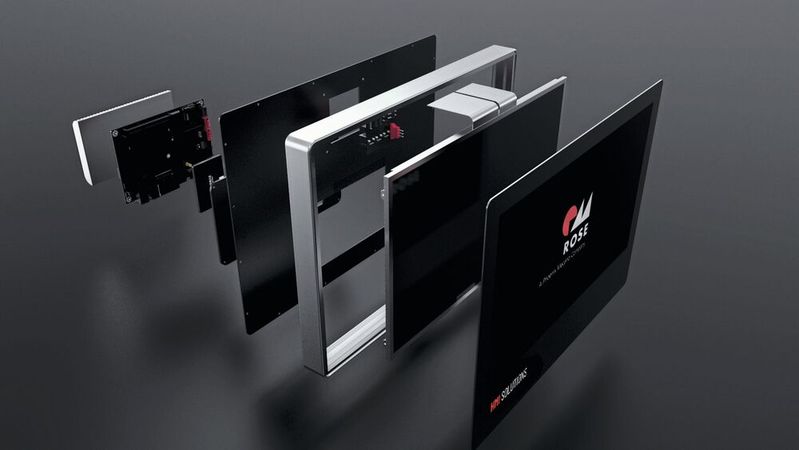
The panel PCs from Rose are modularly manufactured and can therefore be precisely tailored to the requirements of the respective application.
In spring 2025, Audi launched a small revolution at its Heilbronn (Germany) site: the world's first body production based on a virtual programmable logic controller (PLC) with a safety function from Siemens. The controller is located in a local cloud and enables flexible data-driven production as well as real-time monitoring and control of manufacturing from any location. Audi expects the implementation of the cloud-based controller to increase agility, efficiency, and safety in production. The goal is a more flexible, future-proof manufacturing process.
Cloud-based controllers take over the tasks of a traditional—but they no longer run on a panel PC directly at a workstation in production; instead, they operate in a data center. This data center is either located on the company premises or operated by an external service provider. The monitors directly at the production line are used "only" for visualizing the workflow steps taking place at the respective assembly stations. No control software is hosted on them anymore.
The shift of machine and process control to the cloud is a logical advancement of software PLCs, which have become increasingly established over the past decade. Unlike a traditional hardware PLC, software PLCs no longer require specific hardware as a base and can run on standard PCs. This allows the user to utilize their existing IT infrastructure for the PLC. It saves costs and increases flexibility, as the control system can be quickly and easily adapted to changing production conditions.
Cloud Control is Ideal for Large Systems
After the widespread adoption of software PLCs, it was only a matter of time before the next step followed: outsourcing system control to the cloud. "This is particularly useful for complex production systems," says Nils Stello, Division Manager HMI at Rose Systemtechnik. At Rose, he is responsible for the development and production of panel PCs, industrial monitors, control enclosures, handheld devices, and support arm systems.
During his customer visits, Stello learns firsthand what currently concerns the industry. "We are currently in talks with a renowned company that can envision controlling its entire production from the cloud in a few years." The company is currently using panel PCs from Rose, which will reach the end of their service life in a few years. Nils Stello and his colleagues are therefore already designing the next generation of industrial PCs and defining the requirements for the housings of the new devices.
More Compact Housing Design Opens Up Many Options
Since a virtual controller eliminates the need for PLCs to run on the panel PCs in production, the housings for the customer’s future PCs can be designed significantly flatter than before. "With a cloud-based controller, the individual PCs no longer need to be equipped with such a powerful processor as they are today," explains Nils Stello regarding the effects of virtualization. Until now, the power dissipation of the motherboard increased from one panel PC generation to the next, reaching approximately 45 watts most recently.
"By using a cloud-based control system, instead of a mainboard, you would only need a single board for the respective PC on the production line, and it has a power loss of only around 5 watts," said Stello. The board would thus emit very little heat, eliminating the need for a ribbed heat sink, which previously took up a lot of space in the device housing.
"I have completely different design possibilities for the housing of the panel PC by using a single board," says Nils Stello. The user could, for example, choose a stainless steel housing, which might have been problematic before because stainless steel heats up additionally and dissipates heat poorly. This small example clearly illustrates how the space within the housing of the panel PCs changes with the switch to cloud-based control.
Lower Computing Power Reduces Device Costs
A cloud-based control system thus expands the design options for panel PCs on the one hand and enables a significantly more compact design of the devices on the other. These not only require much less space in the application but are also cheaper to manufacture thanks to the smaller circuit board. "A single board costs about one-fifth of the price of a mainboard," explains Stello, highlighting the savings potential. For complex production systems with a large number of devices, this quickly adds up to significant amounts.
Date: 08.12.2025
Naturally, we always handle your personal data responsibly. Any personal data we receive from you is processed in accordance with applicable data protection legislation. For detailed information please see our privacy policy.
Consent to the use of data for promotional purposes
I hereby consent to Vogel Communications Group GmbH & Co. KG, Max-Planck-Str. 7-9, 97082 Würzburg including any affiliated companies according to §§ 15 et seq. AktG (hereafter: Vogel Communications Group) using my e-mail address to send editorial newsletters. A list of all affiliated companies can be found here
Newsletter content may include all products and services of any companies mentioned above, including for example specialist journals and books, events and fairs as well as event-related products and services, print and digital media offers and services such as additional (editorial) newsletters, raffles, lead campaigns, market research both online and offline, specialist webportals and e-learning offers. In case my personal telephone number has also been collected, it may be used for offers of aforementioned products, for services of the companies mentioned above, and market research purposes.
Additionally, my consent also includes the processing of my email address and telephone number for data matching for marketing purposes with select advertising partners such as LinkedIn, Google, and Meta. For this, Vogel Communications Group may transmit said data in hashed form to the advertising partners who then use said data to determine whether I am also a member of the mentioned advertising partner portals. Vogel Communications Group uses this feature for the purposes of re-targeting (up-selling, cross-selling, and customer loyalty), generating so-called look-alike audiences for acquisition of new customers, and as basis for exclusion for on-going advertising campaigns. Further information can be found in section “data matching for marketing purposes”.
In case I access protected data on Internet portals of Vogel Communications Group including any affiliated companies according to §§ 15 et seq. AktG, I need to provide further data in order to register for the access to such content. In return for this free access to editorial content, my data may be used in accordance with this consent for the purposes stated here. This does not apply to data matching for marketing purposes.
Right of revocation
I understand that I can revoke my consent at will. My revocation does not change the lawfulness of data processing that was conducted based on my consent leading up to my revocation. One option to declare my revocation is to use the contact form found at https://contact.vogel.de. In case I no longer wish to receive certain newsletters, I have subscribed to, I can also click on the unsubscribe link included at the end of a newsletter. Further information regarding my right of revocation and the implementation of it as well as the consequences of my revocation can be found in the data protection declaration, section editorial newsletter.
The relatively low weight of panel PCs in systems with cloud-based control also impacts the design of the support arm system used to connect the devices to the application. Since the support arm systems need to bear significantly lighter loads, they can be designed much more compactly. "We are therefore consistently expanding our support arm portfolio with lighter versions that are particularly suitable for these applications."
Still A Niche Topic for Large Companies
Rose has been developing application-specific HMI complete systems for a variety of industries for over 40 years. Individual customer consultation and close coordination with them are integral parts of the work of Nils Stello and his colleagues. They have been addressing the topic of cloud-based control systems and their impact on their own product range for some time. In some areas, there will be adjustments and changes, while in others, there will not.
"The virtualization of controls will initially be a niche topic for a few, large companies," Stello is certain. Rose will comprehensively support them in the transformation: "We are developing HMI solutions with them that fully exploit the advantages of virtual controls in terms of a leaner, more cost-effective device concept."
Future-Proof Authentication with Universal RFID Readers



:quality(80)/p7i.vogel.de/wcms/d9/43/d943b0ce33bdf921f37f14655bb0c376/cuscinetto-a-sfere-di-leonardo-da-vinci-in-una-mostra-su-leonardo-da-vinci-al-mulino-di-mora-bassa---morabassa-croppedv1.jpeg "Replica of Leonardo da Vinci's ball bearing: The inventor used wooden balls. Spacers prevent the balls from rubbing against each other. (Source: Capricornis crispus)")
:quality(80)/p7i.vogel.de/wcms/17/b8/17b8af0cb725e0e1d3e8d72458bab260/siemens-meet-at-the-machinev1.jpeg "“Meet at the Machine” is Siemens’ new initiative, which aims to bring together machine builders, software, and automation technologies to accelerate innovation in the machine tool industry and help manufacturers become productive more quickly. (Source: Siemens)")
:quality(80)/p7i.vogel.de/wcms/8e/7e/8e7e0cda4c68699bcc48283a38739769/0133316747v1.jpeg "A little-known hidden champion! When people think of laser cutting, the first thing that comes to mind is the power of the laser beam—and it is impressive to see the sparks flying. But Air Liquide—an exhibitor at Euroblech, by the way—wants to make it clear that the process gas is also key to success. (Image:AI-generated)")
:quality(80)/p7i.vogel.de/wcms/20/fa/20fa35e0af203c3464f7e7fdbb57a685/0133281172v1.jpeg "Since 2003, Etzinger AG has been developing and manufacturing high-quality coffee grinders, pepper mills, and grinding mechanisms for professional and home use. (Image:Etzinger)")
:quality(80)/p7i.vogel.de/wcms/b1/06/b106cf44923ce39565c3264982fd20eb/0133414574v1.jpeg "Robots Build Robots: At the new Ubtech factory, automated systems even handle parts of the material supply and logistics for the production of humanoid robots. (Image:Ubtech)")
:quality(80)/p7i.vogel.de/wcms/38/79/38799bfbbccd938b64c67068cfa68780/0133329362v1.jpeg "What exactly enables machines to act on their own? (Image:Shutterstock)")
:quality(80)/p7i.vogel.de/wcms/1b/9f/1b9fc9f113fc66212e2c0e17a3edaf9f/org-blobs-user-response-file-output-f317796f-57b7-483f-9403-5d9ac8a816f5-plugin-output-call-kdigtepb7be7us8xvbota0mh-1672x940v1.png "According to Barclays data, Europe leads the global trade in actuator components. With a 34 percent share, the region ranks ahead of China, which has a 26.3 percent share. (Source: Statista | CC BY-ND 4.0, AI-generated)")
:quality(80)/p7i.vogel.de/wcms/f5/4c/f54c9fc59ccb0604ab9219188469a45f/image1v1.jpeg "Christopher Savoia, Global Head of the UR+ Ecosystem at Universal Robots, presents the new SP7 Smart Panel on a UR17g-1300 robot during the unveiling of Gen 7—UR’s 7th-generation robot platform—at IMTS in Chicago on September 14, 2026. (Image:Image: Teradyne Robotics)")
:quality(80)/p7i.vogel.de/wcms/ca/46/ca462051dfb9a1fb37ca4053762af9df/org-blobs-user-response-file-output-908c701c-3b37-491e-bb5c-35fc3d336575-plugin-output-call-182851v1.png "Through extreme compression, high-energy lasers transform simple plastics into high-purity nanodiamonds. What was once used in planetary physics is now opening up entirely new possibilities for quantum sensors, novel catalysts, and extremely hard materials. (Illustrative image) (Source: VCG / AI-generated)")
:quality(80)/p7i.vogel.de/wcms/7c/7a/7c7a5eada63c7a36a365391c292f76d4/hot-fire-jarvisv1.jpeg "(Developed in record time: A “JARVIS-class” jet engine capable of up to 100 pounds of thrust. It was designed in a four-week sprint using generative AI and established CAD/CAE tools.MIT)")
:quality(80)/p7i.vogel.de/wcms/87/87/87870cf2b30aaef7b8a06212a4ef2c14/0133403885v1.jpeg "A digital twin and a real component demonstrate how closely simulation and manufacturing are converging. Stampack Xpress 2026.1 virtually models forming behavior and supports the validation of process and tool design. (Image:Stampack)")
:quality(80)/p7i.vogel.de/wcms/59/2a/592a7f2d0964e9e6846cae331f5daa3a/0133266065v1.jpeg "Perforated metal sheets are particularly well-suited for balcony railings, as they combine stability, privacy, and design versatility. (Image:Ripo Factory)")
:quality(80)/p7i.vogel.de/wcms/24/d5/24d546b8c00887feaef1cbc207b9e2af/0133433032v1.jpeg "Mahle CEO Arnd Franz was recently asked about his vision for the future of the commercial vehicle business—particularly regarding the industry's transition to electric vehicles... (Image:Kai R. Joachim / Mahle)")
:quality(80)/p7i.vogel.de/wcms/8b/c5/8bc5c0c40b6d706aca4e3f3ddcc99958/0133387335v1.jpeg "At InnoTrans, Stadler is unveiling for the first time its new four-axle EURO DuFour locomotive for freight service, which SBB Cargo has ordered. Compared to the existing fleet, it is expected to be significantly more energy-efficient in operation. (Image:Stadler)")
:quality(80)/p7i.vogel.de/wcms/49/97/49978469e969283ccb68531ebef1f412/klaus-zellmer-1v1.jpeg "Klaus Zellmer will become CEO of Volvo no later than October 2027. (Source: Volvo)")
:quality(80)/p7i.vogel.de/wcms/cf/e1/cfe1f3824102bd030f4fe5e4e13e1e0e/0133433007v1.jpeg "The situation in the German automotive manufacturing industry is not exactly rosy, especially when viewed in the context of global competition. Read here to find out what a recent analysis of the situation reveals ... (Image:AI-generated)")
:quality(80)/p7i.vogel.de/wcms/f3/d9/f3d91ebfd703e24d4065b0ae7898e46b/0133177388v1.jpeg "The Evolution of Coding: In the past, programs were written by hand and fed into the computer using punch cards and switches. Today, in the age of “vibe coding,” computers can largely program themselves. (Image:Dall-E / AI-generated)")
:quality(80)/p7i.vogel.de/wcms/00/cd/00cd7c51cf41652dbb295c14634cd34f/0133438409v1.jpeg "Flash memory from Spansion dating back to 2004, before the company merged with Cypress. Infineon is divesting its NOR flash and FRAM memory business. Winbond, which is acquiring the division for $1.12 billion, plans to continue operating it as a separate company under the Spansion name starting next year. (Image:Raimond Spekking / CC BY-SA 4.0 / Wikimedia Commons)")
:quality(80)/p7i.vogel.de/wcms/09/dc/09dcc37616c3a9d5d7a289c97a352a89/0133428369v1.jpeg "(Image:Gemini / AI-generated)")
:quality(80)/p7i.vogel.de/wcms/4c/53/4c534208d09a9b1ce597938715e7fc19/0133288763v1.jpeg "Logic Folding: In its latest Kirin 9050 Pro, Huawei uses hybrid bonding to distribute the computing units across two silicon layers in order to increase the effective transistor density without resorting to finer manufacturing processes. (Image:Huawei)")
:fill(fff,0)/images.vogel.de/vogelonline/companyimg/76800/76895/65.jpg "FAULHABER_120mm.jpg ()")
:fill(fff,0)/p7i.vogel.de/companies/69/de/69de1b7403b0d/simtos-logo.jpeg "simtos-logo (SIMTOS)")
:quality(80)/p7i.vogel.de/wcms/1e/80/1e80b00f40c38ed43f97167f4f2d7951/0127778556v1.jpeg "Rose delivers complete solutions consisting of panel PCs and support arm systems upon request.(Image: © Rose Systemtechnik GmbH)")
:quality(80)/p7i.vogel.de/wcms/1c/56/1c56fedf005cce9e7a7de6f7b0a59617/0127778563v1.jpeg "Stand columns as mounts for panel PCs and mobile devices are also part of Rose's product range.(Image: © Rose Systemtechnik GmbH)")
:quality(80)/p7i.vogel.de/wcms/bb/02/bb023c10c2fc0dbec0ecfcf92a1f9891/0127778565v1.jpeg "For the cosmetics manufacturer Babor, Rose supplied panel PCs running the company's own Manufacturing Execution System.(Image: © Rose Systemtechnik GmbH)")
:quality(80)/p7i.vogel.de/wcms/d6/a8/d6a81cba70d03ef2178aad30e9691559/0127778502v1.jpeg "Each panel PC is configured according to the requirements of the respective application.(Image: © Rose Systemtechnik GmbH)")
:quality(80):fill(efefef,0)/p7i.vogel.de/wcms/67/ae/67ae0b9ac31f8/elatec-wp-universal-reader.png "Elatec WP Universal Reader")
:quality(80)/p7i.vogel.de/wcms/08/72/0872dd2dd119a54824c41e0e580e45a8/0129576591v1.jpeg "The Rose enclosure systems can be customized on request. (Image:Rose Systemtechnik GmbH)")
:quality(80)/p7i.vogel.de/wcms/49/3f/493f0f51259c97a0f3fc279607f43f38/0127955062v1.jpeg "Dragonwing IQ-X Series: Qualcomm's first Arm CPUs for the industry. (Image:Qualcomm Inc.)")