Ceramics, due to their high hardness, could previously almost only be machined using grinding techniques. A ceramics specialist is now milling even sintered aluminum oxide ceramics with a hardness of 1800 HV to micrometer precision.
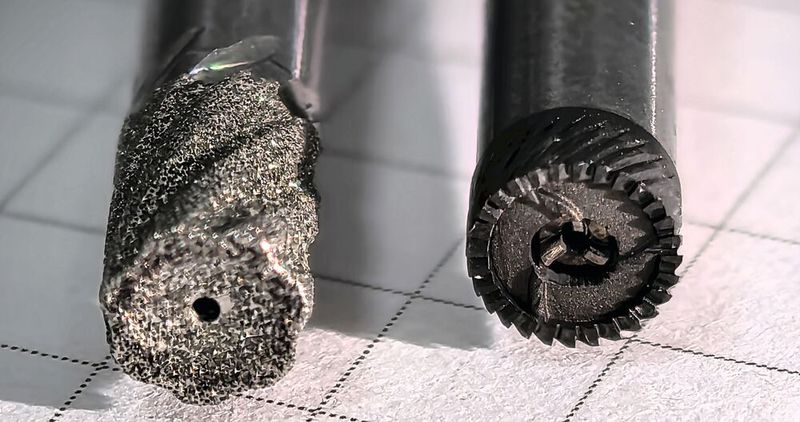
Ceramic-compatible tools from Zecha: On the left, a grinding tool with metal-bonded diamond grit; on the right, a PCD milling tool with numerous defined cutting edges.
(Image: Klaus Vollrath)
"We develop high-precision special ceramic components for use in a variety of demanding applications in industry, research, or medical technology," says Dr.-Ing. Torsten Weiß, Managing Director of BCE Special Ceramics GmbH in Mannheim (Germany). The company, founded in 1986, provides customized solutions made from ceramic materials, primarily oxide ceramics such as aluminum oxide (Al2O3) and zirconium oxide (ZrO2), or mixed oxides like ATZ (Alumina Toughened Zirconia) and ZTA (Zirconia Toughened Alumina). Occasionally, nitride or carbide materials as well as special materials are also used.
In doing so, the developers rely on their extensive material expertise as well as a wide range of processes and equipment for the production and processing of ceramics. The focus is on providing consultation in the collaborative development of customized solutions. This also includes the production of individual pieces and prototypes in a relatively short time. Small to medium-sized series are also produced, while large-scale production is later handed over to specialized manufacturers.
In the first step, the material question is clarified.
Dr.-Ing Torsten Prescher, Application Developer and Sales Manager, BCE Special Ceramics
In addition to the fundamental material properties, other factors need to be clarified, such as potential material pairings with additional ceramic components or dissimilar materials like metal or plastic. For example, in certain components exposed to ionizing radiation, conductivity is increased just enough through suitable additives to prevent static charges from building up. In other cases, the focus is simply on identifying suitable material pairings for use by the customer.
Once these initial questions are clarified, production begins: At BCE, a compact is produced in all cases, on which further processing steps are carried out. The ceramic powder used for this is mixed with a few percent of an organic binder, so the ceramic particles have sufficient strength after pressing.
To achieve the strength required for initial processing, the compact is cold isostatically pressed at a pressure of around 2,000 bar in a liquid-tight enclosure.
Dr.-Ing. Torsten Weiß, Managing Director of BCE Special Ceramics GmbH
The resulting "green body" already has a certain strength but can still be easily machined, for example, by milling, drilling, grinding, or cutting threads. However, dimensions must be given with a significant oversize of around 20 percent linearly, as the component shrinks by this amount in all three dimensions during the subsequent sintering process. Mastering the shrinkage behavior during sintering requires extensive expertise and experience. If the "as-fired" dimensions of the sintered ceramic are insufficient, additional subsequent mechanical processing through grinding is possible.
This significantly impacts the overall costs, as the component attains the typical hardness of fired ceramics after sintering and is consequently difficult to machine.
Dr.-Ing. Torsten Weiß, Managing Director of BCE Special Ceramics GmbH
During the firing process, the binder burns off, while the ceramic grains fuse into a highly dense structure with only about 0.5 percent porosity. Sintering takes place at temperatures between 1300 and 1400 degrees Celsius (approx. between 2370 and 2550 degrees Fahrenheit), and even up to 1700 to 2000 degrees Celsius (approx. 3090 to 3630 degrees Fahrenheit) for aluminum oxide. The components are then characterized by high strength and hardness as well as temperature resistance but can also withstand extreme cold down to absolute zero (-273.15 degrees Celsius, -523.67 degrees Fahrenheit). They are corrosion-resistant and resistant to most chemicals.
One of their main advantages—high hardness of up to 1800 HV and high wear resistance—has a significant drawback when precise machining after sintering is required. Until now, this was almost exclusively possible through grinding processes. Advanced technologies are available for this. However, milling to produce complex three-dimensional geometries or freeform surfaces was hardly possible due to a lack of suitable machines or tools. Consequently, the design of workpiece geometries was limited. Otherwise, extreme manufacturing costs were to be expected.
While searching for suitable technologies to bridge this gap, we spoke with familiar companies that already had experience machining ceramics with Röders milling machines.
Dr.-Ing Torsten Prescher, Application Developer and Sales Manager, BCE Special Ceramics
For milling green bodies, systems from competitors had been used so far, but they were not suitable for the high-precision five-axis machining of sintered ceramics.
Systems Enable Maximum Contour Accuracy
Initial interactions with Röders immediately made a positive impression. They were particularly impressed by the fact that key components of the technology, including the control system, are developed and manufactured with the highest precision by Röders. The result is systems that enable maximum contour accuracy. For example, they allow drilling with roundness deviations of just 1 micrometer. Furthermore, they are robust enough to withstand the extreme stresses involved in machining ceramics. This is made possible by the use of wear-free direct drives, durable linear guides, and efficient seals that effectively prevent the penetration of highly abrasive ceramic dust or grinding emulsion.
It was important, according to Dr. Prescher, that the machine could be used in a variety of ways and that, depending on the component or operator preference, it could be determined whether the control would be fed with CAD/CAM data or whether quick manual programs could be created. After all, both approaches have their specific advantages.
Date: 08.12.2025
Naturally, we always handle your personal data responsibly. Any personal data we receive from you is processed in accordance with applicable data protection legislation. For detailed information please see our privacy policy.
Consent to the use of data for promotional purposes
I hereby consent to Vogel Communications Group GmbH & Co. KG, Max-Planck-Str. 7-9, 97082 Würzburg including any affiliated companies according to §§ 15 et seq. AktG (hereafter: Vogel Communications Group) using my e-mail address to send editorial newsletters. A list of all affiliated companies can be found here
Newsletter content may include all products and services of any companies mentioned above, including for example specialist journals and books, events and fairs as well as event-related products and services, print and digital media offers and services such as additional (editorial) newsletters, raffles, lead campaigns, market research both online and offline, specialist webportals and e-learning offers. In case my personal telephone number has also been collected, it may be used for offers of aforementioned products, for services of the companies mentioned above, and market research purposes.
Additionally, my consent also includes the processing of my email address and telephone number for data matching for marketing purposes with select advertising partners such as LinkedIn, Google, and Meta. For this, Vogel Communications Group may transmit said data in hashed form to the advertising partners who then use said data to determine whether I am also a member of the mentioned advertising partner portals. Vogel Communications Group uses this feature for the purposes of re-targeting (up-selling, cross-selling, and customer loyalty), generating so-called look-alike audiences for acquisition of new customers, and as basis for exclusion for on-going advertising campaigns. Further information can be found in section “data matching for marketing purposes”.
In case I access protected data on Internet portals of Vogel Communications Group including any affiliated companies according to §§ 15 et seq. AktG, I need to provide further data in order to register for the access to such content. In return for this free access to editorial content, my data may be used in accordance with this consent for the purposes stated here. This does not apply to data matching for marketing purposes.
Right of revocation
I understand that I can revoke my consent at will. My revocation does not change the lawfulness of data processing that was conducted based on my consent leading up to my revocation. One option to declare my revocation is to use the contact form found at https://contact.vogel.de. In case I no longer wish to receive certain newsletters, I have subscribed to, I can also click on the unsubscribe link included at the end of a newsletter. Further information regarding my right of revocation and the implementation of it as well as the consequences of my revocation can be found in the data protection declaration, section editorial newsletter.
For this reason, the system was also equipped with a dressing spindle, process monitoring via structure-borne sound, and the highly advanced grinding cycles of the Röders control system. For process cooling and lubrication, internal emulsion supply with up to 80 bar is used, which is essential, especially when working with very small tools. Additionally convincing was the fact that there were references from the use of around 50 systems already employed for various ceramic machining tasks by different users.
Another key point, given the extraordinary hardness of the ceramics, was the procurement of suitable tools.
The operation of the system is so simple and intuitive that we only needed two weeks of training when it was delivered three years ago to be able to work with it and program it directly on the control system.
Fabian Henning,Machine operator, BCE Special Ceramics
Originally, he worked with Siemens controls, but the transition was easy. Since he frequently processes components with simpler 2 to 2 ½ D geometries, he programs a relatively large number of NC sequences directly on the machine. Such tasks can be realized very easily with the Röders control system. This allows him to create NC programs for milling or grinding within a short time. For grinding operations, he uses predefined cycles in the control system. These can be simply applied over the available or directly constructed 2D CAD contours on the control system. The parameters required for this are directly retrieved from the processing database. In cases where more complex NC programs, such as for freeform surfaces, are needed, he uses the CAM system VISI. This enables the quick creation of corresponding three- and five-axis programs.
The reliability of the machine and the high responsiveness of the service are also commendable. For example, callbacks usually occur within 1 to 2 hours. In the three years of using the machine, there has only been one instance of a real failure, caused by a defective sensor. In that case, the technician arrived the very next day with the necessary parts, allowing work to quickly resume.
"The decision for the machine from Röders has proven to be an important and correct step to expand BCE's machining capabilities while significantly reducing production costs," says Dr. Weiß with satisfaction.
*Klaus Vollrath is a freelance author
Secure and Compliant Authentication in Laboratories



:quality(80)/p7i.vogel.de/wcms/d0/4c/d04c032c8e1e150bf33ba84def4ed9a6/0130721540v1.jpeg "Müller Precision Tools supports its customers with customized, application-specific tools. (Image: Müller)")
:quality(80)/p7i.vogel.de/wcms/f0/7a/f07aa6f8243048d3bc7156fa4fc263bb/0113143253v1.jpeg "In our China Market Insider, we regularly provide you with relevant information directly from China. (Image:© Eisenhans - stock.adobe.com)")
:quality(80)/p7i.vogel.de/wcms/c0/92/c0922365a230627bafa6a3ed7fbe15d7/0131573143v1v1.jpeg "The EU members of the European Parliament have voted by a majority in favor of the planned tariff agreement coming into effect. Trump's threats have clearly worked ... (Image: F. Schneidler)")
:quality(80)/p7i.vogel.de/wcms/81/22/8122583abe81b65e0590e99aa189b001/0131847826v1.jpeg "Rymoplast has invested in a recycling plant in Markranstädt, Saxony, near Leipzig. There, high-quality granulate is produced from plastic films. However, the thermal management of the processing systems must be optimal for this. Technotrans had the right solution ... (Image: Rymoplast)")
:quality(80)/p7i.vogel.de/wcms/72/a4/72a42738f6a899a841d4fa5961aca547/0131865780v1.jpeg "Siemens Industrial Edge enables customers to deploy and manage edge devices and apps directly at the production site. The app ecosystem ensures seamless connectivity to industrial systems, IT systems, and the cloud. (Image:Siemens)")
:quality(80)/p7i.vogel.de/wcms/bb/38/bb38b290715449fdcb977cb4a0c720be/0131850167v1.jpeg "To make manufacturing faster, more robust, and more flexible, production must be designed in a more IT-oriented manner. This also requires virtual controls. (Image: Audi AG)")
:quality(80)/p7i.vogel.de/wcms/ab/e8/abe8dd2398744832931a48d525b18acf/screenshot-202026-04-02-20163710v1.png "The interplay of horizontal and vertical grinding discs effortlessly creates a 2-mm radius with maximum efficiency. (Source: Teqram)")
:quality(80)/p7i.vogel.de/wcms/de/49/de496edc0815d63154eccc7d1341d696/0131501872v1.jpeg "Cybersecurity: is increasingly evolving from an isolated IT discipline to an integral part of industrial value creation. (Image: Designed by Freepik)")
:quality(80)/p7i.vogel.de/wcms/7d/f0/7df0df2c3fc0cd9cb7fd614412361aac/henkel-20ami-20pm-20anodis-uminium-bild-201-v1.jpeg "Henkel research in action: The development of Bonderite M-AD 2000A demonstrates how targeted additives can make anodizing processes more energy-efficient, sustainable, and economical. (Source: Henkel)")
:quality(80)/p7i.vogel.de/wcms/e3/01/e3018c55021f2a0ce0745124354eb96e/6000x4000v1.jpeg "Holographic projection of a model of a human ear. (Source: Adrien Buttier/EPFL)")
:quality(80)/p7i.vogel.de/wcms/2c/65/2c65057b446b0c6fd5f59a51af9081c1/ruderer-pm-sonderfahrzeugbau-caravan-cmyk-02v1.jpeg "Modern adhesives and sealants enable stable, tight, and economical connections in special vehicle construction – from vehicle structure to interior fittings to repairs. (Source: Ruderer)")
:quality(80)/p7i.vogel.de/wcms/dc/1e/dc1e164ca1e524e7cb48de6fd6a16a1c/hytank-ifam-pi-bilder-1-ad-plasmav1.png "Non-contact atmospheric pressure plasma pretreatment of a CFRP surface. (Source: Fraunhofer IFAM)")
:quality(80)/p7i.vogel.de/wcms/52/8f/528f5c85caa342eaa46e101351bbb1ee/a201486-largev1.jpeg "Permanent magnets from electric motors contain valuable raw materials. (Source: Audi)")
:quality(80)/p7i.vogel.de/wcms/5a/b6/5ab6a38b387b4f9d9f18e889588d85da/0131905522v1.jpeg "The Chinese are clever! After the EU introduced countervailing duties on electric cars, they quickly realized that plug-in hybrids, like the Sealing 6 Touring from BYD, were not affected. However, the EU Commission now wants to block these loopholes... (Image: BYD)")
:quality(80)/p7i.vogel.de/wcms/5c/46/5c4696dbe0c30e52f9cccb6b0aba1af9/b2026cw00206v1.jpeg "Oliver Blume has reaffirmed the automaker's cost-cutting strategy. (Source: Volkswagen)")
:quality(80)/p7i.vogel.de/wcms/49/d2/49d254cee8bf109b21ebe0012ab7b896/0131877440v1.jpeg "Press conference for the opening of the Schaeffler Automotive Symposium 2026 (from left): Klaus Rosenfeld, CEO of Schaeffler AG, together with Matthias Zink, Board Member Powertrain & Chassis, and Thomas Stierle, Board Member E-Mobility. (Image:Schaeffler | Daniel Karmann)")
:quality(80)/p7i.vogel.de/wcms/49/db/49dbdb906050c2ee2f12aca95a309599/0131907985v1.jpeg "System-wide context integration: AI agents consolidate isolated data from ALM, PLM, and ERP systems into well-founded decision templates. (Image: PTC)")
:quality(80)/p7i.vogel.de/wcms/a8/f7/a8f769adac577406bb0c56f5b7535564/0131874725v1.jpeg "Huge success: In 1983, the Controller Area Network was born. A revolution, as it reduced wiring efforts, is fail-safe, and real-time capable. (Image: ©Elena - stock.adobe.com / AI-generated)")
:quality(80)/p7i.vogel.de/wcms/d3/37/d337fde36d300515a0d679aa55fb5432/0131894777v1.jpeg "Mixed-signal and power semiconductors: The services of the Cosmic Group support customers from the initial design phase to the end-of-line test. (Image: Cosmic Group)")
:quality(80)/p7i.vogel.de/wcms/40/77/4077a0064066bde13aa0a8e2817c8858/0131879275v1.jpeg "Bosch location in Shanghai: Due to unauthorized deliveries to Huawei, Bosch must pay a multi-million dollar fine in the USA. (Image: Bosch)")
:fill(fff,0)/images.vogel.de/vogelonline/companyimg/76800/76895/65.jpg "FAULHABER_120mm.jpg ()")
:fill(fff,0)/p7i.vogel.de/companies/69/de/69de1b7403b0d/simtos-logo.jpeg "simtos-logo (SIMTOS)")
:quality(80)/p7i.vogel.de/wcms/b4/bb/b4bb3496f05aa1436c6ebcf5cea8f616/0125761609v1.jpeg "\"NC programs for milling or grinding components with simpler 2D or 2.5D geometries can be implemented remarkably easily with the Röders control system,\" Fabian Henning.(Image: Klaus Vollrath)")
:quality(80)/p7i.vogel.de/wcms/2d/31/2d3190df8747054259dfcccc53959c43/0125761603v1.jpeg "The Zecha ball head milling cutter made of diamond-coated solid carbide created a semicircular groove in the upper area of the sintered Al2O3 ceramic, 1.5 millimeters wide (approx. 0.06 inches) and 0.5 millimeters deep (approx. 0.02 inches).(Image: Klaus Vollrath)")
:quality(80)/p7i.vogel.de/wcms/0c/30/0c30fd78b463ec3e4f3e1d3ad991437c/0125746906v1.jpeg "BCE Special Ceramics develops and manufactures high-quality precision components made from ceramic materials.(Image: Klaus Vollrath)")
:quality(80)/p7i.vogel.de/wcms/30/e7/30e72c0584b0d15ee58397868faa5b1e/0125748323v1.jpeg "The \"green\" compact is easily machinable, allowing for comprehensive mechanical processing. After sintering, this is no longer readily possible.(Image: Klaus Vollrath)")
:quality(80):fill(efefef,0)/p7i.vogel.de/wcms/67/ac/67acb931a438c/elatec-wp-gmp.png "Elatec WP GMP")
:quality(80)/p7i.vogel.de/wcms/4d/74/4d740870522ccda3ca36efbbfd6f2b47/0127899702v1.jpeg "Comparison of tools before and after vibratory finishing. (Image:Anca)")
:quality(80)/p7i.vogel.de/wcms/be/75/be751aca3fdefe69afba6eb4d8414e68/screenshot-202026-04-02-20172559v1.png "Complex piping systems for hydraulics and fuel made from corrosion- and heat-resistant stainless steel are used in aerospace. (Source: Butting)")