The hype around humanoids is real. But what do they achieve in the industry when they're not performing flips and dancing in viral videos? We look behind the hype and at the current reality of humanoid robots.
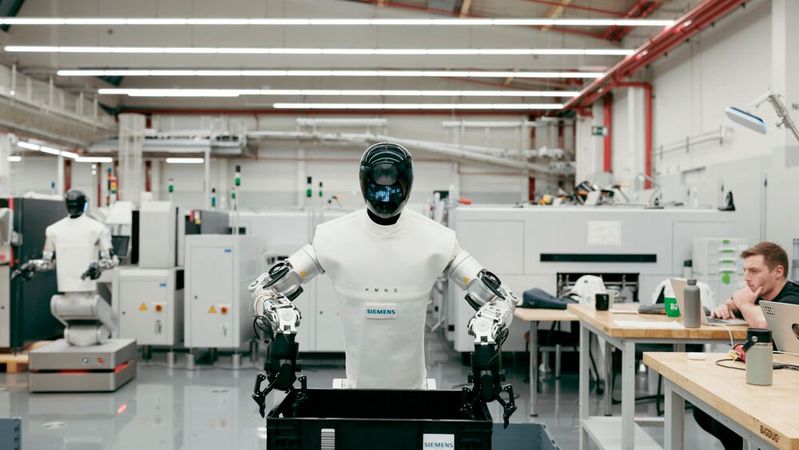
Rolling humanoid at Siemens: In practical testing, the robot moved 60 containers per hour onto the conveyor belt.
(Image: Siemens)
At the Humanoid Days at the University of Erlangen, Dr. Maximilian Metzner, Global Lead Manufacturing Electronics at the Siemens site in Erlangen (Germnay), provided insight into the current state of humanoids and their industrial practicality.
The Siemens device factory in Erlangen is a classic brownfield environment: The factory was built in 1971 and has grown organically over decades. The approximately 1,000 employees in manufacturing produce items such as frequency converters for power electronics, which are used across industries—from simple electric motors to machine tools and battery production.
This broad spectrum is precisely the biggest hurdle for classical automation. There is no mass production in the sense of millions of identical components per year. Instead, an extreme high-mix/low-volume approach dominates: some products are built thousands of times a day, while others only 50 times a month. The physical nature also varies massively.
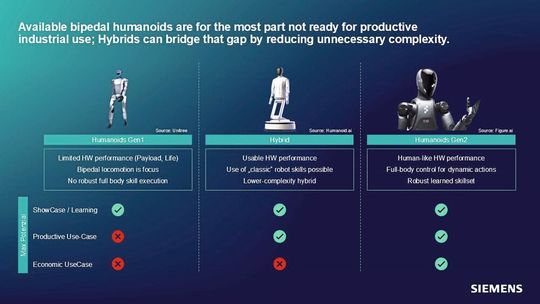
Development stages in comparison: While purely bipedal robots of the first generation are often mere demonstrators and fully autonomous Gen2 systems are not yet available for purchase, hybrid systems are currently filling the gap for productive industrial use.
(Image: Siemens)
"At the end of the day, it's simply physics," explained Dr. Metzner at the Humanoid Days. "Even though we manufacture electronics, you can't create a purely software-based version of power electronics. Whether you draw five kilowatts or five megawatts of power fundamentally requires different circuit boards, components, and heat sinks."
To address demographic change and global cost pressures, the factory is heavily reliant on massive automation and digitalization. However, the solutions sought must be flexible, which is why Siemens relies on AI-driven systems.
In the Erlangen electronics plant, the wheel-driven humanoid robot HMND 01 Alpha from the English manufacturer "Humanoid" took on a clearly defined logistics task in a two-week practical test in spring 2026: it destacked material containers, transported them autonomously to the conveyor belt, and made them available there for employees. The so-called "Tote-to-Conveyor-Destacking" process is thus a real application case in factory logistics, but not yet an announced regular operation. According to Siemens, the robot achieved 60 container movements per hour and achieved a success rate of over 90 percent in autonomous gripping and placement processes.
The Appeal of the Humanoid: The "Drop-In Replacement"
But why is an established plant like Erlangen now focusing so intensively on humanoid or human-like systems? The answer lies in the very nature of the factory itself. Brownfield facilities were historically designed exclusively for humans and their ergonomics. The great advantage of the humanoid form factor is therefore its function as a so-called drop-in replacement. After all, they "hypothetically offer the greatest market potential of all time," as could be read on Metzner's slides. This refers to the replacement of human physical labor.
Additionally, the human-like physique significantly simplifies the training of artificial intelligence. Since the mechanics of the robotic arms resemble human anatomy, movement sequences can be directly transferred via teleoperation and used as learning data for the systems.
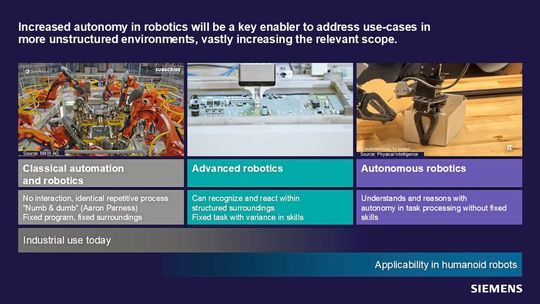
The path to AI autonomy: From the classic, rigidly programmed robotic cell ("Numb & Dumb"), evolution progresses through sensor-based systems to fully autonomous units.
(Image: Siemens)
Perhaps the greatest economic appeal for plant operators lies in the drastic risk minimization. With fully automated special-purpose machines, there is often no Plan B in case of malfunctions. The humanoid approach, on the other hand, offers a simple fallback option, as Metzner emphasized:
"Classic automation is often a final decision: once a system is fully automated and robots are permanently installed, there is no going back to manual work the next day. A humanoid approach offers a built-in emergency concept here: if the robot has not yet mastered a new task reliably, we simply move it aside, and a human employee takes over the position again. No investment is lost, and operations continue."
Date: 08.12.2025
Naturally, we always handle your personal data responsibly. Any personal data we receive from you is processed in accordance with applicable data protection legislation. For detailed information please see our privacy policy.
Consent to the use of data for promotional purposes
I hereby consent to Vogel Communications Group GmbH & Co. KG, Max-Planck-Str. 7-9, 97082 Würzburg including any affiliated companies according to §§ 15 et seq. AktG (hereafter: Vogel Communications Group) using my e-mail address to send editorial newsletters. A list of all affiliated companies can be found here
Newsletter content may include all products and services of any companies mentioned above, including for example specialist journals and books, events and fairs as well as event-related products and services, print and digital media offers and services such as additional (editorial) newsletters, raffles, lead campaigns, market research both online and offline, specialist webportals and e-learning offers. In case my personal telephone number has also been collected, it may be used for offers of aforementioned products, for services of the companies mentioned above, and market research purposes.
Additionally, my consent also includes the processing of my email address and telephone number for data matching for marketing purposes with select advertising partners such as LinkedIn, Google, and Meta. For this, Vogel Communications Group may transmit said data in hashed form to the advertising partners who then use said data to determine whether I am also a member of the mentioned advertising partner portals. Vogel Communications Group uses this feature for the purposes of re-targeting (up-selling, cross-selling, and customer loyalty), generating so-called look-alike audiences for acquisition of new customers, and as basis for exclusion for on-going advertising campaigns. Further information can be found in section “data matching for marketing purposes”.
In case I access protected data on Internet portals of Vogel Communications Group including any affiliated companies according to §§ 15 et seq. AktG, I need to provide further data in order to register for the access to such content. In return for this free access to editorial content, my data may be used in accordance with this consent for the purposes stated here. This does not apply to data matching for marketing purposes.
Right of revocation
I understand that I can revoke my consent at will. My revocation does not change the lawfulness of data processing that was conducted based on my consent leading up to my revocation. One option to declare my revocation is to use the contact form found at https://contact.vogel.de. In case I no longer wish to receive certain newsletters, I have subscribed to, I can also click on the unsubscribe link included at the end of a newsletter. Further information regarding my right of revocation and the implementation of it as well as the consequences of my revocation can be found in the data protection declaration, section editorial newsletter.
Pragmatism Instead of Science Fiction: Why the Industry (Almost) Doesn't Need Legs
When humanoid robots are discussed in public, images of walking robots balancing on two legs over uneven terrain or climbing stairs dominate. For use in classic brownfields, however, these highly complex bipedal systems are currently neither mature nor economically viable.
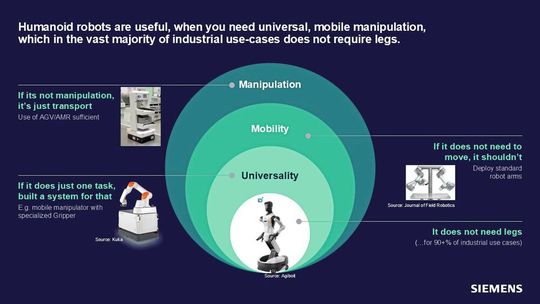
The exclusion principle for humanoids: The effort for a humanoid-like design is only justified at the intersection of mobility, manipulation, and universalization—legs are superfluous in most cases.
(Image: Siemens)
Instead, Metzner advocates for hybrid systems: a mobile AMR base (Autonomous Mobile Robot) combined with a humanoid upper body (torso and arms). This form factor drastically reduces complexity and already enables robust, productive applications today. Human walking requires constant balancing calculations with every movement, which is not only extremely demanding in terms of software but also poses real regulatory challenges in the factory.
"You simply can't get bipedal systems certified and approved in an industrial environment today," the Siemens expert emphasized at the Humanoid Robot Days. "The corresponding standards are missing, the safety technology is incredibly complex, and it only limits you."
The relevance of a humanoid in the factory ultimately arises from the principle of exclusion, which Metzner summarizes as the "95-percent rule": if it's purely about material transport, a simple autonomous transport system is entirely sufficient. For highly specific, stationary tasks, a classic industrial robot is the better choice. Only when a task requires universal, mobile manipulation does the humanoid approach demonstrate its strengths. Even in over 95 percent of these applications, legs are simply not needed in the industry, Metzner adds: "Factory floors are rarely uneven and are generally designed for wheels."
Use Cases in Practice: From Cardboard Boxes to Cognition
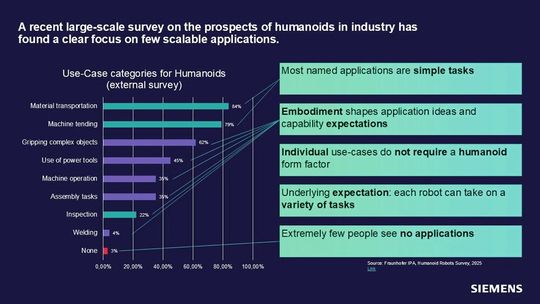
But what exactly is this new type of robot supposed to achieve in the factory? A study by Fraunhofer IPA paints a surprisingly mundane picture: at the top of the industry's wish list are simple skills such as material transport (84 percent) and machine loading (79 percent).
Industrial desires vs. form factor: According to a study by Fraunhofer IPA, simple tasks such as transport and machine loading are the focus. However, the universal humanoid only becomes economically viable for these individual tasks if it performs multiple processes in succession.
(Image: Siemens)
The human-like form often raises false expectations about industrial value, Metzner emphasized. As an example, he cited the frequently demonstrated operation of handheld power tools by robotic hands. "Why should I design and program a highly complex humanoid hand just to operate a standard cordless screwdriver?" Metzner questioned these use cases. "There are already mature screwdriving systems that fit directly onto standard robot flanges."
To reflect the technological reality, Siemens divides the applications for humanoids into three complexity levels (tiers):
Tier 1 (Low): Simple manipulation tasks with sufficient space, such as gripping and carrying standardized storage bins or boxes (Pick & Place). These use cases are already being addressed in proof-of-concepts (PoCs) in the Erlangen production facility.
Tier 2 (Medium): Targeted actions in tighter environments (e.g., reaching into shelves) and greater dexterity to specifically remove individual parts from collection bins. According to Metzner, this level is not yet commercially available and is the subject of ongoing research.
The high investment costs for humanoid hardware are ultimately justified only by their eponymous universality. "It makes no economic sense to place a universal robot at a machine for six hours straight to perform a single repetitive task," Metzner explained the principle of the 'monolith.' "Such a system pays off when it collects boxes for half an hour, then picks parts from a shelf, and subsequently operates the machine. The robot must be able to perform several different task chains in succession."
Software Proves to be a Bottleneck
Initial test runs with hybrid systems in Erlangen show that the pure hardware (chassis and arms) has often already reached a very good, industry-suitable level. Despite all the mechanical advancements, the actual problem lies elsewhere. While standard grippers often still prove to be a weak point in universal tasks, the real bottleneck in integration is the software.
Since mobile robots never stop at exactly the same point, fixed programming misses the mark. Everything must be sensor-supported and camera-based, calculated in real time. Metzner summarizes the challenges in the following six points:
Early software stage: The software stack is in a very early iteration. Comprehensive application frameworks for programming on the robots are missing.
Inherent complexity: The hardware combines a mobile base (or legs), a lift system, two seven-axis arms, and movable camera systems in one device.
Synchronous skill execution: The system requires the absolutely synchronized interaction of navigation, object recognition, motion planning, and gripping process.
Fully sensor-controlled: Since mobile robots never land in the exact same spot down to the millimeter, traditionally programmed waypoints are useless. Every grip must be necessarily calculated using sensor data.
Unpredictable full-body movement: A humanoid body automatically compensates for movements. Metzner explained the problem as follows: "When you extend one arm, the other makes a compensatory movement for stabilization, even if it wasn't actively controlled."
Complex collision avoidance: The system must dynamically predict its own changing form as well as all compensatory movements to avoid obstacles or humans.
"You have a mobile robot with two seven-axis arms and multiple camera systems that move relative to each other," summarized Dr. Metzner, adding, "That's roughly the nightmare of every roboticist."
USA vs. China: Two Poles in the Market
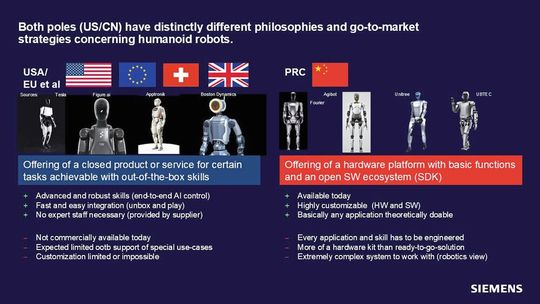
Two opposing market philosophies: Western manufacturers primarily rely on closed black-box solutions with fixed skills, while Chinese providers deliver open hardware platforms that require a high degree of in-house software engineering.
(Image: Siemens)
The Western Model (Closed Systems): Manufacturers from the USA (and partly Europe) typically offer a closed system that comes with pre-trained capabilities. Metzner compares this to the principle of a temporary worker: the robot arrives ready at the station, an operator sets it up, and it starts running. The drawback for industrial users: "To put it bluntly: they sell you nothing. You are offered a closed system where the task no longer even belongs to you because you are renting a service," Metzner described the "Robot-as-a-Service approach." Moreover, highly specific tasks in electronics manufacturing cannot be addressed by general closed data models. Not to mention that this offering simply doesn't exist yet due to a lack of skills.
The Asian model (Open but incomplete platforms): Manufacturers from China take the exact opposite approach: They already sell pure hardware platforms without pre-installed AI skills. This offers maximum freedom for in-house developments on paper. The problem here: the software is not yet fully developed, and the system is relatively complex.
Outlook: The Tipping Point for Humanoids
That humanoid systems, in whatever form, will eventually establish themselves in the industry is, for Metzner, not a question of "if" but rather a simple economic equation: on one side stands demographic change, which inevitably increases the cost and scarcity of human labor. On the other side are technological advancements and the decreasing unit costs of hardware. "If these robots become smarter through better models, then they can do more tasks and become universally applicable. That’s when the system pays off," predicted the engineer.
Humanoid robots have the potential to revolutionize automation in high-mix/low-volume manufacturing, as they fit perfectly into existing brownfield factories as a drop-in replacement. However, anyone expecting Hollywood-style androids on two legs will be disappointed. Industrial pragmatism leads through hybrid, mobile systems.
"In industry, it's not the coolest thing that prevails, but the most practical," sums up Dr. Metzner from Siemens. However, the real race for the factory of the future will not be won by building legs, but in software development. That is, in the battle for the best AI models that turn a piece of hardware into a true, flexible machine colleague.



:quality(80)/p7i.vogel.de/wcms/68/a5/68a5ce0896756c1dcf48dbeceefafbd3/0132300990v1.jpeg "Christoph Geigges is President and CEO of Walter AG. Headquartered in Tübingen (Germany), the company is one of the world’s leading suppliers of precision tools for metalworking. Under Geigges’ leadership, this long-established company is increasingly transforming itself from a tool manufacturer into an engineering partner that supports the entire manufacturing process. (Image: Walter AG)")
:quality(80)/p7i.vogel.de/wcms/3e/7c/3e7c26f44c68545fc7318597b6b65903/0133649650v1.jpeg "The flexible Heller circular storage system can store and process pallets measuring both 630 millimeters by 630 millimeters and 800 millimeters by 800 millimeters—even in mixed-mode operation. This makes the entire production line particularly flexible. (Image:Brighter)")
:quality(80)/p7i.vogel.de/wcms/16/29/162983885950ec1df27ab441bfe88613/0133132549v1.jpeg "Bernd Hermeler is the CEO of Cemecon AG. He studied mechanical engineering at RWTH Aachen University (Germany)—the very university from which the company emerged as a spin-off 40 years ago. Today, Hermeler is responsible for the global strategy of the coating specialist, which, with branches in Europe, the U.S., China, Japan, and India, is considered the global technology leader in the coating of cutting tools. (Image: Cemecon AG)")
:quality(80)/p7i.vogel.de/wcms/af/81/af81b53cb4926dcadc20ba369a29d412/0132695968v1.jpeg "International venture capital is increasingly flowing into the machining industry. Here are the players that entrepreneurs and CEOs should keep an eye on right now. (Image: ©NDABCREATIVITY - stock.adobe.com)")
:quality(80)/p7i.vogel.de/wcms/88/dc/88dc38a1a0b5e016192ab83b0850fbd0/0133514708v1.jpeg "Scalable data sovereignty is the foundation for the transition from computationally intensive AI processing and growing data streams to sustainable, energy-efficient storage systems. (Image:Gemini / AI-generated)")
:quality(80)/p7i.vogel.de/wcms/1c/ef/1cef66e13c5cc02c5731fefcc99c00d2/0133697754v1.jpeg "Embodied AI in Industry: FMC³ Robotics combines AI-based perception and adaptation with traditional robot control to prepare robots for use in industrial manufacturing. (Image:FMC³/processed by AI)")
:quality(80)/p7i.vogel.de/wcms/db/ca/dbcae78eb8853b53fe122832fe3b2cba/0132914918v1.jpeg "Robotics in Flexible Manufacturing: As connectivity increases, so do the requirements for functional safety. (Image: Delta Electronics)")
:quality(80)/p7i.vogel.de/wcms/ea/18/ea18e84aed24bbe1c91937f30c2f7301/image1v1.jpeg "Kassow Robots' new product portfolio now includes seven 7-axis cobots. (Image: Kassow Robots (Image:)")
:quality(80)/p7i.vogel.de/wcms/90/30/90300137452b00d22f95113eff065ac3/fliehkraftkupplungen-und-bremsen-montage-centrifugal-clutches-and-brakes-assembly-1v1.jpeg "Installation: Centrifugal clutches should always be precisely matched to the machine. (Source: Amsbeck Machine Technology)")
:quality(80)/p7i.vogel.de/wcms/93/84/9384230e840a99a2015fdd3e0af11e2b/newsimage428236v1.jpeg "The crutch replicates the natural, biomechanical movement pattern of the human body. (Source: Leon Kast)")
:quality(80)/p7i.vogel.de/wcms/5b/a2/5ba21b3e5fcdd91f6bfe806f745ea723/isc-physioink-bild-3v1.jpeg "In the PhysioINK project, Fraunhofer researchers are developing bio-printing inks from the most common tissue proteins. Under the microscope, the living tissue cells (fibroblasts) are visible in the printed lattice structure: blue represents the cell nucleus, and green represents the cytoskeleton. (Source: Tobias Weigel/Fraunhofer ISC)")
:quality(80)/p7i.vogel.de/wcms/9c/16/9c16e4aa02594fe4bf82ead736562b07/directhop1-scaledv1.jpeg "Light as a feather, but without feathers: The University of Washington's robot, which weighs just one gram, uses a bionic direct-drive system to catapult itself into the air with centimeter-level precision. (Source: Mark Stone/University of Washington)")
:quality(80)/p7i.vogel.de/wcms/0a/50/0a50938be0b598b36efc4e5457ed56dd/forvia-siege-zen-massage-16-9-06v1.jpeg "Seat with massage function by Forvia. (Source: Forvia)")
:quality(80)/p7i.vogel.de/wcms/99/61/9961719acb89bc87fdecb1bba140481c/0133725593v1.jpeg "Ultrason (PSU, PESU, PPSU) is suitable for E&E components used in electric mobility or AI infrastructure, such as connectors for fiber-optic cables. (Image:BASF)")
:quality(80)/p7i.vogel.de/wcms/42/9b/429badd88cd4a74edb6491d10310349c/wayve-london-05v1.jpeg "Wayve is developing an AI software stack for automated driving. It appears that the Volkswagen Group has now opted for this technology. (Source: Wayve)")
:quality(80)/p7i.vogel.de/wcms/14/9f/149f934f87e5418748fa41a611586a4f/rawdon-gloverv1.jpeg "Rowdon Glover, Managing Director of Jaguar: “We are willing to accept polarization.” (Image:JLR)")
:quality(80)/p7i.vogel.de/wcms/36/f0/36f0472d20227013871aa790f4d48ac6/0133726018v1.jpeg "Ion beams can ablate, coat, or smooth surfaces down to the atomic level. Such processes are used, among other things, in optical chips, precision optics, and superconducting materials. (Image:AI-generated)")
:quality(80)/p7i.vogel.de/wcms/1f/47/1f47da6ee12c38a745eb478a04157a65/0133726100v1.jpeg "The schematic diagram shows the structure of a 3D NAND memory device with memory cells stacked on top of one another and vertical connections for high storage density. (Image:Dall-E / AI-generated)")
:quality(80)/p7i.vogel.de/wcms/70/59/7059db055d4eeb8dea752651a071f360/geralt-handshake-4608297v1.jpeg "The deal between Schneider Electric and PTC is intended to create end-to-end data flows for the industry. (Source: )")
:quality(80)/p7i.vogel.de/wcms/67/3d/673d8f6f14bd030b53b61800a0aeb06d/0133548286v1.jpeg "Overview: If even a single critical component is missing, the entire production process can come to a standstill. Proactive procurement is intended to mitigate such bottlenecks early on. (Image:Dall-E / AI-generated)")
:fill(fff,0)/images.vogel.de/vogelonline/companyimg/76800/76895/65.jpg "FAULHABER_120mm.jpg ()")
:fill(fff,0)/p7i.vogel.de/companies/69/88/69882c428938e/tmts2026-ticec-banner-en-2000px.png "tmts2026-ticec-banner-en-2000px (https://www.tmts.tw/en)")
:fill(fff,0)/p7i.vogel.de/companies/69/de/69de1b7403b0d/simtos-logo.jpeg "simtos-logo (SIMTOS)")
:quality(80)/p7i.vogel.de/wcms/61/4a/614aa5816dcfc72ecb01032b2bb85255/igus-20iggy-20rob-20home-3507x1973v1v1.jpeg "Specifically designed for use in the service sector, igus has developed a new cost-effective and CE-compliant humanoid robot called Iggy Rob Home. (Image: Igus SE & Co. KG)")
:quality(80)/p7i.vogel.de/wcms/fe/aa/feaac83ce677d8e33b972cde791df6aa/6bb1bf70-f31a-4875-9fb3-dba34d50b20c-high-1021x574v1.webp "Siemens and Humanoid Bring Physical AI to the Factory Floor: Deploying Humanoids in Industrial Operations with NVIDIA.
(Source: Siemens)")