Export controls, blacklists, and procurement bans have characterized the technology conflict between China and the U.S. for years. The dispute between YMTC and Micron now reveals another dimension: Chinese chip manufacturers are increasingly enforcing their intellectual property rights themselves in international courts.
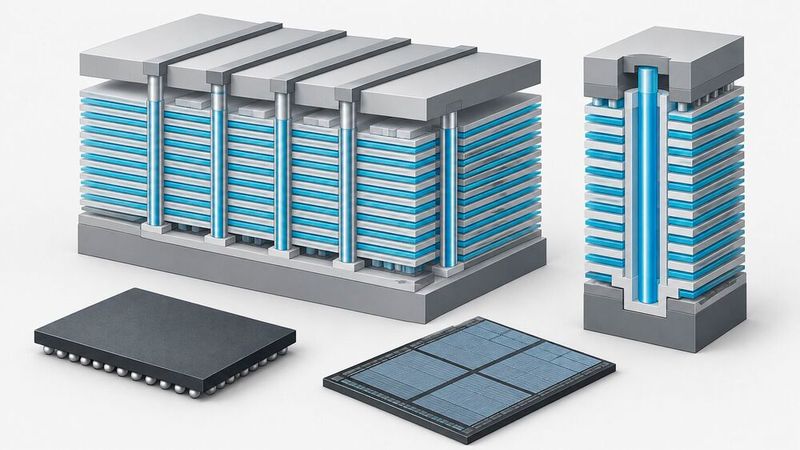
The schematic diagram shows the structure of a 3D NAND memory device with memory cells stacked on top of one another and vertical connections for high storage density.
(Image: Dall-E / AI-generated)
A Chinese memory chip manufacturer has scored its first victory in a long-running patent dispute against its U.S. competitor Micron in a Munich court. Yangtze Memory Technologies (YMTC) had filed two injunctive relief suits against Micron with the Munich I Regional Court and has now prevailed in the first instance in two out of five cases, according to the Chinese technology portal IT Zhijia.
On September 18, 2026, the Bavarian judges ruled that Micron had infringed on two German utility models held by YMTC. The court prohibited Micron from selling the affected products in Germany. However, this does not constitute a blanket ban on the sale of Micron products. Micron has filed an appeal.
“The symbolic significance is far greater than the immediate consequences for the market,” writes the Chinese trade publication Dianzi Chanpin Shijie. The patent dispute centers on technology for 3D NAND flash memory, as used in SSDs and other electronic storage media. Both sides have been locked in a legal battle for years, filing lawsuits against each other in several countries, including the U.S., the U.K., and China.
In this particular case, YMTC had accused its rival, Micron, of infringing several technical intellectual property rights with its products. The lawsuits involved patent EP 3 931 868 as well as four utility models. According to legal experts, utility models in particular are somewhat easier to challenge than patents.
The German Utility Model
“The German utility model is a special form of technical legal protection and, under German law, stands as an independent intellectual property right alongside the patent. Compared to the patent granting process, the procedure for registering a utility model is faster and more cost-effective,” IT Zhijia explained to his readers. However, the judges in Munich (Germany) had apparently examined the allegations in detail. “After nearly two full days of oral arguments, the 7th Civil Chamber, presided over by Judge Oliver Schön, ruled that two of the utility models […] were valid and had been infringed, and issued injunctions in favor of YMTC […] Micron filed an appeal against the decisions,” wrote the trade publication Juve Patent.
In China, a domestic company’s legal victory against a U.S. industry giant has understandably attracted a great deal of attention. “This is YMTC’s first significant global success in enforcing injunctive relief in court since the patent dispute between the two companies erupted in full force in November 2023. The decision concerns the following two German utility models: DE202020006166U1, titled ‘Step Structure of a Three-Dimensional Memory Device’ […] and DE202021004551U1, titled ‘Barrier Layer for Word Line Contacts in a Three-Dimensional NAND Memory’ […],” reported IT Zhijia.
The bitter battle between the two companies, which is being waged simultaneously across several continents and in numerous courtrooms, can only be understood against the backdrop of the U.S.-China “chip war.”
Did it Backfire?
As the rivalry between the U.S. and China in the high-tech sector continued to intensify, Micron had actively lobbied in Washington in the spring of 2026 for stricter export restrictions against the Chinese chip companies ChangXin Memory Technologies (CXMT), SMIC, and YMTC. Micron CEO Sanjay Mehrotra held a private roundtable discussion with members of the House Foreign Affairs Committee in March 2026, Reuters reported on April 22, citing people familiar with the matter. According to the report, the goal of the event was to make it even more difficult for Chinese companies to acquire advanced equipment for chip manufacturing.
China had long been an important market for Micron until it found itself caught in the crossfire of the U.S.-China trade and technology war in early 2023. On March 31, 2023, the Cyberspace Administration of China (CAC) announced a cybersecurity review of Micron products sold in China. The move was widely seen as a retaliatory response to Washington’s restrictions on Chinese access to key technologies. Beijing, however, portrayed it as a legitimate, fact-based cybersecurity review. In any case, Beijing had chosen Micron for its first major test case.
Date: 08.12.2025
Naturally, we always handle your personal data responsibly. Any personal data we receive from you is processed in accordance with applicable data protection legislation. For detailed information please see our privacy policy.
Consent to the use of data for promotional purposes
I hereby consent to Vogel Communications Group GmbH & Co. KG, Max-Planck-Str. 7-9, 97082 Würzburg including any affiliated companies according to §§ 15 et seq. AktG (hereafter: Vogel Communications Group) using my e-mail address to send editorial newsletters. A list of all affiliated companies can be found here
Newsletter content may include all products and services of any companies mentioned above, including for example specialist journals and books, events and fairs as well as event-related products and services, print and digital media offers and services such as additional (editorial) newsletters, raffles, lead campaigns, market research both online and offline, specialist webportals and e-learning offers. In case my personal telephone number has also been collected, it may be used for offers of aforementioned products, for services of the companies mentioned above, and market research purposes.
Additionally, my consent also includes the processing of my email address and telephone number for data matching for marketing purposes with select advertising partners such as LinkedIn, Google, and Meta. For this, Vogel Communications Group may transmit said data in hashed form to the advertising partners who then use said data to determine whether I am also a member of the mentioned advertising partner portals. Vogel Communications Group uses this feature for the purposes of re-targeting (up-selling, cross-selling, and customer loyalty), generating so-called look-alike audiences for acquisition of new customers, and as basis for exclusion for on-going advertising campaigns. Further information can be found in section “data matching for marketing purposes”.
In case I access protected data on Internet portals of Vogel Communications Group including any affiliated companies according to §§ 15 et seq. AktG, I need to provide further data in order to register for the access to such content. In return for this free access to editorial content, my data may be used in accordance with this consent for the purposes stated here. This does not apply to data matching for marketing purposes.
Right of revocation
I understand that I can revoke my consent at will. My revocation does not change the lawfulness of data processing that was conducted based on my consent leading up to my revocation. One option to declare my revocation is to use the contact form found at https://contact.vogel.de. In case I no longer wish to receive certain newsletters, I have subscribed to, I can also click on the unsubscribe link included at the end of a newsletter. Further information regarding my right of revocation and the implementation of it as well as the consequences of my revocation can be found in the data protection declaration, section editorial newsletter.
Procurement Freeze
On May 21, 2023, the CAC instructed operators of critical information infrastructure in China to stop purchasing Micron products. Officially, the agency justified this limited procurement ban by citing significant risks to national security—the same argument Washington uses to place many Chinese technology companies on its blacklists.
Since then, Micron has repeatedly filed lawsuits against YMTC, most recently on September 15, 2026, in a federal court in Idaho. Things are really heating up again. YMTC allegedly poached leading engineers from Micron, misappropriated trade secrets, and is now using against Micron—of all things—patents whose inventions, according to the U.S. company, were in part developed while the engineers were still employed by Micron, Tom’s Hardware reports on the lawsuit in Idaho.
However, Tom’s Hardware also points out that engineers switching to a competitor does not, in and of itself, prove any wrongdoing. “Engineers regularly change employers and continue to develop new inventions in their fields of expertise,” writes the American tech portal. In this bitter battle, it remains somewhat unclear to outsiders who stole what from whom and who is suing whom and why. It’s almost certain that YMTC won’t run out of money for lawyers and lawsuits against Micron anytime soon.
YMTC is predominantly state-owned. According to a stock exchange prospectus from August of this year, the four largest state-owned shareholders of its holding company hold 75.24 percent of the shares, including various state-owned investors from Hubei Province and Wuhan, as well as state-owned semiconductor funds.
Even without taking sides, it’s clear that the Chinese semiconductor industry has learned a lesson. The tactic of filing lawsuits against competitors—which U.S. companies have long employed—is now also being used by China’s NAND champion. The first such victory was just achieved in Munich. However, it will not necessarily be the last. Three additional lawsuits filed by YMTC against Micron are already pending before a court in Düsseldorf (Germany).



:quality(80)/p7i.vogel.de/wcms/68/a5/68a5ce0896756c1dcf48dbeceefafbd3/0132300990v1.jpeg "Christoph Geigges is President and CEO of Walter AG. Headquartered in Tübingen (Germany), the company is one of the world’s leading suppliers of precision tools for metalworking. Under Geigges’ leadership, this long-established company is increasingly transforming itself from a tool manufacturer into an engineering partner that supports the entire manufacturing process. (Image: Walter AG)")
:quality(80)/p7i.vogel.de/wcms/3e/7c/3e7c26f44c68545fc7318597b6b65903/0133649650v1.jpeg "The flexible Heller circular storage system can store and process pallets measuring both 630 millimeters by 630 millimeters and 800 millimeters by 800 millimeters—even in mixed-mode operation. This makes the entire production line particularly flexible. (Image:Brighter)")
:quality(80)/p7i.vogel.de/wcms/16/29/162983885950ec1df27ab441bfe88613/0133132549v1.jpeg "Bernd Hermeler is the CEO of Cemecon AG. He studied mechanical engineering at RWTH Aachen University (Germany)—the very university from which the company emerged as a spin-off 40 years ago. Today, Hermeler is responsible for the global strategy of the coating specialist, which, with branches in Europe, the U.S., China, Japan, and India, is considered the global technology leader in the coating of cutting tools. (Image: Cemecon AG)")
:quality(80)/p7i.vogel.de/wcms/af/81/af81b53cb4926dcadc20ba369a29d412/0132695968v1.jpeg "International venture capital is increasingly flowing into the machining industry. Here are the players that entrepreneurs and CEOs should keep an eye on right now. (Image: ©NDABCREATIVITY - stock.adobe.com)")
:quality(80)/p7i.vogel.de/wcms/88/dc/88dc38a1a0b5e016192ab83b0850fbd0/0133514708v1.jpeg "Scalable data sovereignty is the foundation for the transition from computationally intensive AI processing and growing data streams to sustainable, energy-efficient storage systems. (Image:Gemini / AI-generated)")
:quality(80)/p7i.vogel.de/wcms/1c/ef/1cef66e13c5cc02c5731fefcc99c00d2/0133697754v1.jpeg "Embodied AI in Industry: FMC³ Robotics combines AI-based perception and adaptation with traditional robot control to prepare robots for use in industrial manufacturing. (Image:FMC³/processed by AI)")
:quality(80)/p7i.vogel.de/wcms/db/ca/dbcae78eb8853b53fe122832fe3b2cba/0132914918v1.jpeg "Robotics in Flexible Manufacturing: As connectivity increases, so do the requirements for functional safety. (Image: Delta Electronics)")
:quality(80)/p7i.vogel.de/wcms/ea/18/ea18e84aed24bbe1c91937f30c2f7301/image1v1.jpeg "Kassow Robots' new product portfolio now includes seven 7-axis cobots. (Image: Kassow Robots (Image:)")
:quality(80)/p7i.vogel.de/wcms/90/30/90300137452b00d22f95113eff065ac3/fliehkraftkupplungen-und-bremsen-montage-centrifugal-clutches-and-brakes-assembly-1v1.jpeg "Installation: Centrifugal clutches should always be precisely matched to the machine. (Source: Amsbeck Machine Technology)")
:quality(80)/p7i.vogel.de/wcms/93/84/9384230e840a99a2015fdd3e0af11e2b/newsimage428236v1.jpeg "The crutch replicates the natural, biomechanical movement pattern of the human body. (Source: Leon Kast)")
:quality(80)/p7i.vogel.de/wcms/5b/a2/5ba21b3e5fcdd91f6bfe806f745ea723/isc-physioink-bild-3v1.jpeg "In the PhysioINK project, Fraunhofer researchers are developing bio-printing inks from the most common tissue proteins. Under the microscope, the living tissue cells (fibroblasts) are visible in the printed lattice structure: blue represents the cell nucleus, and green represents the cytoskeleton. (Source: Tobias Weigel/Fraunhofer ISC)")
:quality(80)/p7i.vogel.de/wcms/9c/16/9c16e4aa02594fe4bf82ead736562b07/directhop1-scaledv1.jpeg "Light as a feather, but without feathers: The University of Washington's robot, which weighs just one gram, uses a bionic direct-drive system to catapult itself into the air with centimeter-level precision. (Source: Mark Stone/University of Washington)")
:quality(80)/p7i.vogel.de/wcms/99/61/9961719acb89bc87fdecb1bba140481c/0133725593v1.jpeg "Ultrason (PSU, PESU, PPSU) is suitable for E&E components used in electric mobility or AI infrastructure, such as connectors for fiber-optic cables. (Image:BASF)")
:quality(80)/p7i.vogel.de/wcms/42/9b/429badd88cd4a74edb6491d10310349c/wayve-london-05v1.jpeg "Wayve is developing an AI software stack for automated driving. It appears that the Volkswagen Group has now opted for this technology. (Source: Wayve)")
:quality(80)/p7i.vogel.de/wcms/14/9f/149f934f87e5418748fa41a611586a4f/rawdon-gloverv1.jpeg "Rowdon Glover, Managing Director of Jaguar: “We are willing to accept polarization.” (Image:JLR)")
:quality(80)/p7i.vogel.de/wcms/b3/b9/b3b9b5cef51ae3708c518a48a62ea5e9/silver-front-7-8v1.jpeg "Two years ago, JLR announced a relaunch of the Jaguar brand. The Type 01 is now the first model to be unveiled. (Source: JLR)")
:quality(80)/p7i.vogel.de/wcms/1f/47/1f47da6ee12c38a745eb478a04157a65/0133726100v1.jpeg "The schematic diagram shows the structure of a 3D NAND memory device with memory cells stacked on top of one another and vertical connections for high storage density. (Image:Dall-E / AI-generated)")
:quality(80)/p7i.vogel.de/wcms/70/59/7059db055d4eeb8dea752651a071f360/geralt-handshake-4608297v1.jpeg "The deal between Schneider Electric and PTC is intended to create end-to-end data flows for the industry. (Source: )")
:quality(80)/p7i.vogel.de/wcms/67/3d/673d8f6f14bd030b53b61800a0aeb06d/0133548286v1.jpeg "Overview: If even a single critical component is missing, the entire production process can come to a standstill. Proactive procurement is intended to mitigate such bottlenecks early on. (Image:Dall-E / AI-generated)")
:quality(80)/p7i.vogel.de/wcms/b3/8d/b38d7e914a0a51c24db7e93c8a8420e2/0133672676v1.jpeg "Figure 1: Today, the AT cut is most commonly used for quartz crystals. The double-twisted SC cut further enhances the stability and aging resistance of OCXO oscillators. (Image:Q-Tech)")
:fill(fff,0)/images.vogel.de/vogelonline/companyimg/76800/76895/65.jpg "FAULHABER_120mm.jpg ()")
:quality(80)/p7i.vogel.de/wcms/bf/6f/bf6f9e5ed076475d15903669223daa4d/0132250184v1.jpeg "Infineon's CoolGaN 100 V transistor family offers high switching performance and power capacity in a compact package. (Image:Infineon)")
:quality(80)/p7i.vogel.de/wcms/bf/6f/bf6f9e5ed076475d15903669223daa4d/0132250184v1.jpeg "Infineon's CoolGaN 100 V transistor family offers high switching performance and power capacity in a compact package. (Image:Infineon)")
:quality(80)/p7i.vogel.de/wcms/19/41/194148c719692eece4e091f0caa6f63f/image1v1.jpeg "Patent Infringement Proceedings before the Unified Patent Court (Image:(UPC) is already the second case brought by Teradyne Robotics regarding intellectual property infringement in Europe in 2026. (Universal Robots)")