Decentralized Drone Control Without Mobile RadioHow Mesh Networks Help to Control Swarms of Drones
From
Sebastian Gerstl | Translated by AI
3 min Reading Time
Swarms of drones can monitor progress on large construction sites, monitor remote offshore wind farms and search for survivors of natural disasters. If several drones are used, they have so far had to be controlled centrally via mobile radio. Researchers at the Fraunhofer Institute for Integrated Circuits (IIS) are working on a decentralized, less interference-prone and more flexible solution.
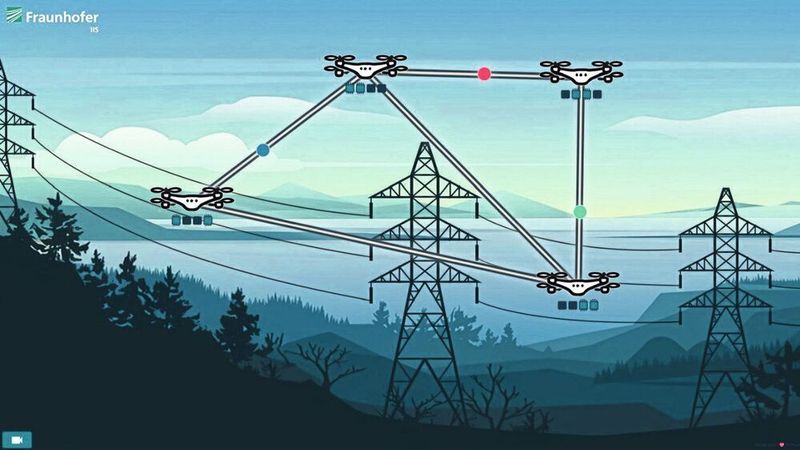
In a mesh network, several drones communicate with each other in a decentralized manner. A mobile phone mast is therefore not necessary.
(Image: Fraunhofer IIS)
Drones operating in a swarm can perform different tasks and exchange information with each other. Until now, civilian drone swarms have often been controlled centrally via a mobile phone connection. With regard to autonomous missions, the individual drones can therefore only communicate with each other in a star shape via a central node—usually a mobile phone mast. However, if this hub is damaged, for example as a result of a natural disaster, it is no longer possible for the swarm to communicate with each other. This makes it more difficult to search for survivors, for example, as the swarm can no longer work cooperatively.
Mesh Networks Enable Information Exchange in A Swarm
Researchers at the Fraunhofer Institute for Integrated Circuits IIS in Erlangen are working on a solution: "We are developing a mobile ad-hoc mesh network in which several drones are connected to each other decentrally and communicate via Bluetooth, for example," explains Dr. Manuel Schrauth, group leader in the Communication Systems department at Fraunhofer IIS. As a result, the exchange of information in the swarm is no longer star-shaped, but completely decentralize— i.e. across several nodes if necessary. "The individual drones can still exchange information with each other even if there is no external communication connection—a decisive advantage when you consider that only a fraction of the entire earth's surface has good mobile connecitivity.
So far, highly dynamic, decentralized networks have mainly been used in the military sector, where the technology is expensive, large and only suitable for heavy drones. There are still no suitable mesh networks in the ultra-low-power sector. "As the connection can run via Bluetooth, for example, our technology is very inexpensive and energy-saving," says Manuel Schrauth. "It is therefore suitable for small, lightweight drones, such as those used in the civilian sector."
The idea for the development of extremely energy-efficient ad-hoc mesh networks originated in projects of the so-called GAIA initiative: Schrauth and his team are working with an interdisciplinary consortium on satellite-based animal transmitters for vultures in Namibia that can communicate with each other in a decentralized manner. This enables the research team to analyze the animals' behaviour—and draw conclusions about environmental changes, among other things.
Constant Exchange of Information—Even Without Mobile Communications
The team is now building on this knowledge to network swarms of drones: The researchers are developing a table-based system for this purpose. The individual drones, which now act as nodes, send out so-called heartbeats, also known as advertisements in technical jargon, at regular intervals. This is comparable to Bluetooth headphones, which flash and send out the signal "I'm here" as they search for devices ready to be paired, says Schrauth.
As soon as two nodes have registered each other, they complete their respective tables: There they record which other devices have been sighted. If this process takes place every few seconds, an almost complete knowledge of the entire network can be built up. Although each individual node only has incomplete information locally, a data packet can be spread out successively, says Schrauth: "If node number one is looking for node number seven, for example, it can pass the information on to the nearest point, node two, which in turn passes it on to node three and so on. A data packet therefore winds its way through several nodes until it reaches its destination; the necessary information is assembled iteratively."
Date: 08.12.2025
Naturally, we always handle your personal data responsibly. Any personal data we receive from you is processed in accordance with applicable data protection legislation. For detailed information please see our privacy policy.
Consent to the use of data for promotional purposes
I hereby consent to Vogel Communications Group GmbH & Co. KG, Max-Planck-Str. 7-9, 97082 Würzburg including any affiliated companies according to §§ 15 et seq. AktG (hereafter: Vogel Communications Group) using my e-mail address to send editorial newsletters. A list of all affiliated companies can be found here
Newsletter content may include all products and services of any companies mentioned above, including for example specialist journals and books, events and fairs as well as event-related products and services, print and digital media offers and services such as additional (editorial) newsletters, raffles, lead campaigns, market research both online and offline, specialist webportals and e-learning offers. In case my personal telephone number has also been collected, it may be used for offers of aforementioned products, for services of the companies mentioned above, and market research purposes.
Additionally, my consent also includes the processing of my email address and telephone number for data matching for marketing purposes with select advertising partners such as LinkedIn, Google, and Meta. For this, Vogel Communications Group may transmit said data in hashed form to the advertising partners who then use said data to determine whether I am also a member of the mentioned advertising partner portals. Vogel Communications Group uses this feature for the purposes of re-targeting (up-selling, cross-selling, and customer loyalty), generating so-called look-alike audiences for acquisition of new customers, and as basis for exclusion for on-going advertising campaigns. Further information can be found in section “data matching for marketing purposes”.
In case I access protected data on Internet portals of Vogel Communications Group including any affiliated companies according to §§ 15 et seq. AktG, I need to provide further data in order to register for the access to such content. In return for this free access to editorial content, my data may be used in accordance with this consent for the purposes stated here. This does not apply to data matching for marketing purposes.
Right of revocation
I understand that I can revoke my consent at will. My revocation does not change the lawfulness of data processing that was conducted based on my consent leading up to my revocation. One option to declare my revocation is to use the contact form found at https://contact.vogel.de. In case I no longer wish to receive certain newsletters, I have subscribed to, I can also click on the unsubscribe link included at the end of a newsletter. Further information regarding my right of revocation and the implementation of it as well as the consequences of my revocation can be found in the data protection declaration, section editorial newsletter.
Task Sharing Thanks to Decentralized Communication
According to Schrauth, communication in the swarm will later feel like a one-to-one connection for the users. In practice, thanks to the new technology, several drones could automatically take off from a suitcase in the future, form a given formation in the mesh network, thereby increasing the range of the swarm and using their different technical strengths to create a three-dimensional map, for example.
The researchers have already shown that the technology works in a simulation, and now they want to transfer it to commercial hardware. Studies are currently underway in the laboratory with Bluetooth devices that process data across multiple nodes.
The project group is expected to present a prototype of the technology next year, and Manuel Schrauth and his team will be showing initial results at this year's ILA.(sg)



:quality(80)/p7i.vogel.de/wcms/43/bc/43bcc092db07947d7f240564e7d8549d/0133068647v1.jpeg "The C80 Giga inductive coupling system from SMW transmits power up to 75 W—and signals in real time at speeds of up to 1 GBit/s. (Image:SMW-Autoblok / SMW-electronics)")
:quality(80)/p7i.vogel.de/wcms/bd/b6/bdb6acbb7eafcbb21fcf66f8835ccb6d/0132925320v1.jpeg "Kyocera's MG90B Series (Image:Kyocera)")
:quality(80)/p7i.vogel.de/wcms/99/1e/991e3f401bd9a889b80c6b92506ecdf5/0132465976v1.jpeg "Above the gearbox is a stainless steel sealing flange designed to house the mechanical seal, which seals the agitator shaft. (Image:SEW)")
:quality(80)/p7i.vogel.de/wcms/90/2e/902e0c106fab72846b830855de1d4c4e/0113143253v1.jpeg "In our China Market Insider, we regularly provide you with relevant information straight from China. (Image:© Eisenhans - stock.adobe.com)")
:quality(80)/p7i.vogel.de/wcms/a2/11/a211bcc07ec547e0fa37965a078802a3/newsimage426357v1.jpeg "As part of the “AgriLoop” project, researchers at the University of Bonn are developing a system designed to control greenhouse robots using natural language and to map plant populations in three dimensions. (Source: University of Bonn)")
:quality(80)/p7i.vogel.de/wcms/bc/2d/bc2d1a3291bcdf3d41ae2088fbcaccd1/0133075989v1.jpeg "Universal Robots' parent company is suing Jaka for patent infringement (Image:Universal Robots)")
:quality(80)/p7i.vogel.de/wcms/54/fa/54fa8fce526b3ab8b00500a06498c7f8/image1v1.jpeg "Humanoid robot Figure 03 in action at the BMW Group plant in Spartanburg. (Image:BMW Group)")
:quality(80)/p7i.vogel.de/wcms/95/fa/95fa92bf59ac4f0a72d6962b7c319ffb/0132527275v1.jpeg "Tom Terlouw from the Paul Scherrer Institute PSI and his team investigated around 13,000 scenarios for the climate-friendly production of ammonia, the basic component of fertilizers. (Image:Mahir Dzambegovic/Paul Scherrer Institute)")
:quality(80)/p7i.vogel.de/wcms/aa/a5/aaa5d3c9a3e218667238db24730422dc/4--sonderteile-aus-nichtrostendem-edelstahl-verbindungstechnikv1.jpeg "In safety- and performance-critical designs, when using fasteners made of stainless steel, geometry, the manufacturing process, and operational loads—in addition to the material and corrosion resistance—play a crucial role in ensuring the safe design of the bolted joint. (Source: Güldner Screws)")
:quality(80)/p7i.vogel.de/wcms/24/91/24913072af80d22b62dffcec62e836de/tcartdesign-snails-757436v1.jpeg "An ordinary garden snail produces an astonishing variety of mucus types using just one molecular building block. (Source: TCartdesign)")
:quality(80)/p7i.vogel.de/wcms/6e/ea/6eea0f7b13ed25685b67b4741883df7a/drohnev1.jpeg "Multi-Jet Fusion is frequently used for drone components because this process offers high mechanical strength and durability while also enabling the production of complex geometries that are difficult to achieve using conventional manufacturing methods. (Source: Protolabs)")
:quality(80)/p7i.vogel.de/wcms/aa/96/aa96adace3d0396e169f3da7f7c9b85e/adobestock-107687632--dennisjacobsen-stock-adobe-comv1.jpeg "Electric eels have three electric organs that allow them to deliver electric shocks with voltages of up to 860 volts (illustration). (Source: dennisjacobsen - stock.adobe.com)")
:quality(80)/p7i.vogel.de/wcms/f5/bc/f5bc380a5039e96c0133de620f5631f7/0133092230v1.jpeg "Chinese automaker BYD is engaging in a fiercer price war on the German market when it comes to sales of plug-in hybrids ... (Image:BYD)")
:quality(80)/p7i.vogel.de/wcms/68/e0/68e0cbb0e8bb537d593c524a81960213/0133037427v1.jpeg "In the coming years, Hyundai plans to step up its efforts, particularly with electric cars such as the Ioniq V, which was developed specifically for China. (Image:Hyundai)")
:quality(80)/p7i.vogel.de/wcms/81/31/81317bbc8be30332955ca435d55956e2/0133006538v1.jpeg "With the Nebula NEXT 01 JET Edition, Dreame presented an electrically powered hypercar with an additional rocket drive. According to Chinese media reports, the company has now largely scaled back its plans for commercial vehicle production. (Image:freely licensed)")
:quality(80)/p7i.vogel.de/wcms/e3/fb/e3fb490c8bcc4cc2e7976fe93ef3bad6/continental-zevra-tire--4v1.jpeg "The \"ZEvRA\" concept tire consists of approximately 43 percent recycled materials. (Source: Continental)")
:quality(80)/p7i.vogel.de/wcms/c5/77/c577c047d3ace675bbc29b1efa4a1050/0133057123v1.jpeg "Figure 1: Typical 2-level DC/DC topology. (Image:Renesas)")
:quality(80)/p7i.vogel.de/wcms/6c/0e/6c0eb42cb3976de378d71ae272745b61/0133056789v1.jpeg "We pay for systems that take over human labor without having yet determined how the resulting value created will be distributed in the future. (Image:freely licensed)")
:quality(80)/p7i.vogel.de/wcms/2a/2f/2a2fc1bb2a6941d1e5c795c047c969ce/0132945015v1.jpeg "Developers at the lab workplace: For WBG-based power converters and highly dynamic loads, precise efficiency and loss analysis require the time-synchronized acquisition of electrical, transient, and thermal parameters. (Image:Yokogawa)")
:quality(80)/p7i.vogel.de/wcms/61/54/6154ff60caffd4552fcdeb45e4dc72b2/0132962188v1.jpeg "Using optical coherence tomography (OCT), high-resolution cross-sectional images of the retina and cornea with a resolution of a few micrometers can be created. However, the demands on the necessary computing power of industrial PCs are high. (Image:freely licensed)")
:quality(80):fill(efefef,0)/p7i.vogel.de/wcms/67/ad/67adf92d254d2/elatec-wp-smart-factory.png "Elatec WP Smart Factory")
:quality(80)/p7i.vogel.de/wcms/86/e0/86e09ea9c278d112c55b995b843abfee/0130494578v1.jpeg "PV system on the roof of the Elbfabrik, a Fraunhofer IFF research factory. A sensor system can detect faults in large-scale PV systems at an early stage. (Image:Fraunhofer IFF/Anne Bornkessel)")
:quality(80)/p7i.vogel.de/wcms/33/4a/334a40bdce62798bd6eb90957e222d6a/0130085649v1.jpeg "From hardware manufacturer to software provider: Neocortec is increasingly licensing its NeoMesh protocol stack directly to OEMs and third-party manufacturers instead of relying exclusively on selling its own radio modules. (Image:mc/VCG)")