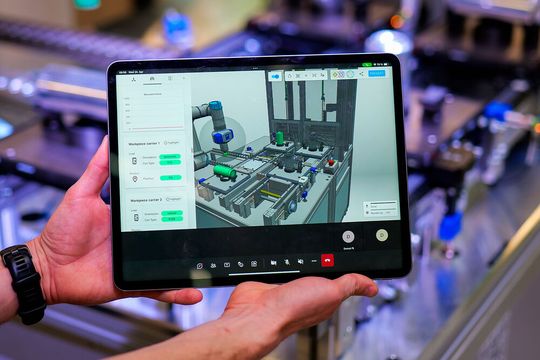
Digital twins and 3D streaming open up new opportunities in the industry by elevating data management and collaboration to a new level. These technologies are thus changing the way modern processes are designed.
Digital twins and 3D streaming enable efficient real-time processing, promote direct collaboration, and reduce costs in the industry.
(Image: Threedy GmbH)
Christian Stein is CEO & Co-Founder of Threedy GmbH.
Physical and virtual worlds are increasingly merging in applications such as digital twins. Complex processes can be simulated, monitored, and controlled in real-time. Augmented Reality (AR) enables intuitive, visual support for complex tasks—from production to maintenance to training. The technology promises greater efficiency, higher precision, a broader range of applications, and increased productivity with fewer errors. The foundation is data, specifically progressive, hyper-connected data, which is stored in a distributed manner. They originate, for example, from the Internet of Things (IoT) or systems like CAD and PLM (Product Lifecycle Management). This shifts the central focus in industrial production away from CAD towards the visualization of connected 3D data.
Challenges in Using Industrial 3D Data
The status quo in the use of industrial 3D data still corresponds to the 1990s. Complex 3D models must first be laboriously exported from their original systems in the form of documents or converted for exchange, thus requiring long download and loading times, offering poor visualization performance, and collaboration takes place accordingly via email, PowerPoint, or screenshots. In addition, dozens of different proprietary formats and thousands of tools exist. For broader use, 3D data often has to be exported from its "single source of truth," resulting in correspondingly inferior output: there is a lack of data quality and depth, and metadata related to components is often completely lost.
Ultimately, with an incorrect focus on aesthetics and immersion, the data depth is further reduced. However, for the industrial end-user, this data depth is precisely what is relevant, as it is the only way to implement typical applications such as DMU (Digital Mock-Ups) or immersive mixed-reality applications in design or aftersales and service. Instead, the accurate assignment of data and its informational depth are particularly important. Another challenge lies in the fact that 3D data and the associated metadata often do not correspond with information from other third-party systems. For example, the integration of CAD and ERP information often fails solely due to different nomenclatures for individual components and groups. This makes the integration of information highly complex.
Virtualize And Stream 3D Data
Industrial data is characterized by heterogeneity—there is no single format that can harmonize all information from all data sources. Therefore, an approach that is capable of handling this heterogeneity is sensible, instead of aiming for format-based standardization. The solution lies in virtualizing or abstracting 3D data and its processing and streaming it "on demand." Live links then lead to the data sources of the original systems. Threedy GmbH, a spin-off of the Fraunhofer Institute for Computer Graphics Research (IGD) in Darmstadt (Germany), has developed the visual computing infrastructure component Instant 3D Hub over the past ten years. In collaboration with renowned car manufacturers such as BMW and Mercedes-Benz, this development aims to process and display 3D data more efficiently and seamlessly.
The approach is comparable to standard software for web-based applications such as Google Maps: the information is not stored on the end device but is provided as a stream on demand. The application continuously pulls relevant information based on user interest and dynamically connects the heterogeneous data. This is now being made possible with industrial 3D data for a wide range of application areas.
Integration of Data Without Changing the Single Source of Truth
It's not about pre-harmonizing data or standardizing the data storage base to create yet another platform as a "single source of truth." Instead, the goal is to enable and accelerate the consumption of data in any 3D and mixed reality applications. The data remains unchanged in the source systems. No copies are generated, and no separate preparation for specific solutions takes place. Explicit conversions and uploads are eliminated. Instead, the merging of all data formats creates a true multi-CAD environment, allowing users with different CAD systems to collaborate, for example, to speed up the exchange of data and ideas during various development phases. Long loading times—up to 20 minutes or more for complex models—are eliminated, as rendering happens in real-time within a few seconds, and the current model data can be worked on at any time. This enables live collaboration without separate data provisioning.
Such a system, which allows networking and consumption at the latest possible moment, provides the flexibility to make complex, distributed 3D data available to users. The user can work in virtual data spaces tailored to their work situation—having all necessary information immediately at hand, across data types, storage formats, and system boundaries. The 3D data space is available to any applications in parallel: whether it be R&D, engineering, marketing and sales, manufacturing, quality assurance, operations, or after-sales.
Date: 08.12.2025
Naturally, we always handle your personal data responsibly. Any personal data we receive from you is processed in accordance with applicable data protection legislation. For detailed information please see our privacy policy.
Consent to the use of data for promotional purposes
I hereby consent to Vogel Communications Group GmbH & Co. KG, Max-Planck-Str. 7-9, 97082 Würzburg including any affiliated companies according to §§ 15 et seq. AktG (hereafter: Vogel Communications Group) using my e-mail address to send editorial newsletters. A list of all affiliated companies can be found here
Newsletter content may include all products and services of any companies mentioned above, including for example specialist journals and books, events and fairs as well as event-related products and services, print and digital media offers and services such as additional (editorial) newsletters, raffles, lead campaigns, market research both online and offline, specialist webportals and e-learning offers. In case my personal telephone number has also been collected, it may be used for offers of aforementioned products, for services of the companies mentioned above, and market research purposes.
Additionally, my consent also includes the processing of my email address and telephone number for data matching for marketing purposes with select advertising partners such as LinkedIn, Google, and Meta. For this, Vogel Communications Group may transmit said data in hashed form to the advertising partners who then use said data to determine whether I am also a member of the mentioned advertising partner portals. Vogel Communications Group uses this feature for the purposes of re-targeting (up-selling, cross-selling, and customer loyalty), generating so-called look-alike audiences for acquisition of new customers, and as basis for exclusion for on-going advertising campaigns. Further information can be found in section “data matching for marketing purposes”.
In case I access protected data on Internet portals of Vogel Communications Group including any affiliated companies according to §§ 15 et seq. AktG, I need to provide further data in order to register for the access to such content. In return for this free access to editorial content, my data may be used in accordance with this consent for the purposes stated here. This does not apply to data matching for marketing purposes.
Right of revocation
I understand that I can revoke my consent at will. My revocation does not change the lawfulness of data processing that was conducted based on my consent leading up to my revocation. One option to declare my revocation is to use the contact form found at https://contact.vogel.de. In case I no longer wish to receive certain newsletters, I have subscribed to, I can also click on the unsubscribe link included at the end of a newsletter. Further information regarding my right of revocation and the implementation of it as well as the consequences of my revocation can be found in the data protection declaration, section editorial newsletter.
Dynamic Information Provision for Work Instructions
A classic use case in the industrial environment with augmented reality involves work instructions. Visualization in 3D enables a high level of detail as well as better understanding and faster information acquisition. This is essential, as components are becoming increasingly smaller and it is often not immediately apparent where they are located or where a specific tool needs to be applied. Additionally, there is the variety of vehicle configurations and machine variants, for example. This variability in production results in enormous volumes of data for the instructions, which not only have to be generated but also stored and made available to the employee.
For example, a major automobile manufacturer from southern Germany is the first in the world to use original CAD data for real-time 3D models and AR in service. This ensures that a digital twin of the respective configuration is always available—including interactive work instructions. The worker scans the vehicle identification number (VIN) and receives a work instruction tailored precisely to the data status of the car they are working on. The basis is the original parts list. This provides the full quality of the information created in design and engineering to generate dynamic work instructions—perfectly matched to the respective situation, from the worker to the service. The employee receives the necessary information immediately. They no longer need to laboriously search for it in pre-published documents or load it onto a device, as the work instruction is no longer historical information produced at an earlier point in time. The interactive work instruction reduces the effort required for the generation and preparation of documentation materials and the publication process. Work processes can thus be carried out with higher quality and fewer errors.
This seamlessly connects to further training and upskilling: the worker does not need to be trained in all possible manufacturing scenarios and various product variants. Through interactive guidance, they learn directly in practice on the respective tasks. This reduces training efforts, and the provisioning process for the instructions can be automated. Efforts for data integration, publication, updating, storage in data management systems, their maintenance, and a search function are eliminated.
Factory of the Future
Another use case for virtualized 3D data and dynamic information flows is the factory of the future: its digital twin accesses real-time IoT data such as sensor information and combines connectivity with 3D and XR (Extended Reality). The information is dynamically available in real time. The virtual factory can simulate how changes will affect operations. Long-term data collection in production allows identifying the causes of problems, for instance, when damages such as scratches occur on a specific model or at a specific time. Cluster-related issues, such as error frequencies, can be particularly clearly visualized through so-called heatmaps in the 3D model. This virtual representation of production requires high data dynamics: the overall volume of data is so substantial that companies must know precisely which information they need and how this can be networked end-to-end for automation.
Such a digital twin therefore requires a lot of groundwork—companies face the challenges of first building competencies, establishing foundational technologies, and bridging the gap between IT and OT (operational technology). There is a lack of technological maturity to serve and network various data sources, especially given different data management environments and formats. The virtual factory is the future of manufacturing, but it is technically complex and will mean a significant change for the working world—in terms of processes, but also in terms of compliance and documentation.
A Challenge that Brings Great Opportunities
The digital twin can be used as an application not only at all stages of the product lifecycle—from design to manufacturing to after-sales—but also to virtualize entire factories. Companies benefit from greater efficiency and reduced efforts. For this, technology is needed that enables flexible data integration and 3D data streaming: for maximum flexibility, timeliness, and dynamism.



:quality(80)/p7i.vogel.de/wcms/57/3e/573e5f8be45ba0d96122888a75ee68c0/0132000673v1.jpeg "EU Economic Affairs Commissioner Valdis Dombrovskis, speaking in the context of a reform of corporate tax rules, promises: “Our proposals for tax simplification include changes that will make life easier for businesses.” Read more here ... (Image:EU)")
:quality(80)/p7i.vogel.de/wcms/5b/99/5b99952e2dabf8632a55cfb60394c123/0131999764v1.jpeg "Billions are at stake! The preliminary proceedings for a project involving the construction of several cruise ships (stock photo) to be built by Meyer Werft and MSC are well underway ... (Image:Meyer Shipyard)")
:quality(80)/p7i.vogel.de/wcms/1f/8c/1f8cd24f2125a5bde27edde12d055d4b/0132000259v1.jpeg "No launch! Rheinmetall had hoped to land a contract for six F126-class frigates as a maritime construction project. But the federal government has now put a stop to the whole thing. Rheinmetall’s stock price dropped a bit further. Meanwhile, TKMS is now celebrating a government contract... (Image:dpa)")
:quality(80)/p7i.vogel.de/wcms/76/d4/76d453c828381481dcda836dfe11685e/0131992071v1.jpeg "The Profimill 3 from Waldrichsiegen has claimed the top spot as the largest machining system in the world. Read here what it can do and who the next three machining giants are... (Image: Waldrichsiegen)")
:quality(80)/p7i.vogel.de/wcms/12/c6/12c6bb1b6dbcdd48fd89da058cf5c80e/0131939666v1.jpeg "Libra is expected to process more than 256 corrected logical qubits and enable approximately one million reliable logical quantum operations. As part of an expanded collaboration with AWS, the system is expected to be available in the cloud via Amazon Braket starting in 2028. (Image:QuEra)")
:quality(80)/p7i.vogel.de/wcms/5f/a0/5fa0f04f647c40da140fceb082a72c86/0131975563v1.jpeg "After nine years, China has once again managed to dethrone the U.S. leader in supercomputing. The Lineshine supercomputer was the fastest of all in a standardized test ... (Image:Shuangong)")
:quality(80)/p7i.vogel.de/wcms/20/05/200513bd2a5145cc89ea9a1633b51abb/0131969098v1.jpeg "With the release of RealSource, RealMan Robotics aims to break down data silos and advance research in the field of AI-powered robot control. (Image:RealMan)")
:quality(80)/p7i.vogel.de/wcms/f1/e0/f1e0762012ba63607bd0ee537ef4db7a/bild1-phoenix-20contact-00167373-full-b5000v1.jpeg "The driverless transport systems (DTS) or automated guided vehicles (AGVs) used in intralogistics must meet one essential requirement: they should operate safely, quickly, and interoperably within the existing infrastructure. (Image: Phoenix Contact)")
:quality(80)/p7i.vogel.de/wcms/2d/da/2ddacc61c32608e3404dff7e9b102f7f/0131807833v1.jpeg "UCS housing with heat sink and heat spreader. (Image: Phoenix Contact)")
:quality(80)/p7i.vogel.de/wcms/9d/0c/9d0cde767c99aa00f527de1a7b0904f5/voss-evtech-2026v1.jpeg "Voss Automotive showcased, among other things, a liquid-cooled charging cable system and a thermal management system in a simulated passenger car application at the dual trade fair EVTech/The Battery Show. (Source: )")
:quality(80)/p7i.vogel.de/wcms/f1/dd/f1dd997329564af5537dc412cc205bd7/0131954184v1.jpeg "At Innovent Technology Development in Jena, it has been demonstrated that atmospheric pressure plasma can be used to clean copper (as shown here) and silver surfaces of oxides and sulfides— without harsh chemicals and with minimal energy consumption... (Image: Innovent)")
:quality(80)/p7i.vogel.de/wcms/0b/ff/0bffa42ea605978169d5e25eedb2c1ee/0131826953v2v1.jpeg "In the picture: from right to left, Pascale Herman, Christophe Delhovren, Antoine de Ryckel, Olivier de Laet. They intend to work together in the future. (Image:Valeo)")
:quality(80)/p7i.vogel.de/wcms/c5/97/c5970168e6bc3c0538715b5071836637/homelink-20console-2560x1439v1v1.jpeg "Gentex integrates Home Link into its rearview mirrors. Automakers can also integrate the supplier's product into their infotainment systems. (Image:Gentex)")
:quality(80)/p7i.vogel.de/wcms/7f/81/7f8112067de570333f3a730b9ed72a26/iaa-20mobility-202025-jf-1-01491-7953x4471v1v1.jpeg "\"AITO\" is the joint automotive brand of Seres and Huawei. With this new brand, Seres is seeking to become more independent from the electronics conglomerate. (Image:VDA/IAA Mobility)")
:quality(80)/p7i.vogel.de/wcms/a1/87/a187d1463ebbed0941233bc14bdde451/0131954862v1.jpeg "A new high-performance dispenser is now included with the Alpitronics HYC1000. (Image:Alpitronic)")
:quality(80)/p7i.vogel.de/wcms/f1/c3/f1c3428d7076590511abe1fb7c9f5bac/lucid-20uber-20nuro-20houston-201v1.webp "Lucid is currently testing its robotaxis in San Francisco and Houston with safety drivers on board. (Image: Lucid Motors)")
:quality(80)/p7i.vogel.de/wcms/3d/69/3d69a2ac15675566050d304cbb7c595a/0132006001v1.jpeg "The productivity paradox: AI speeds up code development, but according to GitLab’s AI Accountability Report, control, traceability, and governance are becoming the new bottleneck in the software delivery process. (Image:Dall-E / AI-generated)")
:quality(80)/p7i.vogel.de/wcms/98/c8/98c8d760f4a3a26c39d5ee61a3fc61d5/0131983597v1.jpeg "SanDisk goes beyond HBM: A U.S. patent reveals the direct connection of a processor to a NAND stack array, with HBM stacks on a shared interposer. (Image:U.S. Patent and Trademark Office / SanDisk)")
:quality(80)/p7i.vogel.de/wcms/44/7d/447da8981c8d2fa36153b34ac87929f5/0131993774v1.jpeg "When copper and aluminum reach their limits, composite material solutions come into play. At the Power of Electronics conference, Dr. Björn Reetz will speak about the potential of special alloys and metal composites. (Image:Materion)")
:quality(80)/p7i.vogel.de/wcms/41/26/4126391b01560b66d9409c831256e97e/0131986045v1.jpeg "Symbolic image: An autonomous mini-robot maps the environment. (Image:AI-generated)")
:fill(fff,0)/images.vogel.de/vogelonline/companyimg/76800/76895/65.jpg "FAULHABER_120mm.jpg ()")
:fill(fff,0)/p7i.vogel.de/companies/69/88/69882c428938e/tmts2026-ticec-banner-en-2000px.png "tmts2026-ticec-banner-en-2000px (https://www.tmts.tw/en)")
:fill(fff,0)/p7i.vogel.de/companies/69/de/69de1b7403b0d/simtos-logo.jpeg "simtos-logo (SIMTOS)")
:quality(80)/p7i.vogel.de/wcms/28/a2/28a2e71cd1e9daaeba5ca4112060da8a/0123736082v1.jpeg "OI4 sees the solution for the digital industry in digital twins, based on the asset administration shell. (Image:redflower - stock.adobe.com / AI-generated)")
:quality(80)/p7i.vogel.de/wcms/9b/0b/9b0b36b44295aec66449dc602f0db193/0127926769v1.jpeg "During ongoing operations, the digital twin becomes the central \"hub\" for process understanding. (Image:Hexagon)")
:quality(80)/p7i.vogel.de/wcms/ab/82/ab82dfd86fd624854af173066cfacea5/0129154593v1.jpeg "The digital Mycelium Lifecycle Platform supports production managers in operating their machines safely, securely, efficiently, and in compliance with standards throughout their entire lifecycle. It combines the management of personnel and machines on a single platform. (Image:Pilz GmbH & Co. KG)")