In our "Fascination with Technology" section, we present impressive research and development projects to engineers every week. Today: Freely movable wing tips made of fiber-reinforced composites inspired by the Venus flytrap.
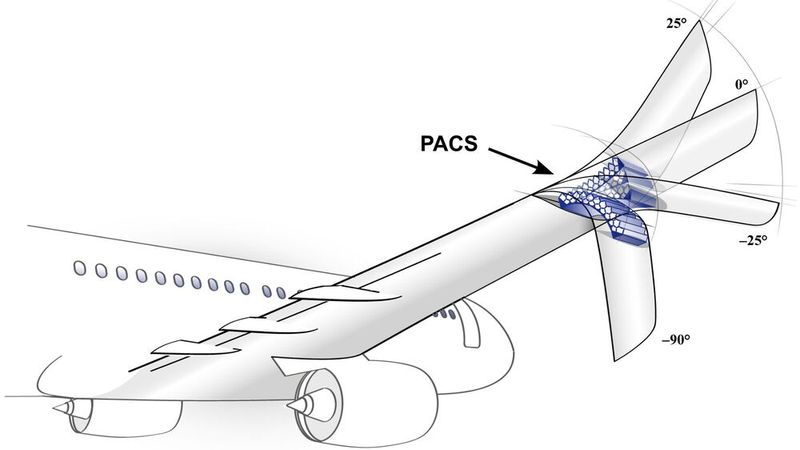
Inspired by the Venus flytrap: Innovative foldable wing tips, woven using Dornier's 3D weaving technology, could contribute to more sustainable aviation in the future.
(Image: TU Braunschweig)
Long wings with foldable tips can reduce aircraft fuel consumption and make aviation more sustainable. An interdisciplinary research team has now developed a new solution inspired by the Venus flytrap: freely movable wing tips made of fiber-reinforced composites, manufactured using innovative 3D weaving technology.
Longer aircraft wings can increase the efficiency and sustainability of commercial airplanes by reducing drag and thus lowering fuel consumption. The problem: aircraft with long wings face spatial limitations at airports, such as on taxiways or at gates. "That's why we simply fold the wingtips upward," says Dr. Patrick Meyer, former research associate at the Institute of Mechanics and Adaptronics at TU Braunschweig (Germany) until July and now a development engineer at Lufthansa Technik since August.
By using pressure-controlled actuators with adjustable mechanical properties, wingtips could become multifunctional control surfaces.
Dr. Patrick Meyer
The idea of foldable wingtips is not new: Boeing, for example, uses foldable wingtips on the ground for its latest model, the 777X. Airbus is also working on movable wingtips. However, according to Meyer, the concept of foldable wingtips holds even more potential: "By using pressure-controlled actuators with adjustable mechanical properties, wingtips could become multifunctional control surfaces." The inspiration for this came from nature.
Gallery
Carnivorous Plant As A Model
In principle, the Venus flytrap functions like a hydraulic system: when an insect enters the trap, the plant closes its leaves within fractions of a second by precisely altering the pressure in its cell walls. These so-called nastic movements form the basis of "PACS" (Pressure-Actuated Cellular Structures) —a relatively new technology that, according to Meyer, is primarily based on research conducted at TU Braunschweig (Germany) and the German Aerospace Center. Meyer explains: "PACS is essentially the technical replication of the Venus flytrap's mechanics and brings exactly the properties that robust yet easily movable wingtips require." To implement the PACS concept for his idea of controllable wingtips, Meyer teamed up with textile researcher Dr. Michael Vorhof from the Institute of Textile Machinery and Textile High-Performance Materials Technology at TU Dresden. "Plants are made of fibers—if you want to copy them, you have to replicate their complex, fiber-based structure," explains Vorhof.
3D Weaving As A Pioneer for Sustainable Aviation
To translate the complex structure and mechanics of the Venus flytrap into a woven and flexible wingtip that can bend through pressure changes, Vorhof used a weaving machine from the machinery manufacturer Lindauer Dornier, which celebrates its 75th anniversary this year. "The robust design, composite-suitable configuration, and high precision of the Dornier weaving machine played a crucial role in implementing the complex fiber structure required for PACS," says Vorhof. The woven semi-finished products consist of glass fiber and polyamide threads and are melted into a fiber-reinforced plastic component in a thermoforming press. "This is significantly cheaper than using an autoclave," adds Vorhof. Aeroelastic analyses on a Cessna Citation model show that the nature-inspired woven lightweight wingtip can bear the loads experienced during flight and can move up and down within seconds.
Development Recognized With Peter Dornier Foundation Award
For their joint research work as part of two dissertations, the doctoral duo from aerospace and textile engineering was awarded the Peter Dornier Foundation Prize 2025, each receiving $5,500 USD. During the award ceremony at the Lindauer Dornier Weaving Technology Center, curators Dr. Bernd Sträter and Dr. Adnan Wahhoud emphasized the significance of the work: "These are two outstanding dissertations that utilize well-known process parameters of Dornier's modern 3D weaving technology to develop practical applications related to current advancements in aircraft construction for more sustainable aviation."
Peter D. Dornier, son of the founder and responsible for the foundation prize on the advisory board of the Peter Dornier Foundation, emphasized in his speech to the approximately 120 guests: "My father would have greatly appreciated the interdisciplinary research work, as it builds on two of his core areas of interest: aircraft construction and textile technology." With his groundbreaking ideas, the founder of Lindauer Dornier shaped both fields—for example, through the development of the positively controlled rapier weaving machine and its delivery to French glass and carbon weavers, who used it early on to manufacture fiber-reinforced aircraft components.
Future of Foldable Wings
The two young researchers expressed their gratitude during the award ceremony in Lindau, Germany: "It is a great honor for us to receive the Peter Dornier Foundation Prize, as it connects textile innovations with aviation and recognizes interdisciplinary research like ours," said Meyer, who conducted research flights in a Dornier Do 128 as part of his studies. To further develop the concept, the institutes of the award winners are planning follow-up projects as well as the construction of the first prototypes. "If everything goes well, our technology could be used in the generation after next of aircraft," the two award winners cautiously estimated.
Date: 08.12.2025
Naturally, we always handle your personal data responsibly. Any personal data we receive from you is processed in accordance with applicable data protection legislation. For detailed information please see our privacy policy.
Consent to the use of data for promotional purposes
I hereby consent to Vogel Communications Group GmbH & Co. KG, Max-Planck-Str. 7-9, 97082 Würzburg including any affiliated companies according to §§ 15 et seq. AktG (hereafter: Vogel Communications Group) using my e-mail address to send editorial newsletters. A list of all affiliated companies can be found here
Newsletter content may include all products and services of any companies mentioned above, including for example specialist journals and books, events and fairs as well as event-related products and services, print and digital media offers and services such as additional (editorial) newsletters, raffles, lead campaigns, market research both online and offline, specialist webportals and e-learning offers. In case my personal telephone number has also been collected, it may be used for offers of aforementioned products, for services of the companies mentioned above, and market research purposes.
Additionally, my consent also includes the processing of my email address and telephone number for data matching for marketing purposes with select advertising partners such as LinkedIn, Google, and Meta. For this, Vogel Communications Group may transmit said data in hashed form to the advertising partners who then use said data to determine whether I am also a member of the mentioned advertising partner portals. Vogel Communications Group uses this feature for the purposes of re-targeting (up-selling, cross-selling, and customer loyalty), generating so-called look-alike audiences for acquisition of new customers, and as basis for exclusion for on-going advertising campaigns. Further information can be found in section “data matching for marketing purposes”.
In case I access protected data on Internet portals of Vogel Communications Group including any affiliated companies according to §§ 15 et seq. AktG, I need to provide further data in order to register for the access to such content. In return for this free access to editorial content, my data may be used in accordance with this consent for the purposes stated here. This does not apply to data matching for marketing purposes.
Right of revocation
I understand that I can revoke my consent at will. My revocation does not change the lawfulness of data processing that was conducted based on my consent leading up to my revocation. One option to declare my revocation is to use the contact form found at https://contact.vogel.de. In case I no longer wish to receive certain newsletters, I have subscribed to, I can also click on the unsubscribe link included at the end of a newsletter. Further information regarding my right of revocation and the implementation of it as well as the consequences of my revocation can be found in the data protection declaration, section editorial newsletter.



:quality(80)/p7i.vogel.de/wcms/ef/08/ef08922ce5a15207a9775d5065527250/0132599857v1.jpeg "What you see here is the innovative WAAM system called Arctitan from Gefertec. With it, high-quality titanium components can finally be additively manufactured under consistent process conditions, as the manufacturer promises. (Image: Gefertec)")
:quality(80)/p7i.vogel.de/wcms/66/fa/66fa3238dd2624ae644a3ba871438757/0113143253v1.jpeg "In our China Market Insider, we regularly provide you with relevant information directly from China. (Image:© Eisenhans - stock.adobe.com)")
:quality(80)/p7i.vogel.de/wcms/2f/8e/2f8efba2743cc71567635b4b6da51db1/0132526560v1.jpeg "At Hofele Blechbearbeitung in Donzdorf, three solid-state laser cutting machines from Trumpf are in operation. Naturally, disturbing slag repeatedly accumulates on the support tables. That's why the family-owned company frequently relies on efficient Trumpf cleaning systems. (Image:Trumpf)")
:quality(80)/p7i.vogel.de/wcms/b2/d6/b2d642c4249639edcca6f7b4b8bee00b/0132537120v1.jpeg "At TIR Technologies in Kilsett near Strasbourg, around 3,500 tons of aluminum profiles are processed into sun protection systems each year. To ensure this is done economically and efficiently, they rely on two Kasto systems: the Unigrip honeycomb storage and Kastofenestra aligne. (Image:Kasto)")
:quality(80)/p7i.vogel.de/wcms/e3/a4/e3a44159531a41ac69f308a3b356fa9e/image1v1.jpeg "The dynamic guidance system LARS projects information directly onto the warehouse floor using laser projection. (Image:Fraunhofer IML)")
:quality(80)/p7i.vogel.de/wcms/2f/2a/2f2ac048a0e03f535795d2b3e05c44c1/0132582608v1.jpeg "If the future storage and material flow structure of a plant site needs to be planned, the digital planning twin can demonstrate whether the structure works even under peak loads or with a changed product mix. (Image:AI-generated)")
:quality(80)/p7i.vogel.de/wcms/78/76/7876189b22214d51effdfbbf244359ad/0132477485v1.jpeg "GenAI helps engineers process unstructured data from device logs and service records and improve predictive maintenance workflows. (Image: MathWorks)")
:quality(80)/p7i.vogel.de/wcms/9a/d8/9ad8c665b3bef8b84e39bb6d27bd1251/0132564098v1.jpeg "Humanoids as a threat to national security? Trump sees it that way and bans foreign robots. (Image:Gemini / AI-generated)")
:quality(80)/p7i.vogel.de/wcms/84/2b/842b528802ab7fb92be95e089d9f5777/csm-wabenstruktur-2026-07-20-jm-855955b94dv1.png "Bionically inspired honeycomb structures with gradually arranged fiber angles made from regenerated cellulose fibers. These lightweight structures could contribute to more sustainable safety components in the future. (Source: © HSB - AG Biologische Werkstoffe)")
:quality(80)/p7i.vogel.de/wcms/f5/e6/f5e67d094c9ff528802907f2986c175f/0132631344v1.jpeg "Graphite electrodes for batteries consist of natural and synthetic graphite. Both materials will be in increasingly high demand in the future. That’s why projects, such as those by International Graphite and Westwater, are already in the starting blocks to seize the opportunity... (Image: International Graphite)")
:quality(80)/p7i.vogel.de/wcms/f3/52/f3528ec89133ba7f1d5dde2fcfbf3f17/0132538728v1.jpeg "A titanium component produced at the Austrian Institute of Technology (AIT) in Ranshofen using a completely new forming method. Read here about the economic and technical advantages for titanium components that this could bring for the future... (Image:AIT / Joh. Zinner)")
:quality(80)/p7i.vogel.de/wcms/21/03/21032b49e5f946f0cd13eeeef2f3cfed/franke-drehverbindung-materialmix-freiv1.png "Possible materials for the housings of wire race bearings (from left clockwise): 3D-printed structure, carbon, steel, plastic, brass, aluminum, bronze, stainless steel (Source: Franke)")
:quality(80)/p7i.vogel.de/wcms/f5/a1/f5a15fd1c847b147b80a0cbb36903636/0132597422v1.jpeg "Aumovio, headquartered in Frankfurt am Main (Germany), can look forward to an expanded collaboration with BMW. (Image: Aumovio)")
:quality(80)/p7i.vogel.de/wcms/f8/d0/f8d01d773db58ffe8927567e3985a21e/0132597548v1.jpeg "Trusted Execution Environments are intended to secure connected automotive real-time systems in such a way that security, updateability, and crypto-agility are ensured even under strict resource and real-time constraints. (Image: Dall-E / AI-generated)")
:quality(80)/p7i.vogel.de/wcms/8d/03/8d033ccdd7ed47d955ee2723f07ed9ca/0132562176v1.jpeg "Mahle plans to showcase its system approach for the electrification of heavy commercial vehicles at the IAA Transportation 2026. (Image: Mahle)")
:quality(80)/p7i.vogel.de/wcms/c9/01/c90176c00d56449fba73180da5c1a2b1/0132586078v1.jpeg "BMW headquarters in Munich (Image:Blue and White / Rob Oo / CC BY-SA 4.0 / flickr.com)")
:quality(80)/p7i.vogel.de/wcms/62/2d/622d79199f67c7721eca0b81dd350779/0132577934v1.jpeg "The executives at Globalfoundries are planning for additional funds from the CHIPS Act. (Image:Globalfoundries)")
:quality(80)/p7i.vogel.de/wcms/70/21/7021d732ad7b441d0436592046a25432/0132610698v1.jpeg "Kimi K3 can fundamentally be self-hosted. However, due to its size, it is not a model for just any company: even in a compressed form, extensive storage and computing resources are required. (Image:Moonshot AI)")
:quality(80)/p7i.vogel.de/wcms/a9/9e/a99e8427e635e49ec97a87b86dd6248b/ziaurrehman-f-cybersecurity-10398389v1.jpeg "One click, one shutdown: How ransomware paralyzed Fairlife's factory. (Source: )")
:quality(80)/p7i.vogel.de/wcms/d8/d0/d8d0c3ef90c18f6f155b4f162d69d788/adobestock-452368624--c2-a9-20digital-20gfx-20-e2-80-93-20stock-adobe-comv1.jpeg "Still futuristic, but with concrete potential: Quantum computing could make energy grids and supply chains more sustainable. (Source: © Digital GFX – stock.adobe.com)")
:fill(fff,0)/p7i.vogel.de/companies/69/de/69de1b7403b0d/simtos-logo.jpeg "simtos-logo (SIMTOS)")
:quality(80)/p7i.vogel.de/wcms/d2/21/d221232e306cc29bb53f3e35777c6f4a/0125932007v1.jpeg "In 2024, the first production-ready Dornier Tritos PP 3D weaving machine was delivered to the aviation industry after years of extensive certification and approval processes.(Image: Dornier)")
:quality(80)/p7i.vogel.de/wcms/ad/c0/adc0584050e02d1ae1e1d54f89f8fbae/0125932010v1.jpeg "Nature as inspiration, 3D weaving technology as the key: For their work on foldable airplane wings, Patrick Meyer (left) and Michael Vorhof received the Peter Dornier Foundation Award 2025.(Image: Dornier)")
:quality(80)/p7i.vogel.de/wcms/bc/93/bc9357d672d4f37e8e2dc4853e373bd6/0125932009v1.jpeg "Peter Dornier Foundation Award 2025: Award winners Dr. Patrick Meyer (3rd from left) and Dr. Michael Vorhof (6th from left) with Foundation Chairwoman Maja Dornier (4th from left), Foundation Advisory Board and DORNIER Supervisory Board Chairman Peter D. Dornier (2nd from right), and Prof. Wolf Mutschler (5th from left)(Image: Dornier)")
:quality(80):fill(efefef,0)/p7i.vogel.de/wcms/67/ad/67adf4a647532/elatec-wp-machine-authentication.png "Elatec WP Machine Authentication")
:quality(80)/p7i.vogel.de/wcms/72/1c/721c8ca942a91375a0c3505d38c9dd53/0127942113v1.jpeg "A new fabric that can be moved by magnetic force: Here is the flexible fabric in plain weave. (Image:Hong Kong Polytechnic University)")
:quality(80)/p7i.vogel.de/wcms/f6/a1/f6a1ab3f4221c2a1ba19b47076ce20f6/0128777874v1.jpeg "Aerospace is among the beneficiaries of the current advancements in metallic 3D printing. Small production quantities and the high complexity of lightweight, high-performance components are already strengths of additive manufacturing today. (Image:Fraunhofer ILT)")