Additive ManufacturingRevolutionizing Aerospace with Laser Technology
Source:
Fraunhofer Institute for Laser Technology ILT | Translated by AI
7 min Reading Time
The Fraunhofer ILT uses modern laser technologies to address the challenges of aviation. Laser-based processes enable the efficient production or repair of high-performance components.
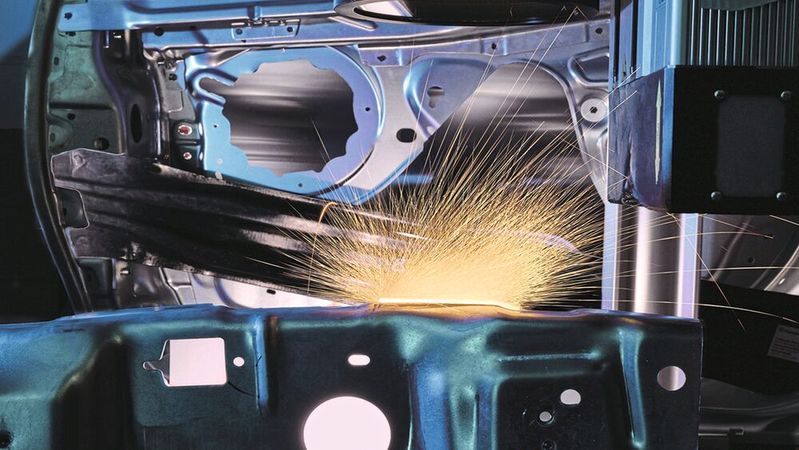
Laser cladding: A flexible and fast alternative to conventional manufacturing with forming, welding, and mechanical processing.
(Image: Fraunhofer ILT/Volker Lannert)
The aerospace industry is undergoing a profound transformation. Companies face the challenge of drastically shortening development cycles, developing more sustainable technologies, and simultaneously reducing costs. Additionally, advances in satellite technology demand new manufacturing approaches to develop smaller, lighter, and more efficient systems.
While government space programs continue to play a pivotal role, private players like SpaceX, Blue Origin, and Rocket Lab are driving the commercialization of space travel and setting new standards for efficiency and cost-effectiveness – competition has never been greater.
Gallery
In parallel, climate change demands innovative solutions in aviation. The implementation of alternative propulsion systems, the use of sustainable materials, and the desire for zero-emission aircraft are increasing pressure on the industry. It is foreseeable that national and international regulations will impose higher costs on pollutant emissions and enforce stricter requirements for sustainable flying in the future.
This is where the Fraunhofer Institute for Laser Technology ILT comes into play, as state-of-the-art laser technology can address many of these challenges: Laser-based manufacturing and measurement technologies enable the fast, flexible, and resource-efficient production of complex components as well as lighter and more powerful parts. With processes such as Laser Powder Bed Fusion (LPBF) and Laser Material Deposition (LMD), high-performance components for aircraft, carrier systems, and satellites can be efficiently produced or repaired.
Additive Manufacturing for Aerospace
The LPBF basic patent for metallic 3D printing developed at the Fraunhofer ILT forms the foundation for today's prototyping and the production of function-optimized components in aerospace. This drastically shortens development cycles: the journey from CAD model to prototype now takes only a few days, compared to several months in the past—while also reducing costs. Designers gain greater design freedom and can test different variants simultaneously.
"Anywhere that customized, highly complex components are required, additive manufacturing can fully leverage its advantages in terms of flexibility," explains Dr. Tim Lantzsch, head of the Laser Powder Bed Fusion department at Fraunhofer ILT.
In aerospace, additive manufacturing offers enormous possibilities to optimize components while reducing weight and material usage.
Dr. Tim Lantzsch, Head of Laser Powder Bed Fusion at Fraunhofer ILT
A good example of the application of additive manufacturing (AM) at Fraunhofer ILT is the development of LPBF for copper materials. Copper is ideal for components that must withstand extreme thermal loads, such as combustion chambers in rocket engines, due to its high thermal conductivity.
The LPBF team at Fraunhofer ILT has expanded the process limits for copper alloys by specifically using green laser radiation to process GRCop42 (CuCrNb). This enables the production of high-density, thin-walled structures with optimized thermal management—a crucial advantage for aerospace applications, which benefit from more durable components with higher efficiency and reduced manufacturing costs.
LMD is another established AM process for manufacturing components with high precision and optimal material properties. In the ENLIGHTEN project (European Initiative for Low cost, Innovative & Green High Thrust Engine), it enables the high-productivity production of components with optimized topology, reduced weight, and maximum durability. "What makes it special is that through the diverse capabilities of LMD technology, we drastically improve the speed and cost-effectiveness of producing new generations of rocket nozzles. The design under investigation, apart from its large build volume, features exceptionally delicate and thin-walled cooling channels, which can only be realized with great effort using conventional manufacturing methods," explains Dr. Thomas Schopphoven, Head of the Laser Material Deposition Department at Fraunhofer ILT.
Date: 08.12.2025
Naturally, we always handle your personal data responsibly. Any personal data we receive from you is processed in accordance with applicable data protection legislation. For detailed information please see our privacy policy.
Consent to the use of data for promotional purposes
I hereby consent to Vogel Communications Group GmbH & Co. KG, Max-Planck-Str. 7-9, 97082 Würzburg including any affiliated companies according to §§ 15 et seq. AktG (hereafter: Vogel Communications Group) using my e-mail address to send editorial newsletters. A list of all affiliated companies can be found here
Newsletter content may include all products and services of any companies mentioned above, including for example specialist journals and books, events and fairs as well as event-related products and services, print and digital media offers and services such as additional (editorial) newsletters, raffles, lead campaigns, market research both online and offline, specialist webportals and e-learning offers. In case my personal telephone number has also been collected, it may be used for offers of aforementioned products, for services of the companies mentioned above, and market research purposes.
Additionally, my consent also includes the processing of my email address and telephone number for data matching for marketing purposes with select advertising partners such as LinkedIn, Google, and Meta. For this, Vogel Communications Group may transmit said data in hashed form to the advertising partners who then use said data to determine whether I am also a member of the mentioned advertising partner portals. Vogel Communications Group uses this feature for the purposes of re-targeting (up-selling, cross-selling, and customer loyalty), generating so-called look-alike audiences for acquisition of new customers, and as basis for exclusion for on-going advertising campaigns. Further information can be found in section “data matching for marketing purposes”.
In case I access protected data on Internet portals of Vogel Communications Group including any affiliated companies according to §§ 15 et seq. AktG, I need to provide further data in order to register for the access to such content. In return for this free access to editorial content, my data may be used in accordance with this consent for the purposes stated here. This does not apply to data matching for marketing purposes.
Right of revocation
I understand that I can revoke my consent at will. My revocation does not change the lawfulness of data processing that was conducted based on my consent leading up to my revocation. One option to declare my revocation is to use the contact form found at https://contact.vogel.de. In case I no longer wish to receive certain newsletters, I have subscribed to, I can also click on the unsubscribe link included at the end of a newsletter. Further information regarding my right of revocation and the implementation of it as well as the consequences of my revocation can be found in the data protection declaration, section editorial newsletter.
Another focus is on the production of structural components for aircraft with high strength and reduced weight. LPBF enables the manufacturing of lightweight components that enhance the efficiency of modern aircraft. Additionally, AM contributes to the efficient repair and maintenance of aerospace components. With LMD, damaged parts can be specifically renewed—a crucial step toward streamlined supply chains, sustainability, and cost reduction.



:quality(80)/p7i.vogel.de/wcms/8e/7e/8e7e0cda4c68699bcc48283a38739769/0133316747v1.jpeg "A little-known hidden champion! When people think of laser cutting, the first thing that comes to mind is the power of the laser beam—and it is impressive to see the sparks flying. But Air Liquide—an exhibitor at Euroblech, by the way—wants to make it clear that the process gas is also key to success. (Image:AI-generated)")
:quality(80)/p7i.vogel.de/wcms/20/fa/20fa35e0af203c3464f7e7fdbb57a685/0133281172v1.jpeg "Since 2003, Etzinger AG has been developing and manufacturing high-quality coffee grinders, pepper mills, and grinding mechanisms for professional and home use. (Image:Etzinger)")
:quality(80)/p7i.vogel.de/wcms/69/91/6991413943488b4a2f6fde9dcd88c5b0/0133256686v1.jpeg "The CMA-patented pendulum mount can compensate for radial tolerances of up to one millimeter. (Image:Schwiening)")
:quality(80)/p7i.vogel.de/wcms/0b/cd/0bcd6d502ffcd087c4fc12b7b760b3ce/0133317507v2v1.jpeg "The new Multi Center from J.G. Weisser. (Image:J.G. Weisser)")
:quality(80)/p7i.vogel.de/wcms/bd/4e/bd4ef09ab0f84932ea76ca0330ffe789/0133329802v1.jpeg "The robotics boom and its consequences: According to a study, a significant portion of value creation occurs in the electronics industry. (Image:Fraunhofer IPA)")
:quality(80)/p7i.vogel.de/wcms/35/81/35815f36be1b1c13f9abef4cea2a3e2b/0133171739v1.jpeg "Humanoid robots in industry: Despite impressive progress, many systems are still in the pilot phase. (Image:AI-generated)")
:quality(80)/p7i.vogel.de/wcms/81/dc/81dc63ed24c562521413023779495e7d/chris-kramerv1.jpeg "Chris Kramar, Director and General Manager of OEM Solutions for Germany, Austria, and Switzerland at Dell Technologies (Source: Dell Technologies)")
:quality(80)/p7i.vogel.de/wcms/bb/f5/bbf5342f532debc1bd7c09c2b9a0bf42/0133176497v1.jpeg "Over the past two years, AI has emerged as the most important growth driver in the industry. (Image: ©Gorodenkoff - stock.adobe.com)")
:quality(80)/p7i.vogel.de/wcms/e9/19/e91905d37afe605bc348a690a4fed72e/0133350592v1.jpeg "At Autodesk University, Autodesk is introducing new AI features for CAD and PLM. (Image:Autodesk)")
:quality(80)/p7i.vogel.de/wcms/98/73/98731d23cbd95ff22391993a74cfefbf/mit-bifurcatedcircuits-01-pressv1.jpeg "A sample of the variety of configurations that Bifur circuits can form. (Source: Courtesy of the researchers)")
:quality(80)/p7i.vogel.de/wcms/f4/3d/f43d1f4297d9ae0cd1b6d2adfcb5ffe1/0133276470v1.jpeg "Simulation: Electric arcs in the electrical industry, including associated field simulation. (Image:CADFEM)")
:quality(80)/p7i.vogel.de/wcms/3e/f1/3ef196715e1b291ec7ae84f02c875c63/0133310495v1.jpeg "The Next Phase of Ethernet in Vehicles: End-to-end Ethernet integrates all high-data-rate devices into the network, including displays and central high-performance computing units. (Image:Infineon Technologies)")
:quality(80)/p7i.vogel.de/wcms/b4/b8/b4b89c48bb797df7251706d4ee096a80/0133359349v1.jpeg "To advance modern rail transportation, Knorr-Bremse and CARS have signed a memorandum of understanding regarding the China Freight Cooperation Program. Pictured here is Rail Executive Board Member Nicolas Lange at the signing ceremony in Beijing. (Image: Knorr-Bremse)")
:quality(80)/p7i.vogel.de/wcms/99/8c/998cb26cfb3110e8444a4ecbfe2dc799/0133338279v1.jpeg "Electric car manufacturer Rivian is launching its R2 SUV in the U.S. (Image:Rivian)")
:quality(80)/p7i.vogel.de/wcms/cc/d1/ccd1607af856c9cff96c73a5ffccfcad/p90652283-highres-demonstrator-woodenv1.jpeg "The FSCM research project, which was recently completed, is delivering innovations close to production for plastics, metals, and design at BMW. (Source: BMW)")
:quality(80)/p7i.vogel.de/wcms/4c/53/4c534208d09a9b1ce597938715e7fc19/0133288763v1.jpeg "Logic Folding: In its latest Kirin 9050 Pro, Huawei uses hybrid bonding to distribute the computing units across two silicon layers in order to increase the effective transistor density without resorting to finer manufacturing processes. (Image:Huawei)")
:quality(80)/p7i.vogel.de/wcms/56/d1/56d131e0b5bd05ef47411e92ad740cb4/0133351029v1.jpeg "Researchers at DTU have developed a nanolaser in a semiconductor membrane. The structure concentrates charge carriers and the light field into a small area (shaded in blue). If data is transmitted on microchips using light instead of electrical signals, transmission speeds can be increased and energy losses reduced. (Image:Yi Yu, DTU)")
:quality(80)/p7i.vogel.de/wcms/5e/55/5e55101ddc6338f755fcf3244db1367f/0133331863v1.jpeg "For data center projects, it is becoming increasingly important to also obtain the consent of the affected community. (Image:Dall-E / AI-generated)")
:quality(80)/p7i.vogel.de/wcms/8d/f9/8df95d3f58408673986b3d643e6b63ba/0133252773v1.jpeg "TXC targets high-speed optical links in AI data centers with 312.5 MHz oscillators, among other solutions. As data rates increase, requirements for jitter and frequency stability become more demanding as well. (Bild: TXC)")
:quality(80)/p7i.vogel.de/wcms/07/df/07dfb643edd7c722888ed32b92196871/0128777903v1.jpeg "Artistic representation of the Merlin instrument based on the Myriade satellite platform.(Image: CNES/illustration David DUCROS, 2016)")
:quality(80)/p7i.vogel.de/wcms/34/46/34462611fc29d8a4858672ec86c22b40/0128777891v1.jpeg "The process principle of LMD technology can be applied to almost any machine kinematics. This allows the application of extremely hard alloys that are particularly long-term stable.(Image: Fraunhofer ILT/Ralf Baumgarten)")
:quality(80)/p7i.vogel.de/wcms/bd/e5/bde59ef23d195923bb9193adf17485f1/0128778306v1.jpeg "Robust laser technology for environmental satellites. The Lidar system for the Merlin mission includes all components from the pump laser to frequency conversion in an especially compact and space-ready design.(Image: Fraunhofer ILT)")
:quality(80)/p7i.vogel.de/wcms/18/6d/186db3fe269627eaeace471ea2f56b55/0132123312v1.jpeg "Proven laser cladding processes are now being optimized by Fraunhofer ILT from Aachen and Etxetar from Spain to help meet new requirements in additional industrial sectors. Here, a railway axle is being repaired using LMD. (Image: Etxetar)")
:quality(80)/p7i.vogel.de/wcms/dc/1e/dc1e164ca1e524e7cb48de6fd6a16a1c/hytank-ifam-pi-bilder-1-ad-plasmav1.png "Non-contact atmospheric pressure plasma pretreatment of a CFRP surface. (Source: Fraunhofer IFAM)")