With LogicFolding and the Tau scaling law, Huawei aims to increase the performance of future chips through shorter signal paths and more efficient architectures. In China, the approach is being celebrated as a breakthrough. Nvidia CEO Jensen Huang sees it as progress for Huawei, but not yet a threat to TSMC's leading manufacturing processes.
Huawei is exploring alternative ways to produce fast and advanced chips.
(Image: Huawei)
The Chinese technology company Huawei has introduced a new design principle for chips that aims to enhance their performance through faster signal and data flow. With this alternative to the continued miniaturization dictated by Moore's Law, Huawei seeks to bypass US boycotts and build its own high-end chips by 2031, achieving a transistor density equivalent to 1.4-nanometer processes.
This new "Tau (τ) scaling law," as we reported, was recently presented by He Tingbo, the head of Huawei's semiconductor division. "Losing geometric scaling does not mean losing temporal scaling," the business portal 36Kr quoted the Huawei manager.
Concentrating more and more transistors in increasingly smaller spaces has become technically more challenging and costly in recent years. For Huawei, the search for alternative performance boosters became even more urgent after the company was placed on the notorious "Entity List" by the US government in 2019, restricting its access to advanced semiconductor technology from the USA.
Because the USA has also put massive diplomatic pressure on the Netherlands and Japan to support their "technology war" against China, the import of EUV lithography machines from the Dutch monopoly manufacturer ASML into the People's Republic has become difficult to nearly impossible.
Without it, chips smaller than around seven nanometers cannot currently be produced economically at truly large scales. Despite all efforts, China has not progressed much further with miniaturization, while TSMC in Taiwan is already producing 2-nanometer processes and plans to begin 1.4-nanometer process manufacturing by 2028. It is only against this backdrop that Huawei's announcement of its 1.4-nanometer goal by 2031 becomes understandable.
Similarity Instead of Copy
Huawei is therefore not attempting to achieve 1.4 nm itself but instead aims to make less densely packed transistors on semiconductors equally powerful. The electrical resistance is reduced so that signals take less time to traverse the circuits. This is where the term "Tau Scaling" used by Huawei comes from, named after the Greek letter τ (tau), which represents the time constant in electrical engineering and signal propagation time in chip manufacturing.
This reduces the signal propagation time across all levels, from the individual transistor to the circuit and up to the entire system, i.e., across the entire computing stack. This way, computational performance and energy efficiency can be increased without reducing the size of the transistors themselves.
Specifically, Huawei uses a new chip design called "LogicFolding" for this. The logic circuits of a chip are no longer arranged flat side by side but are folded and stacked in two layers on top of each other.
"Before LogicFolding, it took three years to increase the transistor density from 126 to 155 million transistors per square millimeter," He said during the presentation of the new architecture. "In 2026, LogicFolding will boost it in a single step to 238 million transistors per square millimeter."
Huawei cites a 55 percent higher transistor density and a 41 percent better energy efficiency for the new design.
Technology for Smartphones
The company announced that the next generation of Kirin smartphone chips will be the first to use LogicFolding. These are expected to hit the market in the fall. Later, by 2030, the Ascend chips, which are central to China's hopes for improved AI data centers, will also be optimized with this technology. Large AI clusters consisting of hundreds or thousands of chips are also set to be accelerated by it.
"What Huawei is proposing is a shift from traditional node-driven scaling to efficiency scaling at the system level," said He Hui, Director of Semiconductor Research at market research firm Omdia. Instead of relying solely on ever-smaller transistors, Huawei is focusing on shortening connections, reducing latency, and improving data flow within the chip.
Date: 08.12.2025
Naturally, we always handle your personal data responsibly. Any personal data we receive from you is processed in accordance with applicable data protection legislation. For detailed information please see our privacy policy.
Consent to the use of data for promotional purposes
I hereby consent to Vogel Communications Group GmbH & Co. KG, Max-Planck-Str. 7-9, 97082 Würzburg including any affiliated companies according to §§ 15 et seq. AktG (hereafter: Vogel Communications Group) using my e-mail address to send editorial newsletters. A list of all affiliated companies can be found here
Newsletter content may include all products and services of any companies mentioned above, including for example specialist journals and books, events and fairs as well as event-related products and services, print and digital media offers and services such as additional (editorial) newsletters, raffles, lead campaigns, market research both online and offline, specialist webportals and e-learning offers. In case my personal telephone number has also been collected, it may be used for offers of aforementioned products, for services of the companies mentioned above, and market research purposes.
Additionally, my consent also includes the processing of my email address and telephone number for data matching for marketing purposes with select advertising partners such as LinkedIn, Google, and Meta. For this, Vogel Communications Group may transmit said data in hashed form to the advertising partners who then use said data to determine whether I am also a member of the mentioned advertising partner portals. Vogel Communications Group uses this feature for the purposes of re-targeting (up-selling, cross-selling, and customer loyalty), generating so-called look-alike audiences for acquisition of new customers, and as basis for exclusion for on-going advertising campaigns. Further information can be found in section “data matching for marketing purposes”.
In case I access protected data on Internet portals of Vogel Communications Group including any affiliated companies according to §§ 15 et seq. AktG, I need to provide further data in order to register for the access to such content. In return for this free access to editorial content, my data may be used in accordance with this consent for the purposes stated here. This does not apply to data matching for marketing purposes.
Right of revocation
I understand that I can revoke my consent at will. My revocation does not change the lawfulness of data processing that was conducted based on my consent leading up to my revocation. One option to declare my revocation is to use the contact form found at https://contact.vogel.de. In case I no longer wish to receive certain newsletters, I have subscribed to, I can also click on the unsubscribe link included at the end of a newsletter. Further information regarding my right of revocation and the implementation of it as well as the consequences of my revocation can be found in the data protection declaration, section editorial newsletter.
Driven by a clever PR strategy from Huawei and the widespread desire in China to stand up to the Americans and the Trump administration, Chinese media were full of exuberant praise for Huawei's new architecture.
"Huawei overthrows Moore's Law," headlined the technology portal Huxiu. For the first time, a Chinese manufacturer has proposed a new guiding principle for the global semiconductor industry, wrote the People's Daily (Renmin Ribao). Everywhere there was talk of a "breakthrough in semiconductor manufacturing," just like in Huawei's press releases.
Experts Slow Down
It took a sharp mind and proven experts like Jensen Huang to deflate this overhyped Tau balloon a bit. "This is certainly a breakthrough for Huawei," said the Nvidia CEO. However, it is not necessarily a threat to the world market leader TSMC, Huang added. Moore's Law also remains relevant. What Huawei is doing is impressive, according to the Nvidia CEO, but not entirely new. Taiwan has been working on similar optimization approaches such as die-stacking, 3D packaging, and hybrid bonding for many years.
Other analysts curbed the Chinese enthusiasm by pointing to unresolved technical hurdles for "LogicFolding." Folding and stacking circuits, among other things, increases the complexity of architectures and makes heat dissipation more difficult.
Even He Tingbo of Huawei admitted that Tau Scaling will not win the "chip war" with the USA overnight. "Given all the various restrictions, we have found some fairly good solutions. I can confidently say that our solutions for mobile computing and AI computing will be competitive in the next ten years," she said. At least.



:quality(80)/p7i.vogel.de/wcms/8e/7e/8e7e0cda4c68699bcc48283a38739769/0133316747v1.jpeg "A little-known hidden champion! When people think of laser cutting, the first thing that comes to mind is the power of the laser beam—and it is impressive to see the sparks flying. But Air Liquide—an exhibitor at Euroblech, by the way—wants to make it clear that the process gas is also key to success. (Image:AI-generated)")
:quality(80)/p7i.vogel.de/wcms/20/fa/20fa35e0af203c3464f7e7fdbb57a685/0133281172v1.jpeg "Since 2003, Etzinger AG has been developing and manufacturing high-quality coffee grinders, pepper mills, and grinding mechanisms for professional and home use. (Image:Etzinger)")
:quality(80)/p7i.vogel.de/wcms/69/91/6991413943488b4a2f6fde9dcd88c5b0/0133256686v1.jpeg "The CMA-patented pendulum mount can compensate for radial tolerances of up to one millimeter. (Image:Schwiening)")
:quality(80)/p7i.vogel.de/wcms/0b/cd/0bcd6d502ffcd087c4fc12b7b760b3ce/0133317507v2v1.jpeg "The new Multi Center from J.G. Weisser. (Image:J.G. Weisser)")
:quality(80)/p7i.vogel.de/wcms/bd/4e/bd4ef09ab0f84932ea76ca0330ffe789/0133329802v1.jpeg "The robotics boom and its consequences: According to a study, a significant portion of value creation occurs in the electronics industry. (Image:Fraunhofer IPA)")
:quality(80)/p7i.vogel.de/wcms/35/81/35815f36be1b1c13f9abef4cea2a3e2b/0133171739v1.jpeg "Humanoid robots in industry: Despite impressive progress, many systems are still in the pilot phase. (Image:AI-generated)")
:quality(80)/p7i.vogel.de/wcms/81/dc/81dc63ed24c562521413023779495e7d/chris-kramerv1.jpeg "Chris Kramar, Director and General Manager of OEM Solutions for Germany, Austria, and Switzerland at Dell Technologies (Source: Dell Technologies)")
:quality(80)/p7i.vogel.de/wcms/bb/f5/bbf5342f532debc1bd7c09c2b9a0bf42/0133176497v1.jpeg "Over the past two years, AI has emerged as the most important growth driver in the industry. (Image: ©Gorodenkoff - stock.adobe.com)")
:quality(80)/p7i.vogel.de/wcms/e9/19/e91905d37afe605bc348a690a4fed72e/0133350592v1.jpeg "At Autodesk University, Autodesk is introducing new AI features for CAD and PLM. (Image:Autodesk)")
:quality(80)/p7i.vogel.de/wcms/98/73/98731d23cbd95ff22391993a74cfefbf/mit-bifurcatedcircuits-01-pressv1.jpeg "A sample of the variety of configurations that Bifur circuits can form. (Source: Courtesy of the researchers)")
:quality(80)/p7i.vogel.de/wcms/f4/3d/f43d1f4297d9ae0cd1b6d2adfcb5ffe1/0133276470v1.jpeg "Simulation: Electric arcs in the electrical industry, including associated field simulation. (Image:CADFEM)")
:quality(80)/p7i.vogel.de/wcms/cc/d1/ccd1607af856c9cff96c73a5ffccfcad/p90652283-highres-demonstrator-woodenv1.jpeg "The FSCM research project, which was recently completed, is delivering innovations close to production for plastics, metals, and design at BMW. (Source: BMW)")
:quality(80)/p7i.vogel.de/wcms/e3/6b/e36b7702f47642f516e0fc49b674f3cc/0132171014v1.jpeg "From a legacy structure to a competitive one: An automotive supplier transformed its global production network (stock photo). (Image: ©Kostiantyn - stock.adobe.com)")
:quality(80)/p7i.vogel.de/wcms/67/19/671987b3438916a45a20e59c277be816/0133343882v1.jpeg "Mercedes-Benz is recalling approximately 24,000 vehicles worldwide. (Image:Mercedes-Benz AG)")
:quality(80)/p7i.vogel.de/wcms/4a/c4/4ac4bb8a6a43ec0c3cb642530612bf4d/db2026au00881-largev1.jpeg "The “Mission Efficiency” study uses the production powertrain from the current MEB platform. Thanks to its specialized aerodynamics, the vehicle achieves fuel consumption of less than seven kWh per 100 km. (Image:Volkswagen AG)")
:quality(80)/p7i.vogel.de/wcms/4c/53/4c534208d09a9b1ce597938715e7fc19/0133288763v1.jpeg "Logic Folding: In its latest Kirin 9050 Pro, Huawei uses hybrid bonding to distribute the computing units across two silicon layers in order to increase the effective transistor density without resorting to finer manufacturing processes. (Image:Huawei)")
:quality(80)/p7i.vogel.de/wcms/56/d1/56d131e0b5bd05ef47411e92ad740cb4/0133351029v1.jpeg "Researchers at DTU have developed a nanolaser in a semiconductor membrane. The structure concentrates charge carriers and the light field into a small area (shaded in blue). If data is transmitted on microchips using light instead of electrical signals, transmission speeds can be increased and energy losses reduced. (Image:Yi Yu, DTU)")
:quality(80)/p7i.vogel.de/wcms/5e/55/5e55101ddc6338f755fcf3244db1367f/0133331863v1.jpeg "For data center projects, it is becoming increasingly important to also obtain the consent of the affected community. (Image:Dall-E / AI-generated)")
:quality(80)/p7i.vogel.de/wcms/8d/f9/8df95d3f58408673986b3d643e6b63ba/0133252773v1.jpeg "TXC targets high-speed optical links in AI data centers with 312.5 MHz oscillators, among other solutions. As data rates increase, requirements for jitter and frequency stability become more demanding as well. (Bild: TXC)")
:fill(fff,0)/images.vogel.de/vogelonline/companyimg/76800/76895/65.jpg "FAULHABER_120mm.jpg ()")
:fill(fff,0)/p7i.vogel.de/companies/69/de/69de1b7403b0d/simtos-logo.jpeg "simtos-logo (SIMTOS)")
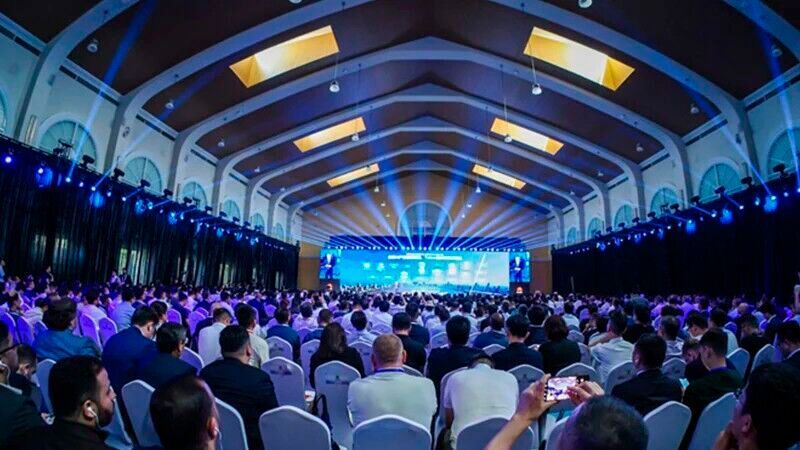
:quality(80)/p7i.vogel.de/wcms/e5/ec/e5ecd0db602320f5df17db00e3fc20a6/0131484998v1.jpeg "He Tingbo, President of Huawei's Semiconductor Business Unit, at the IEEE International Symposium on Circuits and Systems (ISCAS) 2026 in Shanghai. (Image:Huawei)")
:quality(80)/p7i.vogel.de/wcms/e5/ec/e5ecd0db602320f5df17db00e3fc20a6/0131484998v1.jpeg "He Tingbo, President of Huawei's Semiconductor Business Unit, at the IEEE International Symposium on Circuits and Systems (ISCAS) 2026 in Shanghai. (Image:Huawei)")
:quality(80)/p7i.vogel.de/wcms/a5/64/a5644b60e5d321b7fd01a23f0fe5874c/0132746071v1.jpeg "Heinz Arnold: Can China offer an alternative to ASML's EUV machines? (Image:Dall-E / AI-generated)")