ComponentsFPGA with many transceivers for infotainment systems
From
Danny Fisher * | Translated by AI
7 min Reading Time
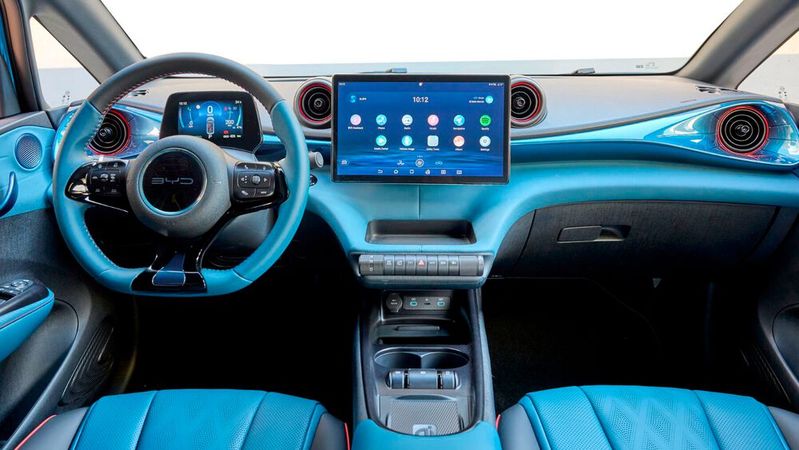
In an electric vehicle, not only the range is important to the end consumer, but also the driving experience inside the cabin. Here, he wants the same features and functions that he is accustomed to from his smartphone. A prerequisite for the smartphone on wheels are powerful components for infotainment systems.
The product innovations and technologies developed for electric vehicles in China, for example BYD, will also be incorporated into vehicle developments in other parts of Asia as well as in Europe and the USA.
(Image: BYD)
Danny Fisher, Director of International Marketing, Gowin Semiconductor
The automotive industry is in the midst of a transformation from combustion engines to electric drives, and the basis of competition in this market is fundamentally changing. In the previous automotive world, the segments primarily differed in the drivetrain. For the end consumer, the differences in cost and appeal, for example between a small car with a 1-liter gasoline engine, a family sedan with a 2-liter diesel engine, and an upper-class vehicle with a supercharged 4-liter gasoline engine, were clearly recognizable.
Such a hierarchy no longer exists with electric drives. Instead, competition in the electric vehicle market revolves around other factors: styling, range, and particularly the driving experience inside the cabin. It is evident that the end consumer demands information, entertainment, and user interfaces, as well as audio functions and displays in the vehicle that they use outside of the vehicle as well.
The design philosophy of a smartphone on wheels is impressively demonstrated in the 2024 Xiaomi SU7, the first vehicle from the manufacturer known for smartphones and consumer electronics. While video content and user interfaces on a smartphone are limited to a small display, in the vehicle, information and entertainment can be shown on multiple screens in various sizes, formats, and resolutions.
Thus, the number and performance of displays become one of the most important distinguishing features. This, in turn, leads to a demand for a new generation of components for video bridging and signal processing to create a vehicle interior that more closely resembles a consumer electronics environment.
Smartphone-based system architecture in the vehicle
In the market for electric vehicles, functions are demanded that increasingly resemble those of a smartphone, beyond just mobility, such as:
Communication with people and devices
Audio and video entertainment
Navigation
Internet research and other forms of information delivery
Work-related functions with productivity apps for spreadsheets and documents
And thus, vehicle manufacturers find that the best developments for these functions are based on smartphone-based hardware. Infotainment systems use platforms with application processors from the smartphone world, such as products like Qualcomm's Snapdragon or MediaTek's Dimensity 8000 SoC family. These SoCs directly support the implementation of products that emulate a smartphone, such as Apple AirPlay or Android Auto.
However, the architecture of these smartphone SoCs from Qualcomm, MediaTek, and other manufacturers cannot be directly transferred to the hardware configuration inside vehicles. The display output of the SoCs is optimized for a single small screen, usually with an HD signal over MIPI DSI or an Embedded DisplayPort (eDP).
The strong competition in the electric vehicle market leads to innovation in interiors, where manufacturers are installing more and larger displays, for example:
a larger display in the center console that extends across part of the entire width of the dashboard
a digitally generated virtual instrument cluster
a holographic head-up display in front of the driver
4K displays on the back of the front headrests
a large, roof-mounted central 4K display for rear seat passengers
These displays have various specifications regarding their resolution and refresh rate, size, and aspect ratio. A smartphone SoC with only one DSI or eDP interface is not sufficient for four or more different displays in the interior of a modern electric vehicle.
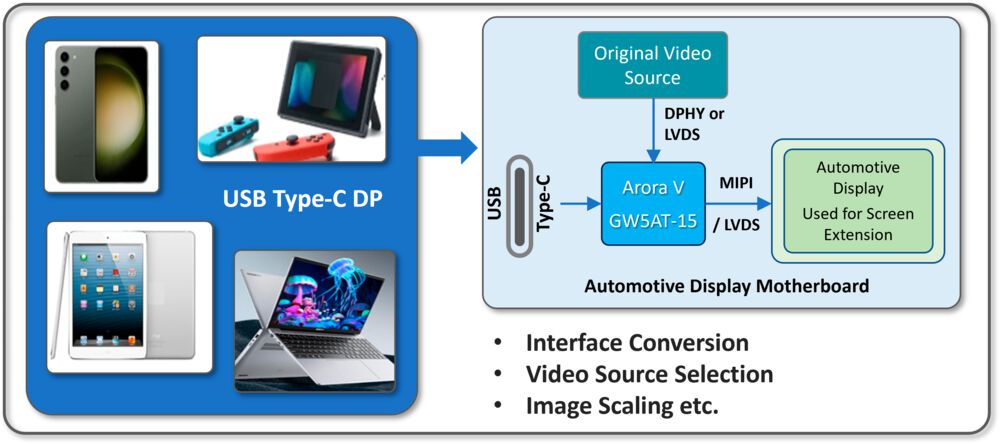
New solutions are required that distribute the output of the SoC across multiple display inputs. The technical challenges become even more complex as consumers in the vehicle want to use content and apps from their other devices. This is also evident in the transition of USB ports in the vehicle from USB 2 to USB 3 and USB Type-C. Particularly, individuals in the back seats can stream 4K content from a tablet, notebook, or smartphone through a Display Port over USB Type-C interface on the large central display on the vehicle roof. Similarly, the display can be used as a screen for a notebook, transforming the interior into a workspace for individuals in the back seats. At the same time, the rear central display must continue to provide an interface for the vehicle’s own infotainment SoC as the standard source of content when no USB Type-C device is connected (Image 1).
Date: 08.12.2025
Naturally, we always handle your personal data responsibly. Any personal data we receive from you is processed in accordance with applicable data protection legislation. For detailed information please see our privacy policy.
Consent to the use of data for promotional purposes
I hereby consent to Vogel Communications Group GmbH & Co. KG, Max-Planck-Str. 7-9, 97082 Würzburg including any affiliated companies according to §§ 15 et seq. AktG (hereafter: Vogel Communications Group) using my e-mail address to send editorial newsletters. A list of all affiliated companies can be found here
Newsletter content may include all products and services of any companies mentioned above, including for example specialist journals and books, events and fairs as well as event-related products and services, print and digital media offers and services such as additional (editorial) newsletters, raffles, lead campaigns, market research both online and offline, specialist webportals and e-learning offers. In case my personal telephone number has also been collected, it may be used for offers of aforementioned products, for services of the companies mentioned above, and market research purposes.
Additionally, my consent also includes the processing of my email address and telephone number for data matching for marketing purposes with select advertising partners such as LinkedIn, Google, and Meta. For this, Vogel Communications Group may transmit said data in hashed form to the advertising partners who then use said data to determine whether I am also a member of the mentioned advertising partner portals. Vogel Communications Group uses this feature for the purposes of re-targeting (up-selling, cross-selling, and customer loyalty), generating so-called look-alike audiences for acquisition of new customers, and as basis for exclusion for on-going advertising campaigns. Further information can be found in section “data matching for marketing purposes”.
In case I access protected data on Internet portals of Vogel Communications Group including any affiliated companies according to §§ 15 et seq. AktG, I need to provide further data in order to register for the access to such content. In return for this free access to editorial content, my data may be used in accordance with this consent for the purposes stated here. This does not apply to data matching for marketing purposes.
Right of revocation
I understand that I can revoke my consent at will. My revocation does not change the lawfulness of data processing that was conducted based on my consent leading up to my revocation. One option to declare my revocation is to use the contact form found at https://contact.vogel.de. In case I no longer wish to receive certain newsletters, I have subscribed to, I can also click on the unsubscribe link included at the end of a newsletter. Further information regarding my right of revocation and the implementation of it as well as the consequences of my revocation can be found in the data protection declaration, section editorial newsletter.
The rear, roof-mounted display can receive input signals from a USB Type-C device or the vehicle's infotainment SoC.
(Image:Gowin)
The increase in number, size, and quality of displays in the interior of the vehicle has fundamental implications for the philosophy of designing this space. The vehicle evolves from a mobility product into an entertainment and workspace. As this represents a new philosophy in response to profound and rapidly evolving shifts in consumer tastes and preferences, implementation will require a series of iterations as vehicle manufacturers determine what the end consumer desires and considers valuable.
To achieve this, automobile manufacturers need something that creates a link between the limited display outputs of the SoC and the numerous displays in the vehicle while also handling the high speeds of USB 3, LVDS, and MIPI D-PHY or C-PHY. Additionally, they must continue to respond quickly to changes in customer demands and revise their designs multiple times with as little effort as possible in hardware development.
FPGA in new UI for vehicles
For this development requirement, the FPGA is the ideal solution. FPGAs allow for very fast interfaces with high transmission rates. In network environments, FPGAs are commonly used as interfaces to meet new specifications of standards such as PCIe or Ethernet.
Because an FPGA is programmable, it offers the flexibility to quickly adapt developments to changed requirements without needing alterations to the circuit board. This is a tremendous advantage in today's electric vehicle market, as product development cycles are significantly shorter than in times when integrating and assembling complex drivetrains with diesel or gasoline engines meant a much slower pace throughout the entire development process for new products.
New electric vehicles are increasingly being developed like new smartphone products—quickly and with constant innovations in displays, cameras, and video technologies. For this, FPGAs for automotive products are needed to meet the requirements of a growing number of functions for video bridging and image processing.
Chinese market in focus
Gowin Semiconductor has a unique perspective on this increasing demand, as the planning and development of the FPGA manufacturer are based in China. China is committed to playing a leading role in the electric vehicle sector. The product innovations and technologies developed for electric vehicles in China will also be incorporated into vehicle developments in other parts of Asia, as well as in Europe and the USA.
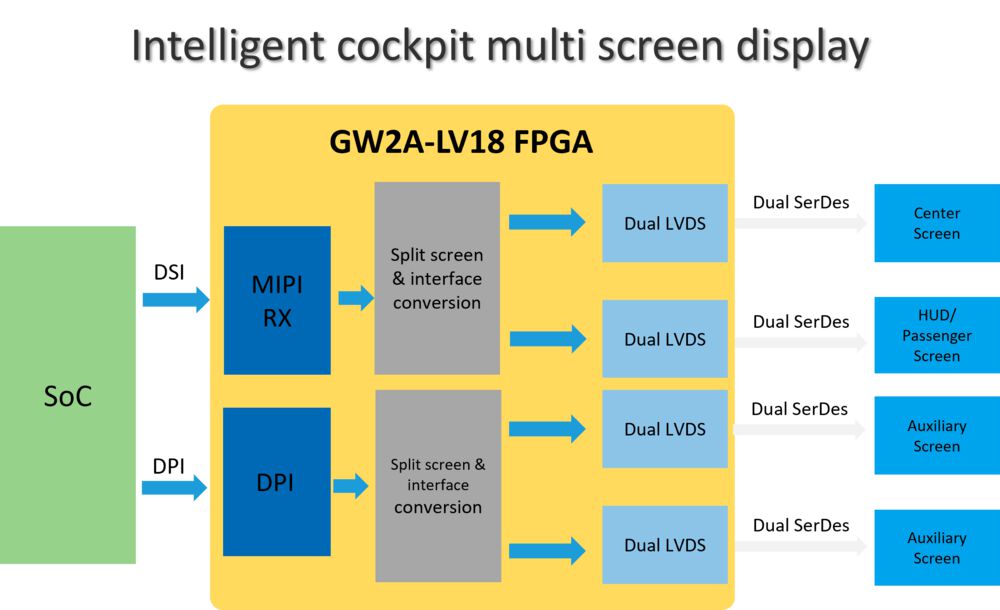
Smartphone SoCs with limited output functions can control multiple displays with specialized FPGAs.
(Image:Gowin)
Gowin's product developments build on experiences with Chinese electric vehicle manufacturers. This approach provides new solutions for processing SoC output signals for smartphone displays, making them suitable for automotive displays as well.
Thus, a new series of FPGAs has been developed for the automotive sector, which can be used in applications such as:
Display outputs for multiple screens with signal conversion for long cable distances. A single infotainment SoC, derived from a smartphone platform, has limited capabilities at video outputs. In new vehicles with multiple displays inside, these output signals for the displays in the front and rear parts of the vehicle must be processed and possibly converted into the MIPI or LVDS format (Image 2).
Screen extension—the output signals from a tablet or notebook with a USB-Type-C interface need to be converted into a MIPI or LVDS format that can be displayed on a large automotive-compliant display. When no external video source is connected, the standard video source of the SoC is automatically switched to these screens. This requires a series of logic functions for source selection, bridging, for example from MIPI D-PHY to LVDS, and for video processing, such as scaling the video signal.
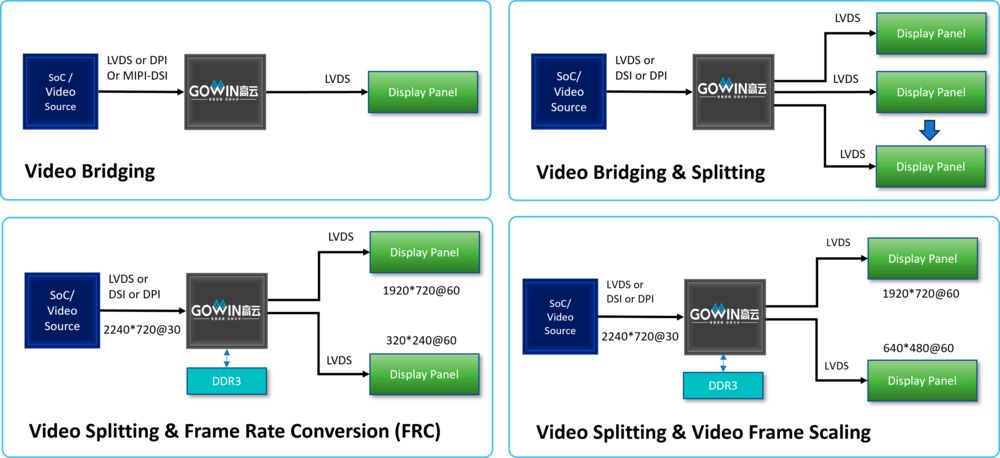
Video bridging, signal splitting, and frame rate conversion (Figure 3).
FPGA for new bridging applications
Typical example of video editing applications in new infotainment systems based on smartphone SoC platforms.
(Image:Gowin)
FPGAs are generally well-suited for video bridging and image processing applications. In response to the demand from Chinese electric vehicle manufacturers, Gowin Semiconductor has developed new automotive products that cover these applications in various ways. These include:
The FPGA GW5AT-15 and GW5AT-60 with multiple transceivers and fixed MIPI C-PHY and D-PHY interfaces for data rates up to 5.7 Gbps, a USB Type-C interface, and SerDes capability up to 12.5 Gbps
The GW2A-LV18 as an automotive version with MIPI D-PHY and LVDS capability up to 1.0 Gbps
All automotive FPGA products from Gowin Semiconductor are supported by the Gowin EDA FPGA development environment, which is certified according to ISO 26262. (se)



:quality(80)/p7i.vogel.de/wcms/4c/af/4cafbff8a06028a7250e03626a7e6afb/0132939283v1.jpeg "Behind the acronym Clasco is a project based on laser processing techniques, aiming to enable the reliable and application-specific post-processing of even complex metal parts produced by 3D printers. TU Dresden took the lead... (Image:German Materials Society)")
:quality(80)/p7i.vogel.de/wcms/cf/fc/cffc25779317b5b1e42cba9cfcd52bbc/0132927530v1.jpeg "The analysts were wrong again, as Japan was able to increase its export volume far more than predicted. Here are some numbers and facts about Nippon's economic situation... (Image:AI-generated)")
:quality(80)/p7i.vogel.de/wcms/6f/12/6f122ac26fd08f621f7b14f421fc435c/0132930817v1.jpeg "The Federal Statistical Office has taken a closer look at the first half of 2026 in terms of trade. Among other findings, it revealed that China is once again Germany's top trading partner... (Image:AI-generated)")
:quality(80)/p7i.vogel.de/wcms/3c/26/3c2635fb73f283b2d0e6ede46a2c2f9f/0113143253v1.jpeg "In our China Market Insider, we regularly provide you with relevant information directly from China. (Image:© Eisenhans - stock.adobe.com)")
:quality(80)/p7i.vogel.de/wcms/05/e7/05e7017a2699ef15b513bfd2e18431fb/digitaler-planungszwilling-bildv1.png "The author explains here why the digital twin only becomes a planning tool when it follows a clear decision-making question. (Source: T&O Group/AI-generated)")
:quality(80)/p7i.vogel.de/wcms/07/b3/07b368b6d067acdbb49c1e88b0cd8e9d/0131022521v1.jpeg "The seven-axis collaborative robot from Yamaha Motor is equipped with Harting connectors. (Image:Yamaha Motor)")
:quality(80)/p7i.vogel.de/wcms/dc/64/dc64212882d6898cd5b44fcbeb5aedbb/image1v1.jpeg "The cobots from Rheinmetall Yardstick Robotics use all-in-one servo drives from Synapticon. (Image: Rheinmetall Yardstick Robotics) (Image:)")
:quality(80)/p7i.vogel.de/wcms/a7/38/a73840cb81da9dc3c503f4c04bf66b96/0132892768v1.jpeg "Unitree's IPO symbolizes the high expectations for humanoid robots and embodied AI. (Image:Dall-E / AI-generated)")
:quality(80)/p7i.vogel.de/wcms/c8/a1/c8a170f594765cecbdafbc139b96d91a/0132860586v1.jpeg "V-shaped grooves, known as riblets, are directly incorporated into the paint. They reduce overall drag by 50 percent, resulting in significant fuel savings. (Image:Trumpf)")
:quality(80)/p7i.vogel.de/wcms/c9/80/c98042b5898cde9670b4c3ae1efbc656/adobestock-165496610v1.jpeg "In just 45 days, the team from Stauff India completely renewed the hydraulic piping of a steel plant. The key factor here was the right pipe connection system. (Source: Stauff)")
:quality(80)/p7i.vogel.de/wcms/41/fc/41fc456ff1ff8f30807924663e8df127/img-0942v1.jpeg "In industrial additive manufacturing, the production strategy must influence the design from the very beginning. (Source: Materialise)")
:quality(80)/p7i.vogel.de/wcms/44/fe/44fe86a16c26c09bb363b3671bf0b930/0132847771v1.jpeg "CoreTechnologie (CT) points out that the 3D printing software 4D_Additive has been equipped with additional application possibilities. Here you can learn more about what the new version 1.8 can do – such as generating complex lattice structures or optimizing faulty data ... (Image:CT)")
:quality(80)/p7i.vogel.de/wcms/d1/42/d142e0e90738d0335c4ed7936f030e6a/0132948392v1.jpeg "Its production was long delayed, but now Tesla's electric truck Semi is being built in the USA. If the Elon Musk company has its way, it will soon also be seen on Europe's roads... (Image: Tesla)")
:quality(80)/p7i.vogel.de/wcms/a4/19/a419e31b91a2da68d3b59afed58dc31c/26c0194-001v1.jpeg "The Mercedes VLE will soon also be produced in China, local media report. (Image:Mercedes-Benz AG)")
:quality(80)/p7i.vogel.de/wcms/16/2f/162ff38606f0034832fbaadea1829933/precision-measurement-labv1.jpeg "In car manufacturing, much revolves around precision. This is evaluated, among other things, in the precision measurement laboratory. (Source: Geely)")
:quality(80)/p7i.vogel.de/wcms/5b/88/5b88d94e6a43f2b857462cd1921f7386/0132281427v1.jpeg "The eTurbo solves a well-known turbocharger problem: by combining an exhaust gas turbocharger and a permanently excited synchronous motor into a highly integrated core assembly, the compressor achieves sufficient speed even when the exhaust energy is actually not yet sufficient. (Image: BorgWarner)")
:quality(80)/p7i.vogel.de/wcms/65/74/6574fcb9fb6b589ef577767613f5397c/0132928076v1.jpeg "Compact and standardized: CubeSats enable cost-effective space missions and are increasingly serving as a platform for testing new technologies—from sensors and communications to innovative power supply systems. (Image:City Labs, Inc.)")
:quality(80)/p7i.vogel.de/wcms/07/f6/07f6c430c86bf0d5d915268b881ada49/0132895094v1.jpeg "FOUP wafer cassette for 300-mm semiconductor manufacturing in TSMC's Fab 12. (Image:TSMC)")
:quality(80)/p7i.vogel.de/wcms/59/25/59258a3771bf03dd3461d0378884464d/0132928076v1.jpeg "Compact and standardized: CubeSats enable cost-effective space missions and increasingly serve as platforms for testing new technologies—from sensors and communication to innovative energy supply systems. (Image: City Labs, Inc.)")
:quality(80)/p7i.vogel.de/wcms/22/82/22826566c11220ed61efac5982fb94a2/0132896083v1.jpeg "Electrodes made from paper and copper paste deliver comparable signal quality to the established gold standard. They perform significantly better in all environmental impact analyses. (Image:Screentec)")
:quality(80)/p7i.vogel.de/wcms/31/a8/31a883a47b86634c382923e78fd9a4c9/0130133225v1.jpeg "Figure 1: GMSL-capable point-to-point connection. (Image:ADI)")
:quality(80)/p7i.vogel.de/wcms/87/f8/87f87cbd3669c82cf8a929f50541f806/0130618626v1.jpeg "Microchip's new hybrid MCU system-in-package SAM9X75 enables MPU computing power with the familiar development environment of MCU-based designs, (Image:Microchip)")